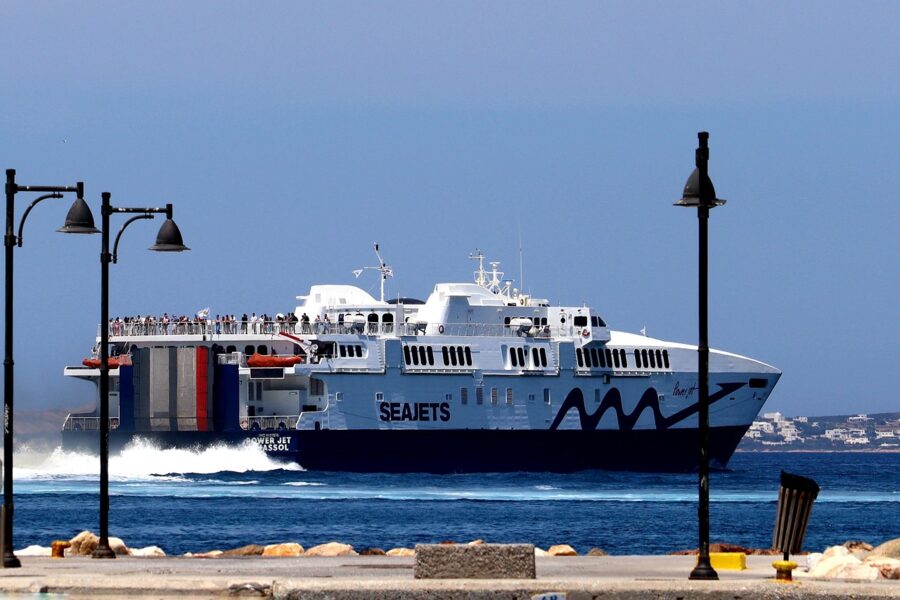
Paros to Naxos takes 50 minutes on the big Blue Star ferry, and an economy seat on the winter 2026–27 timetable costs €15.50. The Seajets catamaran on the same crossing takes 25–30 minutes, and in May 2026 its fares started at €37. That pair of numbers is Greek island hopping in miniature: every leg is a trade between time and money, and on a backpack budget the slow boat wins nearly every time.
The rest follows from that trade. Which port in Athens to leave from, which islands to string together, whether to sleep on deck or in a four-berth cabin, when to go so the bed costs half as much: all of it is the same calculation, so every leg in the routes that follow carries its fare and its time, and every bed its price in euros.


Contents
How island hopping in Greece works
Greece has about 6,000 islands and islets, a couple of hundred of them inhabited, but for planning purposes there are only a handful of island groups, and the ferries run along each group much more than across them. The mistake that costs the most time is choosing islands from a map. Santorini and Rhodes look close; there is no quick boat between them, and the one slow ferry that links them calls at half a dozen islands on the way.
So the first decision is the group, and for a first trip the answer is nearly always the Cyclades. The second is the port, because Athens has three.
Piraeus, Rafina or Lavrio
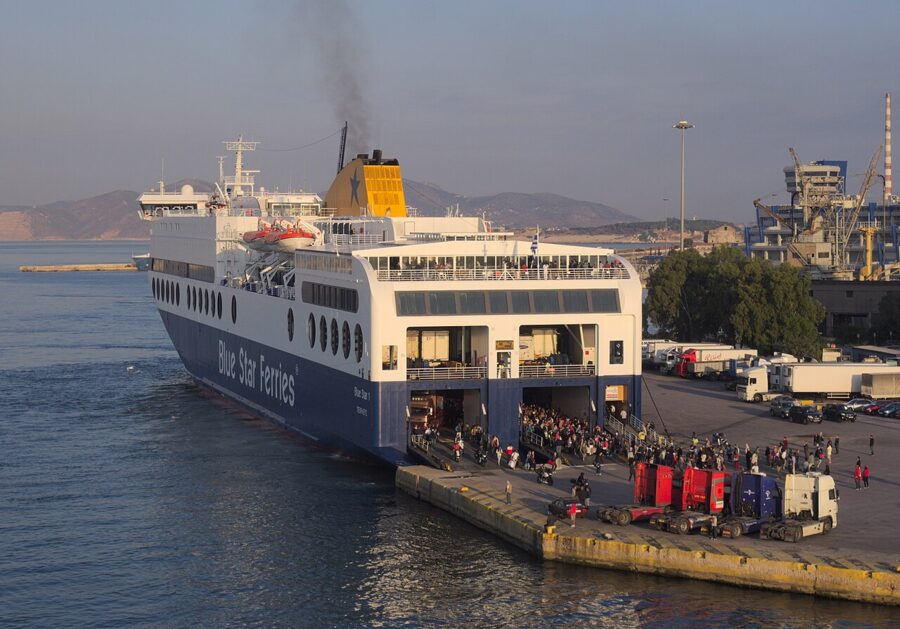
Piraeus is the big one, and most boats to the Cyclades, Crete and the Dodecanese leave from it. Metro line 1 ends at Piraeus station, opposite the ferry gates, and metro line 3 from the airport now runs through to Piraeus as well; a standard 90-minute ticket costs €1.20, the airport metro ticket €9. From the airport, the X96 express bus goes straight to the port for €5.50 and takes 70–100 minutes depending on traffic.
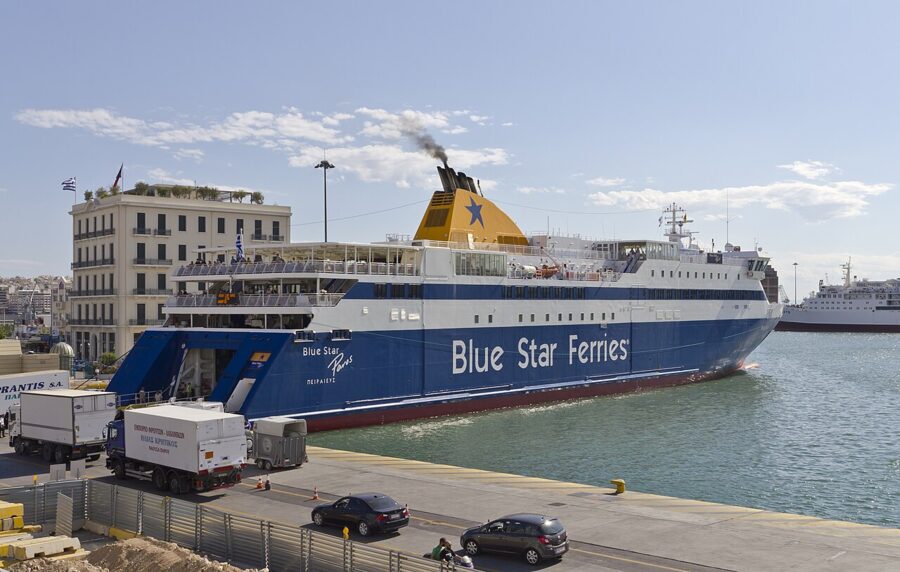
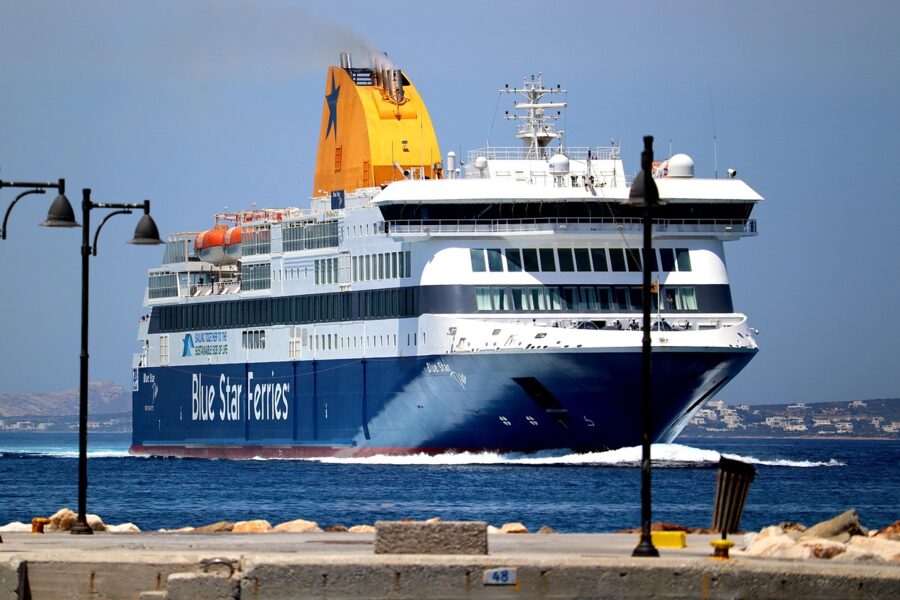
The port is a long arc of quays with numbered gates, and the gate matters. Blue Star’s Cyclades ferries to Paros, Naxos, Ios and Santorini, and to Syros, Tinos and Mykonos, berth at gate E7, a few minutes’ walk from the metro. The overnight boats to Crete and the slow line to Santorini and Rhodes use gates E1 and E3, further round the harbor; E1 is almost 2 km along the quay from the metro, so allow 25 minutes on foot or arrive early. Your ticket and the operator’s app both show the gate.

Rafina, on the east coast of Attica, is closer to the airport (about 30 minutes by the KTEL Attikis bus) and closer to the northern Cyclades by sea. Fast Ferries sails Rafina to Andros, Tinos and Mykonos all year, adding Naxos from 25 May to 30 September 2026 and Paros from 13 June to 13 September. Golden Star Ferries’ Rafina line calls at Andros, Tinos, Mykonos, Paros, Naxos, Ios and Santorini, and Seajets has Rafina departures too.
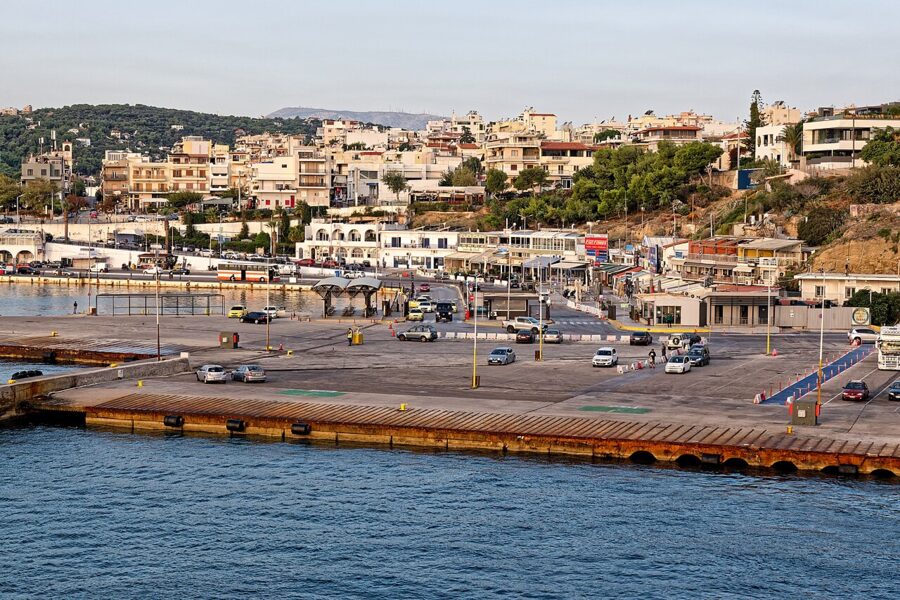

Lavrio, at the southern tip of Attica, handles the short crossings to Kea and Kythnos and a slower line on to Syros, Paros, Naxos and the western islands. It is the port for a long weekend on Kea, not usually the start of a first island-hopping trip.
The island groups, one line each
- Cyclades: the ring of islands in the middle of the Aegean, from Andros in the north to Santorini in the south. Paros, Naxos, Mykonos, Ios, Santorini, Milos and Folegandros are all here, and the ferries between them are frequent from May to October.
- Dodecanese: the chain along the Turkish coast, with Rhodes and Kos the big two. Piraeus to Rhodes took 14–19 hours on the December 2026 timetable, so this is a separate trip, not an add-on.
- Saronic Gulf: Aegina, Agistri, Poros, Hydra and Spetses, an hour or three from Piraeus on the Aero Highspeed boats. Good for a day or two from Athens, not for hopping.
- Crete: one island the size of a small country, reached overnight from Piraeus to Heraklion or Chania, or from Santorini in a few hours.
- Ionian: Corfu, Kefalonia and Zakynthos lie off the west coast and are reached from Patras, Kyllini or Igoumenitsa, or by ferry from Italy. No boat links them to the Aegean islands.
The North Aegean islands (Chios, Lesvos, Samos, Ikaria) and the Sporades (Skiathos, Skopelos) complete the list. Both make good second trips; neither connects well with the Cyclades.
Why the Cyclades suit a first trip
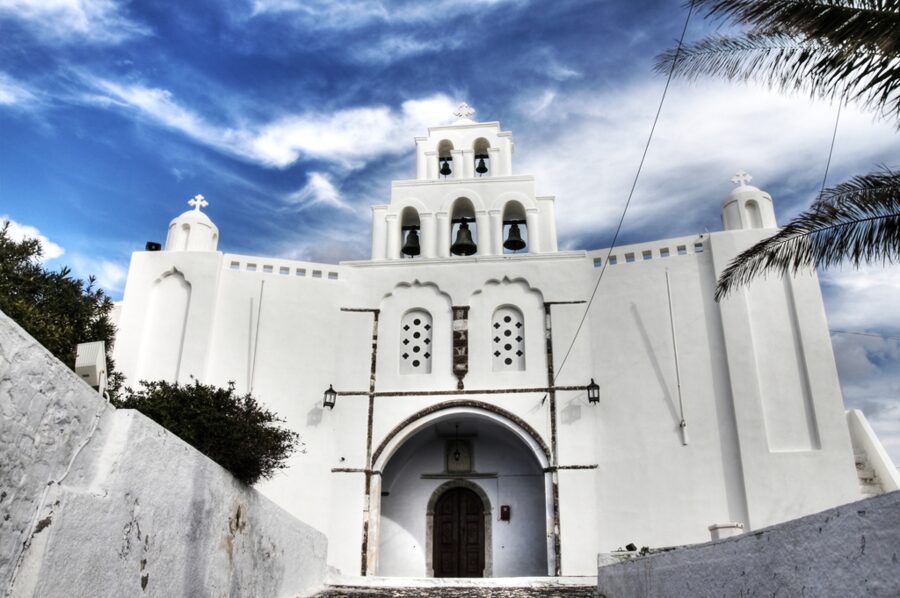
Three things put the Cyclades first. The islands are close together, so most hops between neighbors take one to three hours. The two big conventional lines out of Piraeus (one to Paros, Naxos, Ios and Santorini; one to Syros, Tinos and Mykonos) run all year, and in summer the high-speed boats join them across the whole group. And the islands differ enough that a week does not feel like the same village five times: volcanic cliffs on Santorini, beaches and mountain villages on Naxos, a party town on Ios, lunar rock on Milos.
The Cyclades also have cheap beds in the places that matter. A campsite dorm in Fira, the main town on Santorini, costs less than a hotel room almost anywhere in the group, and Ios has a long-running backpacker hostel on the edge of its main village.
A night in Athens first
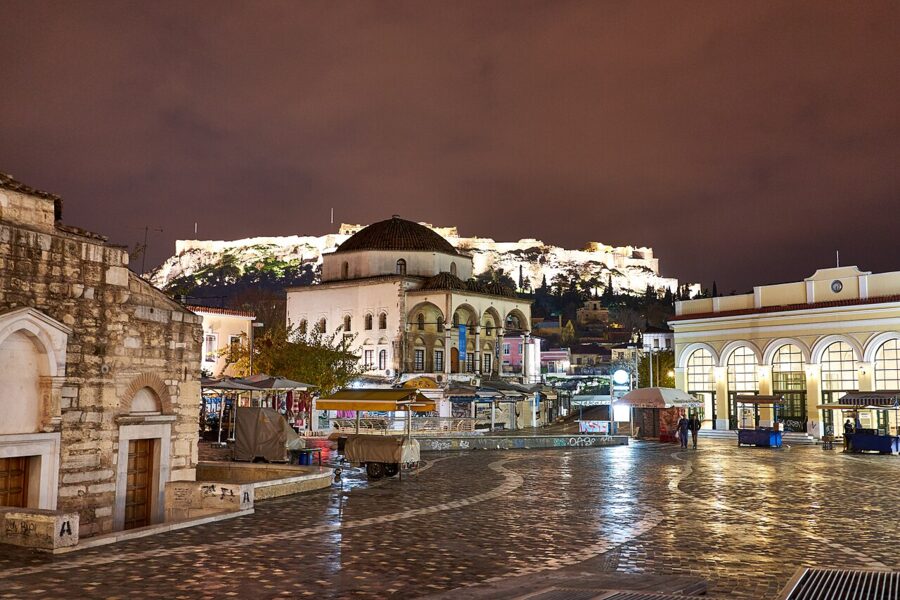
Most routes start with a night in Athens, because international flights land at all hours and the first big ferries leave Piraeus at 06:45–07:30. Psyrri and the streets around Monastiraki are the cheap-bed district, a short metro ride from Piraeus on line 1; my picks for dorms there are in the guide to the best hostels in Europe for solo travelers, with City Circus the one I would book first. Leave the Acropolis for the last day, when you come back through Athens and have the afternoon free.

Routes for one, two and three weeks
The fares below come from the operators. Conventional fares are Blue Star’s economy class on the winter 2026–27 timetable, which is the timetable currently on sale; summer fares on the same boats run a little higher, with a high-season supplement. High-speed fares are Seajets’ published “from” prices for May 2026, which the company itself says rise in July and August. Treat every figure as the floor, and expect the July version of the same ticket to cost more.
Every route below starts and ends at Piraeus and moves in one direction, which is the cheapest way to see the most. Doubling back costs an extra day and an extra fare every time.
One week: Paros, Naxos, Santorini
This is the route the big conventional ferry runs every day of the year, so it works in October and April as well as in July. It skips Mykonos on purpose: it is the most expensive island in the group to sleep on, and Paros does the same job (a harbor town, beaches and a nightlife village) for less.
| Day | Leg or base | Boat and time | Fare |
|---|---|---|---|
| 1 | Piraeus to Paros | Blue Star from gate E7 (06:45 in winter), 4 hrs 45 min | €51 economy |
| 2 | Paros: Parikia, then the bus to Naoussa | ||
| 3 | Paros to Naxos | Blue Star, 50 min; Seajets, 25–30 min | €15.50; from €37 |
| 4 | Naxos: Kastro, Portara, Plaka beach | ||
| 5 | Naxos to Santorini | Blue Star, 2 hrs 10 min; Seajets, 1 hr 10 min–1 hr 30 min | €31.50; from €68 |
| 6 | Santorini: Akrotiri, the walk from Fira to Oia | ||
| 7 | Santorini to Piraeus | Blue Star day boat, about 8 hrs; overnight boat, 6 hrs 40 min | €59; €41 |
On conventional boats the four legs come to €139 at these fares. Swap in the catamarans for the two middle hops and it rises to about €197, to save a little over an hour across the whole week. I would spend that €58 on an extra night instead.
Two weeks: Mykonos to Milos
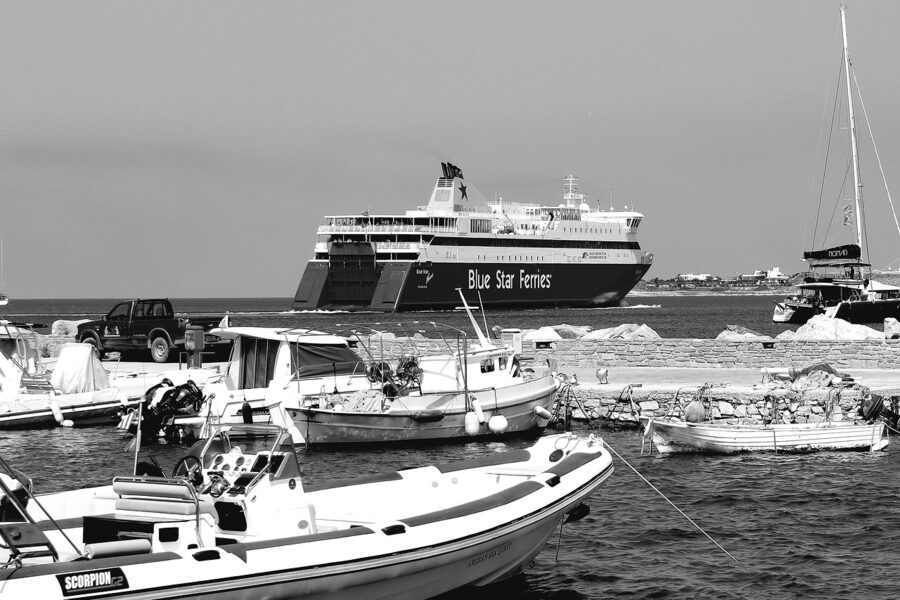
Two weeks lets you take in the famous pair and the quieter islands that make the trip, still in one line. You do Mykonos early (for Delos), drop south through Paros, Naxos and Ios to Santorini, then jump west to Milos for the last few days and the overnight boat home.
| Days | Leg or base | Boat and time | Fare |
|---|---|---|---|
| 1 | Piraeus to Mykonos | Blue Star via Syros and Tinos, 5 hrs 50 min; Seajets, 2 hrs 40 min | €53; from €80 |
| 1–2 | Mykonos, with a morning on Delos | ||
| 3 | Mykonos to Paros | Seajets, 35–50 min | from €65 |
| 3–4 | Paros | ||
| 5 | Paros to Naxos | Blue Star, 50 min | €15.50 |
| 5–7 | Naxos | ||
| 8 | Naxos to Ios | Blue Star, 1 hr 20 min | €22.50 |
| 8–9 | Ios | ||
| 10 | Ios to Santorini | Blue Star, 1 hr 15 min | €19.50 |
| 10–11 | Santorini | ||
| 12 | Santorini to Milos | Seajets, 1 hr 55 min (summer) | from €97 |
| 12–13 | Milos | ||
| 14 | Milos to Piraeus | Overnight conventional, about 4 hrs 15 min | €42 |
Ferries total about €315 at the floor prices. Two legs do most of the damage: Mykonos to Paros and Santorini to Milos, where in summer the catamaran is the practical option. If the budget is tight, cut Mykonos (start at Paros) and take the night boat from Santorini to Piraeus instead of going on to Milos; that brings the ferries down to about €150.

Three weeks: the Small Cyclades and the western line
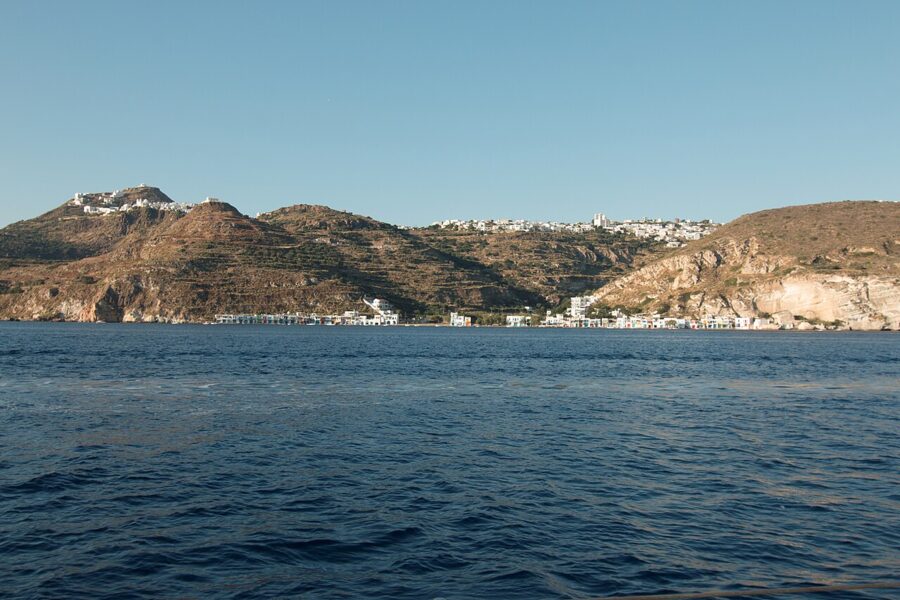
Three weeks is where island hopping stops being a checklist. Add the Small Cyclades between Naxos and Amorgos (Koufonisia, Schinoussa, Iraklia), and the western line of Sifnos, Milos and Folegandros, and you meet islands where the ferry arriving is still the event of the day.
| Days | Leg or base | Boat and time | Fare |
|---|---|---|---|
| 1 | Piraeus to Paros | Blue Star, 4 hrs 45 min | €51 |
| 1–3 | Paros | ||
| 4 | Paros to Naxos | Blue Star, 50 min | €15.50 |
| 4–6 | Naxos | ||
| 7 | Naxos to Koufonisia | Blue Star Delos, about 2 hrs; summer day boats too | €7 (winter economy) |
| 7–9 | Koufonisia | ||
| 10 | Koufonisia to Amorgos | Small Cyclades line | check the day’s boats |
| 10–11 | Amorgos | ||
| 12 | Amorgos to Naxos, on to Ios | Blue Star; change at Naxos | about €10.50 + €22.50 (winter) |
| 12–13 | Ios | ||
| 14 | Ios to Santorini | Blue Star, 1 hr 15 min | €19.50 |
| 14–16 | Santorini | ||
| 17 | Santorini to Folegandros | summer only, conventional or high-speed | check the day’s boats |
| 17–18 | Folegandros | ||
| 19 | Folegandros to Milos | summer only, western line | check the day’s boats |
| 19–20 | Milos | ||
| 21 | Milos to Piraeus | Overnight conventional | €42 |
Three of these legs exist only in summer and their 2027 fares are not on sale yet, which is why the table says so instead of guessing. The western line from Piraeus is worked by the Dionysios Solomos, which in 2026 sailed Piraeus, Serifos, Sifnos, Milos, Kimolos, Folegandros, Sikinos, Ios and Santorini three or four times a week, rising to six between 29 June and 30 August. Build the three-week route around its days, not the other way round.

The ferries themselves
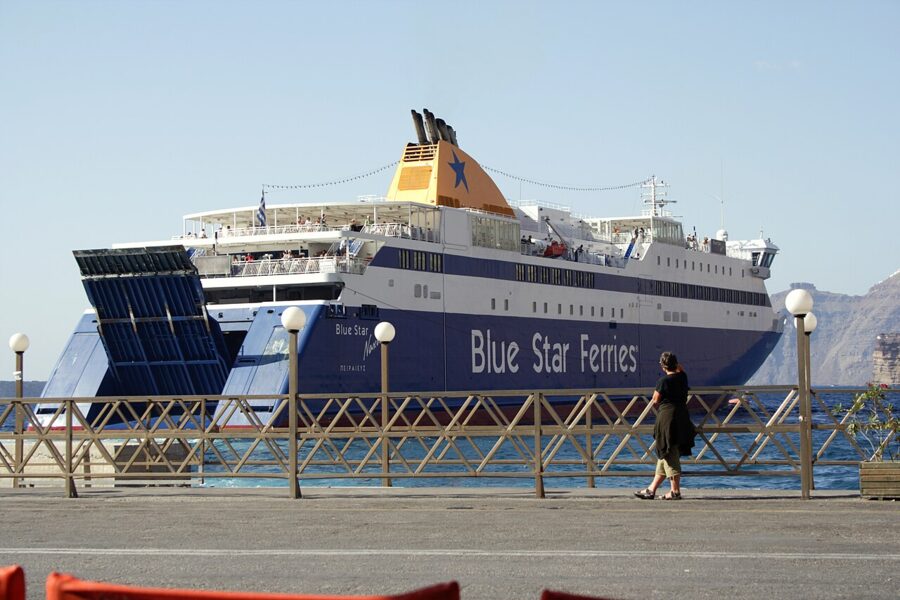
Greek ferries come in two kinds, and almost every decision follows from which one you are on. Conventional ferries are big car-carrying ships with outdoor decks, a cafeteria and cabins on the longer routes. High-speed boats are catamarans and monohulls that cruise at 35–42 knots, keep you indoors for most of the trip, and charge for it.
Who runs what
- Blue Star Ferries (part of Attica Group with Hellenic Seaways, ANEK and Superfast): the conventional backbone, year-round from Piraeus to the Cyclades, Crete, the Dodecanese and the North Aegean. The same booking system sells ANEK’s night boats to Milos and Chania.
- Seajets: the biggest name in high-speed boats, from Piraeus, Rafina and Crete across the Cyclades from spring to autumn. Their booking tool has an “Island Hop” mode that chains several legs into one search.
- Golden Star Ferries: Rafina to Andros, Tinos, Mykonos, Paros, Naxos, Ios and Santorini.
- Fast Ferries: Rafina to Andros, Tinos and Mykonos all year, with Naxos and Paros in summer, plus the Dionysios Solomos on the western line from Piraeus.
- Minoan Lines: overnight Piraeus to Heraklion, and the Piraeus and Heraklion links with Milos.
- Aero Highspeed (Attica Group): the Saronic islands from Piraeus.

Booking: the operator’s own site, or the port
Book on the operator’s own site or app. Blue Star, Seajets, Golden Star and Fast Ferries all sell e-tickets that you show on your phone at the ramp, and the price is the operator’s price with no booking fee on top. In July and August, book the legs that matter (the first boat out of Piraeus, anything to or from Santorini, the catamaran legs) a few weeks ahead; peak-season departures do sell out. Outside those two months you can usually buy at the port agency on the day, which keeps the route flexible.
Watch the fare names. Many Blue Star sailings show a “Special Economy” fare online, about 20% under economy (€46.50 against €59 to Santorini); read its change and refund conditions before you take it. The operator also sells a limited “Super Economy” fare from €20 to the Cyclades, the Dodecanese and the North Aegean from Piraeus (from €25 to Heraklion), but only through its agencies and call center, not online. And if you are traveling on an Interrail pass, the Greek Islands Pass gives four domestic travel days within a month on the Attica Group boats, with 30% off any further trips.
Deck, seats and cabins
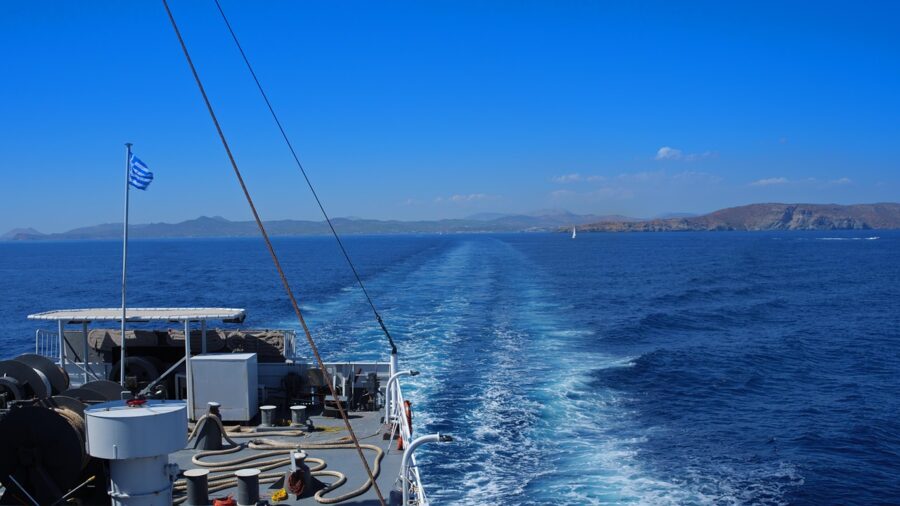
Economy on a conventional ferry is not a seat number. It gets you on board, and you sit where you like: the lounges, the cafeteria, the outside decks. On a busy summer morning the good spots inside go fast, so board early, and on the long runs bring something to sleep on. “Airplane seats” cost a few euros more (€64 against €59 to Santorini) and get you a reclining seat in a quieter lounge.
Cabins only make sense overnight. On the December 2026 timetable a bed in a shared four-berth inside cabin on Blue Star 1 from Piraeus to Heraklion cost €59.50, against €41 for economy; on the long Dodecanese run to Rhodes it was €92.50 against €59. Between Paros and Santorini a four-berth bed was €52 for a crossing of three hours and twenty minutes, which is money for nothing. The overnight boats are the one real budget trick in the system: a night boat replaces a night’s accommodation, and on the Santorini run it is also the cheapest fare.
The meltemi, sailing bans and strikes
The meltemi is the dry north wind that blows across the Aegean in summer, strongest in July and August, often at 15–30 knots. It keeps the islands bearable in the heat and makes the sea short and steep, especially on the exposed crossings south of Mykonos and around Ios and Santorini. The catamarans feel it most, and they are also the first boats the port authority stops.
When the forecast reaches gale strength the coast guard issues an apagorevtiko, a sailing ban, port by port. Each ship has its own limits, so on a windy day the big conventional ferries often sail while the high-speed boats stay tied up. The ban dates from 1966, when the ferry Heraklion capsized in a storm off the island of Falkonera with more than 200 people lost. Build one spare day into any route that ends with a flight home, and never take the last boat to Piraeus on the day you fly.
Strikes are the other interruption. The seamen’s unions call 24-hour strikes a few times a year; the one on 25 November 2026 cancelled Blue Star’s morning Piraeus sailing to Paros, Naxos, Santorini and Ios, and every Aero Highspeed sailing to the Saronic islands. The operators post the changes on their sites a few days ahead and rebook affected passengers through the agency or call center that sold the ticket.
The islands, one by one
Where no place to sleep is named below, the cheap option is a room in a family-run guesthouse, which on these islands you find through the usual booking sites or by asking at the port agency.
Paros
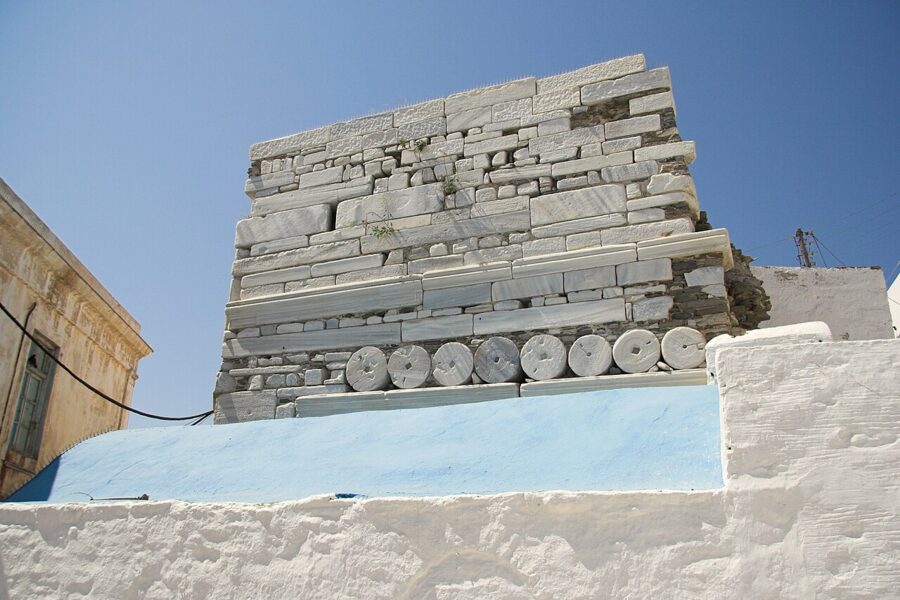
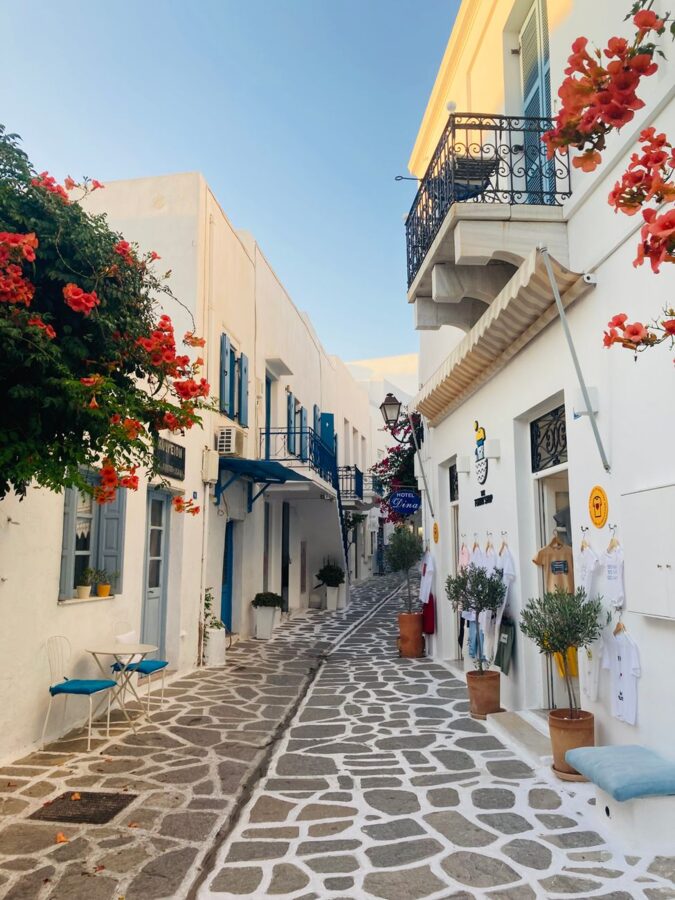
Paros is the hub. Boats from Parikia, the port town, reach more islands than from anywhere else in the Cyclades, which makes it the best first stop and the best place to wait out a cancellation. Parikia itself is a working harbor town with a Venetian kastro quarter built partly out of ancient temple marble; you can see column drums laid sideways in its walls.

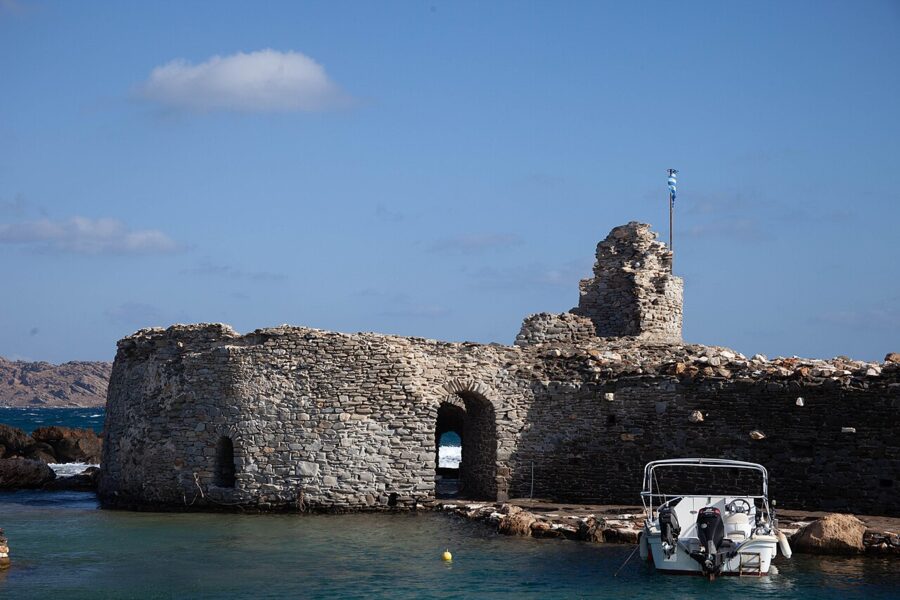
Naoussa, on the north coast, is the second town: a fishing harbor with a small Venetian fort at its mouth and the island’s bars along the waterfront. The KTEL bus links Parikia and Naoussa through the day, and the beaches on the bay beyond Naoussa are reached by bus or small boat. Paros Backpackers in Parikia was taking guests through autumn 2026; it is basic, so read recent guests’ comments before you book, and compare it with a double room split two ways.

Naxos
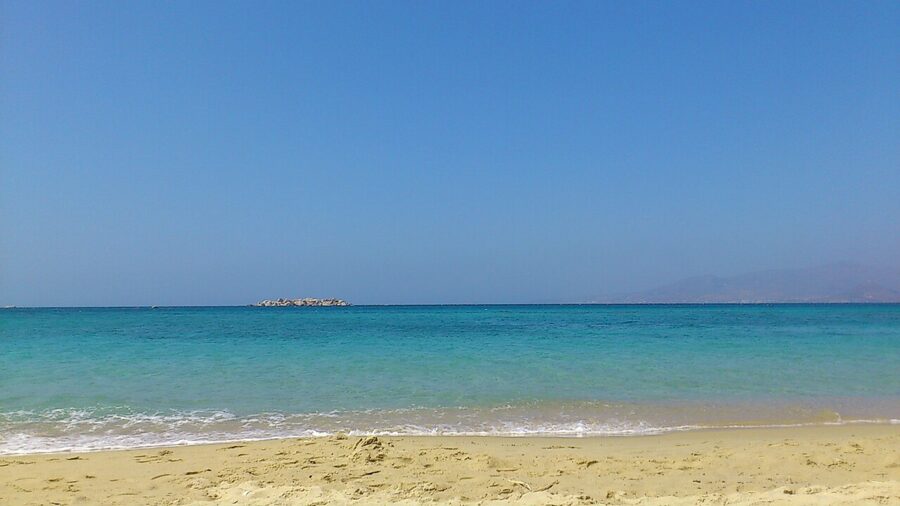
Naxos is the biggest island in the Cyclades and the best value in it. It has long sandy beaches south of the town (Agios Georgios, Agios Prokopios, Plaka), mountain villages in the interior, and its own cheeses, potatoes and meat from the farms inland. If you only stay long on one island, make it this one.
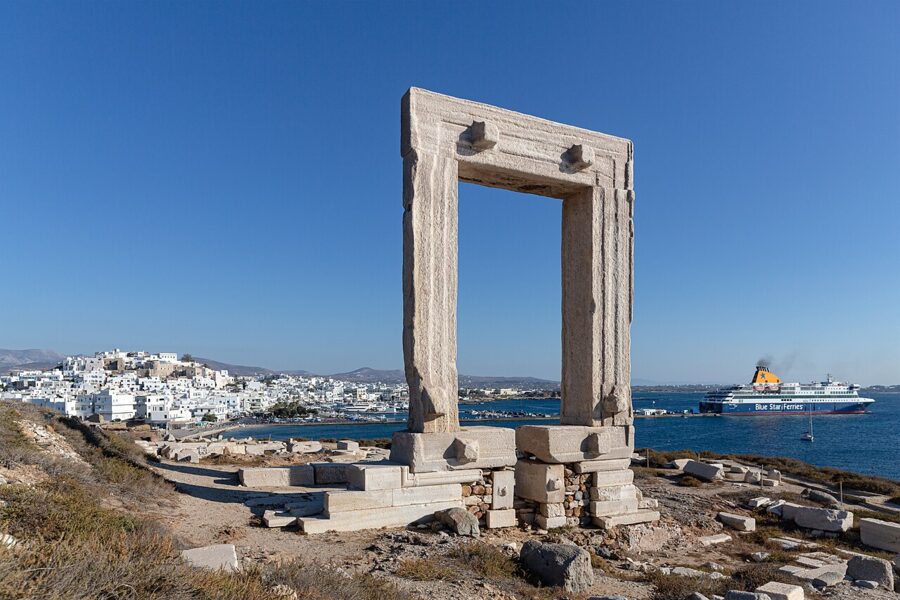
The Portara, the giant marble doorway on the islet by the harbor, is free and open at all hours. The tyrant Lygdamis began a temple of Apollo here around 530 BC; he fell before it was finished, and the doorway is what was never taken away. Above the port, the Kastro is the walled Venetian quarter, founded after Marco Sanudo took the island in the early 13th century, and still lived in.
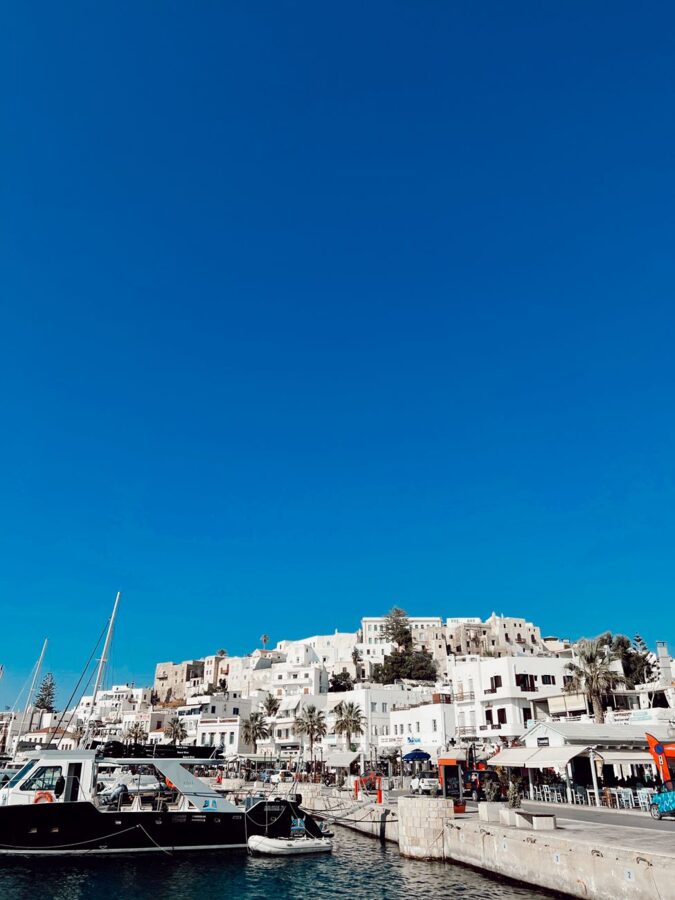
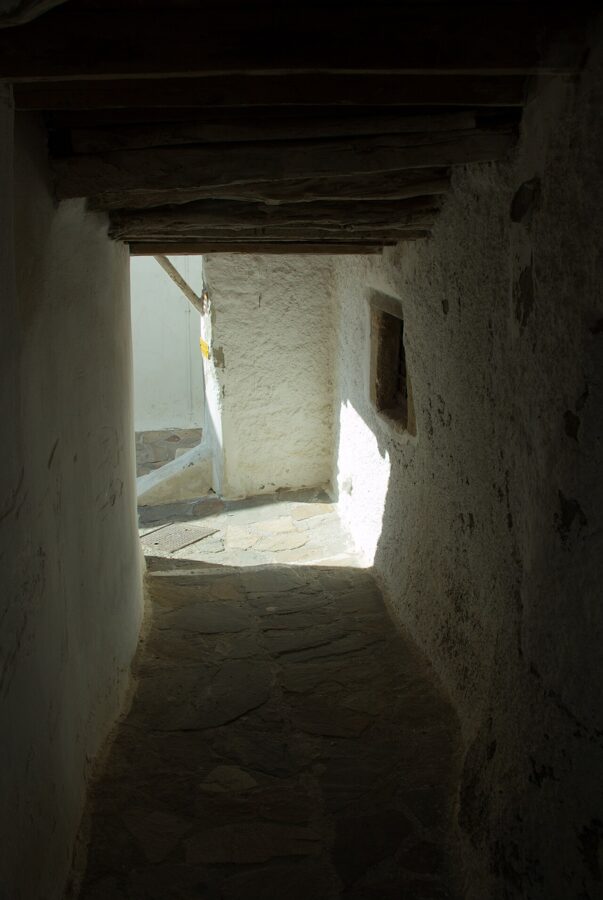

The cheap beds on Naxos are campsites and family-run rooms behind the beaches south of town. Plaka Camping, on Plaka beach, ran its 2026 season with a restaurant and mini market on site, and the island bus runs along the beach road to Naxos Town through the summer day.

Santorini
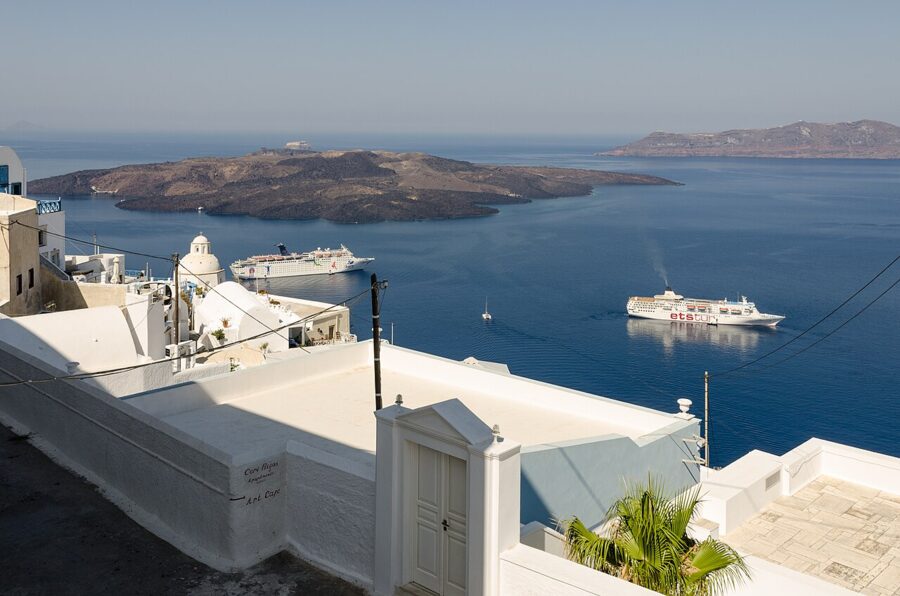
Santorini is a volcano that blew itself apart. The eruption, which sources date anywhere from the late 1600s BC to around 1500 BC, emptied the magma chamber, the center collapsed, and the sea poured into the hole; the towns of Fira and Oia sit on the rim of that flooded crater, high above the water. It is the most famous view in Greece, and in July and August the rim is a queue with a view.
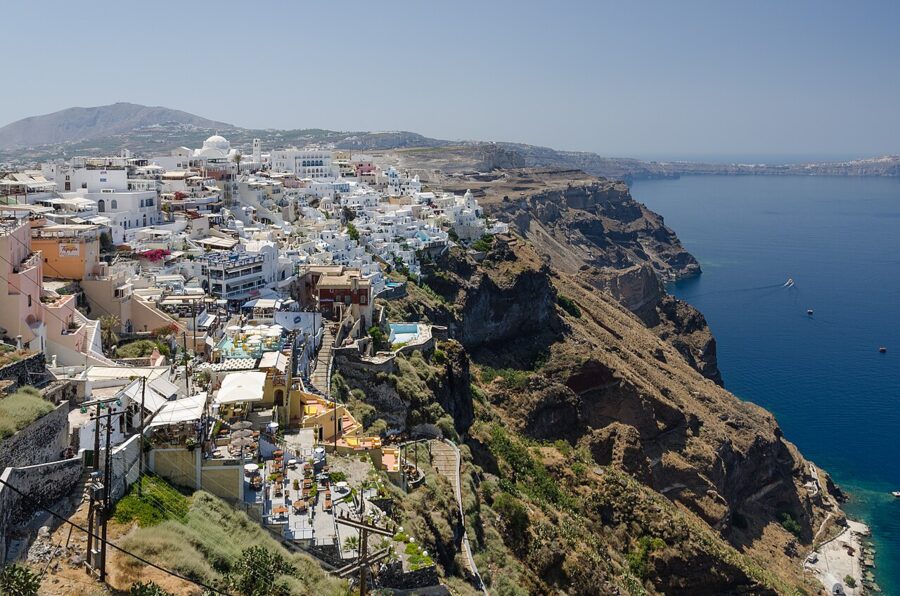

Do it cheaply and Santorini works. The KTEL buses all start in Fira: €2.20 to Oia, Kamari or Akrotiri, €2.70 to Perissa or the port at Athinios (2026 fares). Santorini Camping, a few minutes from the Fira bus station, has a pool, a hostel and bed tents, and its price list puts a hostel bed at €12.50 in March and April, €15 in May, €20–25 in June and €30 from July to the end of August. It is open from 1 March to 30 November.
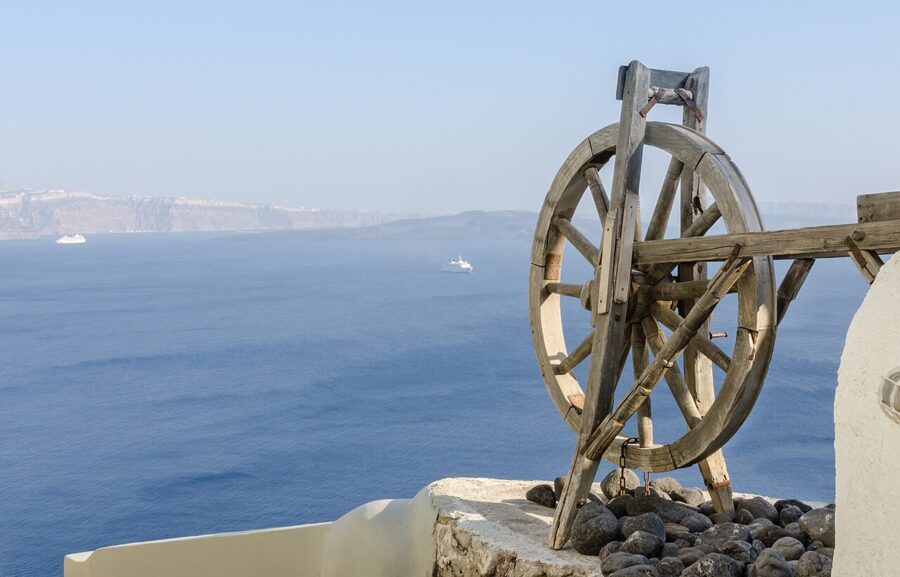

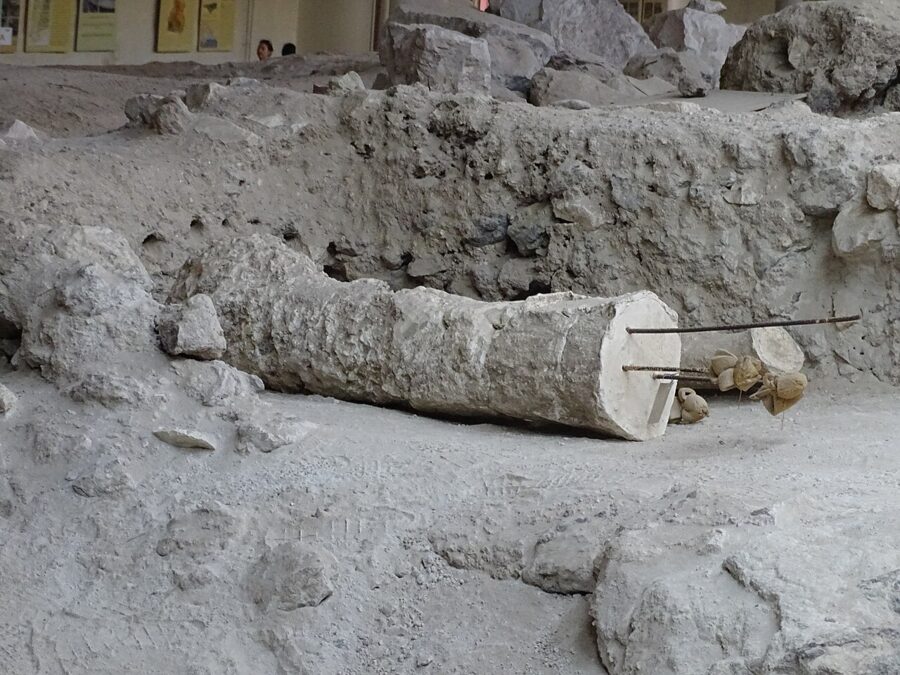
Akrotiri is the reason to stay a second day. The Bronze Age town buried by the eruption lies under a modern roof at the south end of the island, with streets, three-story houses and staircases preserved under the ash; no bodies have been found, so the people seem to have left in time. Entry is €20 (€10 reduced). From April to August it opens 08:00–20:00 except Monday and Thursday (08:30–15:30); from November to March it opens 08:30–15:30 and closes on Tuesdays, with last entry 20 minutes before closing.


Ios
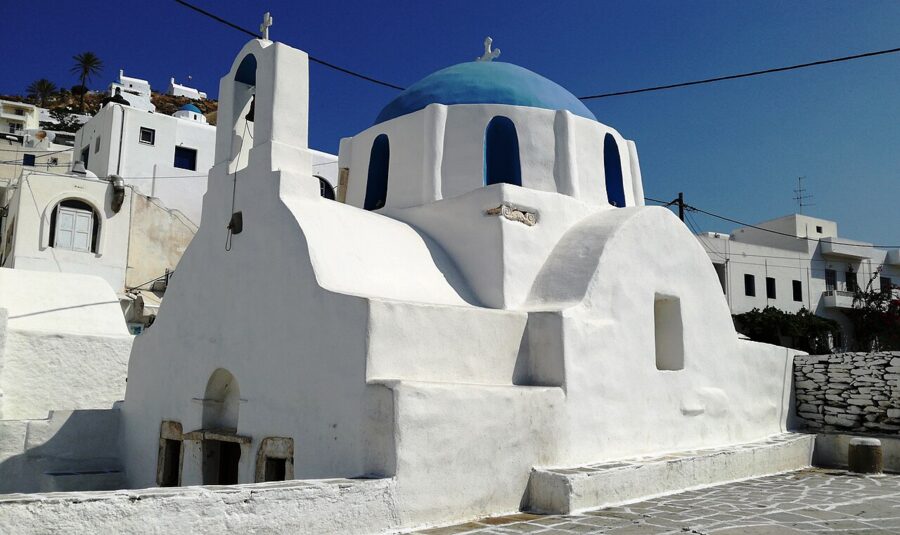
Ios has been the party island of the Cyclades since the 1970s, and from late June to early September the main village, Chora, is a hillside of bars that fill after midnight. Outside those weeks it is a quiet island with a whitewashed village, good beaches and a tomb that tradition gives to Homer. The port, Chora and Mylopotas beach are strung along one road with a local bus between them.

Francesco’s, on the edge of Chora, is the island’s long-running hostel: dorms with fans, private rooms, a pool, no curfew and no lockout. Dorm beds are for travelers up to 33, reception keeps 09:00–21:00 hours, check-in is from 15:00, and the house charges the Greek accommodation tax of €2 per room per night on top. There are showers in common areas for anyone waiting on a late ferry, which is a small kindness worth knowing about on an island whose boats run late.

Milos
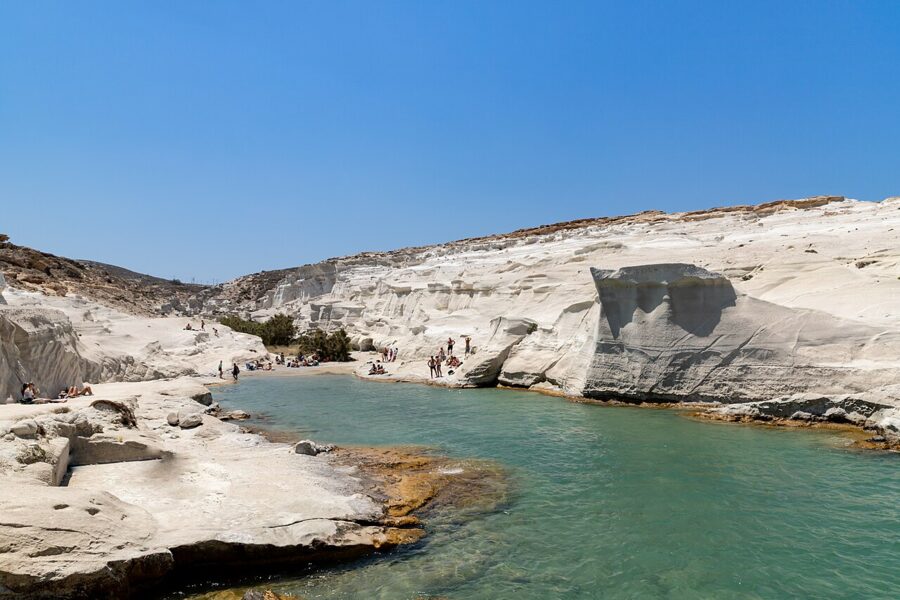
Milos is a volcanic island shaped like a horseshoe around a huge natural harbor, and its coast is a run of colored rock: white at Sarakiniko, red and ochre at Firiplaka, sea caves at Kleftiko that most people reach by boat. It is quieter and cheaper than Santorini for the same kind of drama. The Venus de Milo was found here in 1820, by a farmer near Plaka; the statue went to the Louvre and has not been back.

Ferries arrive at Adamas, the port town, which has the island’s widest choice of rooms and the bus station. On the winter timetable the conventional boat to Piraeus (about four hours, €42 in economy) leaves in the small hours and arrives in Athens at dawn, which makes Milos the natural last island of a route through the western Cyclades. In summer the high-speed boats link it with Santorini, Folegandros and Sifnos.
Folegandros
Folegandros is small, steep and car-light, and its Chora sits right on the lip of a sea cliff. There is not much to do except walk to beaches, eat in the shaded squares of Chora and watch the evening light on the cliffs, which is the point of coming. Ferries dock at Karavostasis, a small bay below Chora, with a bus up.
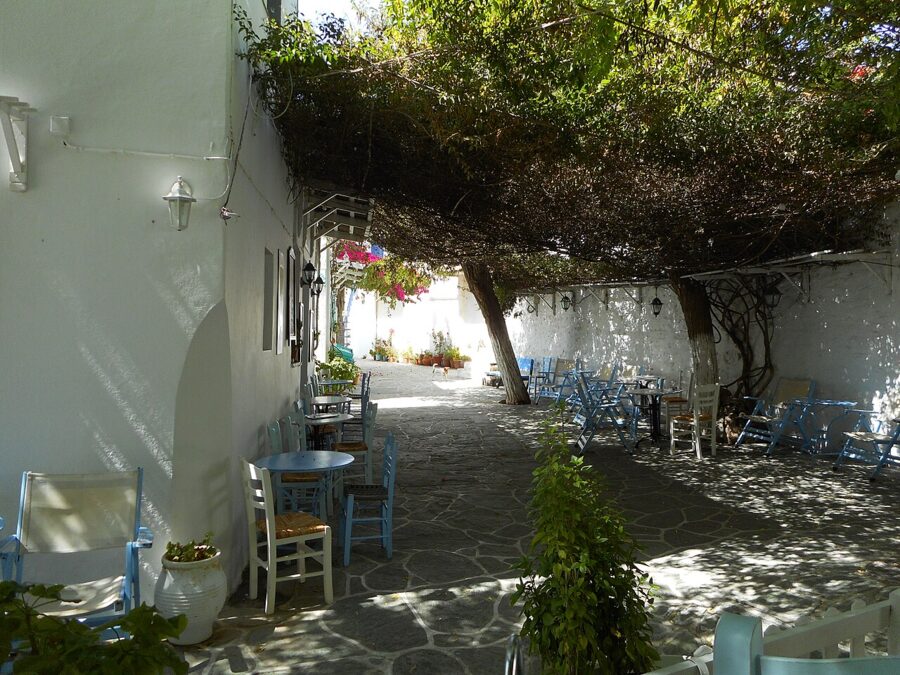

It is also an island you plan around. There is no hostel; beds are rooms and studios in Chora and at Karavostasis, and in summer they fill early. Boats are fewer than on the main line, and several of them run only in summer. Check the day you want to leave before you book the day you arrive.
Mykonos
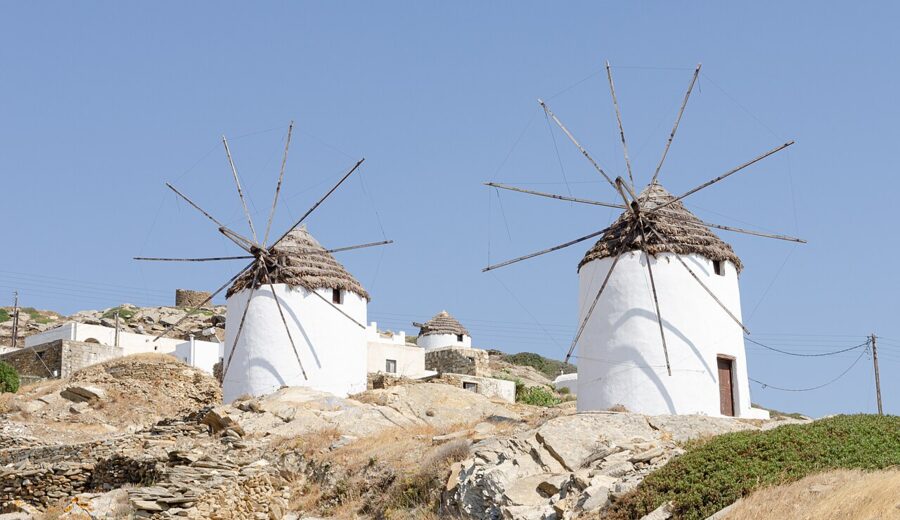
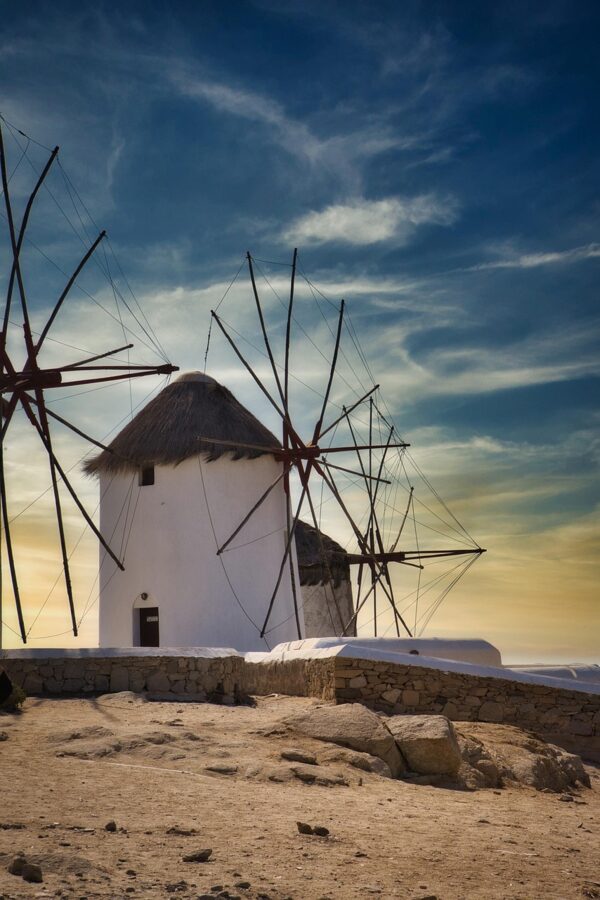
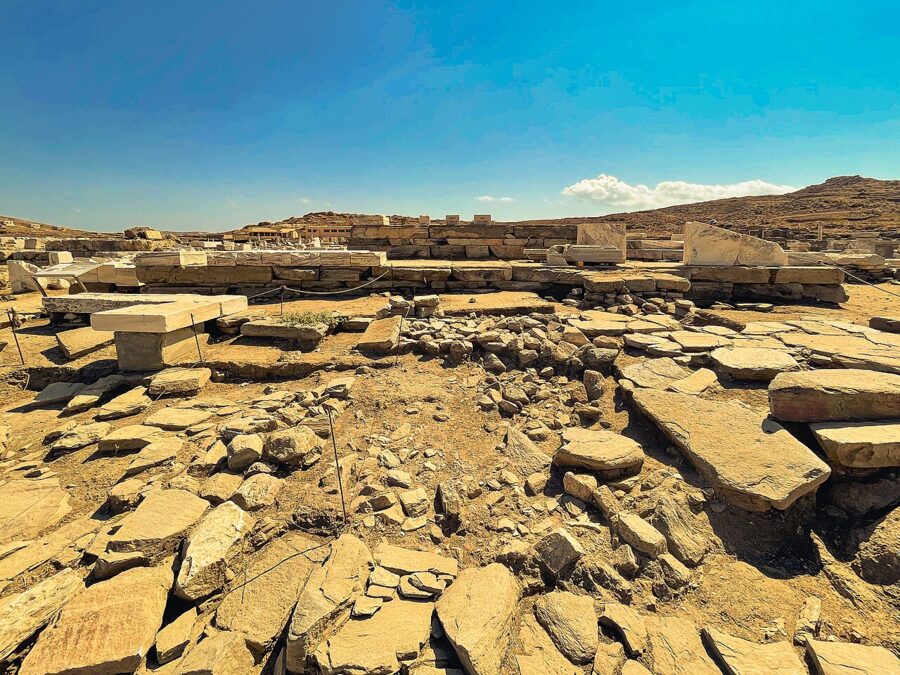
Mykonos is, with Santorini, the most expensive island in the group to sleep on, and for a budget route its value is mainly Delos. The town is worth an evening: the windmills on the ridge, the old harbor, and Little Venice, where houses stand with their feet in the water. Then take the morning boat to Delos and move on.
Delos was the sacred island of the Aegean, birthplace of Apollo and Artemis in myth and later a free port, and the ruins cover most of it. The site and its museum cost €20 (€10 reduced) and open 08:00–20:00 between April and August, closing earlier through September and October and at 16:00 in November; from December to March the site is closed. The boats leave from Mykonos Old Port, and the crossing takes about 30 minutes.

Koufonisia and Amorgos
The Small Cyclades between Naxos and Amorgos are the islands people describe when they say they found the Greece they were looking for. Ano Koufonisi has one village, a line of beaches you walk to, and few cars. Schinoussa and Iraklia are smaller and quieter still. In winter one Blue Star ferry a few times a week holds the line together, leaving Naxos at 01:00; in summer extra daytime boats and the high-speed lines fill in the timetable.
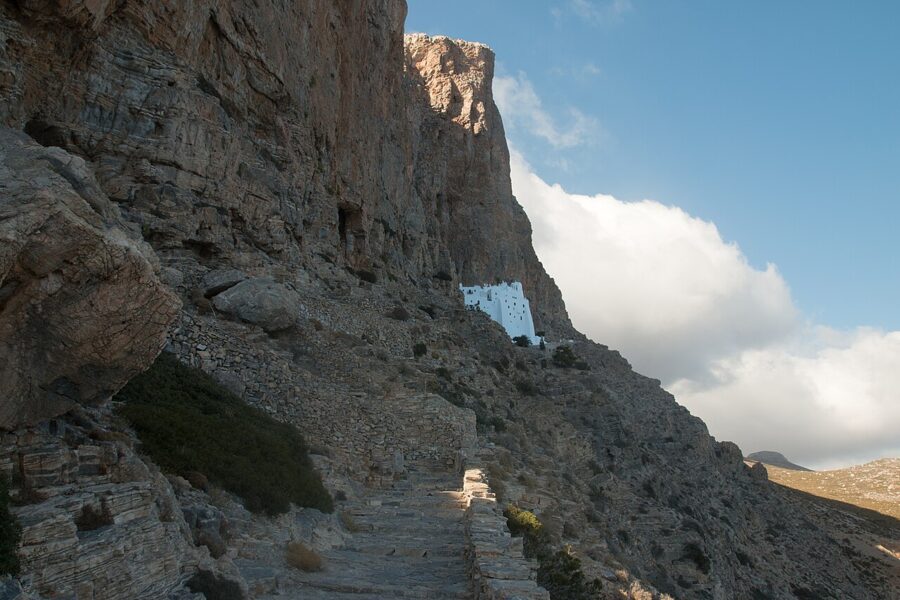
Amorgos, at the end of the line, is long and mountainous, with two ports (Katapola and Aegiali) and the Monastery of Panagia Chozoviotissa built into a cliff above the south coast, founded in the 11th century. It is a working monastery, so wear long trousers or a long skirt and cover your shoulders; the monks usually offer a small glass of raki at the top.

Syros and Tinos
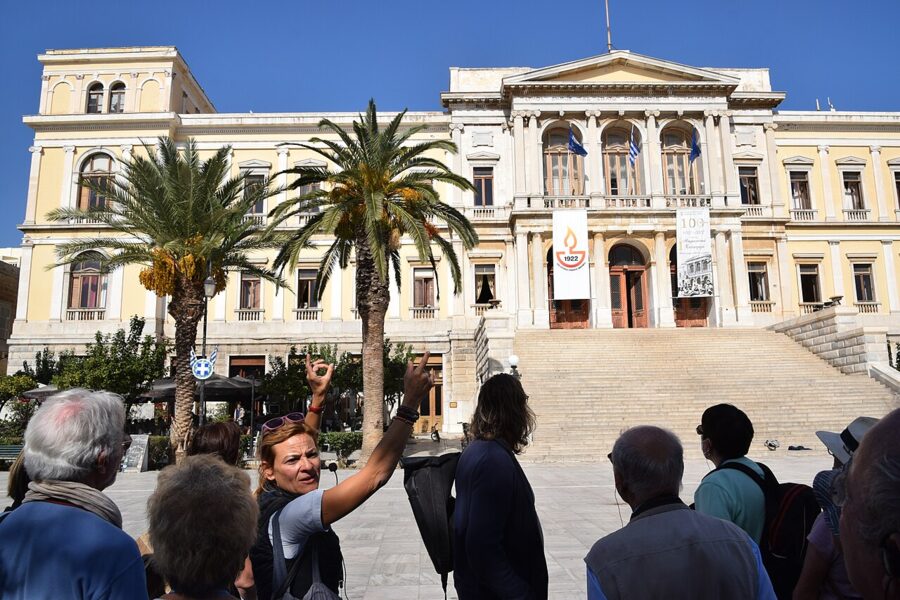
Syros and Tinos sit on the Mykonos line and are easy to add on the way in or out. Syros has Ermoupoli, the capital of the Cyclades, a 19th-century port city of marble squares and mansions that feels nothing like the white villages. Tinos is the island of pilgrimage: the church of Panagia Evangelistria above the harbor draws Greek pilgrims all year, and the villages inland are known for marble carving and stone dovecotes. Blue Star’s morning boat from Piraeus reaches Syros in about four hours (€46.50 in economy in winter) and Tinos in about five (€50).

A cruise or the ferries on your own?
The short Aegean cruises from Piraeus still run. Celestyal Cruises sails three- and four-night “Iconic Greek Islands” trips on the Celestyal Discovery, with 2027 departures from spring to autumn. The four-night version calls at Mykonos, Kuşadası on the Turkish coast (for Ephesus), Patmos, Rhodes and on some dates Santorini; the three-night one takes in Heraklion and Santorini. That is a lot of famous names in a few days, with no packing and unpacking and no ferry timetables to read.
What you give up is time ashore. A cruise stop is a few hours in port, often at the same time as several other ships, and from 1 June to 30 September every cruise passenger landing at Santorini or Mykonos pays a €20 fee for it, folded into the cruise price. Santorini also caps cruise passengers at 8,000 a day. You never see an island in the evening or the early morning, which is when the Cyclades are at their best, and you cannot stay longer where you like it.
The ferries win on cost and on everything that happens after 18:00. The cruise wins if you have four days, want Ephesus and Rhodes in the same trip and hate logistics. For a backpacker with two weeks there is no contest: a ticket on the 07:00 boat to Paros and a dorm bed are the cruise, done slowly.

Money: a daily budget in euros
Greece is cheaper than most of western Europe and the islands are dearer than the mainland, so the budget swings mainly with the island and the month. The figures below are 2026 prices; the daily totals add them up.
| Item | Shoulder (May, late September) | Peak (July–August) |
|---|---|---|
| Dorm or campsite hostel bed (Santorini Camping) | €15–20 | €30 |
| Accommodation tax, budget room | €2 per room per night | €2 per room per night |
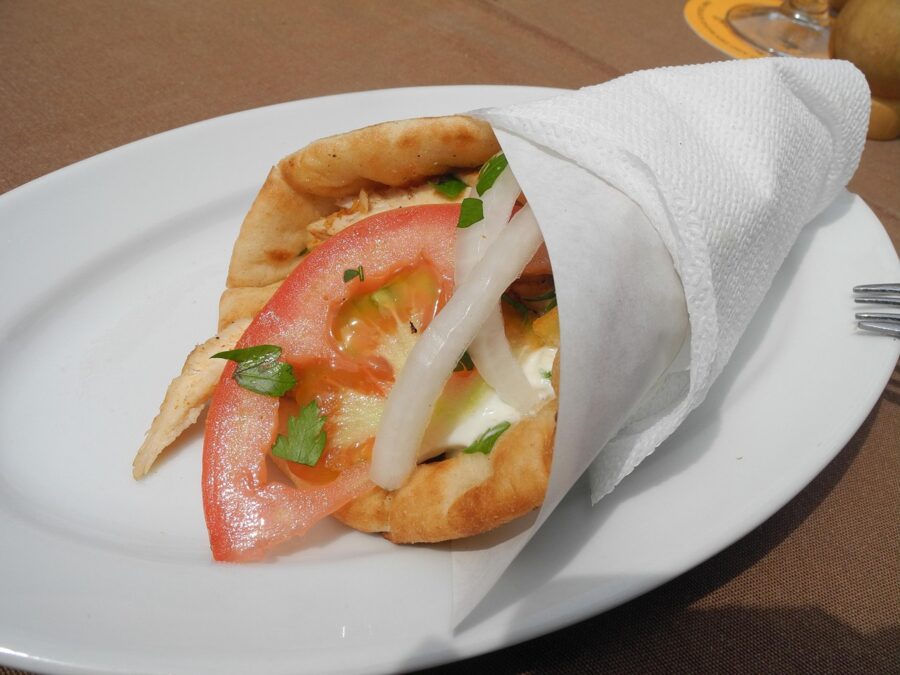
| Gyros or souvlaki wrap | €4–4.50 in Athens, more on the islands | same, more on Mykonos and Santorini |
| Island bus ride (Santorini KTEL) | €2.20–2.70 | €2.20–2.70 |
| Main archaeological site (Akrotiri, Delos) | €20 | €20 |
| Ferry leg, conventional economy | €15.50–59 | a little more |
| Ferry leg, high-speed | from €37–97 | more than May |
Put together, budget €50–60 a day in the shoulder months on the cheaper islands (dorm or campsite, wraps and bakery food with one taverna meal, a bus or two) and €70–90 in July and August, before ferries. Add the ferries as a lump: about €140 for the one-week route on conventional boats, €150–315 for two weeks depending on the route and how many catamarans you take. Mykonos and Santorini in August can wreck any budget, so keep them short or keep them in the shoulder months.
Cards work on the ferries and in most shops and tavernas; small guesthouses, campsites and island kiosks often want cash, and Francesco’s on Ios asks for cash payment. I land on any small island with €50 or so in notes; one cash machine is not a plan.
When to go
The best months are late May, June and September into early October. The boats run the full summer timetable or close to it, beds cost half their August price (the Santorini Camping hostel bed is €15 in May and €30 in August), the sea is warm by June and stays warm into October, and the meltemi is weaker. Easter, which moves between late March and early May, is a big Greek holiday; boats and rooms fill for the long weekend.
July and August are the peak. Every route runs, the high-speed boats run often, and so does everyone else: book the main legs ahead, expect the highest fares and room prices of the year, and plan around the meltemi. Ios and Mykonos are at their loudest; Santorini’s rim is at its most crowded.
Winter is a different trip. From November to April most high-speed services stop, some islands drop to a few boats a week, and much of the island accommodation closes. The backbone keeps going, though: Blue Star still sailed the Piraeus line to Paros, Naxos, Ios and Santorini in December 2026, and an economy ticket to Santorini was €59, or €41 on the night boat.
Akrotiri and other sites switch to short winter hours, Delos closes completely between December and March, and the Santorini campsite is shut through the winter months. For a quiet trip with Naxos and Santorini nearly to yourself, it works; for beaches and island hopping, it does not.

Rhodes, Kos and the crossings to Turkey
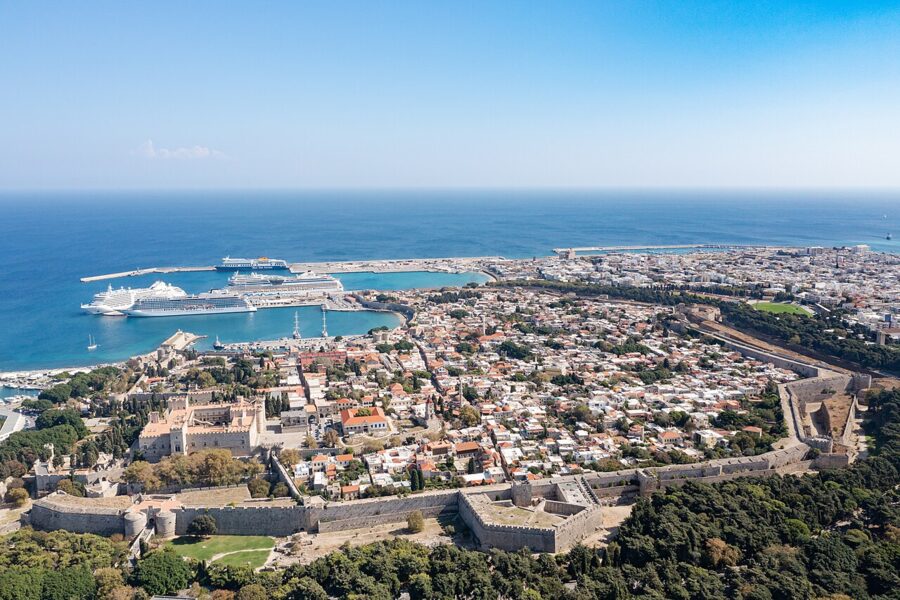
The Dodecanese are a separate trip from the Cyclades, but they are where Greece meets Turkey, and for a backpacker route that matters. Rhodes and Kos lie a short boat ride off the Turkish coast. The crossings to Rhodes from Marmaris and Fethiye, the Bodrum–Kos boats and the gulet weeks that cross to the Greek side are all in the guide to gulet cruises in Turkey.
From Piraeus, Rhodes is 14–19 hours by Blue Star (economy €59 on the slow boat through the Cyclades, €93 on the direct one, winter 2026–27), and Kos about 10–12 hours (€79). The slow Rhodes boat also calls at Santorini, which is the one practical link between the two groups.

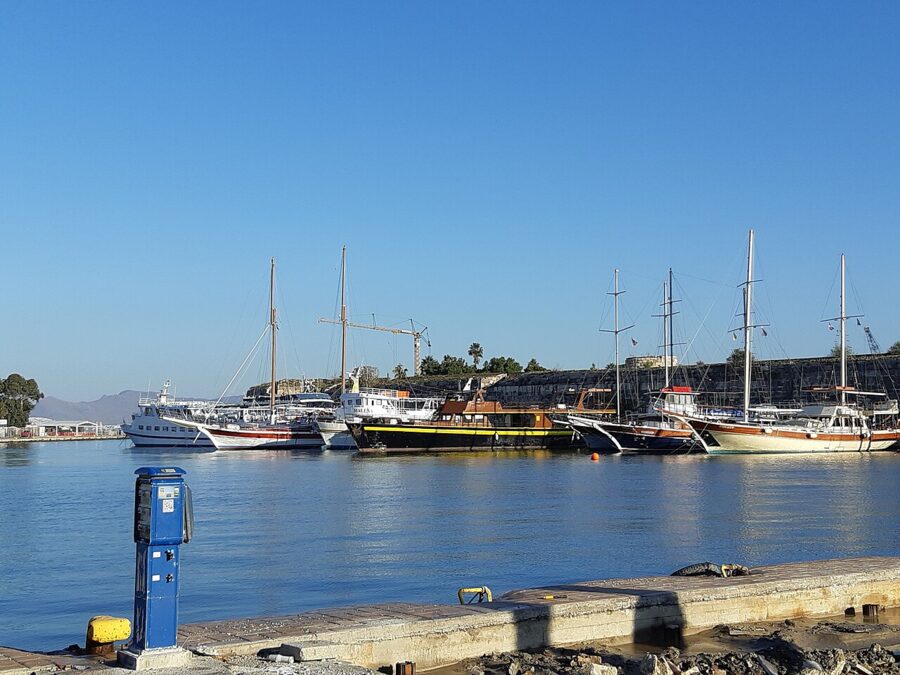
Further north, the short crossings from the North Aegean islands are the other way into Turkey. In summer 2026 boats ran between Samos (Vathy) and Kuşadası, the port for Ephesus, for €37 one way, and Chios faces Çeşme across a narrow strait. Kuşadası is a short dolmuş ride from Selçuk, where the Turkey itinerary passes on its way from Istanbul to Pamukkale and the coast, so an island summer can turn into a month in Turkey without a flight. Check your visa or e-visa conditions for Turkey before you cross; non-EU travelers coming back into Greece now have fingerprints and a photo taken under the EU’s Entry/Exit System, so allow time at the border.

For the first trip, though, keep it simple. Book the early Blue Star from gate E7 to Paros, buy a gyros on the quay at Parikia, and decide the rest of the route on the ferry deck with the timetable open. The boat to Naxos leaves the next day, and the one after that the day after.