Two and a half million people went through the gates of Ephesus in 2025, more than at any other archaeological site in Turkey. You do not need a tour to be one of them. The ruins lie 3 km from the train station in Selçuk, the ticket is €40 at the gate, and the first hour after the 08:00 opening belongs to whoever slept closest.

Doing it yourself comes down to four decisions: where to sleep, which of the two gates to walk in through, whether to pay the extra €15 for the Terrace Houses, and how early you can get up. The rest is a long downhill walk on Roman marble. Everything below uses the prices the Ministry of Culture listed in November 2026; state sites price foreign visitors in euros, and everything else around Selçuk is in lira.

Give the ruins a full morning and the town of Selçuk the afternoon. With a second day you can add the House of the Virgin Mary in the hills and the wine village of Şirince, and still be on the bus to Pamukkale the morning after.

Contents
A harbor city that lost its sea
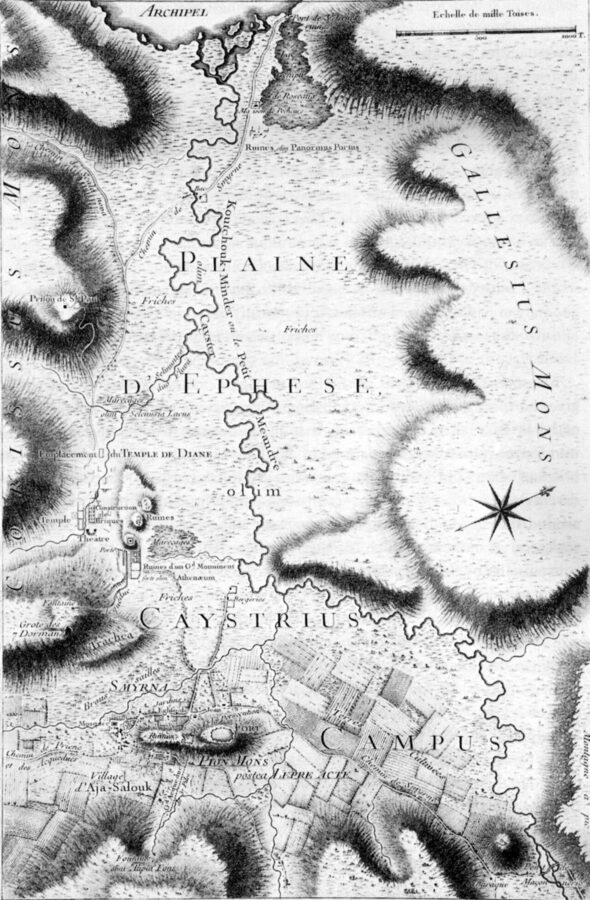
Ephesus was a port, and that is the hardest thing to picture once you are standing in it, because the sea is nowhere in sight. The city grew on the estuary of the Kaystros, the river now called the Küçük Menderes, and the silt it carried pushed the shoreline west, century after century. Each time the harbor choked, the city moved after the water. The Ephesus you walk through is one of several, and the newest of them, Selçuk, sits back where the story started.
Before the Greeks there was a goddess. The sanctuary of Artemis on the plain below Ayasuluk Hill began as the shrine of an Anatolian mother goddess in the second millennium BC and grew into one of the richest sanctuaries of the ancient world. Its marble temple was burned in 356 BC by a man named Herostratus, who wanted to be remembered; the rebuilt temple made the list of the Seven Wonders, and he got his wish.
After Alexander the Great, his general Lysimachus refounded the city on its present site, in the valley between two hills and closer to the water. When Rome absorbed the region in 133 BC, Ephesus became the capital of the new province of Asia. Most of what you see today, the library, the Terrace Houses, the theater in its final shape, was paid for in the following three centuries by governors, priests and rich families competing to put their names on marble.
For many people the Christian city matters as much as the Roman one. Paul spent two to three years here in the 50s AD, and the Acts of the Apostles describes a riot in the Great Theatre, stirred up by a silversmith named Demetrius whose trade in Artemis shrines was suffering. Tradition brings John the Apostle here late in life and buries him on Ayasuluk Hill, and in 431 a church council met in the Church of Mary in the lower city. Ephesus is also the first of the seven churches of Revelation.
The silt won in the end. By the seventh century the harbor was failing and the city had shrunk back to Ayasuluk Hill, around the great church built over John’s tomb. Turkish emirs took the hill town in 1304, the Aydınid dynasty made it a capital for a while, and the Ottomans followed; the old city was quarried for building stone, then buried, and serious excavation began only in the late nineteenth century. Austrian archaeologists have dug here since 1895, and they still do.
Getting there: Selçuk is the base
Selçuk is a small market town with a railway station, a bus station (otogar) and a cluster of family pensions, and it is the right place to sleep. The lower gate of Ephesus is about 3 km away, the Ephesus Museum and the Basilica of St. John are in town, and dinner costs what dinner costs in an Aegean farm town rather than in a resort. Kuşadası on the coast, about 20 km away, has more hotels and a cruise port, but you will spend every morning in traffic getting back.
Most people arrive from Istanbul, by a flight of just over an hour to İzmir or by bus. The bus connections and the whole loop around western Turkey are worked out leg by leg in the Turkey itinerary; what follows is the last stretch into Selçuk.
From İzmir airport by train
İzmir’s suburban railway, İZBAN, has a station at Adnan Menderes Airport, connected to the terminal. Trains on the main line do not run through to Selçuk: you ride south to Tepeköy and change to a shuttle train for the last 26 minutes. That shuttle runs only about 14 times a day, with daytime gaps of up to an hour and a half, so check the next Selçuk departure before you leave the airport. With a good connection the whole trip takes about 70 minutes; with a bad one, more than two hours.
You pay with an İzmirim Kart, sold at station machines (the card itself cost 200 TL in 2026, plus whatever you load). Fares have been distance-based since 1 April 2026: 40 TL for the first 20 km and 1.50 TL for each kilometer after that, which puts the airport to Selçuk, roughly 60 km, at around 100 TL. Tap the card on the reader as you leave the station at Selçuk. If you do not, the system charges you to the end of the line.
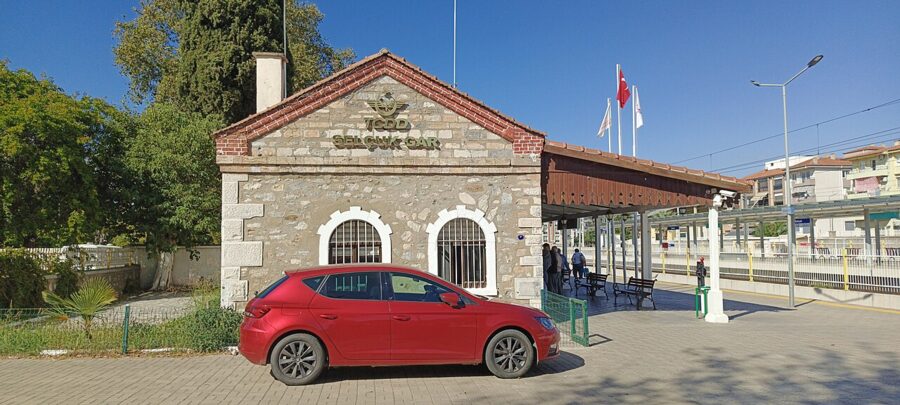

From central İzmir the regional trains of the state railway, TCDD, are simpler. In autumn 2026 eight or nine a day ran from İzmir Basmane to Selçuk, taking 1 hour 20 minutes to 1 hour 40 minutes, with fares from about 120 TL. Minibuses also run from İzmir’s main otogar to Selçuk in about an hour and a quarter.
From the cruise port at Kuşadası
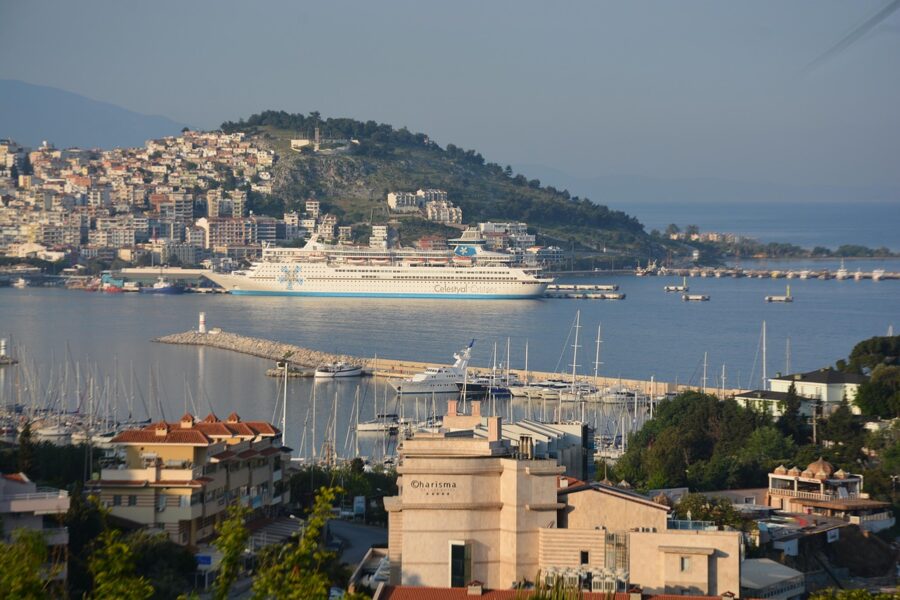
If you are coming off a ship, you do not need the excursion desk. Walk out of the port to the main road or the minibus station and take a dolmuş signed for Selçuk, and tell the driver “Efes”. He will drop you at the turning for the ruins, from where the lower gate is about 1 km on foot; the ride takes about half an hour. Coming back, flag down any Kuşadası dolmuş on the same road, and leave a full hour of slack before the ship’s all-aboard time.
Upper gate or lower gate
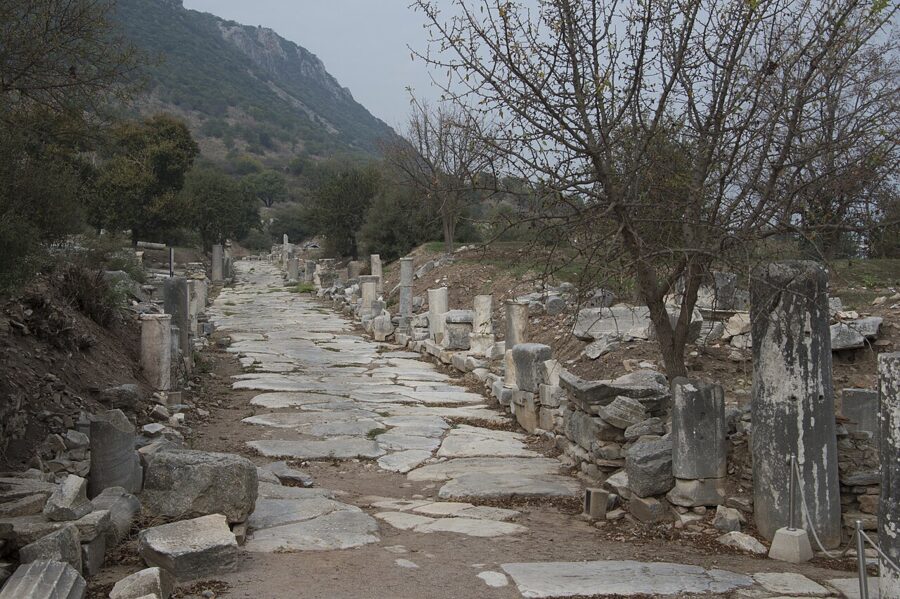
Ephesus has two entrances. The upper gate (Üst Kapı) is on the south-east side, by the old Magnesian Gate, high in the valley; the lower gate (Alt Kapı) is on the Selçuk side, near the Great Theatre and the old harbor road. The main street runs downhill from one to the other for roughly 2 km, so the right answer is to start at the top and walk down.
The cheapest way to do that from Selçuk is a taxi to the upper gate (metered; ask for “Efes üst kapı”), then a walk down through the whole site and out of the lower gate. From there it is about 40 minutes on foot back to Selçuk, past the Temple of Artemis, or a short dolmuş ride. If you would rather spend nothing on transport, walk the 3 km from Selçuk to the lower gate, see the theater first, climb the main street to the top and come back down; it adds about 2 km of walking and most of it is uphill in the morning sun.

Both gates may move one day. In February 2026 the Ministry announced plans to relocate the main entrance to a point outside the ancient city walls and to clear the car parks and shops from the archaeological zone so the excavators can dig there. No date was given, so for now the two gates work as they always have.
Tickets, hours and the timing that matters
Every site in this table except the House of the Virgin Mary is run by the Ministry of Culture and Tourism, and all of them let foreign children under 8 in free; from 8 upward, foreign visitors pay the adult price. Hours are the Ministry’s winter hours, which apply from October to the start of April.
| Site | Foreign visitor ticket (Nov 2026) | Winter hours | Notes |
|---|---|---|---|
| Ephesus ancient city | €40 | 08:00–17:30 | Includes the Ephesus Experience Museum |
| Terrace Houses (inside Ephesus) | €15 | Same as the site | Separate ticket; no museum pass covers it |
| Ephesus Museum, Selçuk | €10 | 08:30–17:30, ticket office closes 17:00 | In town, near the otogar |
| Basilica of St. John and Ayasuluk Castle | €6 | 08:30–17:30; castle 09:00–16:00 | One ticket for both |
| Temple of Artemis | Free | Open site | Beside the road from Selçuk to Ephesus |
| House of the Virgin Mary | Paid in lira | Daytime | Run separately; no pass covers it |
| MuseumPass The Aegean | €95 | 7 days | Ministry sites in İzmir, Aydın, Muğla and Denizli |
| MuseumPass Türkiye | €165 | 15 days | One entry to each Ministry site nationwide |
In summer the Ministry lists Ephesus as open 08:00–21:30, and from 1 June to 1 October 2026 the site ran night openings from 19:00 on Wednesdays, Thursdays, Fridays and Saturdays, with the library and the theater floodlit. More than 213,000 people came after dark in the first two months, so the evenings are no longer the quiet secret they were. The price is also going up: the Ministry’s 2027 tariff, announced in September 2026, raises the Ephesus ticket to €45 from 1 April 2027.
Do the pass arithmetic before you buy. Ephesus, the museum and the Basilica of St. John come to €56, and Hierapolis at Pamukkale adds €30, so the €95 Aegean pass only pays for itself if you also visit at least one more Ministry site within the seven days. On a Selçuk and Pamukkale trip of three or four days, paying at each gate is cheaper.
Heat, crowds and the best hours
The site is a white marble bowl with almost no shade. From June to September the middle of the day is genuinely punishing, and the polished paving gets slippery when it is wet or worn, so wear shoes with grip and carry more water than you think you need, plus a hat.
The crowds come in a wave. Cruise passengers and coach tours from the coast usually build through the morning and thin out in the afternoon, so you want to be through the upper gate at 08:00 or arrive in the last two or three hours before closing. Allow three hours for the main walk and another hour for the Terrace Houses; people who say they “did Ephesus in 90 minutes” saw the library and the theater and not much else.
The Experience Museum
The Ephesus Experience Museum, opposite the theater near the lower gate, opened in 2023 and is included in the foreign visitor’s €40 ticket. It is a run of digital rooms with projections of the city in its prime, the Temple of Artemis and the library, and takes about 20 minutes. It is a good place to sit out the worst of the afternoon heat, and children like it; adults who have read up on the site can skip it without losing much.
Do you need a guide?
Most people do not. The site has information panels at the major buildings, the route is one street long, and you can read up the night before. A good guide earns the fee if you want the inscriptions translated, the architectural tricks pointed out and two hours of stories, and if you are traveling as a group the cost per head falls fast.
If you hire one at the gate, check the license. Under Turkey’s 2012 tourist guiding law only guides holding a Ministry-issued professional ID card, the badge they call a kokart, may guide foreign visitors, and a licensed guide will show it without being asked twice; check that the photo matches the face. Agree the price, the length and the language before you start walking, and say no to anyone whose tour ends at a shop.
The walk: Ephesus from top to bottom
From the upper gate the route is simple: across the civic center at the top of the valley, down Curetes Street to the Library of Celsus, then north along Marble Street to the Great Theatre and out. The walk is about 2 km; with stops, it fills a morning. These are the buildings worth slowing down for, in the order you meet them.
The upper city: State Agora, Odeon and Prytaneion
The first big open space inside the upper gate is the State Agora, the city’s administrative square, where business that mattered to the governor was done. Along its north side ran a long hall, the Basilica Stoa, and behind that sits the Odeon, a small theater of about 1,400 seats built around 150 AD by Publius Vedius Antoninus and his wife Flavia Papiane. It probably served as the council chamber, the bouleuterion, as well as a concert hall, and it had a roof.
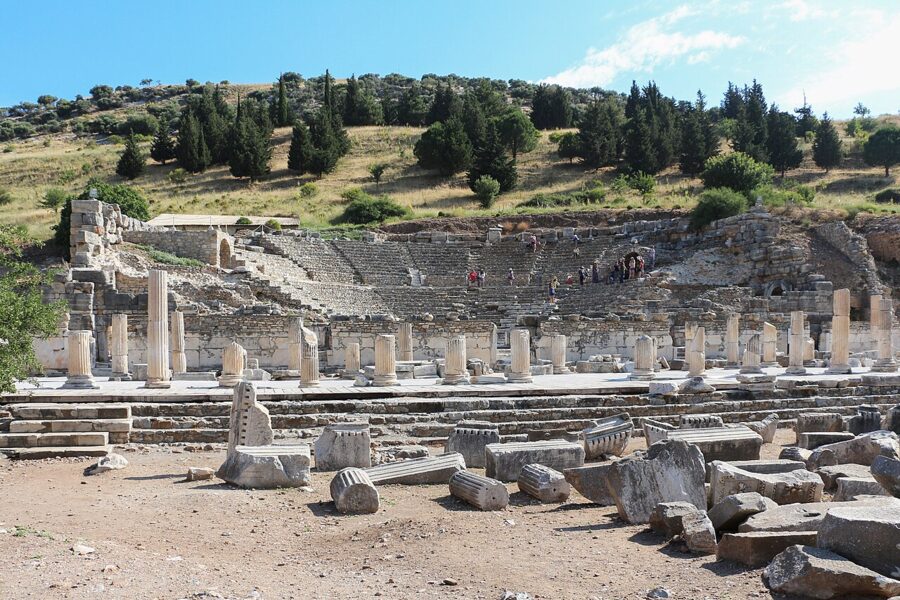

Next door is the Prytaneion, the city hall, where a sacred flame was kept burning and where excavators in the 1950s found the two great statues of Artemis now in the Ephesus Museum.
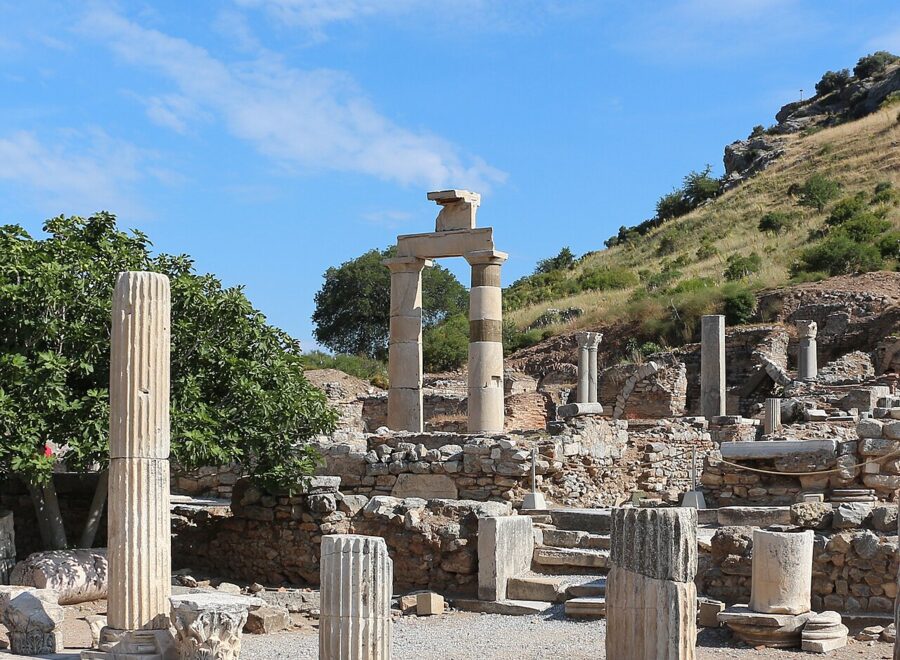

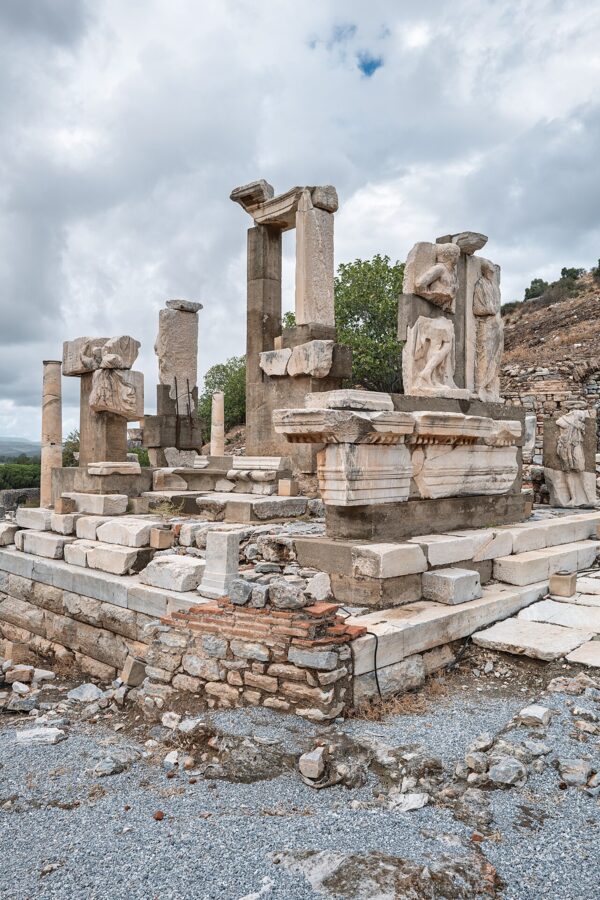
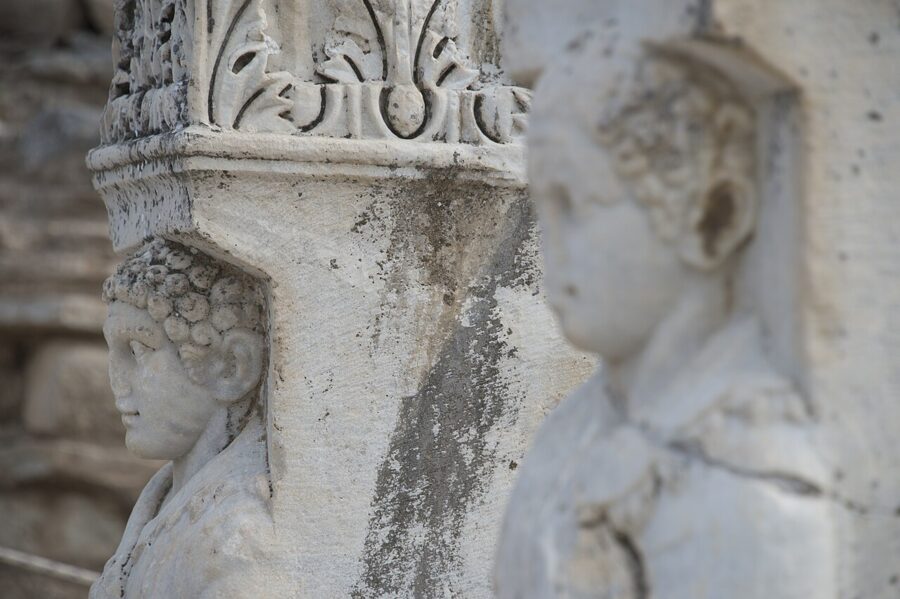
Across the street, a high terrace marks the Temple of the Sebastoi, built for the emperor cult under Domitian. From here the road narrows, passes the Memmius Monument and the Pollio Fountain, and arrives at the Hercules Gate, where Curetes Street begins.


Curetes Street
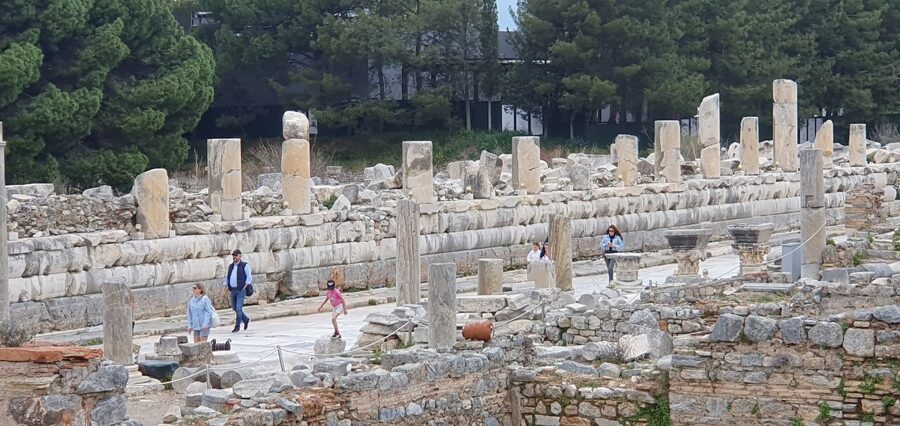
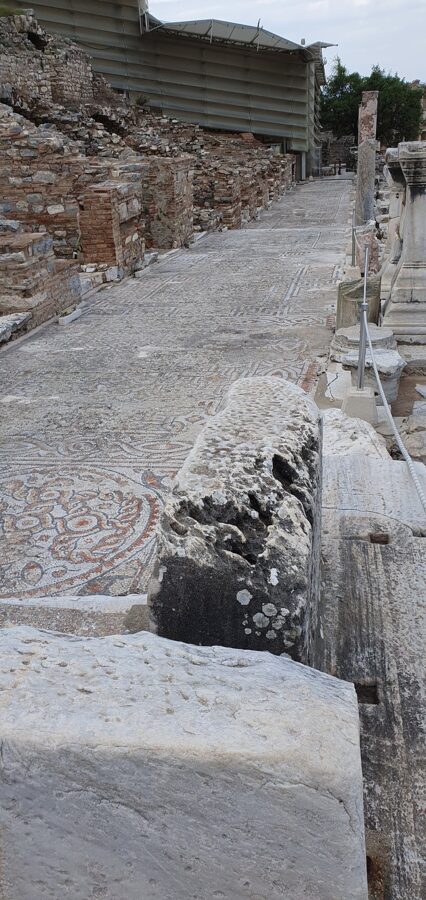
Curetes Street takes its name from the Curetes, a college of priests tied to the cult of Artemis, and it was the grandest street in the city. Statues of benefactors stood on the bases along both sides, and shops opened onto colonnades whose mosaic floors you can still see behind the column line. Look down as well as up: game boards are scratched into the steps and paving, left by people with time to kill.
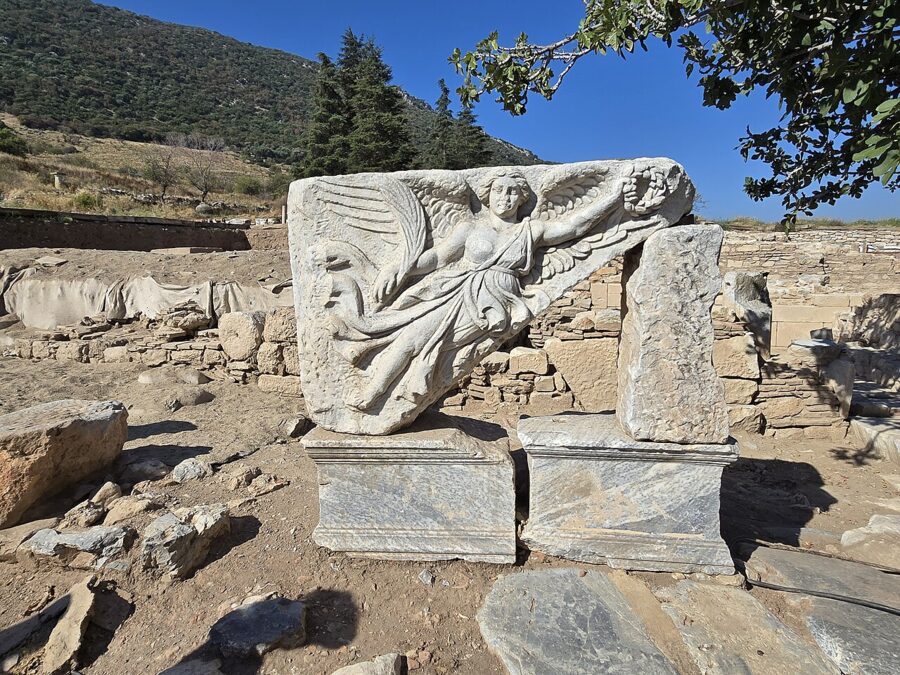

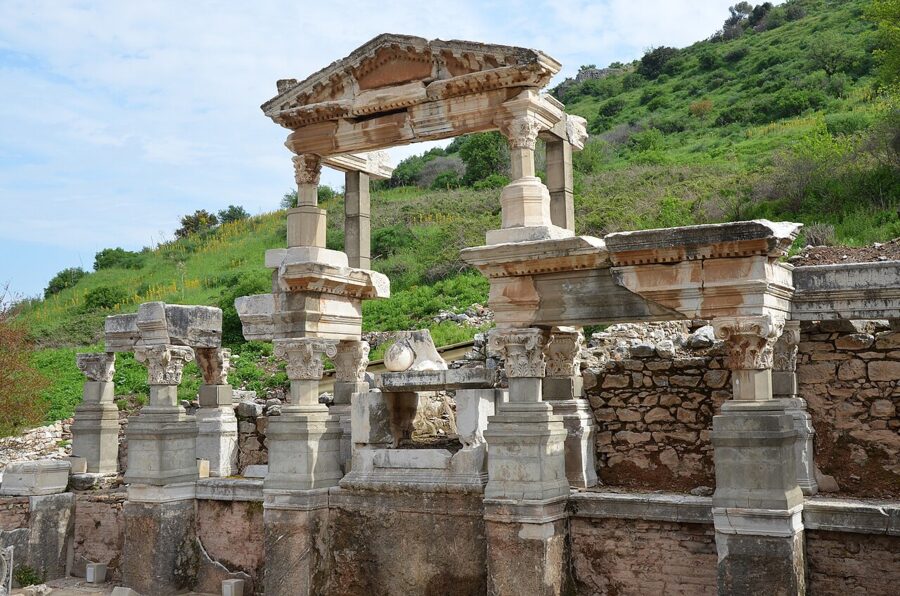
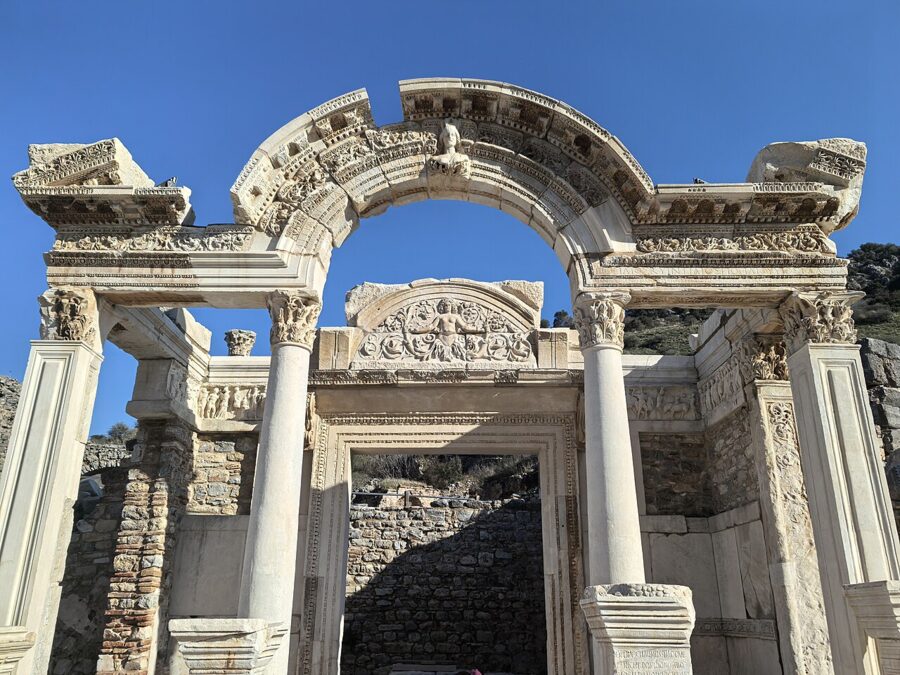
Halfway down stands the Fountain of Trajan, put up around 104 AD with a statue of the emperor above a basin that once filled the whole front. Further down, on the north side of the street, is the Temple of Hadrian, small and beautifully carved, dedicated before 138 by a local notable, Publius Quintilius Valens Varius. Tyche, the city’s goddess of fortune, looks down from the arch; the friezes inside the porch are casts, and the originals are in the Ephesus Museum in Selçuk.


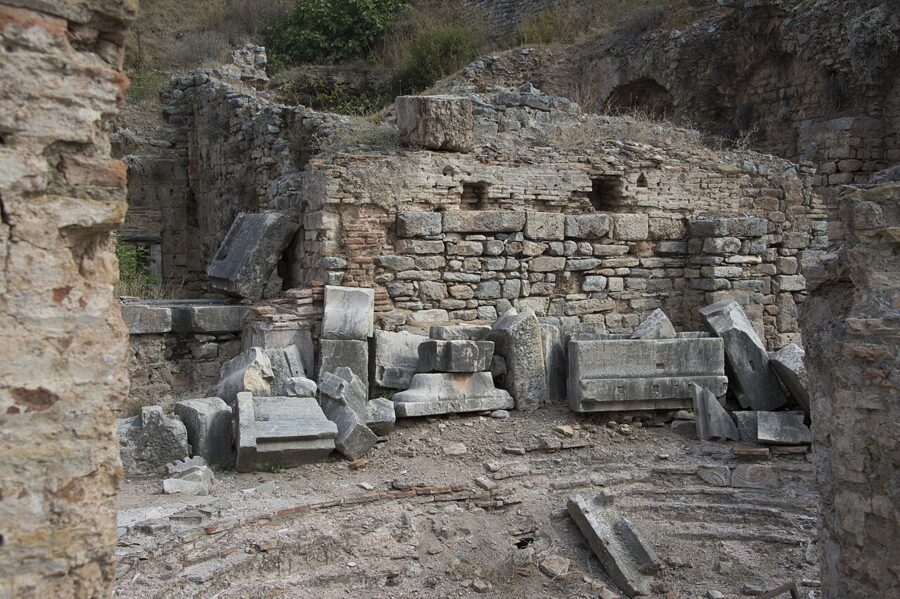
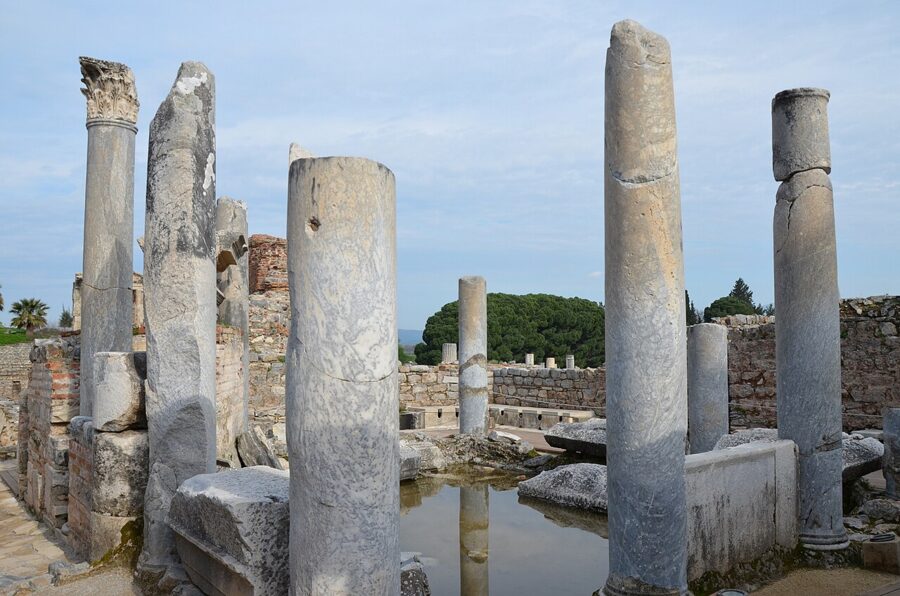
Behind the temple are the Baths of Scholastica and, beside them, the public latrines: a long marble bench with a row of keyhole seats over a channel of running water, and a second, shallow channel at your feet. It was a social room, and from the bench you could talk to the man next to you. The building across the street that guides call the brothel is an identification based on very little, so treat the stories you hear there as stories.



The Terrace Houses
Across Curetes Street from the Temple of Hadrian, a modern roof covers Terrace House 2, a block of houses climbing the slope of Bülbüldağı. Wealthy Ephesians lived here from the first century AD until earthquakes brought the houses down in the third, and the collapse preserved what normally vanishes: wall paintings, mosaic floors, marble wall panelling, the plumbing and the heating under the floors. Walkways and stairs take you above and through the rooms, so you look down into dining halls and courtyards rather than at foundations.
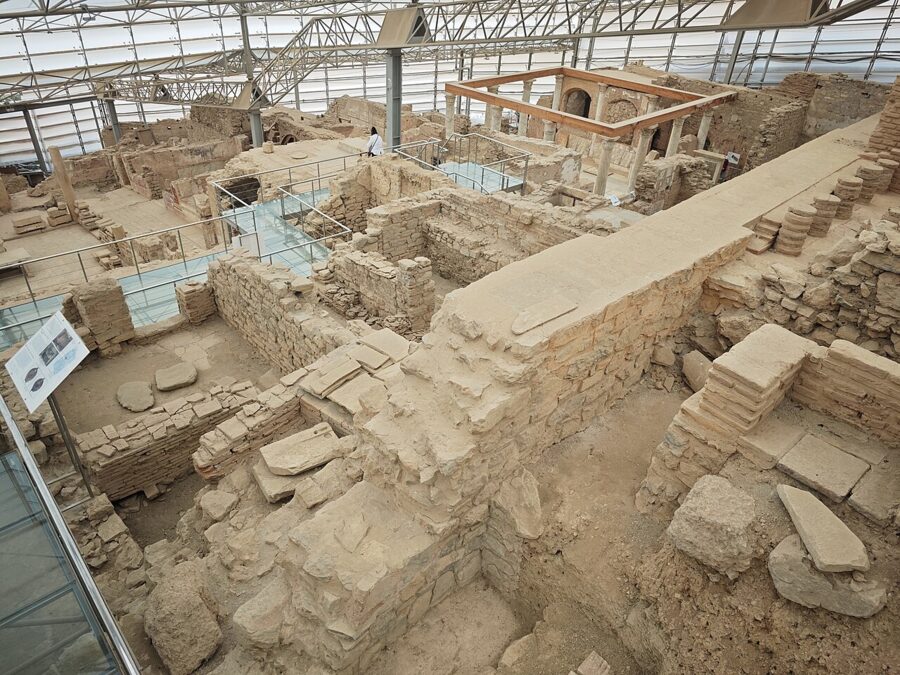

The Terrace Houses need their own €15 ticket from the booth at the entrance, and neither MuseumPass covers them. Pay it. Everywhere else in Ephesus you look at public buildings and imagine the people; here you are in their dining rooms, with the painted walls still around you.
In one of the houses restorers spent years fitting the marble wall panelling back together from thousands of broken pieces, and the reassembled slabs are back on the walls. The route is all steps and walkways, so it is not accessible to wheelchairs.
The Library of Celsus
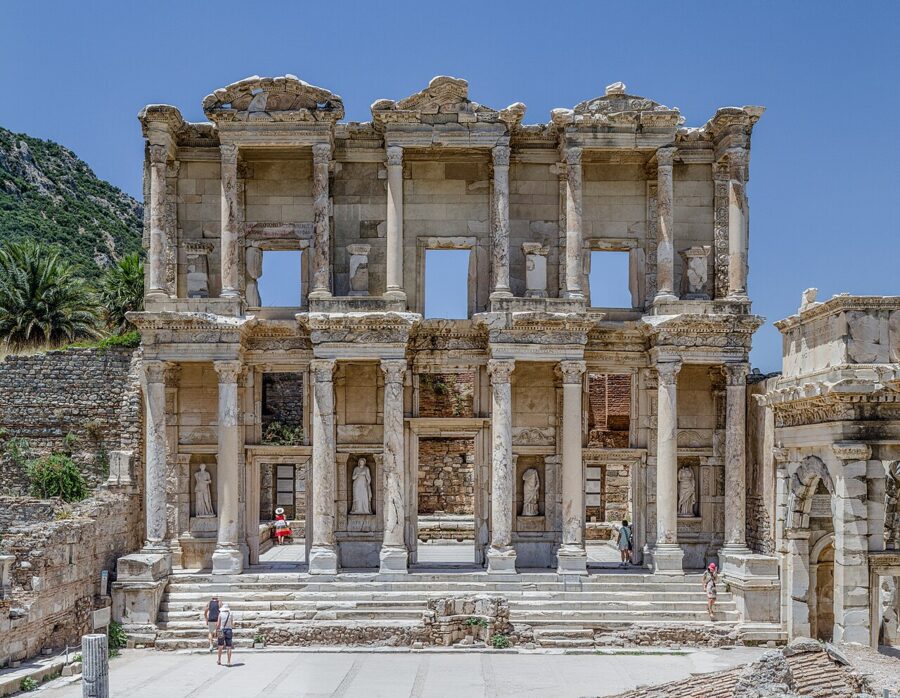
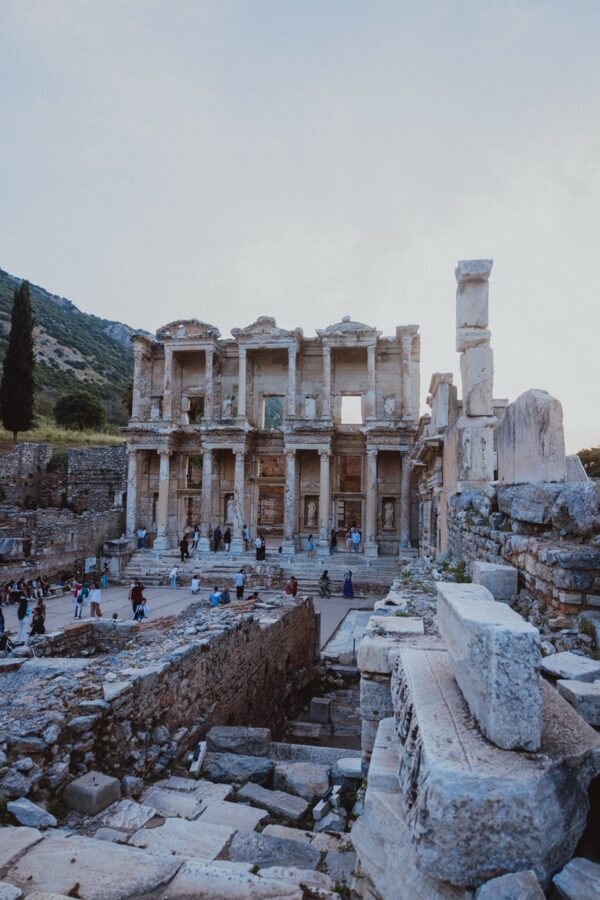
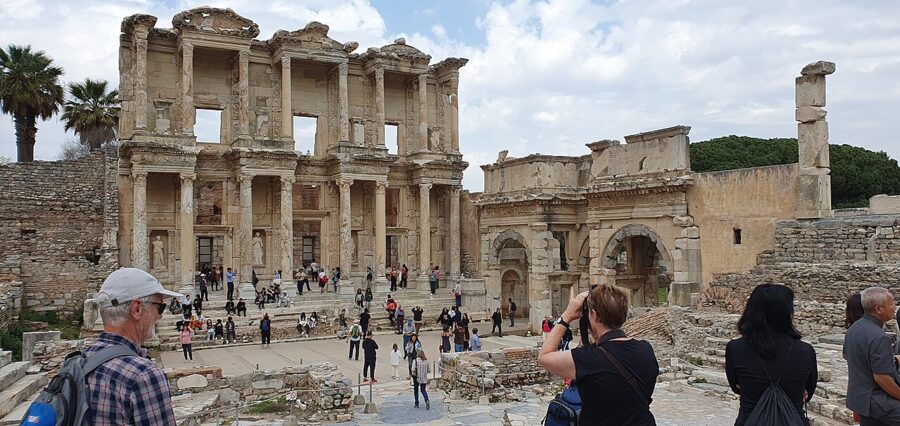
At the foot of Curetes Street stands the building on every poster. Tiberius Julius Celsus Polemaeanus was governor of the province of Asia around 105–107 AD; after his death his son Aquila, a consul in Rome, built this library as a monument to him, and Celsus was buried in a sarcophagus in a chamber under the floor. Sources put its completion anywhere from the 110s to the 130s. The collection is usually estimated at around 12,000 scrolls, a modern guess rather than a recorded number.
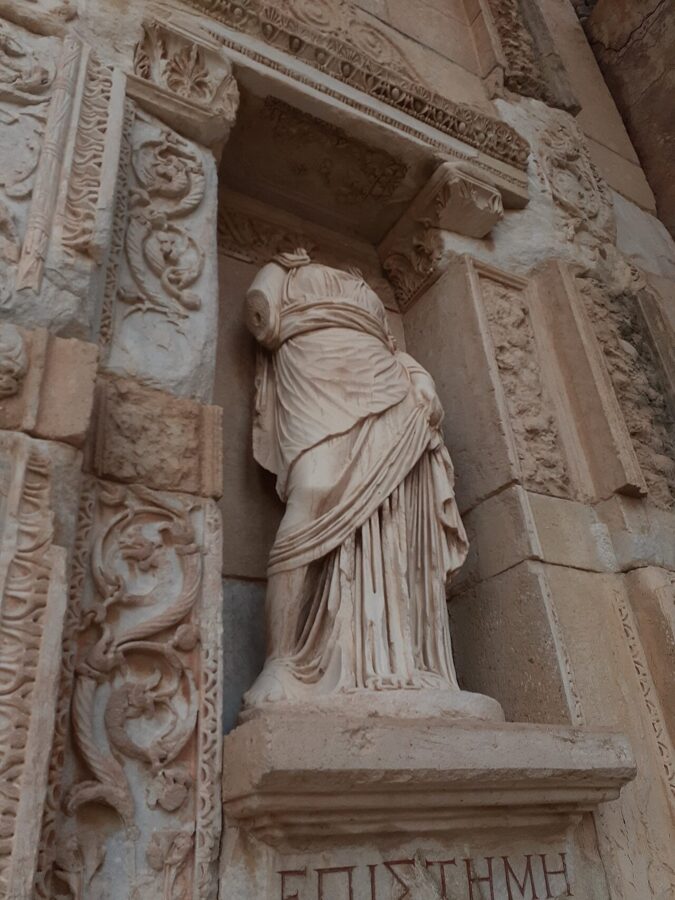
What you see is a reconstruction. The facade fell in an earthquake, and Austrian archaeologists stood it back up from its own fallen pieces between 1970 and 1978. The four women in the niches are Wisdom, Virtue, Thought and Knowledge (Sophia, Arete, Ennoia and Episteme); the ones on the building are casts, and the originals are in the Ephesos Museum in Vienna.

To the right of the library, the triple arch is the Gate of Mazaeus and Mithridates, built in 4–3 BC by two freed slaves of the emperor Augustus as a thank-you to their former owner. It leads into the Commercial Agora, the city’s great market square.

Marble Street, the Great Theatre and Harbor Street
From the library square, Marble Street runs north beside the Commercial Agora, a market about 110 m on each side, ringed by shops. Paul worked as a tentmaker during his stay, and if he had a stall in Ephesus it was most likely in a market like this one. Look for the carved footprint in the paving that guides like to call an advertisement for the brothel; it is another story to take with a smile.
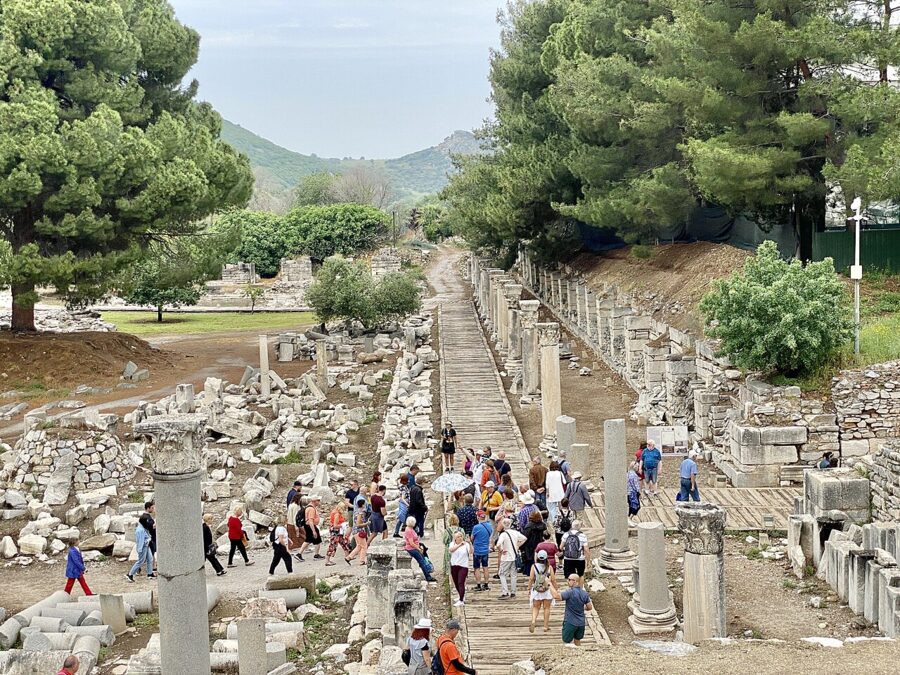

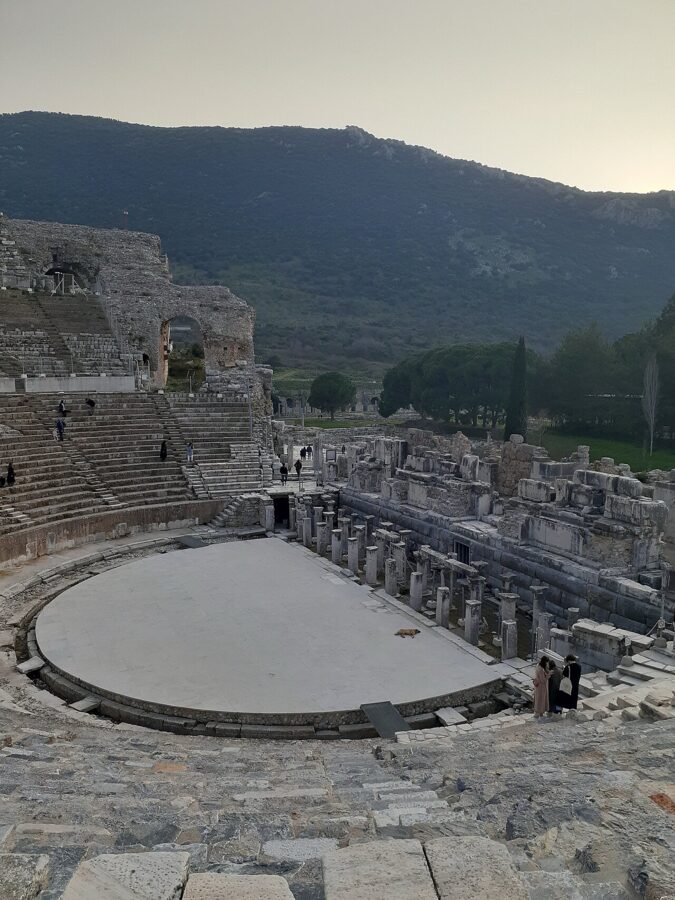
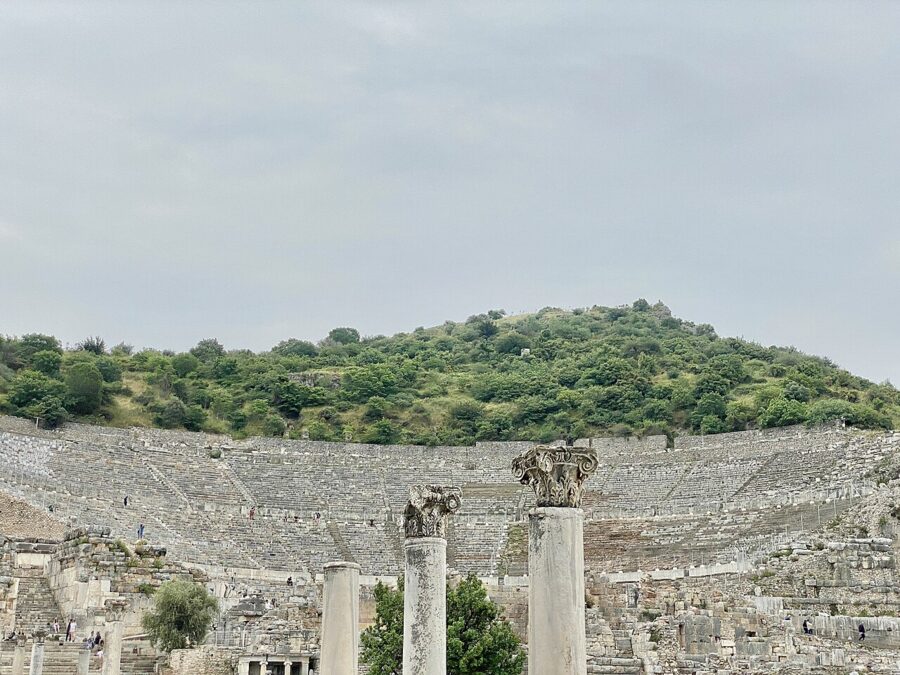
The Great Theatre is cut into the slope of Mount Pion and held about 24,000 people. It was begun in the Hellenistic period, enlarged by the Romans and later adapted for gladiator and animal fights. This is where the silversmiths’ crowd shouted “Great is Artemis of the Ephesians” for two hours, according to Acts, until the town clerk talked them down. Climb to the upper rows: you get the best view of the city, and the scale of the harbor plain below.

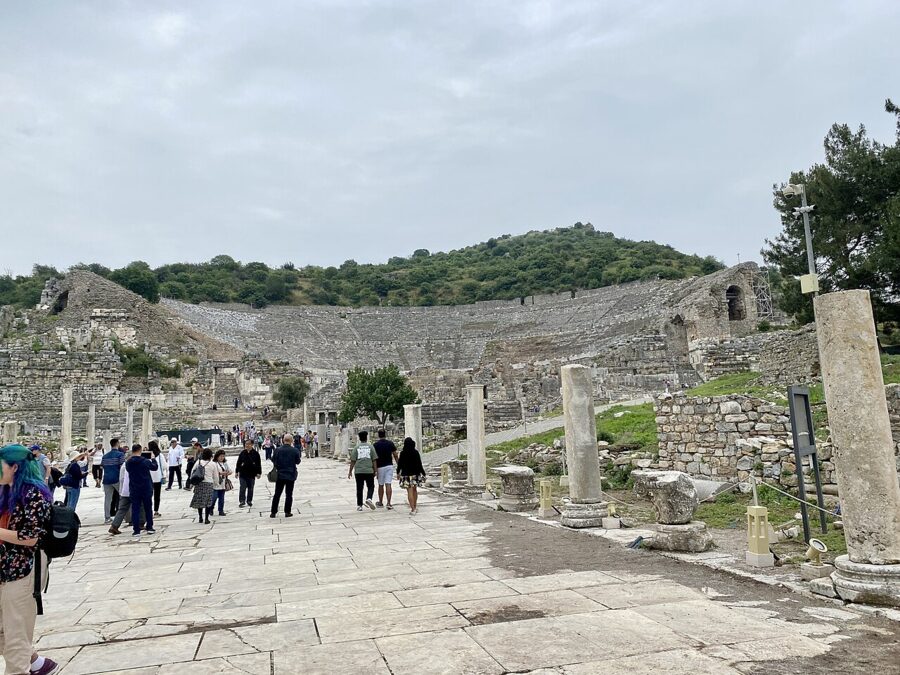
From the theater, Harbor Street runs about 500 m west toward where the harbor was. It was rebuilt and renamed the Arcadiane after the emperor Arcadius, who ruled from 395 to 408, and it was colonnaded and lined with shops. Parts of it have been fenced for restoration: in May 2026 the excavation team said it aimed to finish work on Harbor Street and Stadium Street by the end of the year, and to open a new visitor route through them.

North of Harbor Street, a short detour most groups skip leads to the Church of Mary, a long ruined basilica built into an older Roman hall. The Council of Ephesus met here in 431 and declared Mary the Theotokos, the Mother of God, which is why this quiet field of walls matters to so many pilgrims.
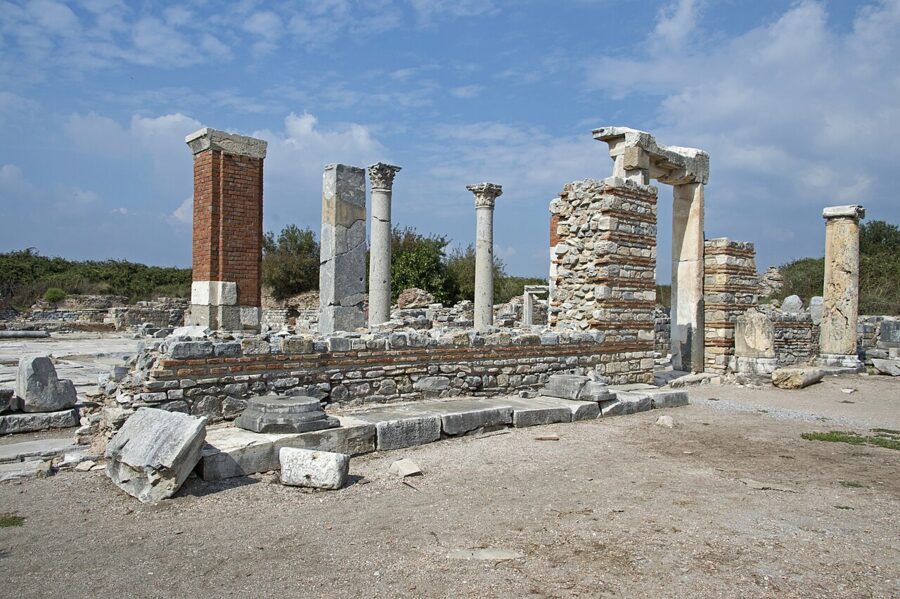

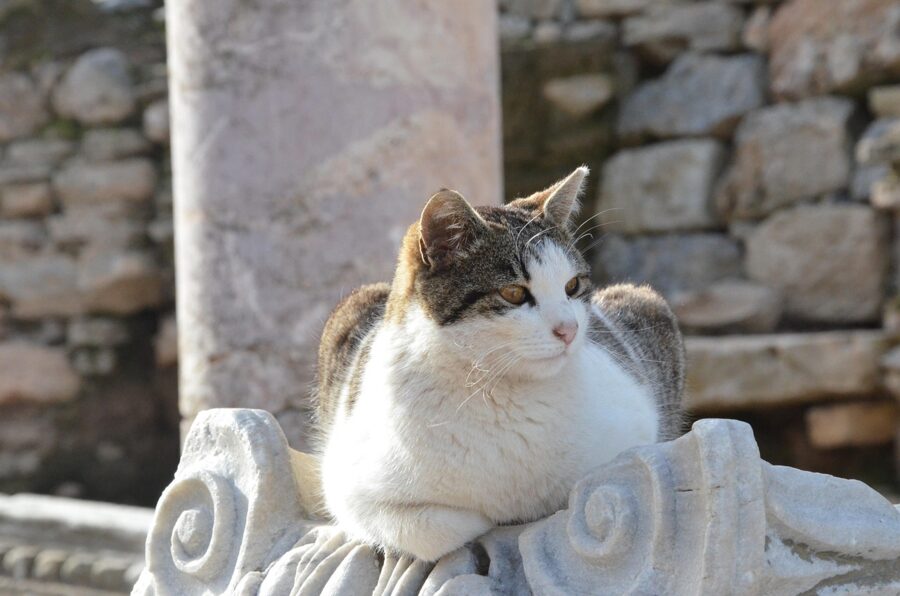
You will not be alone at any point, because Ephesus has a resident population of cats. They sleep on the warm marble, take shelter in the shade of the column drums, and are fed by the staff and by half the people walking past.
Selçuk: the town that took over
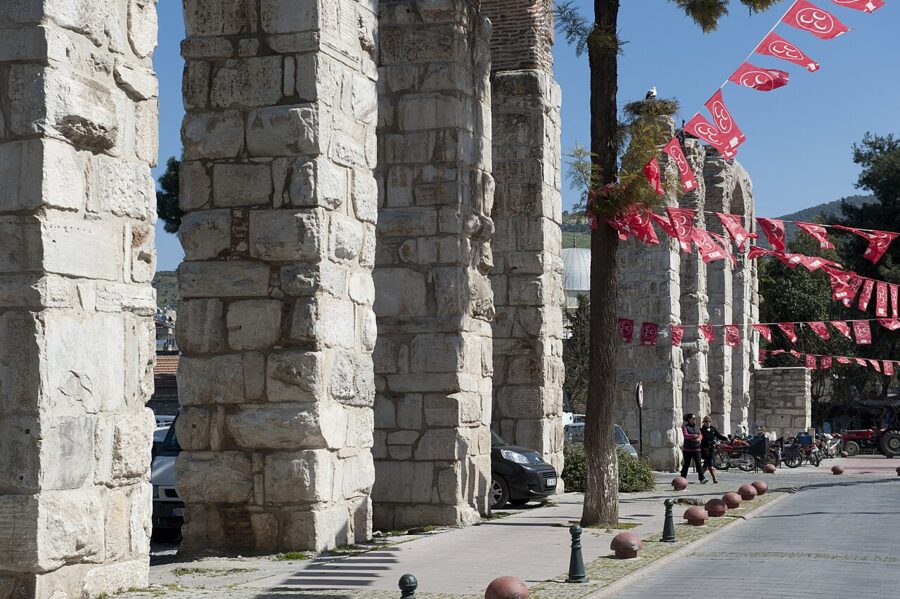
Selçuk is where Ephesus went when the harbor died, and it is worth more than a bed. Ayasuluk Hill above the town carries the Basilica of St. John and a castle; at its foot are the İsa Bey Mosque and the Ephesus Museum, and out on the plain stands the last column of the Temple of Artemis. A Byzantine aqueduct runs through the middle of town, and in spring and summer storks nest on its piers.

The Ephesus Museum
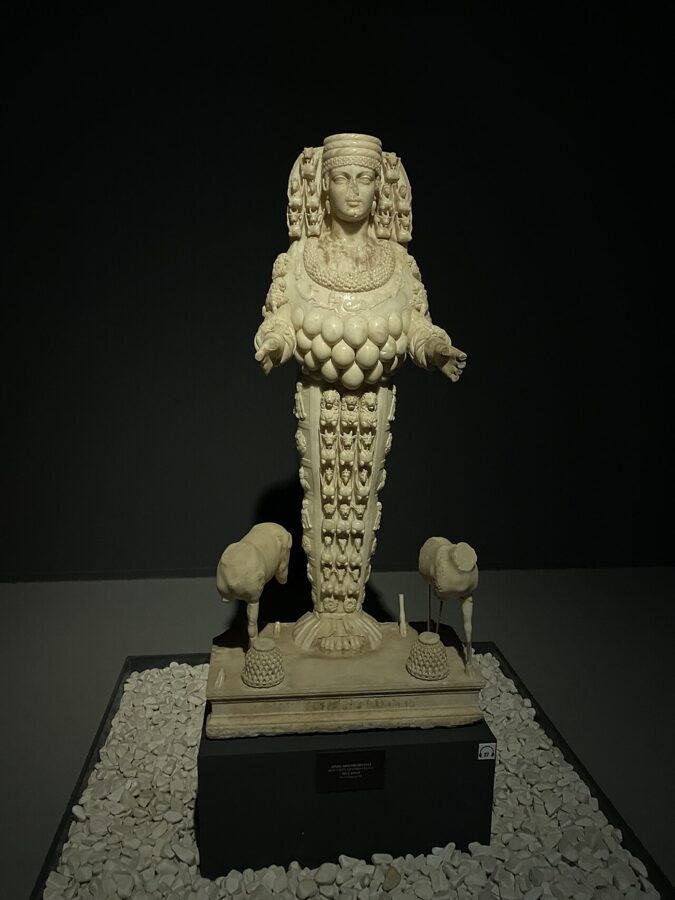
The Ephesus Museum, near the otogar in the center of town, is where the best statues from the site ended up (apart from those in Vienna and London). The two big statues of Artemis found in the Prytaneion are here, with the rows of egg-shaped forms on the chest that scholars have argued over for a century: breasts, bull’s testicles or amber beads, depending on the book. There is a room of finds from the Terrace Houses, the originals of the Hadrian’s Temple friezes, and a hall on the gladiators of Ephesus, whose graveyard was excavated in the 1990s.

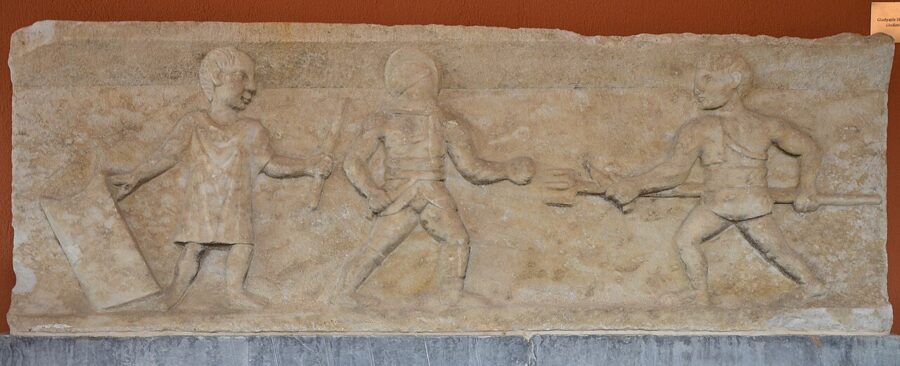

The museum takes about an hour, costs €10 and is best visited after the ruins rather than before, when the names on the labels will mean something. In winter it opens 08:30–17:30, with the ticket office closing at 17:00.
The Temple of Artemis
Of one of the Seven Wonders, one column stands, and it was put back together from fragments. The temple had about 127 columns, according to the Roman writer Pliny, and was destroyed in stages: by fire, by Gothic raiders in the third century, and then by centuries of stone robbers. Its marble went into later buildings around Selçuk. The site was lost so completely that the English engineer John Turtle Wood searched for six years before finding it in 1869, and much of what he dug up is in the British Museum.
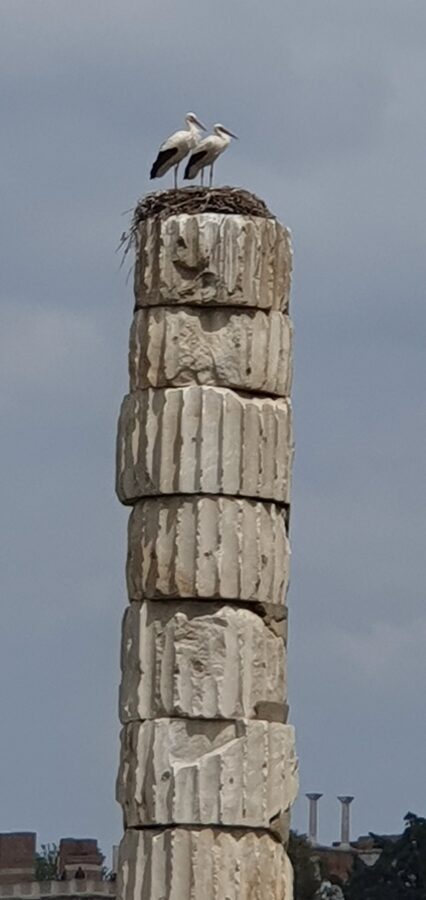

The site is free and sits beside the road between Selçuk and the lower gate of Ephesus, so you pass it if you walk. Ten minutes is enough. The best thing about it is the view back toward town, with three religions stacked up the slope behind the column.
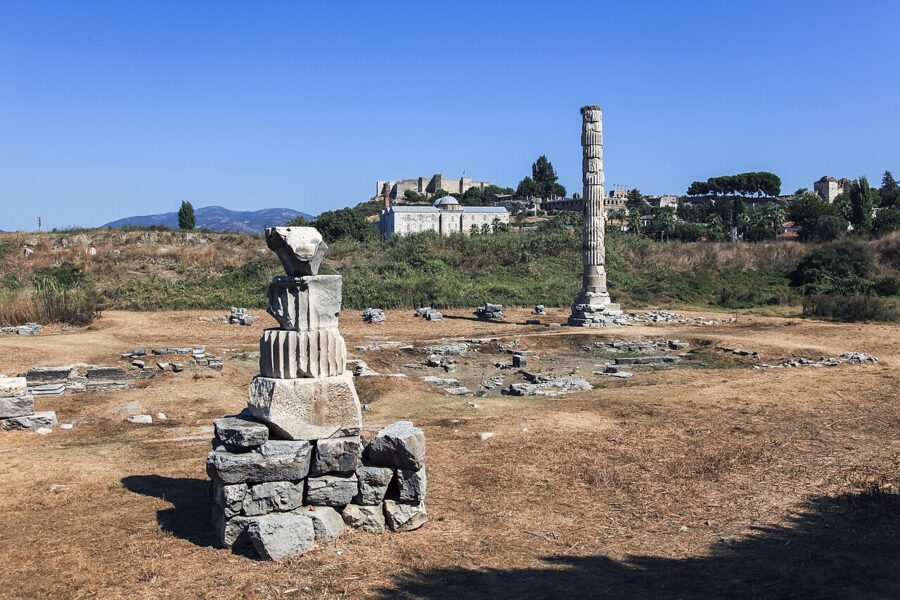

Ayasuluk Hill: the Basilica of St. John and the castle
Tradition says John the Apostle was buried on this hill, and in the sixth century the emperor Justinian and his wife Theodora replaced an earlier church over the grave with a huge cross-shaped basilica, roofed with six domes. Earthquakes and stone robbers have reduced it to walls, columns and floors, but the scale is still clear, and the tomb is marked in the middle of the nave. Enter through the Gate of Persecution at the bottom of the hill.
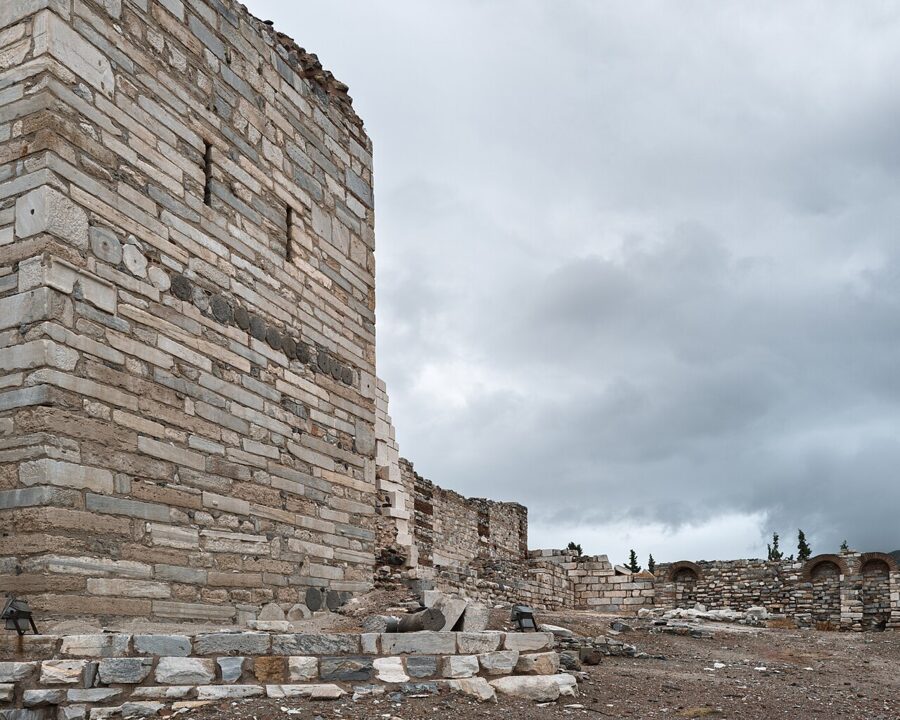

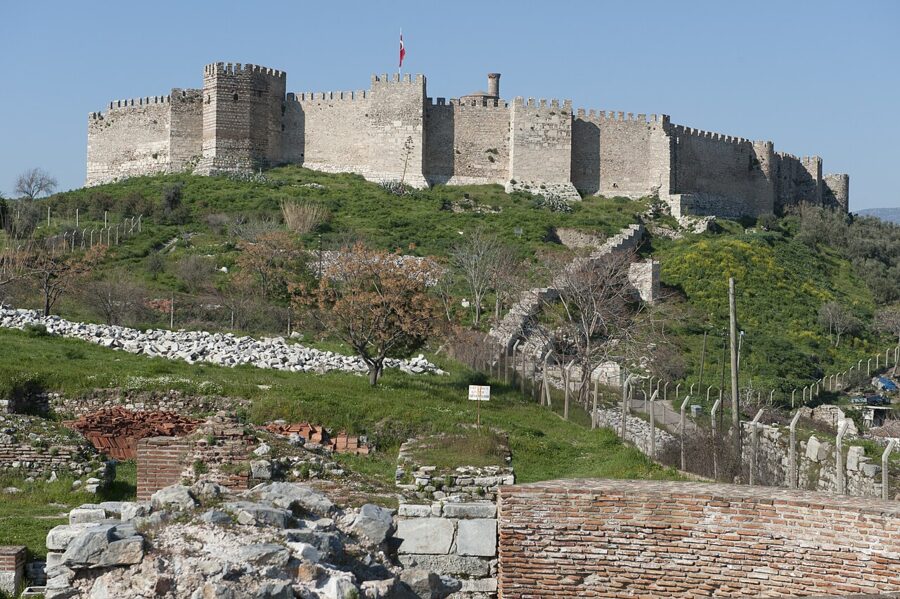
The same €6 ticket covers the castle at the top of the hill, whose walls date from the Byzantine, Seljuk and Ottoman periods. In winter the basilica opens 08:30–17:30 and the castle 09:00–16:00, so do the castle first if you arrive in the afternoon. It is the quietest of the Selçuk sites and has the best view in town, across the rooftops and the plain toward Ephesus.

The İsa Bey Mosque
At the foot of the hill stands the İsa Bey Mosque, built in 1374–1375 for İsa Bey of the Aydınid dynasty. Its inscription names the architect as Ali, son of Mushimish, of Damascus, and the plan, with its courtyard and the prayer hall set along the long side, looks back to the great mosque of Damascus. The builders reused Roman columns and marble, very likely from Ephesus and the Artemision. The Directorate of Foundations, which owns the building, restored it from 2023 and announced its reopening for the first Ramadan prayers on 28 February 2025.
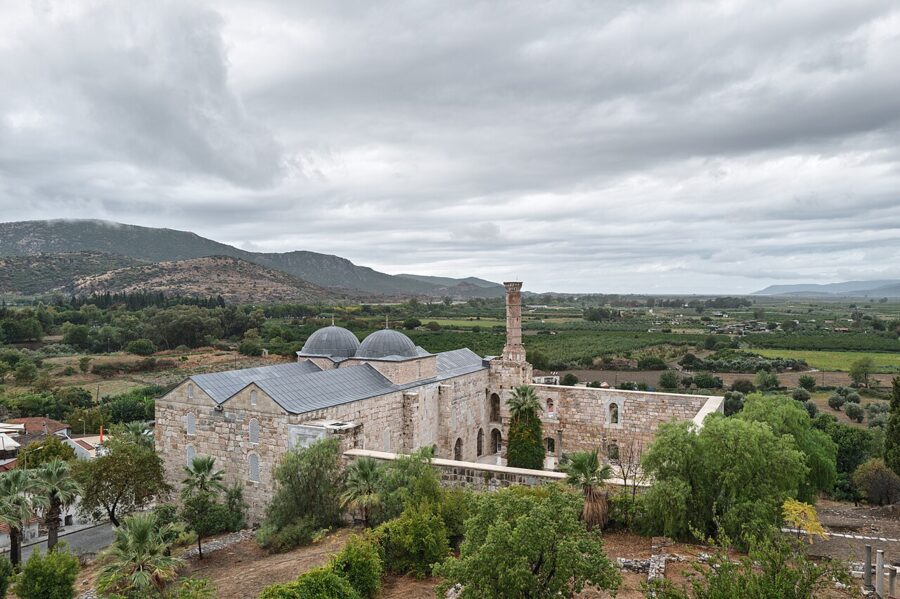

Like any working mosque, it is closed to visitors during the five daily prayers and for longer around the Friday noon prayer. Cover shoulders and knees, women should bring a scarf for their hair, and take your shoes off at the door.
The Saturday market
On Saturdays the streets behind the otogar turn into Selçuk’s weekly market, still going strong in 2026. Farmers from the villages around sell olives, olive oil soap, honey, dried figs and whatever is in season, alongside clothes and housewares. Stalls go up the night before and early in the morning, and roads in the center close while they do, so if you are leaving by bus on a Saturday morning, allow extra time to reach the otogar.
Cheap beds
Most of Selçuk’s budget beds are in the quiet streets of the Atatürk quarter, on the slope behind the museum, a short walk from both the station and the otogar. In late November 2026 the booking sites listed dorm beds in Selçuk from about €13 to €23 and private rooms in family pensions from about €10. Boomerang Guesthouse in the Atatürk quarter has dorms and private rooms, with meals served in its garden restaurant, and was taking guests through autumn 2026.
Pensions here are family affairs, and the good ones will tell you the dolmuş times, call you a taxi to the upper gate and keep your bag after checkout. Ask about breakfast and about the price of a taxi before you need one.
Two half-days: Meryemana and Şirince
The House of the Virgin Mary (Meryemana)
On Bülbüldağı, the mountain above the upper gate, a small stone chapel in the pine woods is venerated as the last home of the Virgin Mary. The identification goes back to the visions of Anne Catherine Emmerich, a German nun who died in 1824 and never left Germany. After her description was published, Lazarist priests from İzmir went looking in 1891 and found the ruins of a chapel on the mountain that matched it. The Catholic Church has never ruled on whether Mary lived here, but three popes have prayed here (Paul VI in 1967, John Paul II in 1979 and Benedict XVI in 2006), and Muslims come too, to Meryem Ana, Mother Mary.
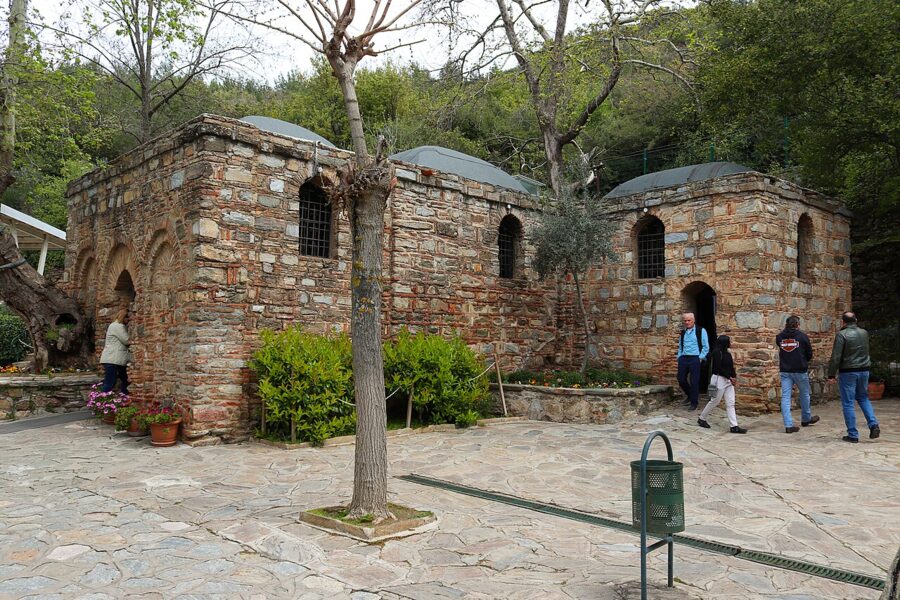

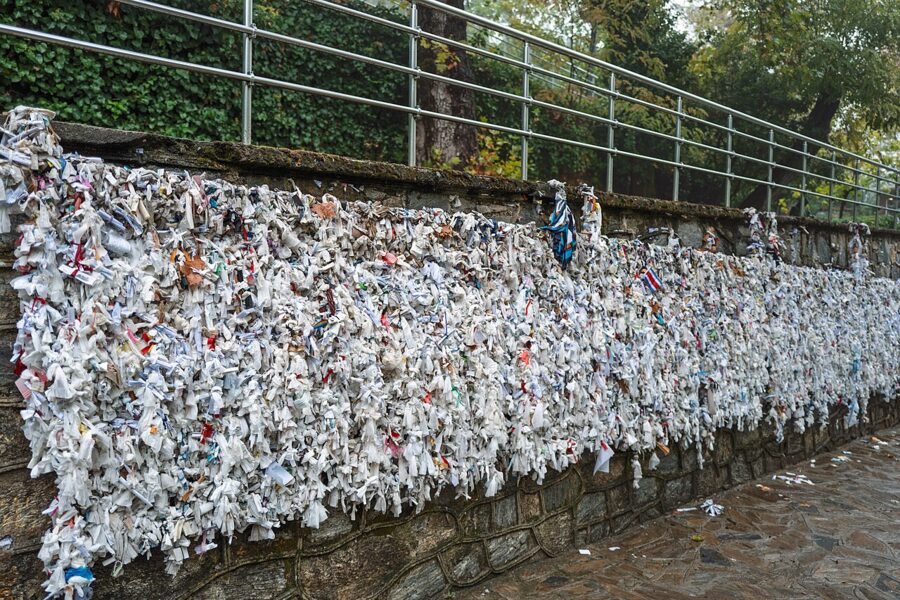
Below the house, pilgrims drink from the spring taps and tie written wishes to a long wall. There is no public transport up the mountain, about 9 km by road from Selçuk. The practical move is a taxi from Selçuk to Meryemana, with the driver waiting, then on down to the upper gate of Ephesus to start the walk. Agree the whole route and the waiting time before you get in.

The site is not run by the Ministry, and its ticket is sold in lira and covered by no pass. Listings in 2026 gave prices between about 500 TL and 700 TL, so check at the gate. It opens in daylight hours and closes earlier in winter.
Şirince
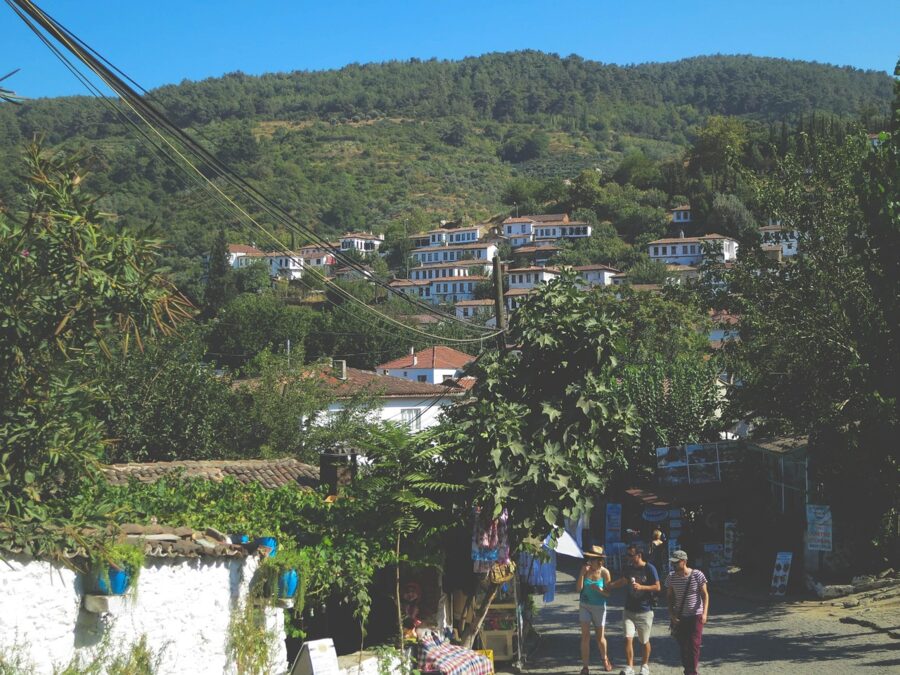
Şirince sits in the hills about 8 km east of Selçuk, a village of whitewashed houses on terraced slopes that was home to a Greek community until the population exchange of 1923. Turks from Greece moved into the houses the Greek families had left and took over their vineyards and orchards. The story goes that the old name meant something close to “ugly”, and that the new name, Şirince, chosen in 1926, means “pleasant”.
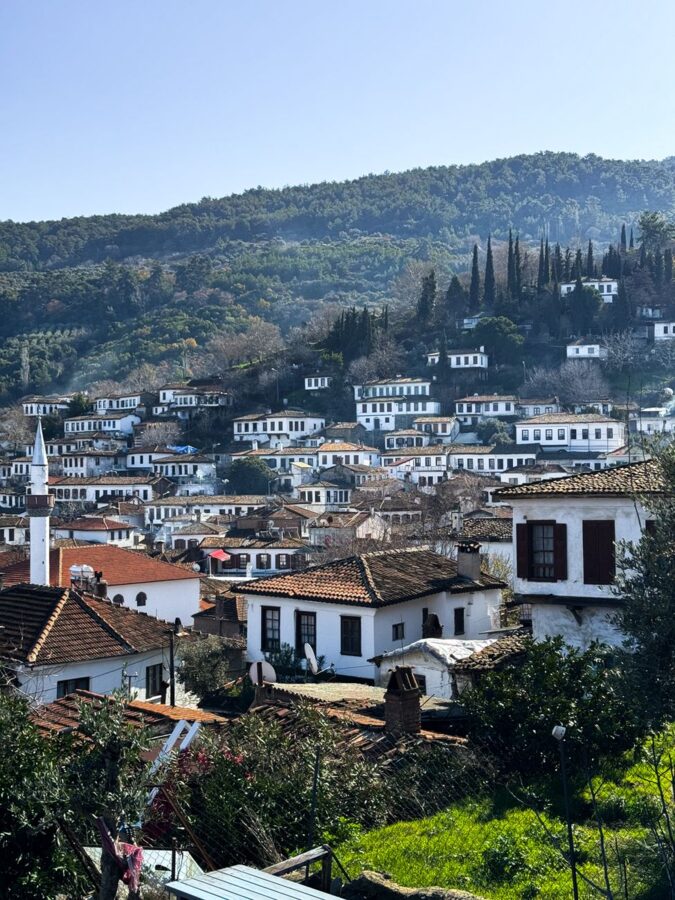
Today Şirince lives on tourism and fruit wine, sold by the glass and the bottle in tasting shops on the main lane. Come on a weekday: at weekends Turkish day-trippers fill it and the lanes jam. Dolmuşes leave from Selçuk otogar every 15–20 minutes in season, and a ride cost 50 TL in mid-2026.
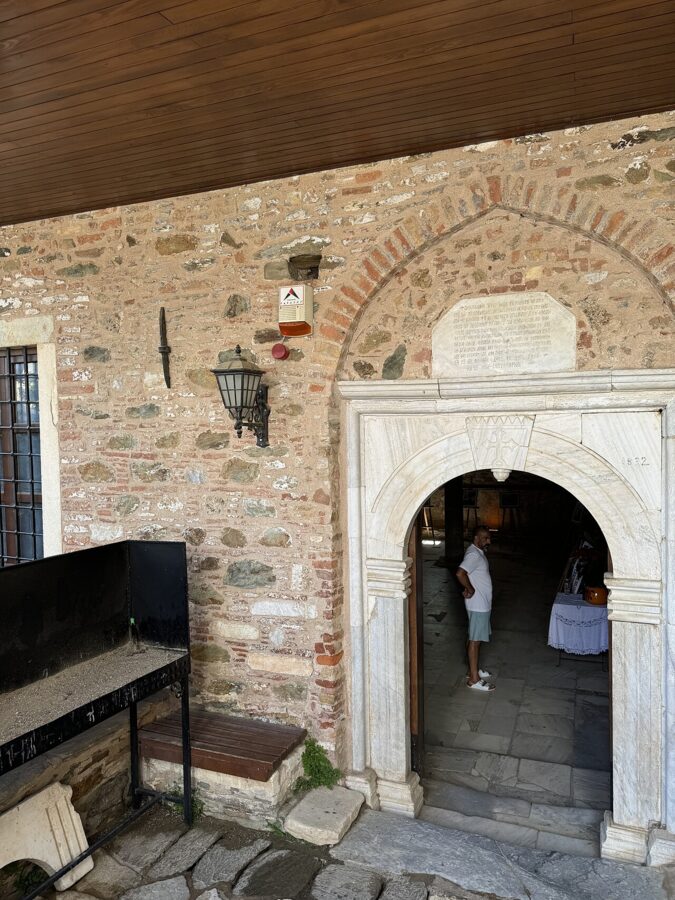
Half a day is plenty; climb to the restored church of St. John the Baptist at the top of the village and walk back down through the back lanes.

Onward: Pamukkale and the coast
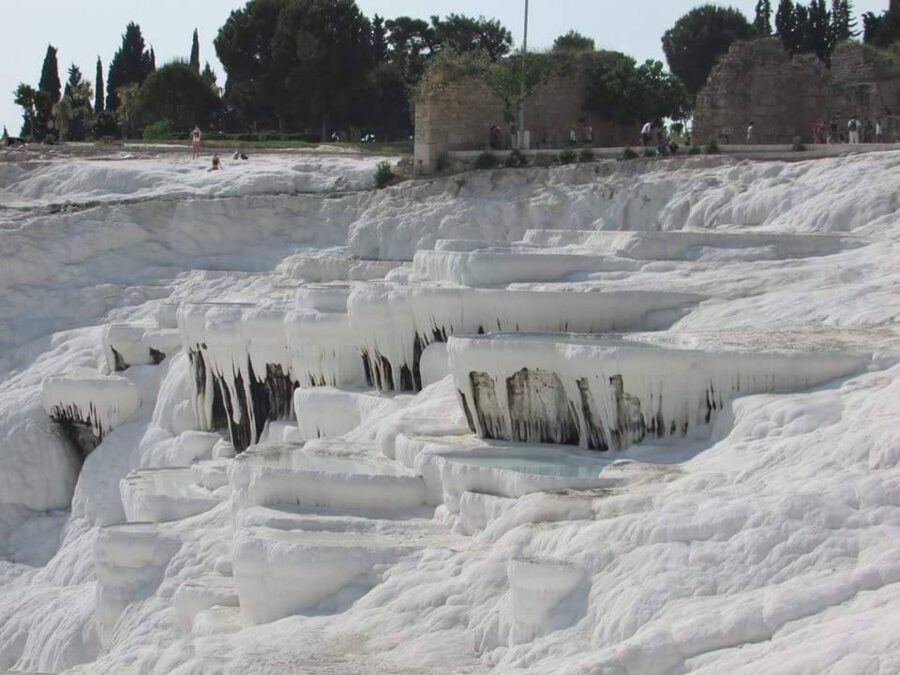
Most people go on from Selçuk to Pamukkale, the white travertine terraces above the ruins of Hierapolis. In November 2026 about six buses a day ran from Selçuk to Denizli (2.5–3.25 hours, 600–800 TL), and regional trains from Selçuk station to Denizli ran about eight times a day, with fares from about 265 TL. From Denizli otogar, minibuses climb the last 20 km to Pamukkale village, and the combined ticket for the terraces and Hierapolis was €30. Spend the night there, then carry on to the coast at Fethiye; the Turkey itinerary has the times and fares for every leg.
And for Ephesus itself: sleep in Selçuk, take the taxi to the upper gate for 08:00, and walk down while the coaches are still on the road from the coast. By the time the crowds reach the library, you should be inside the Terrace Houses, a step ahead of them all the way down.