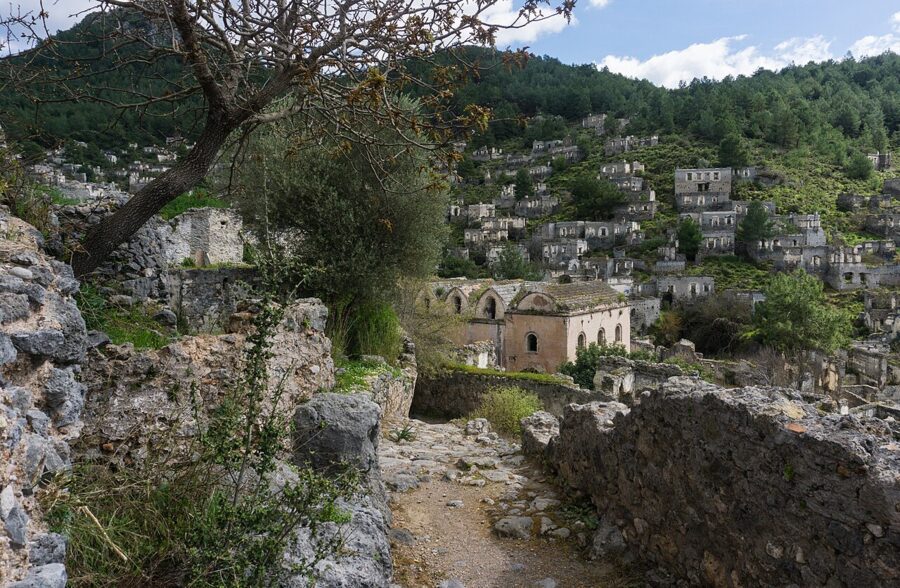
Three euros gets you into Kayaköy, a hillside of roofless stone houses that has stood empty since its Greek Orthodox families were sent away in 1923. A tandem paragliding flight off Babadağ, the mountain behind the next bay, costs fifty or sixty times as much. Fethiye sits between those two prices, and most of what makes it worth a few days sits at the cheap end.

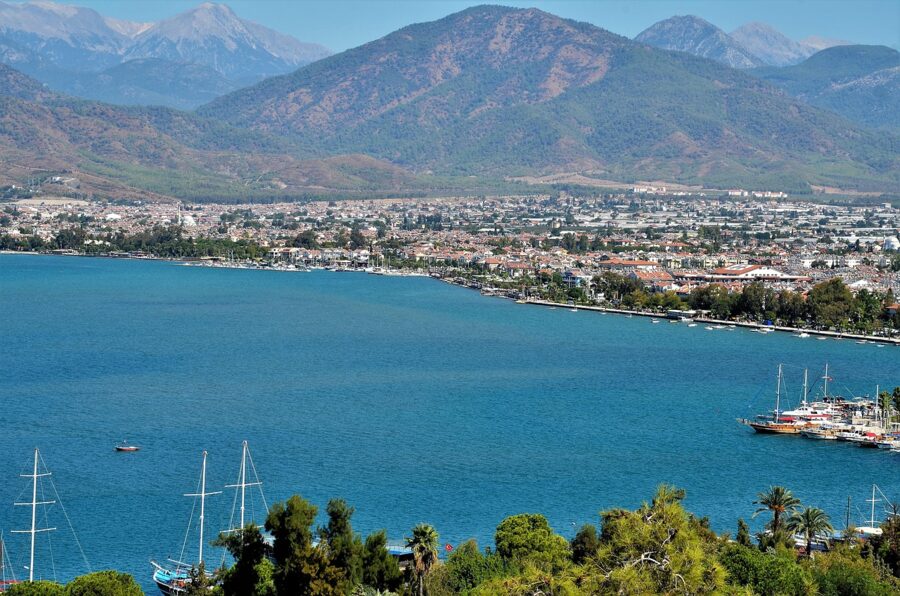
Fethiye itself is a working harbor town, the center of a district of about 187,000 people, on a deep bay in the far southwest of Turkey, where the Aegean turns into the Mediterranean. It is not a beach resort. The beaches are a dolmuş ride away at Çalış and Ölüdeniz, and the town is where you sleep cheaply, eat at the fish market and catch the minibuses out to gorges, ghost villages and Lycian cities.
Three to five days covers it on a backpacker budget, if you base yourself in town, use the dolmuş for every day trip and save real money for one or two things that deserve it, a paragliding flight or a day on a boat. If Fethiye is one stop on a longer route, the Turkey itinerary shows where it sits in the classic loop and what the buses in and out cost.

Contents
- Three to five days in Fethiye
- Fethiye town: the harbor, the tombs and the old quarter
- Where to stay on a budget: town, Çalış or Ölüdeniz
- Ölüdeniz and the Blue Lagoon
- Kayaköy and the walk over the hill
- Saklıkent, Tlos and the Xanthos valley by dolmuş
- Boat days on the bay
- The Lycian Way: the first stages from Ovacık and Faralya
- Getting to Fethiye and away
- When to go
Three to five days in Fethiye
The sights split neatly into day-sized pieces, and every one of them is reachable by dolmuş, the shared minibuses that leave from the lanes behind the otogar and from stops in the center. A car saves time only on the Saklıkent and Xanthos days. Here is the order I’d do them in, with the cheap option first.
| Day | Plan | Getting there | Main costs (2026) |
|---|---|---|---|
| 1 | Fethiye town: the harbor, the Tomb of Amyntas, Paspatur, dinner at the fish market | On foot | Amyntas €3; fish by weight plus a cooking fee |
| 2 | Ölüdeniz: the lagoon, a boat to Butterfly Valley, or the cable car up Babadağ | Dolmuş, 25–30 minutes | Valley boat about 500 TL return; cable car 950 TL |
| 3 | Kayaköy, then walk over the hill to Ölüdeniz for a swim | Dolmuş out, dolmuş back from Ölüdeniz | Kayaköy €3 |
| 4 | Saklıkent gorge and Tlos | Dolmuş, 45–60 minutes | Saklıkent 250 TL; Tlos €3 |
| 5 | Either the Lycian Way from Ovacık to Faralya, or a 12 Islands boat day | Dolmuş to Ovacık, back from Faralya; or the harbor | Walk free; boat about €40–60 with lunch |
With three days, keep days 1 to 3 and fold the town into the evenings. With five, the order matters less than the weather: put the boat or the paragliding on the calmest day, and save Saklıkent for a hot one, because the water in the gorge is cold enough to hurt.
Fethiye town: the harbor, the tombs and the old quarter
The town lines the eastern curve of the bay. The harbor and the long seafront promenade (the Kordon) run along the water, the old quarter of Paspatur sits just behind them, and the cliff with the rock tombs rises at the southern edge. Everything below fits into one unhurried day on foot.
The harbor and the waterfront
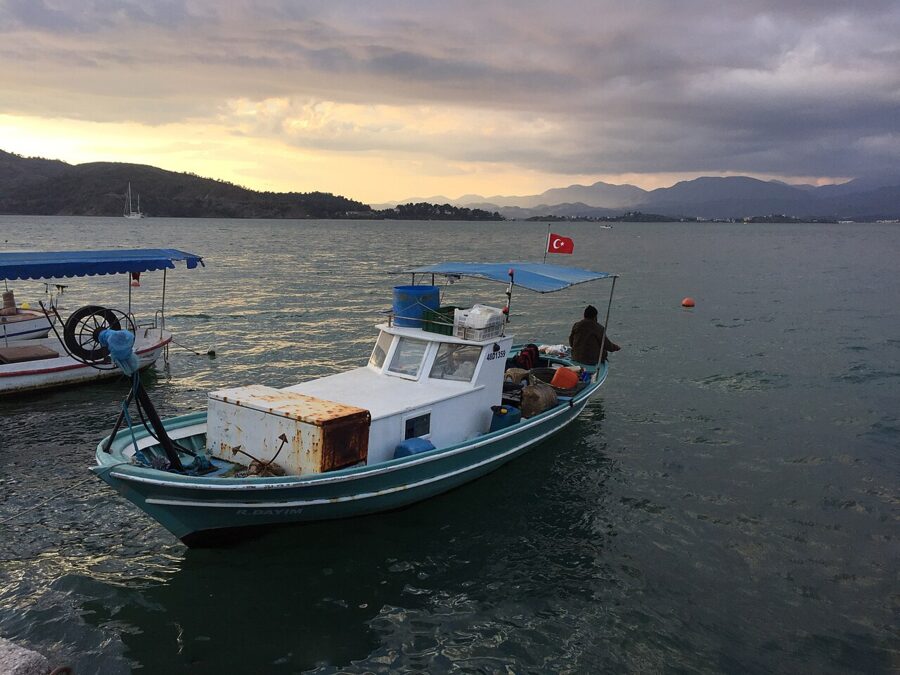
Start at the harbor in the morning, when the day boats are loading. This is where the 12 Islands trips, the gulets and the ferry to Rhodes leave from, and where the agencies along the quay sell all of them. You don’t have to buy anything to walk it, and a morning walk is the quickest way to see which boats are big party boats and which are small and quiet.

Fethiye stands on the site of Telmessos, a Lycian city on the border with Caria. It was renamed more than once: Anastasioupolis in the Byzantine centuries, then Makri, which the Turks wrote as Meğri. In 1934 it took the name Fethiye after Fethi Bey, one of the first Ottoman military pilots, who died in a crash in 1914.
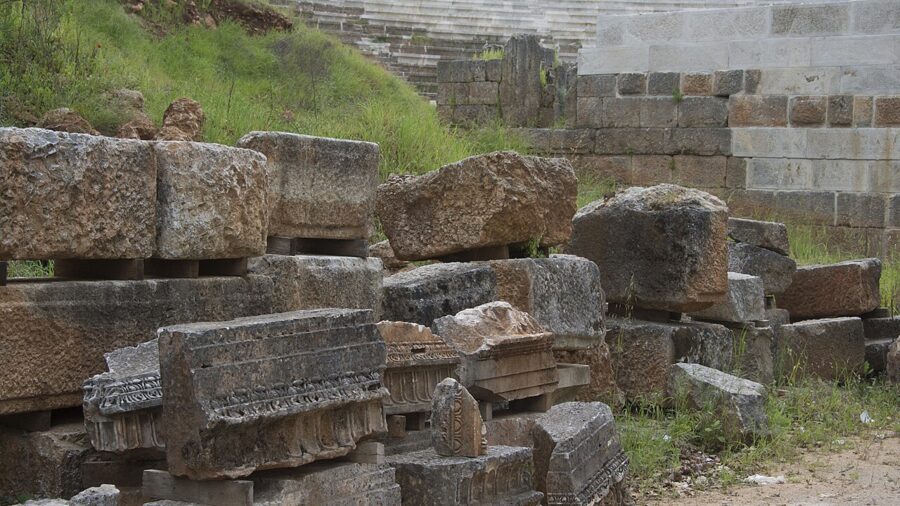
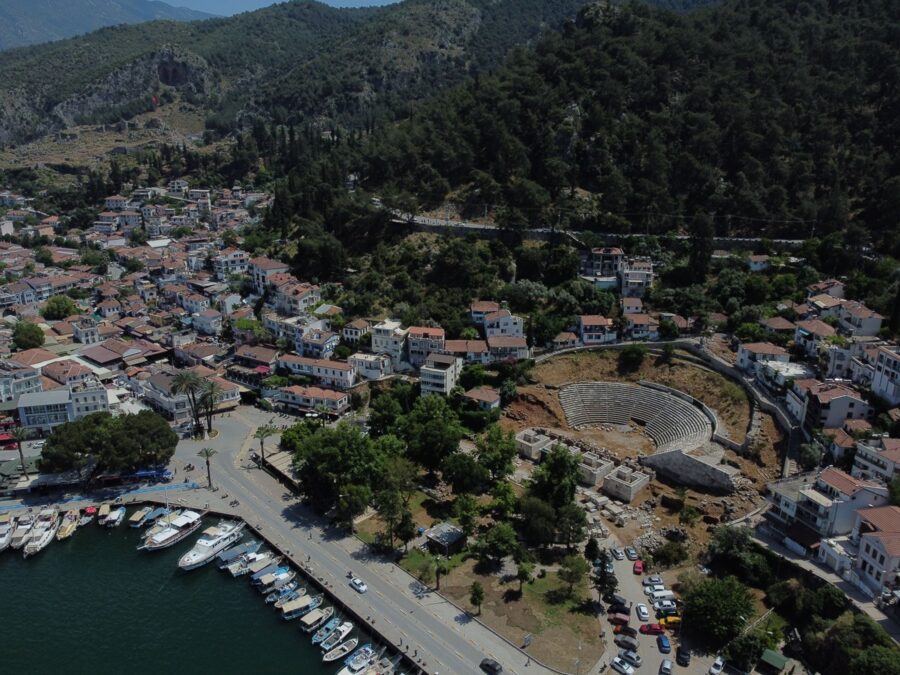
The ancient theatre of Telmessos sits by the main road just behind the harbor, a short walk from the quay. A sign on site dated it to the late Hellenistic period, with the stage added around 200 AD. It spent years as a restoration site behind fencing, so see what state it is in as you pass; it is free to look at from the street either way.

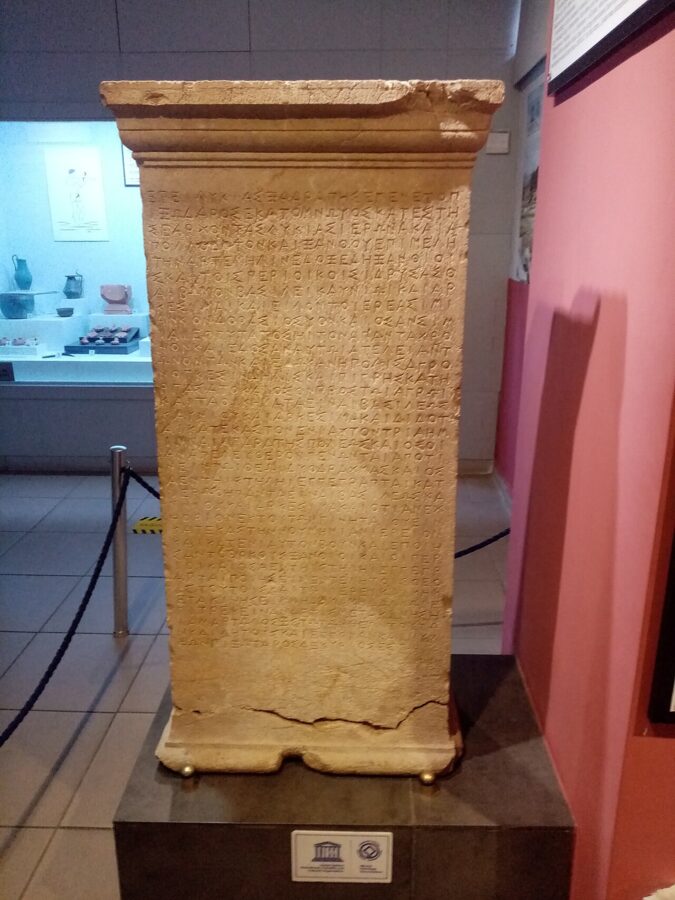
The town museum, which holds the best finds from the region, is listed by the Ministry of Culture as closed, and Turkish press reports put the closure back to 2023. Its star piece is the trilingual stele from Letoon, dated 338 BC, with the same decree in Lycian, Aramaic and Greek; it did for Lycian roughly what the Rosetta Stone did for Egyptian. Check the Ministry’s site before you walk over in case it has reopened.

The Tomb of Amyntas and the rock tombs
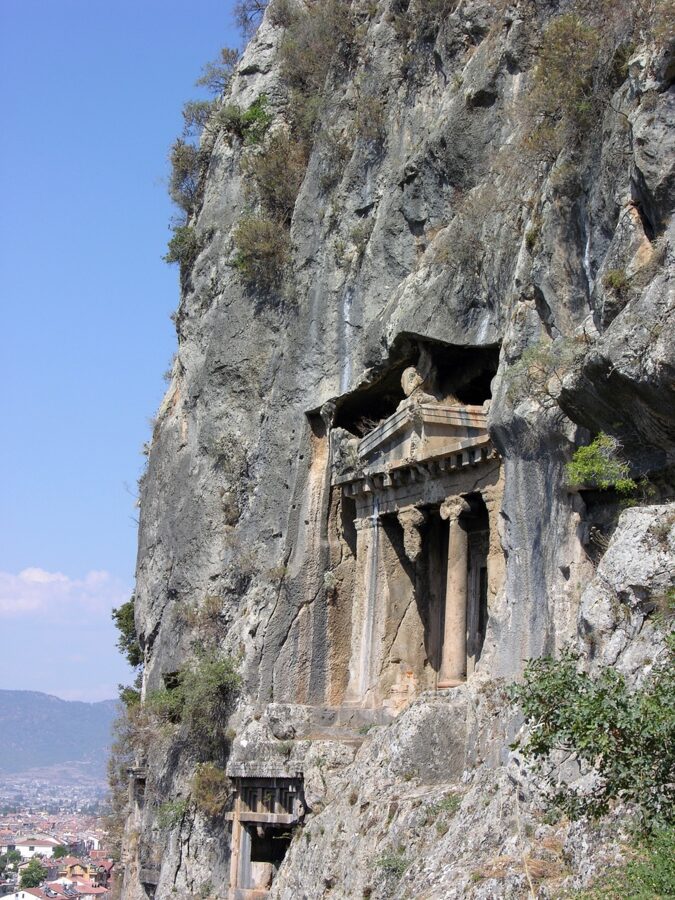
Look south from almost anywhere in town and you will see temple fronts cut into the cliff. The largest is the Tomb of Amyntas, carved in the 4th century BC and named for the inscription on it: “Amyntas, son of Hermapias.” It copies a small Ionic temple, with two columns between the side walls and a stone door carved into four panels, as if the masons were imitating wood and metal in rock.
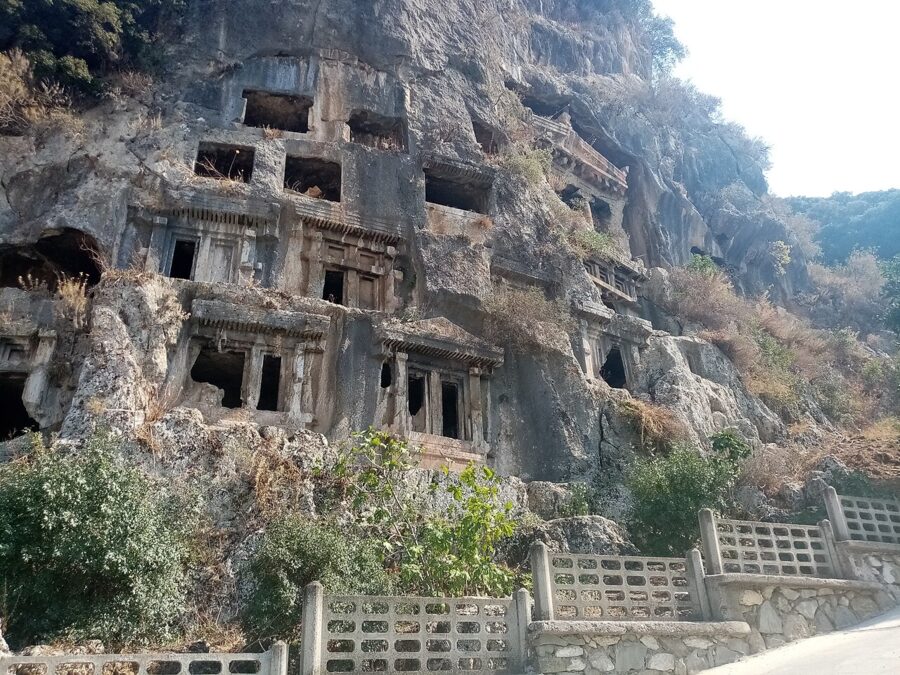

The tomb is in the Kesikkapı neighborhood on the southern edge of town, and the last part of the walk is a climb up steps, hard work at midday in summer. The Ministry lists it at €3, open daily 08:30–17:30. Look for the name carved in the upper left of the facade: it is the French traveler Charles Texier, who drew the tomb in the 19th century and signed it as proof he had been there, the oldest graffiti you will be annoyed by all week.
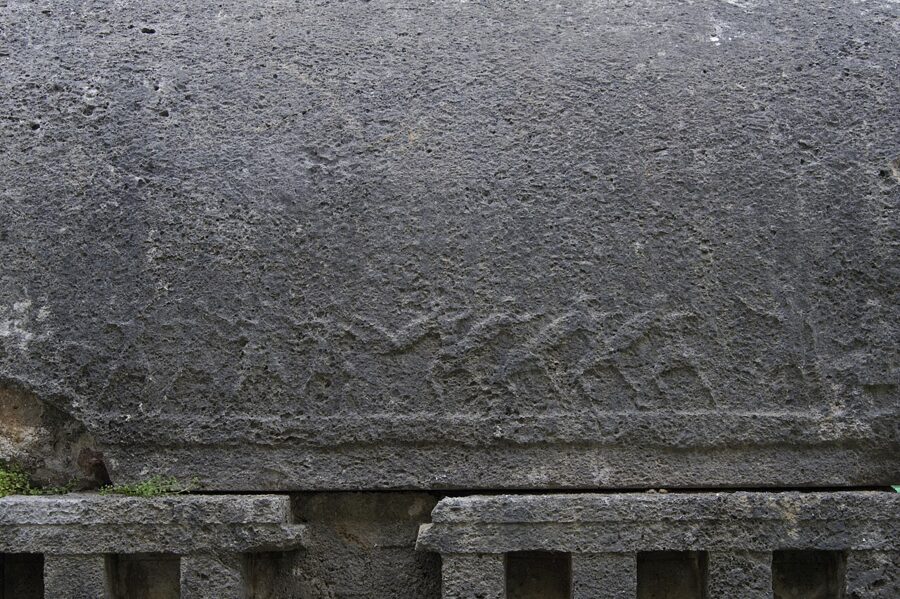
You don’t need to pay to see Lycian tombs in Fethiye. Freestanding sarcophagi stand in the streets of the center, one beside a taxi rank and others in side streets, with houses and traffic built around them. The Lycians buried their dead high up, in house-shaped tombs with pointed lids, and the town simply grew around them.

Paspatur, the old quarter
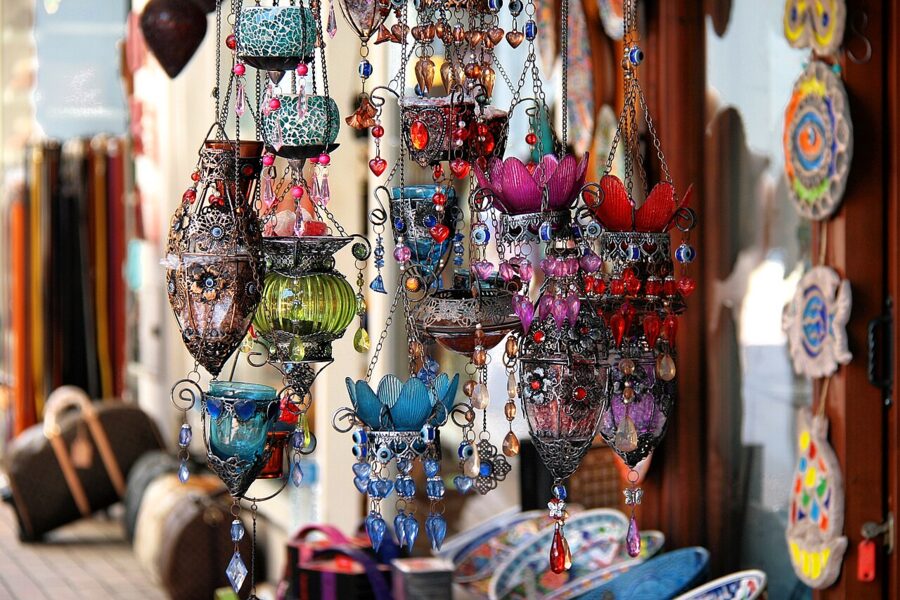
Paspatur is the knot of lanes behind the harbor that survived the 1957 earthquakes better than the rest of town. Today it is shops, cafés and bars under vines and awnings, a little touristy by day and busy after dark. It is the place to buy the cheap things you forgot (a sun hat, a sarong, a phone cable) and to drink a tea in the shade between sights.

Above Paspatur, on the hill, is the castle. Excavations there have been running for a few years and turned up a chapel and a head of Apollo, so access depends on where the dig has got to. It is worth the climb only if you find it open.
The fish market and the Tuesday market
Fethiye’s fish market is the best dinner in town at the price, and it works in a way that confuses first-timers. In the middle of the old town is a ring of fish counters, and around it a ring of restaurants. You choose your fish at a counter and pay for it by weight, then take it to one of the restaurants, which cooks it and charges you a per-person fee for the cooking, usually with bread, salad and sauces thrown in.
Two rules keep it cheap. First, ask the restaurant what the cooking fee is before you sit down, and what it includes; the waiters are used to the question. Second, buy local fish in season (sea bream and sea bass are farmed and cheap all year; the wild catches cost more), and let the counter clean it for you. Drinks and meze are extra, and that is where a bill grows.
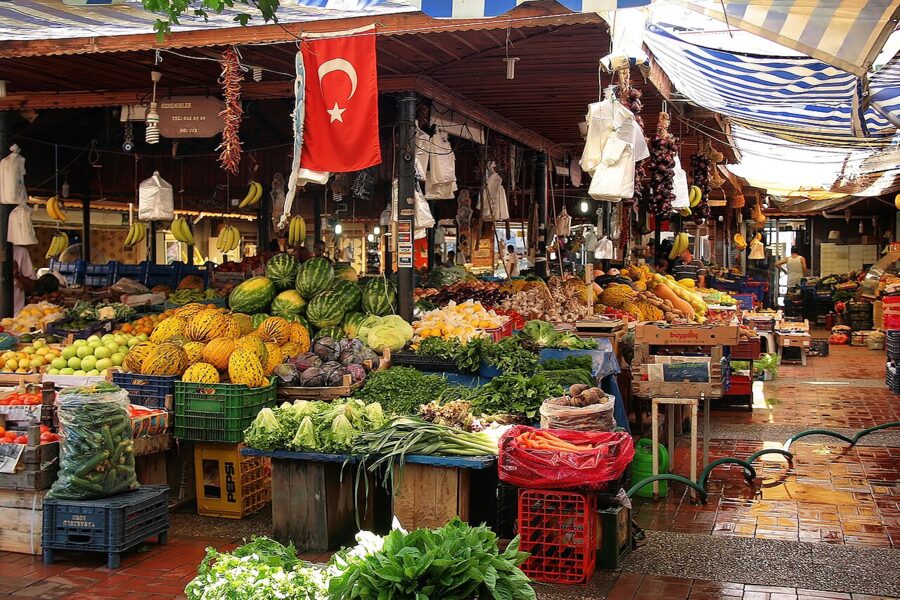

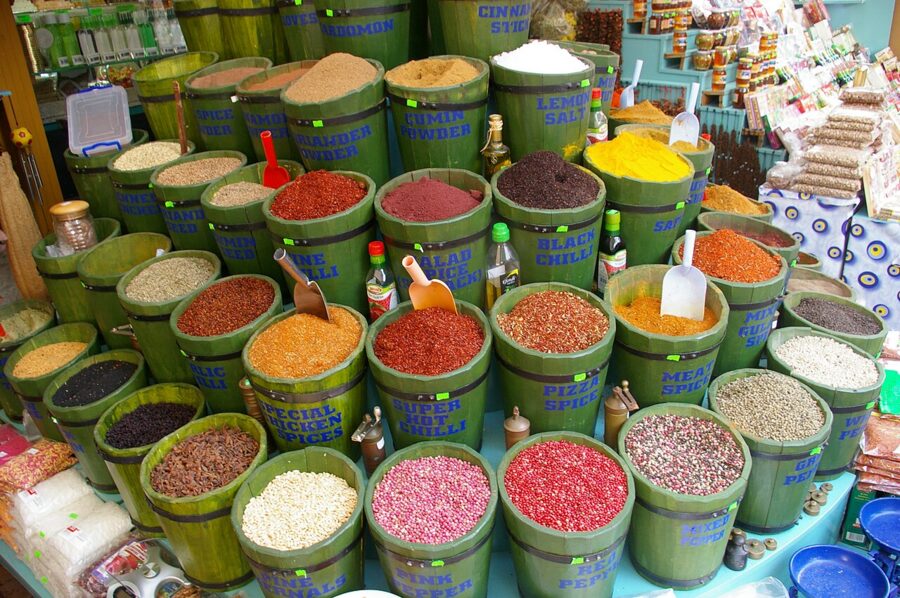
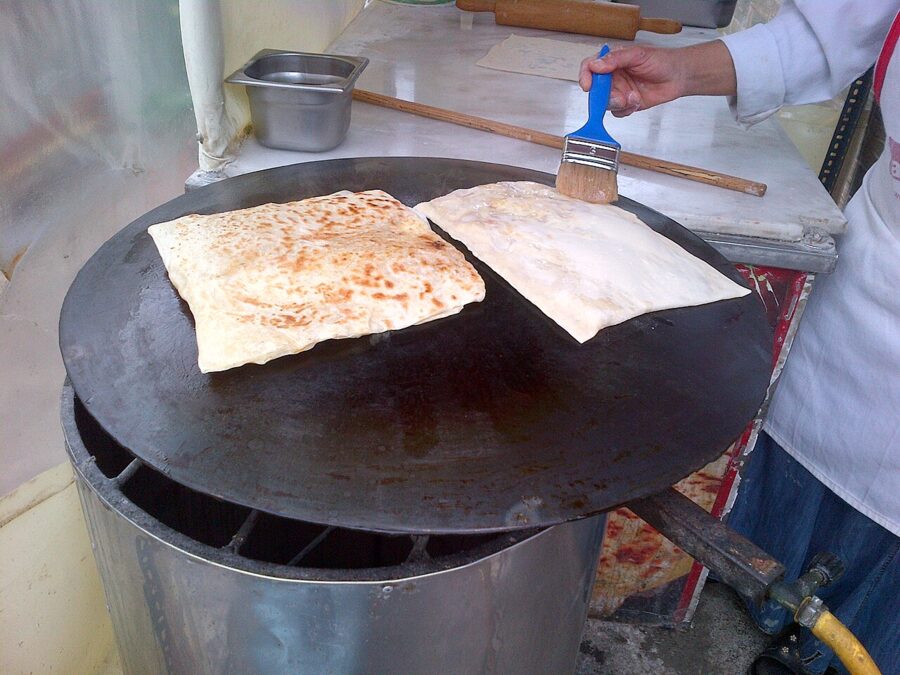
The big weekly market is on Tuesdays, laid out along the canal north of Paspatur near the stadium, 10 to 15 minutes on foot from the harbor. Half of it is food: tomatoes, peppers, olives, white cheese, dried figs, spices and the women making gözleme, the thin stuffed flatbread, on griddles. The other half is clothes, bags and copies of famous brands. Go before 11:00 in summer, when it is cooler and less crowded; local holidays sometimes shift it by a day.

Where to stay on a budget: town, Çalış or Ölüdeniz
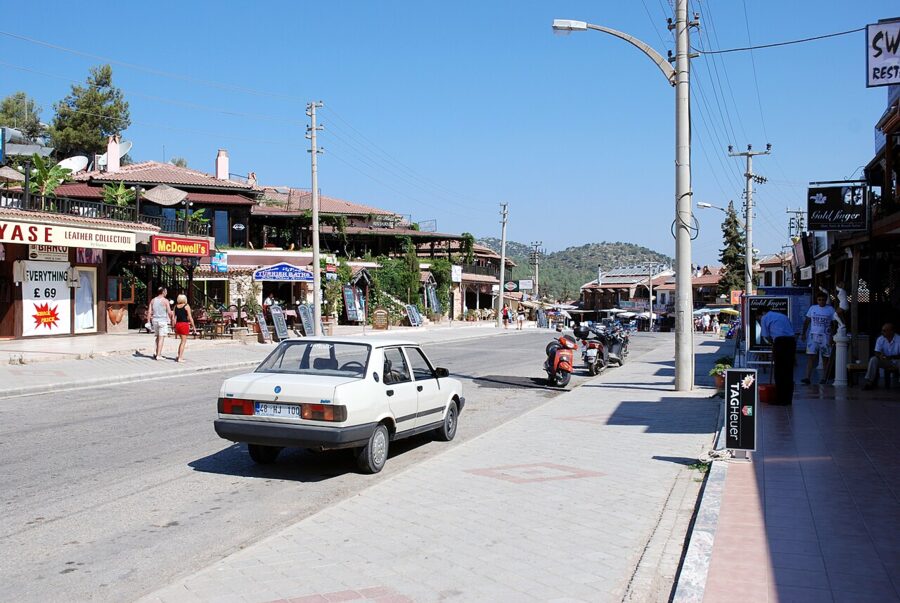
Your base decides how much you spend on dolmuş fares and how your evenings feel. All three areas below are on frequent minibus lines, and none is more than about 30 minutes from the others, so pick on character, not on distance.
| Base | Good for | Bad for |
|---|---|---|
| Fethiye town (harbor, Karagözler, the center) | Cheapest beds, the fish market, the otogar and every dolmuş line; boats leave from here | No beach; noisy in Paspatur at night |
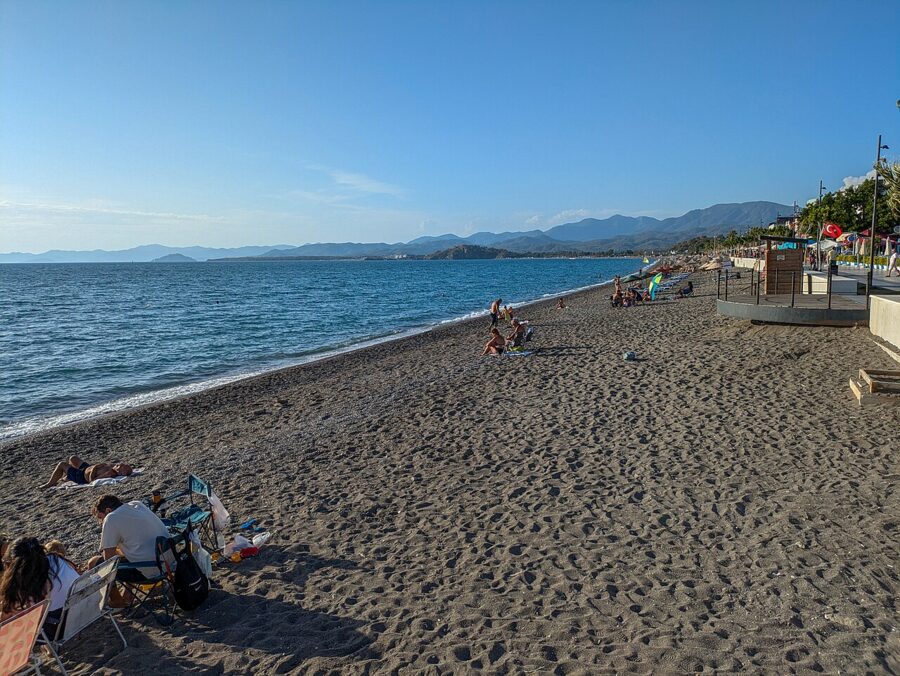
| Çalış | A long beach, sunsets, a quieter residential feel; 15 minutes to town by dolmuş | Few cheap restaurants on the beachfront itself; you are commuting for every day trip |
| Ölüdeniz | The lagoon and beach on your doorstep, paragliding, the boats to Butterfly Valley | Few dorms, higher prices, very quiet out of season |
| Hisarönü and Ovacık | Package-holiday bars and food in Hisarönü; Ovacık is the trailhead for the Lycian Way | Hisarönü’s bar strip is loud and not much like Turkey; neither has a beach |
I’d base myself in town or at the Çalış end of it. The town has the most budget beds and the shortest walk to the otogar, and every day trip below starts from there. Ölüdeniz is lovely for a night or two, but on a budget you are better off sleeping in town and taking the dolmuş out for the day.


Fethiye has a handful of small hostels rather than big chains, and most sit in residential streets a little outside the center. Three that were taking guests through autumn 2026:
- Adventurous Local Çalış Hostel, on Feray Özdemir Caddesi in Yeni Mahalle, about 1.7 km from the center and a five-minute walk from the Çalış minibus stop. Dorms and private rooms, a shared kitchen, a garden and a 24-hour reception; breakfast is extra (300 TL in 2026) and has to be ordered ahead.
- Hostel Chillsteps, in Çiftlik Mahallesi about 4 km from the center, with dorms and private rooms, a big shared kitchen and free parking. It is far enough out that you’ll use the dolmuş every day.
- Dovan’s Lycian Way Hostel, in Akarca about 1.4 km from the center. Despite the name it currently lists private rooms only, which suits two people sharing.
Dorm beds in Fethiye were listing from about €10–12 a night in late 2026, more in July and August. A double in a family-run pansiyon starts around twice that, and splitting one between two people often costs the same as two dorm beds. Many places on the coast cut their prices or close between November and March; book ahead for summer weekends and for the Kurban Bayramı holiday, when half of Turkey heads to the coast.
Ölüdeniz and the Blue Lagoon
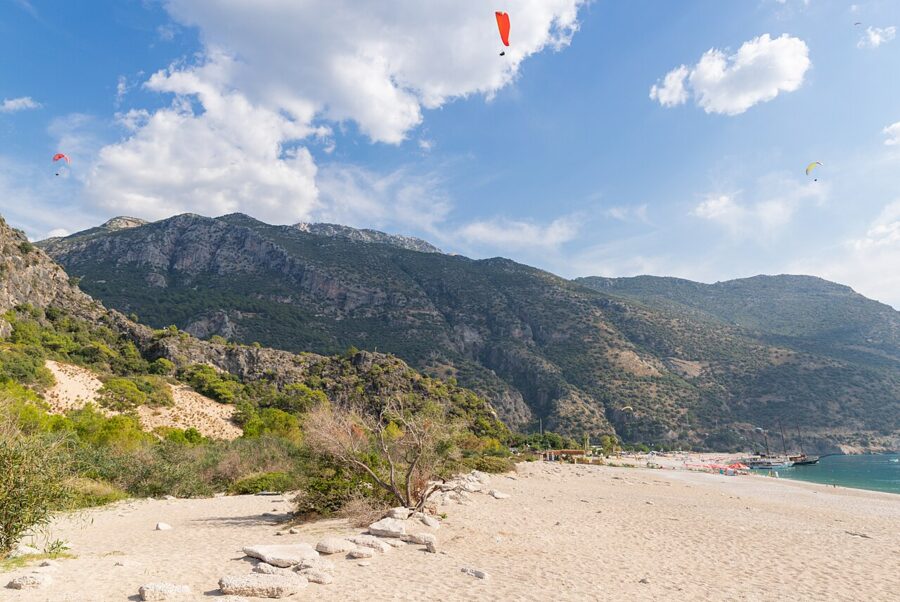
Ölüdeniz, “the dead sea,” is named for the lagoon: a shallow basin of still water behind a sand spit, sheltered from the open sea and calm when the bay outside is choppy. It is 14 km from Fethiye, and the dolmuş from the lanes behind the otogar takes 25 to 30 minutes, running every few minutes in summer and late into the evening. Hisarönü and Ovacık are on the same line, 20 minutes out.
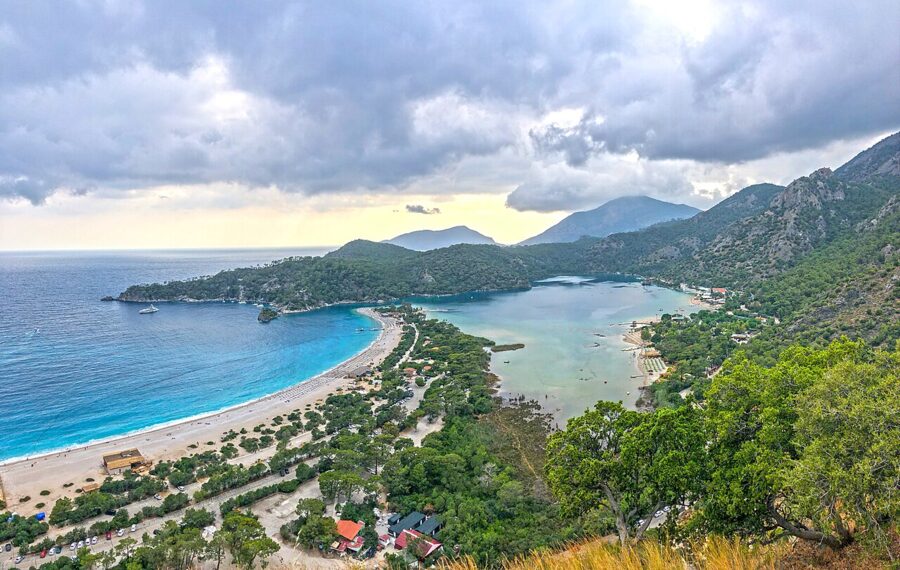

There are two beaches, and the difference matters to your budget. Belcekız is the long public beach in front of the village and the promenade, and walking onto it is free; you pay only if you rent a sunbed. The lagoon itself sits inside a fenced nature park on the Kumburnu spit, with a gate fee per person and a car-park charge. The forestry ministry’s 2026 tariff caps person entry to Muğla’s nature parks at 85 TL, but parks run by private operators can apply for a separate rate for foreign visitors, so check the board at the gate.
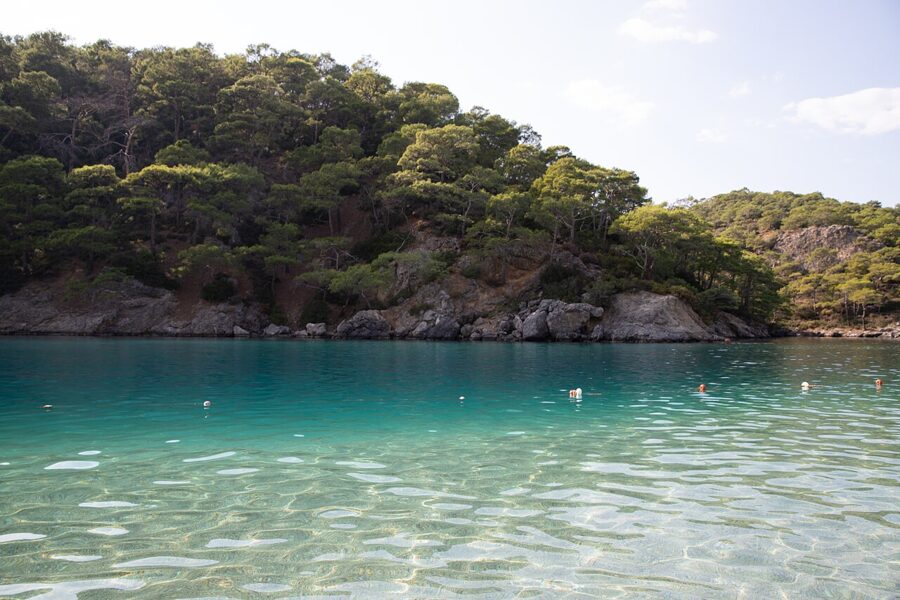

Is the lagoon worth it? In July and August it is a queue with a view: shuttle boats, sunbed rows and every tour bus on the coast. Come early, before 10:00, or after 16:00 when the day trippers leave, and the water is as clear as the photos. Out of season, from late October to April, the village goes quiet, many restaurants shut, and the lagoon is yours.
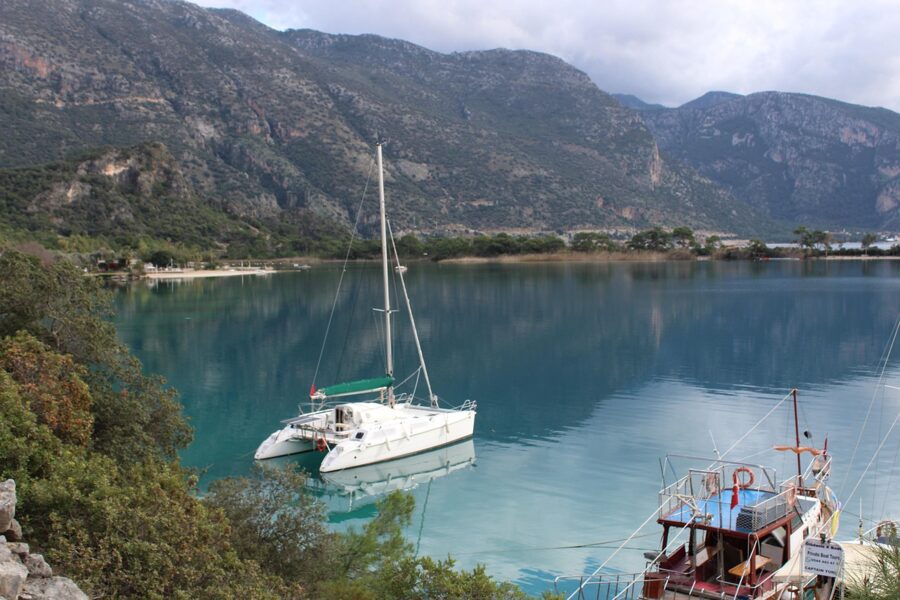
Butterfly Valley by boat
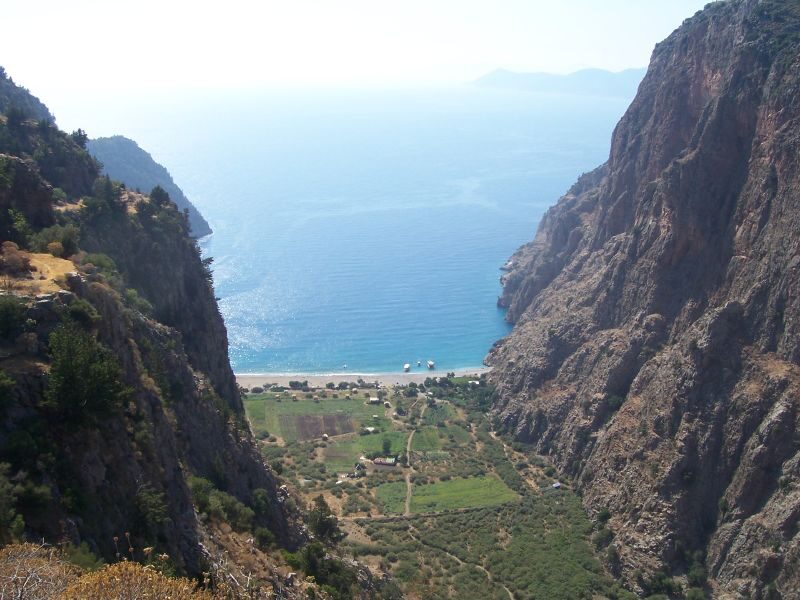
South of Ölüdeniz, the coast turns into cliffs, and one of them splits open into Butterfly Valley, Kelebekler Vadisi. It is a cleft about 4 km deep with walls around 350 m high, a pebble beach at the mouth and a stream running back to a waterfall. Sources give the waterfall as 50 to 60 m and the butterfly species as more than 80 to over 100; the valley is named above all for the Jersey tiger, a day-flying moth that gathers there in summer.
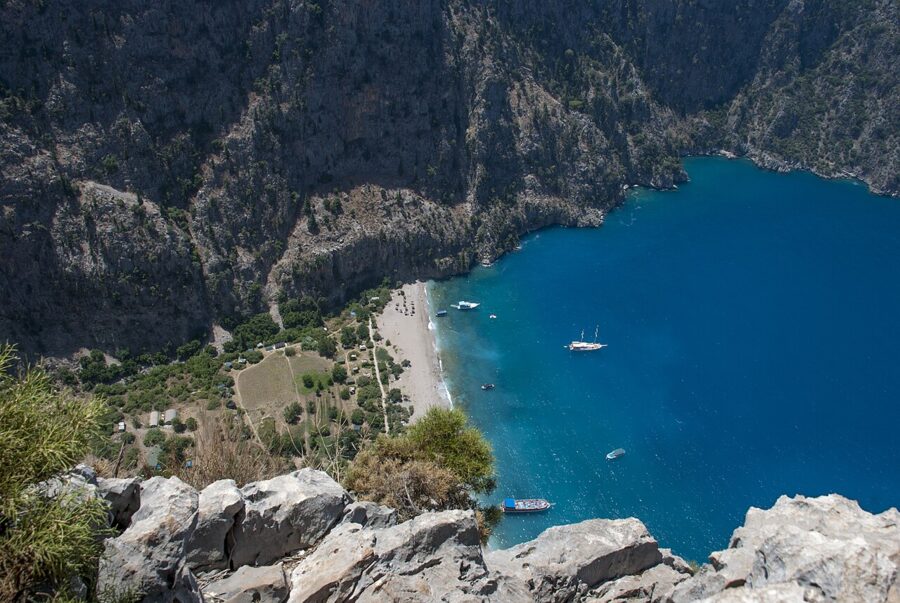

A shuttle boat runs from Belcekız beach through the season, roughly 10:00 to 18:00 in high summer; a 2026 listing put the return ticket at 500 TL, bought at the kiosk on the beach. Check the time of the last boat back before you go. The valley has been a protected natural site since 1995, nothing permanent can be built in it, and an operator runs a seasonal tent camp and simple meals from March to the start of November, if you want to stay the night.
There is also a path down from the village of Faralya on the clifftop, and I would not take it. It is a scramble down rock with fixed ropes in places, people have fallen and died on it, and the local authorities have tried to close it. Take the boat in, and if you want to see the valley from above, look down from Faralya, which is on the Lycian Way.

Paragliding from Babadağ
Babadağ rises straight up behind Ölüdeniz to 1,969 m, and its launch sites at around 1,700, 1,800 and 1,900 m make it one of the busiest paragliding sites in Turkey. During the nine-day Kurban Bayramı holiday in 2026, 8,436 flights went off it on the seven flyable days, 6,924 of them tandem. On a tandem you are strapped in front of a pilot, you run a few steps off the slope, and 20 to 40 minutes later you land on the promenade at Belcekız.
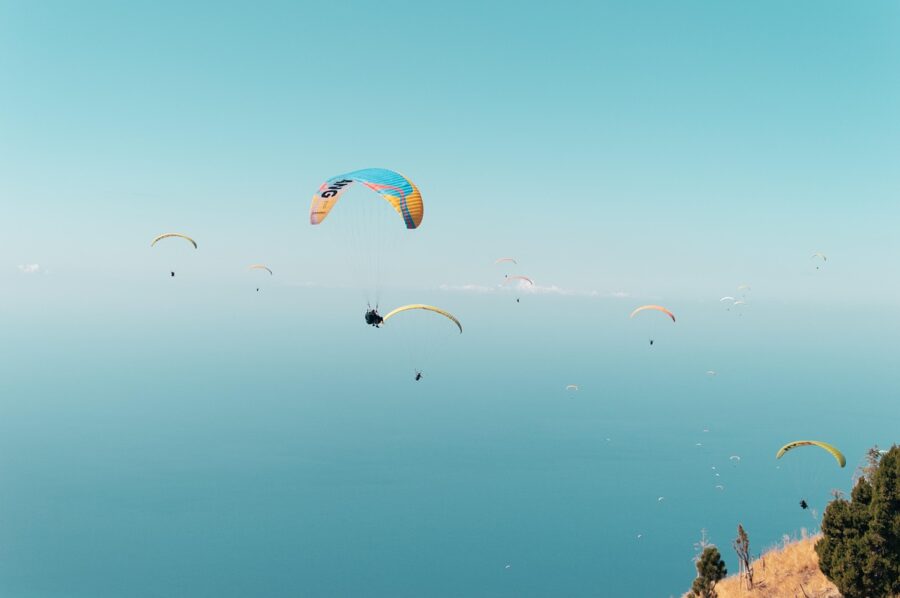
Price first. In 2026 a standard tandem flight was listed from about €135–140 on the booking platforms, and the same flight sold as an add-on from a gulet cost €190. The photos and video your pilot shoots with a pole camera are almost always extra, and that is where the bill grows. Hotel pickup can be extra too, so ask for the full price with everything you want included.
Then the operator. Commercial tandem flying from Babadağ runs under a local directive for the mountain, and it is specific about what you are entitled to:
- A licensed pilot. Commercial tandem pilots need a tandem certificate (T2 under the Turkish Aeronautical Association’s rules) and must fly for a registered agency licensed for the activity. Ask to see the pilot’s card.
- Insurance. Every commercial tandem flight must carry personal accident or seat insurance for the passenger plus third-party liability cover. Ask whether you are covered before you pay; a vague answer is a reason to walk.
- Equipment. A reserve parachute, a helmet for take-off and landing, and a harness that clips you in with steel carabiners. You should be issued all of it, not asked to bring anything.
- A weather call. The pilot decides on the day and can cancel. A good agency refunds or reschedules a cancelled flight without argument; get that in writing.
Paragliding comes under the Turkish Aeronautical Association and the district authorities rather than the civil aviation authority, whose ultralight rules leave paragliders out. It is also not risk-free. In late August 2026 a tandem pilot and his passenger were killed when their wing went out of control shortly after launching from the 1,900 m site, and the cause was still under investigation when the news broke. Thousands of flights a week go well, but this is a sport in which choosing a careful operator is the part you control.
The Babadağ cable car, for non-fliers
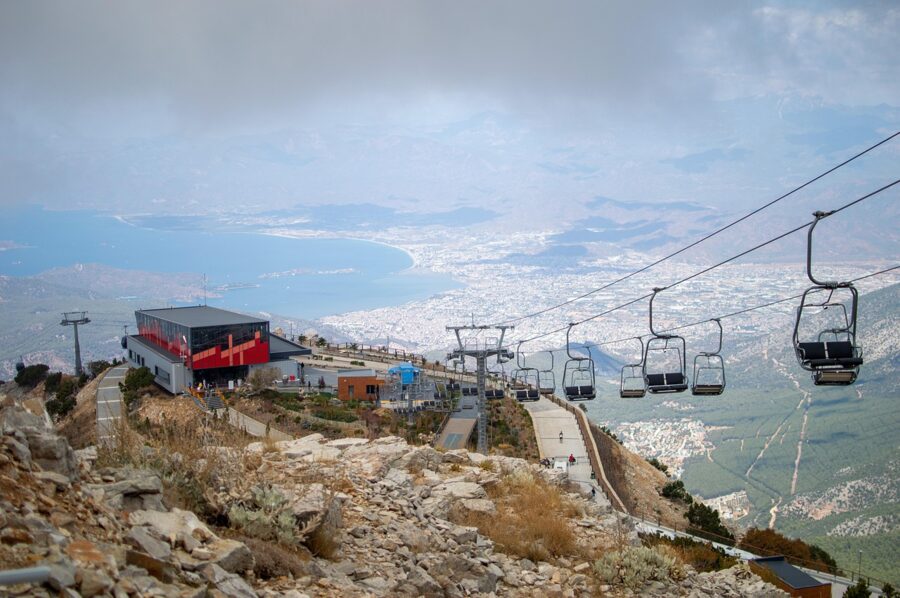
You don’t have to jump off Babadağ to see the view from it. A cable car climbs from a base station at 226 m on the main road into Ölüdeniz, with stations at 1,200 and 1,700 m, and chairlifts take you on to 1,800 m and 1,900 m near the summit, where the paragliders launch. The operator’s price is 950 TL return, or 700 TL for students with a card; children aged 7 and under ride free but cannot use the chairlifts.
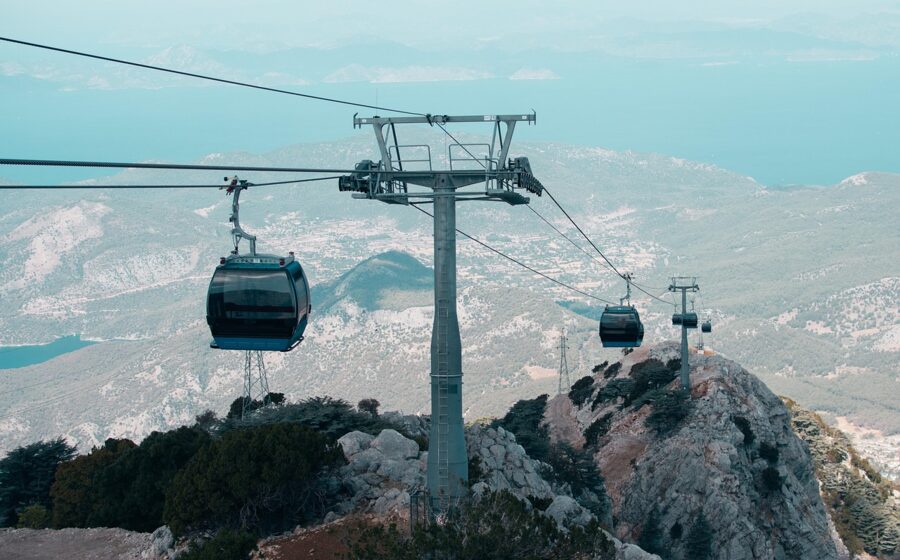
The ticket covers the chairlifts, but read the small print: if the upper stations close because of wind, the ticket is good only as far as 1,200 m and there is no refund. Hours change with the weather, so check the operator’s site on the morning. Up top, it is noticeably colder than on the beach, even in summer; bring a layer.
Kayaköy and the walk over the hill
Kayaköy lies in a valley 8 km south of Fethiye, and the abandoned village climbs the slope above the modern one. Its Greek name was Livissi, and the Ministry of Culture identifies the site with ancient Karmylassos. What you see today was built in the late Ottoman period by the Greek Orthodox families who lived here: some 400 two-storey stone houses, none larger than about 50 m², set so that no house blocks another’s view or light.
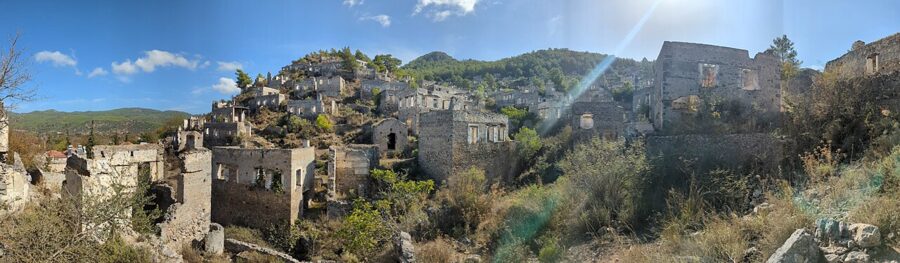
The village emptied in 1923, when the Greek and Turkish governments agreed to swap their Orthodox and Muslim minorities. The Greek families of Livissi left for Greece, and the Muslim families resettled from Greece in their place mostly moved on. Roofs, doors and window frames went over the following decades, and the 1957 earthquake did the rest. The novel Birds Without Wings is set in a village closely modeled on it, and reading it before you go changes how the place looks.
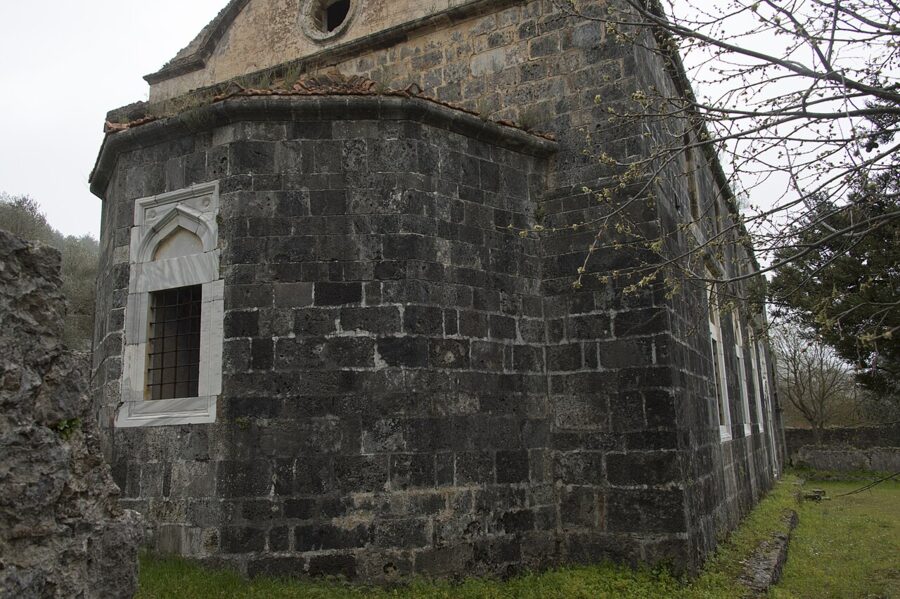
Two buildings are worth finding. The Upper Church, Taxiarchis, stands on the rise in the middle of the village. The Lower Church, Panagia Pyrgiotissa, on the western edge, is better preserved because it was used as a mosque until the 1960s, and both have pebble mosaics in the courtyard. The site is €3 for foreign visitors and open every day 08:30–18:00, with the ticket office closing at 17:30.

Minibuses run between Fethiye and Kayaköy through the year, and in the warmer months others link Kayaköy with Hisarönü and Ölüdeniz. A cluster of restaurants sits in the modern village below the ruins, and a tea or a gözleme there is cheaper than anything in Ölüdeniz.
Then walk to the beach. A marked path climbs from the ruins over the ridge and down to Ölüdeniz: about 5 km, 210 m of climbing and 365 m of descent, and two to two and a half hours. The Kayaköy side is steep; the descent to Ölüdeniz is long, loose and rough underfoot, so wear proper shoes.
There is no water on the way. Carry a liter or two each, follow the painted marks through the ruins, where the path is easy to lose, and you finish with a swim and a dolmuş back to town.
The same ridge has a second branch that leads to Ovacık in about 5.5 km and two and a half hours, which is where the Lycian Way starts. Walk that one if you want to sleep in Ovacık and set off on the Lycian Way the next morning.
From Kayaköy a road also runs down to Gemiler beach, the departure point for Gemiler Island, covered with the boat trips below.
Saklıkent, Tlos and the Xanthos valley by dolmuş
East of Fethiye the road climbs over a pass into the Eşen valley, the ancient Xanthos valley, and the best inland day trip runs up it: the Saklıkent gorge and the hilltop city of Tlos, with the trout restaurants of Yaka village in between. Tour agencies sell it as a jeep safari; you can do it by dolmuş for the price of two tickets.
Saklıkent gorge
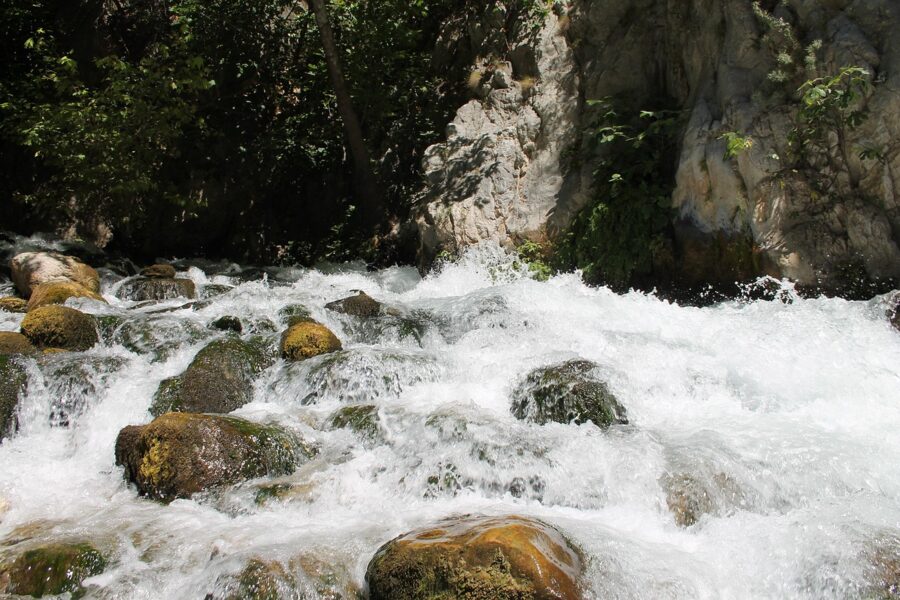
Saklıkent, “the hidden town,” is a gorge about 18 km long, with walls up to 300 m high, cut by a river that pours out of the mountain from cold springs. Only the first stretch is walkable without canyoning gear. You go in on a wooden walkway bolted to the cliff, wade across the river where it comes out of the rock, then walk up the riverbed between the walls until a boulder or a waterfall stops you.
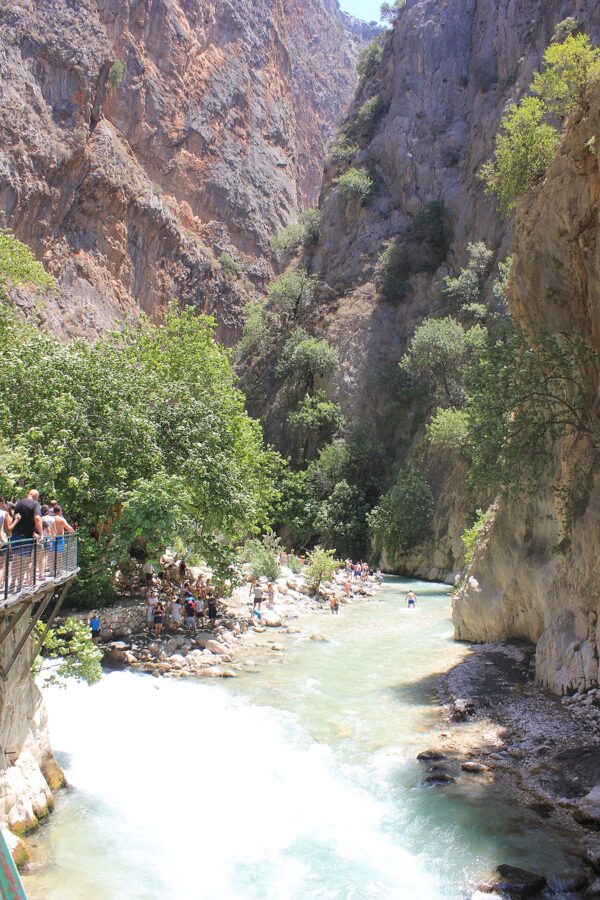

Entry cost 250 TL for adults and 125 TL for students in 2026, paid in cash or by card. There is no ATM at the gorge, so bring cash for rubber shoes and lockers, which you can hire on site. In summer it opens around 08:45 and stays open until 19:00 or 19:30, with last entry around 17:30–18:00; arrive before 11:00, when the tour groups pile in.
The dolmuş leaves from outside the otogar and from stops in the center, takes 45 minutes to an hour for the 45 km, and runs about every half hour in high season. The last one back usually goes around 19:30. Saklıkent was closed for a while as a precaution during a wildfire in late August 2026, a reminder to check the morning you go in fire season.
Tlos and the Yaka valley
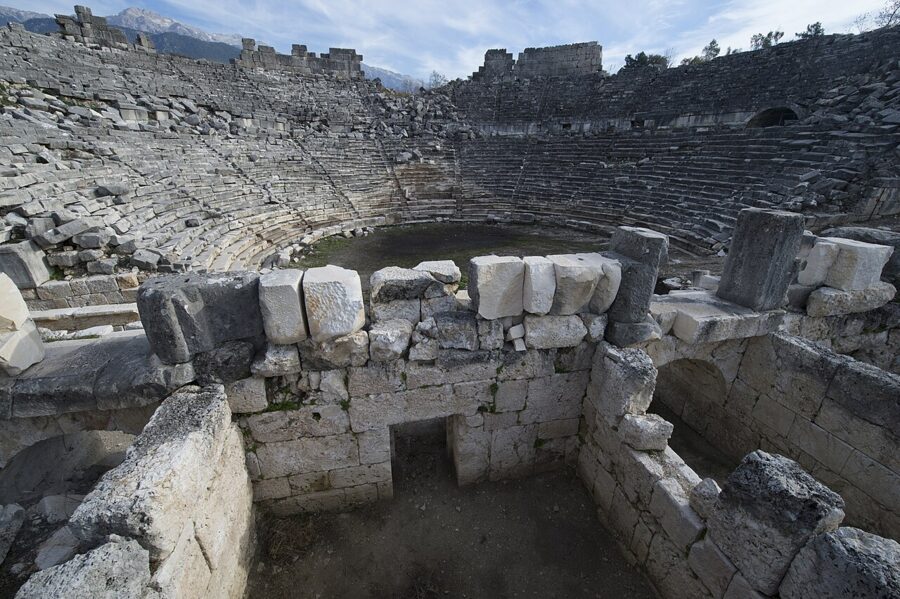
Tlos sits on the Saklıkent road at Yakaköy, on a rock spur at the foot of the Akdağlar range, and it was one of the six largest cities of the Lycian League, with three votes in its assembly. The acropolis cliff is honeycombed with rock tombs, and on top are the walls of a castle built in the 19th century by Kanlı Ali Ağa, a local strongman, out of the ancient stones. Below are a stadium 137 m long, baths, a basilica and a Roman theatre.
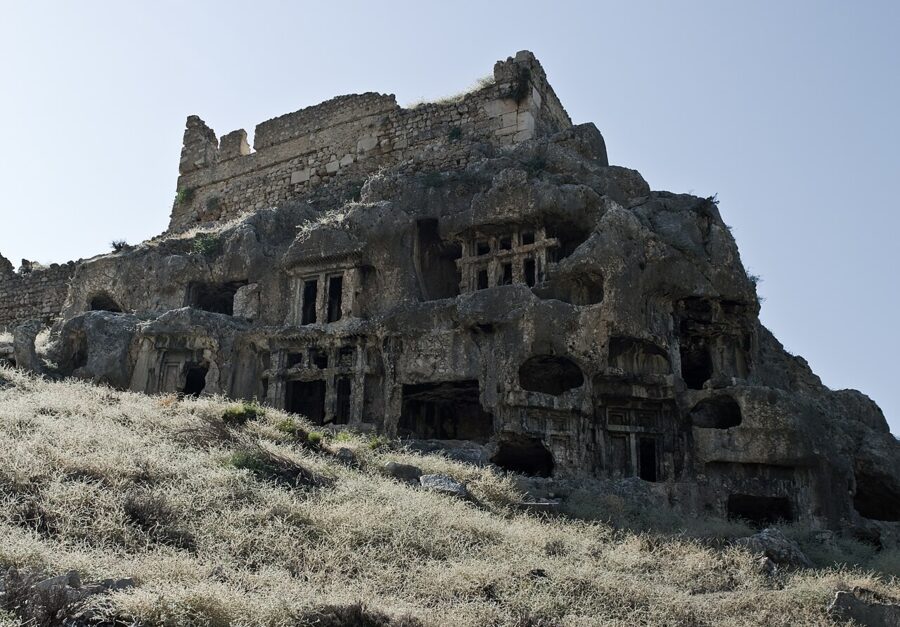

The Ministry lists Tlos as open every day 08:30–18:00, ticket office closing at 17:30, and the ticket price on its 2026 tariff was €3. The theatre has been restored since 2023 and is now lit by a solar plant for evening events. Ask the Saklıkent dolmuş driver to drop you at the Tlos turn and walk up to the gate; to go on or back, flag down a dolmuş on the main road.

Between Tlos and Saklıkent, the village of Yaka is known for trout restaurants set among plane trees and ice-cold spring water. They are a classic lunch stop on the jeep tours. Prices are tourist prices, so look at the menu before you sit down, or bring a picnic from the Tuesday market.
Letoon and Xanthos
Further down the valley, near the sea, are the two sites that together make up a UNESCO World Heritage listing: Xanthos, the leading city of Lycia, and Letoon, its sanctuary. Both lie off the Fethiye–Kaş road, so any bus or dolmuş towards Kaş can drop you at the turn-offs. Each is €3 on the Ministry’s 2026 tariff, open every day 08:30–18:00.
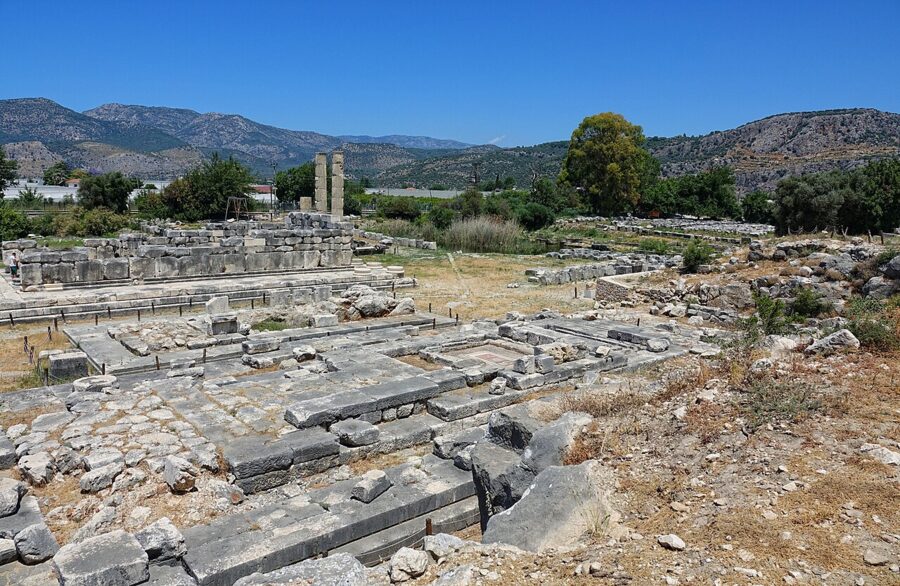

Letoon sits at the 65 km mark on the Kaş road. Legend has the goddess Leto stop at its spring with her newborn twins, Apollo and Artemis, and turn the locals into frogs when they refused her water. The ruins and inscriptions show it was the religious and political center of the Lycian League.
Xanthos is a few kilometers away above the village of Kınık. The Romans destroyed it in 42 BC, and the British carried off its finest monuments in the 1840s; the Nereid Monument now stands in the British Museum.
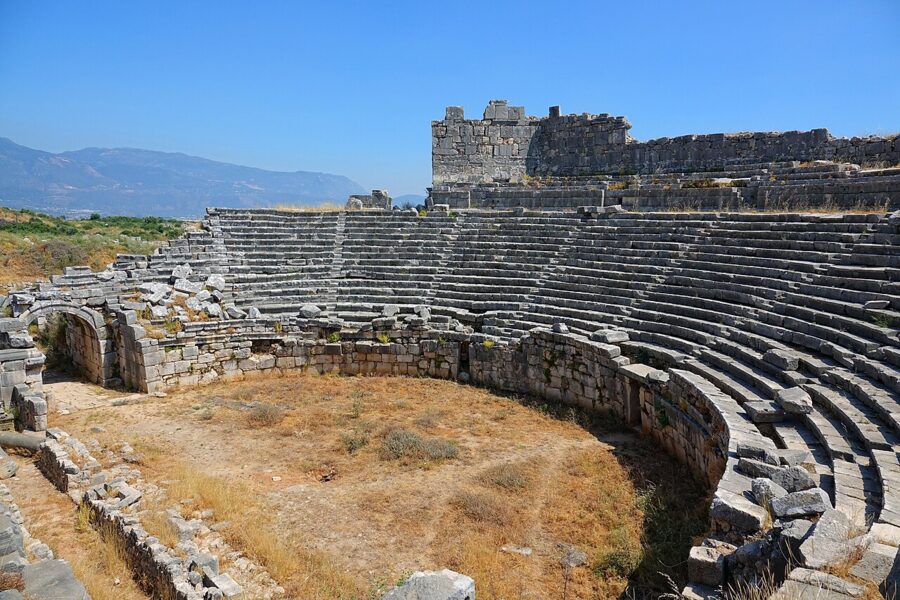

Both are quick visits, an hour each, and easy to fit into the bus ride to Kaş if you leave Fethiye early and are not carrying a big pack. If you are, ask at the otogar about leaving bags; otherwise make it a separate day and return to Fethiye.
Boat days on the bay
Fethiye Bay is full of islands and coves no road reaches, and the cheapest way onto it is the day boat. The 12 Islands trip is the classic: boats leave the harbor around 10:00 and spend 7 to 9 hours hopping between the islands and coves, with several swim stops and lunch on board. Listings for 2026 ran about €40 to €60 a head, and the agencies on the quay sell the same trips in lira.
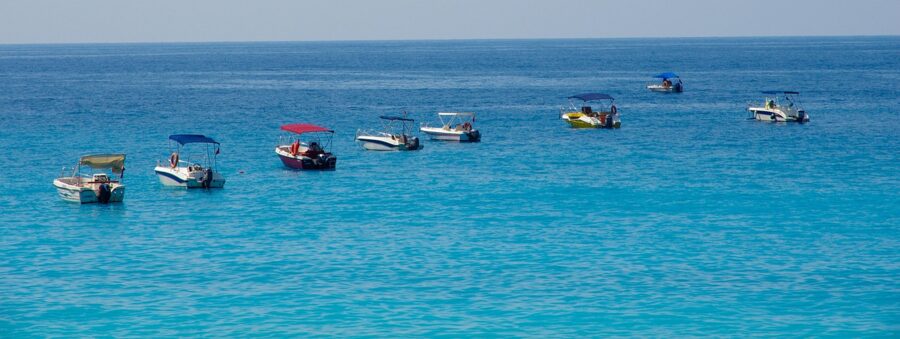
Before you pay, ask four things: which boat (and look at it), how many passengers it takes, what lunch is, and whether the music is on all day. The biggest boats are floating parties with the speakers on from breakfast; the smaller ones usually cost a little more and are worth it. Drinks on board are extra and priced accordingly, so bring water. Between November and April most boats don’t run at all.
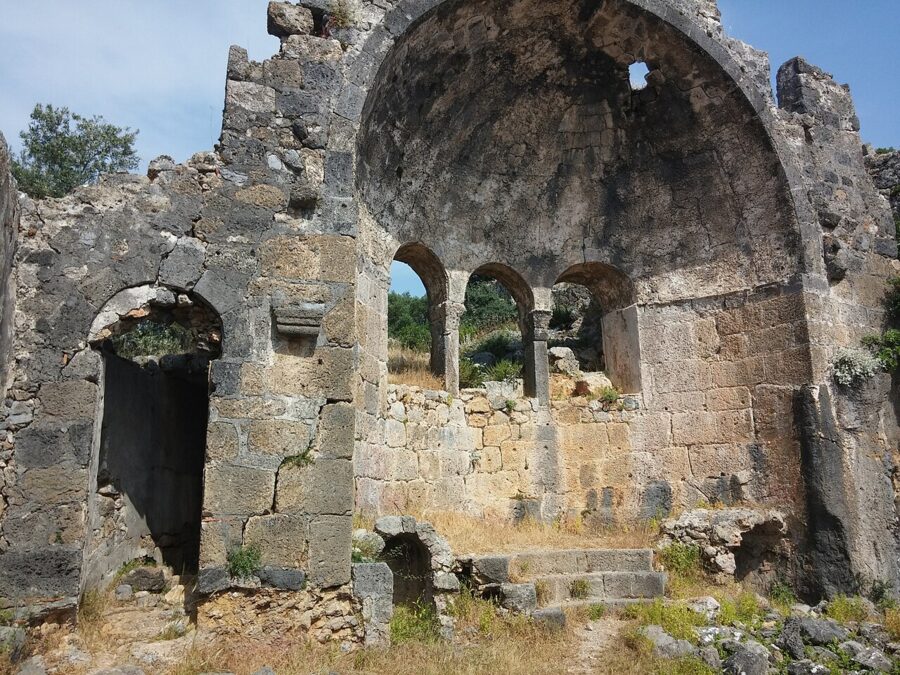
Most 12 Islands boats and every gulet stop at Gemiler Island, which the crews call St. Nicholas Island. It is covered in the ruins of four churches, tombs, houses and cisterns, some of them now underwater, and a fresco in one church names Hosios Nikolaos. The Ministry’s account dates the settlement to the 5th to 7th centuries and has it abandoned after Arab raids in the 7th.
Entry to the island is €3, open 08:30–18:00, and the climb to the top is short but loose underfoot, so trainers beat flip-flops. You can also reach it without a tour: boats cross from Gemiler beach, at the end of the road down from Kayaköy.
If you have more money and more days, the longer option is a gulet, the wooden motor-sailers that carry passengers along the Lycian coast for three or more nights. The budget version is a three-night cabin cruise from Fethiye to the Olympos area, and the gulet cruise guide covers it stop by stop, with 2026 prices and what to check before you book. A day boat gives you the same water for a fraction of the price; the gulet gives you the coves after the day boats have gone home.
One more boat, and it is a big one. In summer a ferry runs from Fethiye harbor to Rhodes in about 1 hour 45 minutes to 2 hours, which makes Fethiye a jumping-off point for Greek island hopping. Port taxes are often not in the advertised price, and you clear Turkish exit control at the harbor, so arrive early.
The Lycian Way: the first stages from Ovacık and Faralya
The Lycian Way starts at the southern edge of Ovacık, on the road that drops to Ölüdeniz. It was researched and waymarked in 1999 by Kate Clow, a British amateur historian living in Turkey, as Turkey’s first long-distance walking route, and it now runs about 760 km to Geyikbayırı near Antalya. Most people who walk it do a few days, and the first stages from Fethiye make an excellent day or two.
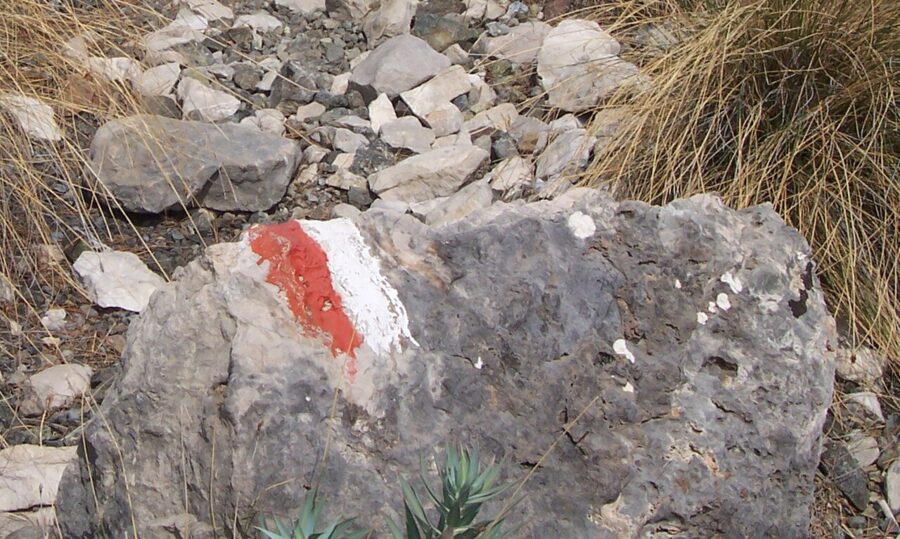
Stage one goes from Ovacık over the shoulder of Babadağ to Faralya: about 12.8 km, with 765 m of climbing and 735 m of descent, and close to six hours of walking. The first stretch out of Ovacık is the steepest of the day, a stony climb of 18 to 20 per cent in places. Then it eases onto a rolling plateau through the hamlet of Kozağaç and the village of Kirme, and drops more gently to Faralya. Signposts and painted blazes mark it well.
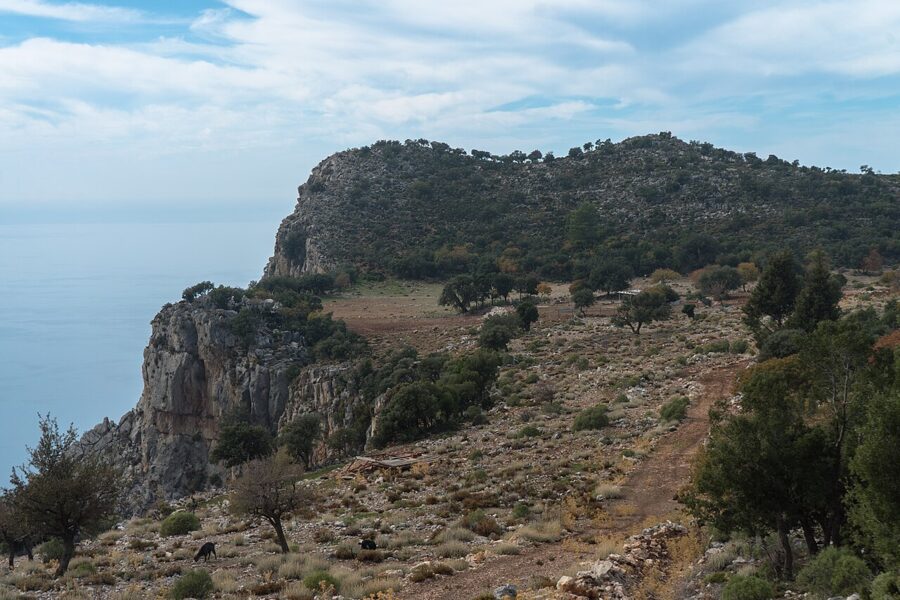

Water is easier than on most of the route. There are cisterns on the climb out of Ovacık, fountains in Kozağaç, spigots between Kozağaç and Kirme, fountains in and near Kirme and two more between Kirme and Faralya. Still carry two liters each, because in summer you can walk for hours in strong sun between them and some may be dry. Storms build quickly on the mountain in spring, and there is nowhere to stay between the two ends.
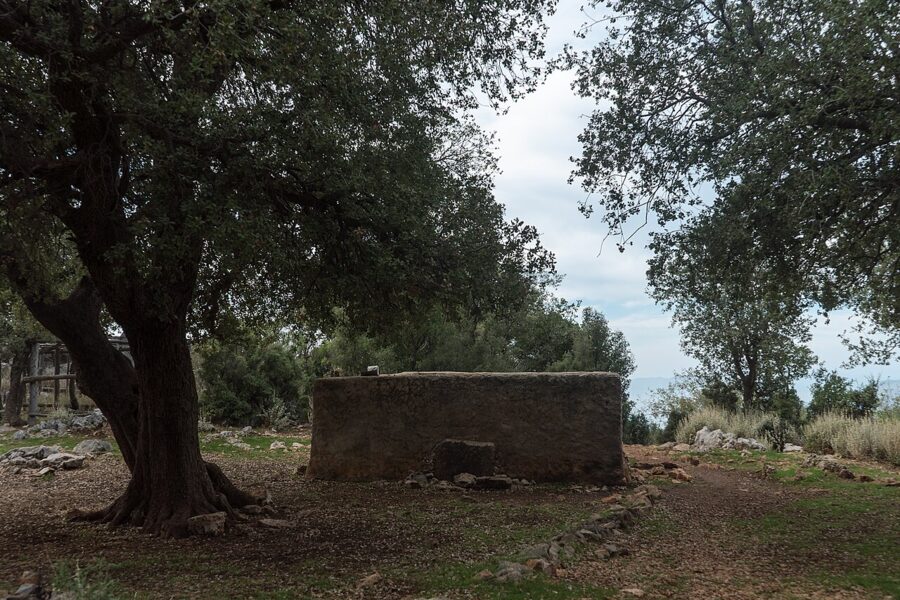

Faralya, also called Uzunyurt, sits on the cliff above Butterfly Valley and has several pansiyons. The dolmuş stop is at the north end of the village. From there, stage two is a short 4.8 km on to Kabak, about two and a half hours, with a long descent at the end to a beach of camps and bungalows that people come to for a night and stay a week.
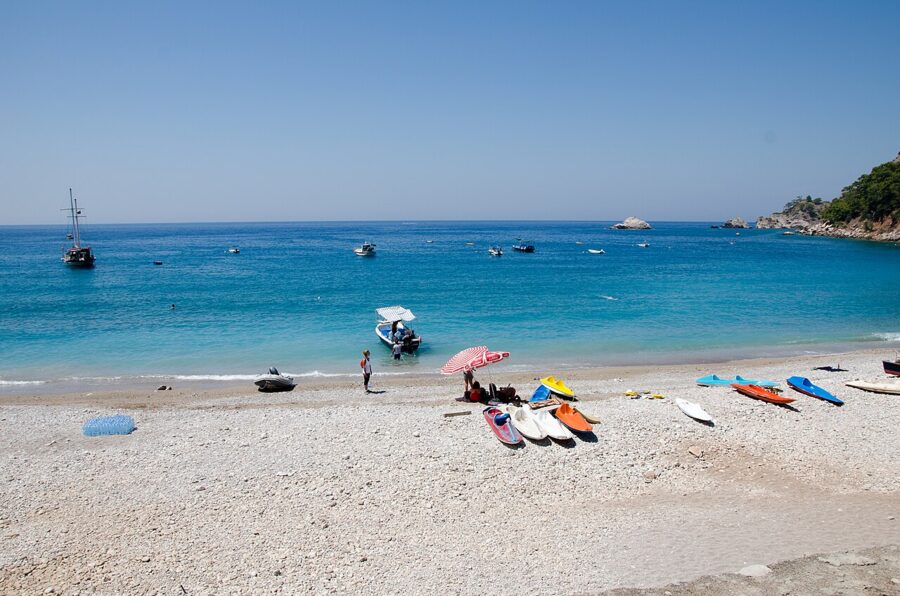

The best walking months are February to May and September to November; in July and August the midday heat makes long stages hard work, so start at dawn and stop early. For a day, take the dolmuş to Ovacık, walk to Faralya and ride the dolmuş back. For two, sleep in Faralya and finish at Kabak. Either way, carry the Lycian Way guidebook or an offline map, because some junctions on the plateau are confusing.
Getting to Fethiye and away
The nearest airport is Dalaman, about 59 km northwest by road. Muttaş, the Muğla metropolitan transport company, runs airport buses from there to the Fethiye otogar, timed to the arriving flights rather than a fixed timetable. The fare went up to 360 TL on 16 November 2026, paid on board in cash or by card, and the ride takes 60 to 75 minutes. Havaş runs the same route with extra departures in summer.
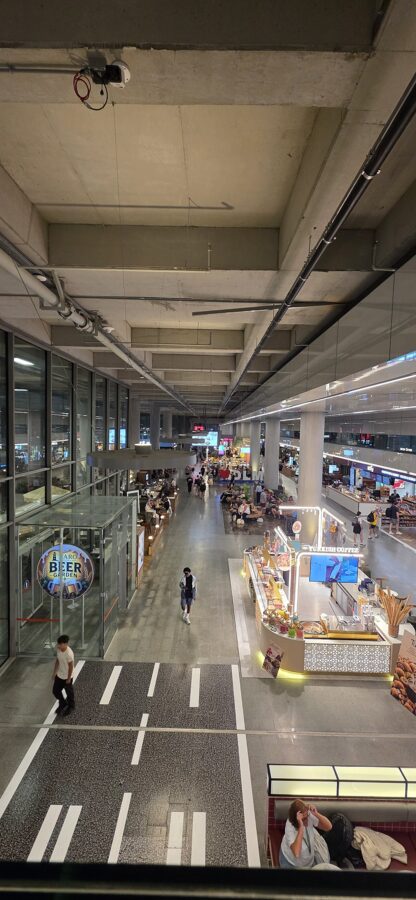
Taxis from the airport run on the meter, which in Muğla since 16 November 2026 starts at 180 TL and adds 60 TL a kilometer, so expect about 3,500 to 4,000 TL to Fethiye. Make sure the meter is on before you set off.
Fethiye’s otogar is a 10-minute dolmuş ride from the center. Long-distance buses run along the coast to Kaş in about 2 hours, to Antalya in 3 to 3.5 hours, and inland to Denizli for Pamukkale, and there are overnight buses to Istanbul and Cappadocia. If you are coming from Ephesus and Selçuk, the usual route runs inland via Pamukkale and the Denizli otogar. Metro Turizm, Kamil Koç and Pamukkale Turizm are the big companies on these routes, and the smaller regional firms often undercut them on short hops.
Around town, the dolmuş does everything. Minibuses stop anywhere on their route if you wave or call out, and since 16 November 2026 the full fare on in-town routes has been 50 TL, or 25 TL for students. Longer lines to Ölüdeniz, Kayaköy and Saklıkent are priced by distance and cost more. Fares rose three times in 2026, in February, May and November, so take the numbers below as a guide and keep small notes; the main Ölüdeniz line also takes contactless bank cards.
| What | Cost in late 2026 | Notes |
|---|---|---|
| Dalaman Airport to Fethiye otogar, Muttaş bus | 360 TL | 60–75 minutes, timed to flights |
| Airport taxi to Fethiye | about 3,500–4,000 TL | Metered: 180 TL start, 60 TL per km |
| In-town dolmuş | 50 TL (students 25 TL) | Longer lines cost more |
| Bus to Kaş | 400–490 TL | About 2 hours |
| Bus to Denizli (for Pamukkale) | 500–600 TL | 2.75–4 hours |
| Bus to Göreme | 1,500–1,980 TL | About 12 hours, overnight |
| Kayaköy, Amyntas, Tlos, Letoon, Xanthos, Gemiler | €3 each | Ministry of Culture sites, daily |
| Saklıkent gorge | 250 TL (students 125 TL) | Cash or card, no ATM |
| Babadağ cable car, return | 950 TL (students 700 TL) | Upper stations close in wind |
| Butterfly Valley boat, return | about 500 TL | From Belcekız beach, seasonal |
| 12 Islands day boat | about €40–60 | With lunch, 7–9 hours |
| Tandem paragliding | about €135–190 | Photos and video extra |
| Dorm bed | from about €10–12 | Higher in July and August |
The Ministry sites price their tickets in euros. For the rest, bring lira in small notes. ATMs are everywhere in the center and in Ölüdeniz, and thin out in the villages, so draw cash before a day in Kayaköy, Saklıkent or Faralya.
When to go
Late May, June and September are the best months: the sea is warm, the boats and the dolmuş lines run full timetables, and the crowds and prices are below their July and August peak. October is still good for swimming and better for walking. In high summer, plan on the beach early, a bus or a gorge in the heat of the day, and the old town at night.
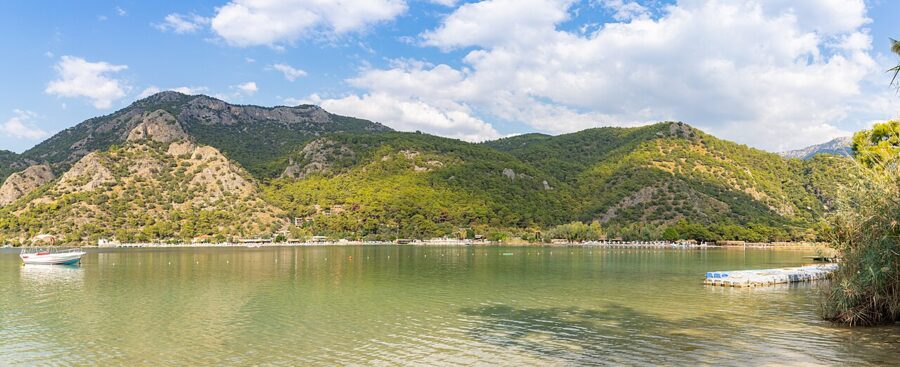

From November to March Fethiye is a quiet market town with mild, wet weather. Many hostels, pansiyons and restaurants in Ölüdeniz and Kabak shut, the day boats stop and the dolmuş lines thin out, but the ruins have no queues, the Lycian Way is at its best and the town itself carries on as normal. A winter visit works if you want walking and ruins rather than swimming.
Whatever the month, the last move is the same: get to the otogar with your bag the evening before, check the next morning’s departures on the board, and buy the coastal bus ticket to Kaş. The best seat on that ride is on the right-hand side, facing the sea.