Entry to the Grand Bazaar costs nothing, and that one fact should decide how you use it. Walk in at 08:30 with a tram ride’s worth of lira in your pocket and you can cross the whole thing, sit in a 17th-century han with a glass of tea, step into the stone strongroom Mehmed II built for the city’s valuables, and leave without having bought a fridge magnet. Buying is optional. Getting lost is not, at least the first time.
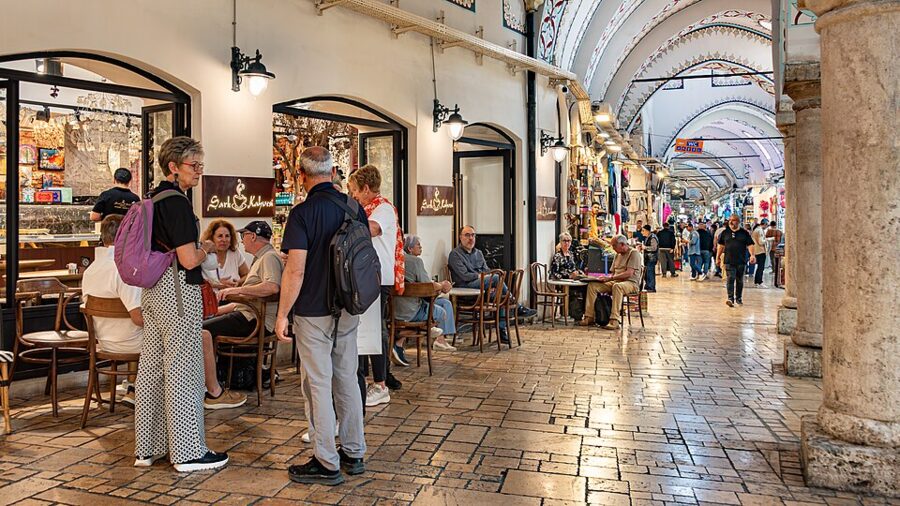

The Kapalıçarşı (the covered market; older Turkish calls it the Büyük Çarşı) fills the slope between the Beyazıt and Nuruosmaniye mosques in the old city. How big it is depends on who counts. The traders’ association puts it at 2,486 shops on 62 streets with 18 hans and 2 bedestens, the property owners’ management plan registers 2,385 shops, 14 hans and 2 bedestens, and the roof restoration reports of 2024 spoke of 3,600 shops behind 22 gates.
| Before you go | As it stands in late 2026 |
|---|---|
| Hours | Monday to Saturday, about 08:30–19:00; some shutters go down from 18:30 |
| Closed | Every Sunday, and every day of the two religious holidays (bayrams) |
| Holiday eves | Open in the morning, closed from 13:00 |
| Next closures | Ramazan Bayramı, 9–11 March 2027 (eve 8 March); Kurban Bayramı, 16–19 May 2027 (eve 15 May) |
| Entry | Free, no ticket |
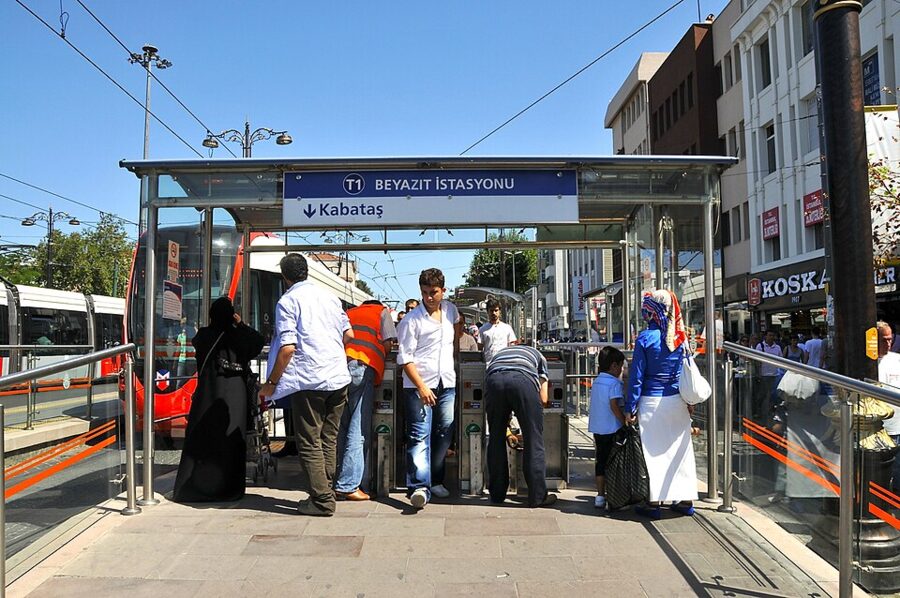
| Tram | T1 to Beyazıt–Kapalıçarşı (for the Beyazıt Gate) or Çemberlitaş (for the Nuruosmaniye Gate); 46.20 TL a ride on the Istanbulkart since 20 July 2026 |

My strategy for a looking-not-buying visit is simple. Arrive at opening on a weekday, walk the main street end to end in 20 minutes so you have the spine in your head, then spend the next hour in the two bedestens and the hans on the north side, where the work is done. Buy nothing in the first hour. If something is still on your mind at the end, go back to the shop and bargain for it with a price already fixed in your head.

Contents
Hours, Sundays and the bayram closures
The bazaar keeps shop hours, not museum hours, and the traders’ association posts no timetable online. Most guides give about 08:30 to 19:00, Monday to Saturday; a few shops open at 09:00 or later, and the antique dealers in the inner hall often shut before the rest. The gates are locked at night, as they have been for five centuries, so do not plan an evening stroll through it.
Sunday is the trap. The whole bazaar is shut, and a surprising number of travelers find out at the gate. If Sunday is your only free day, go to the Spice Bazaar or the Arasta Bazaar, both of which trade that day, or spend it on one of the day trips from Istanbul, and save the Kapalıçarşı for a weekday.
The religious holidays close it completely. In March 2026 the bazaar’s Facebook page announced that it would open on the eve, 19 March, and stay shut for the whole of Ramazan Bayramı; the same rule applies to the four days of Kurban Bayramı, and on each eve the shutters come down at 13:00. The Turkish public holidays calendar gives the dates for the next ones, and for planning purposes the two to avoid in 2027 are 8–11 March and 15–19 May.
The one-day national holidays, such as Republic Day on 29 October, are less clear. Some guides list the bazaar as closed on every public holiday, others say it opens as usual on the secular ones. If one falls on your shopping day, ask at your hostel the evening before rather than gambling the morning.

From one strongroom to a roofed town
The bazaar began as a single building. In the winter of 1455–56, two years after he took Constantinople, Mehmed II started a domed stone hall for the trade in cloth and jewels, near the palace he was building on the third hill. It was finished in 1460–61 and endowed to the foundation of the Hagia Sophia mosque, so its rents paid for the upkeep of the city’s great church-turned-mosque.
That hall is the Cevahir (jewels) Bedesten, also called the İç (inner) or Eski (old) Bedesten. The word bedesten comes from the Persian bezestan, a cloth-sellers’ hall, from bez, cloth. A second hall, the Sandal Bedesteni, followed; sources disagree on whether Mehmed II built it too or whether it dates from Süleyman’s reign around 1545.
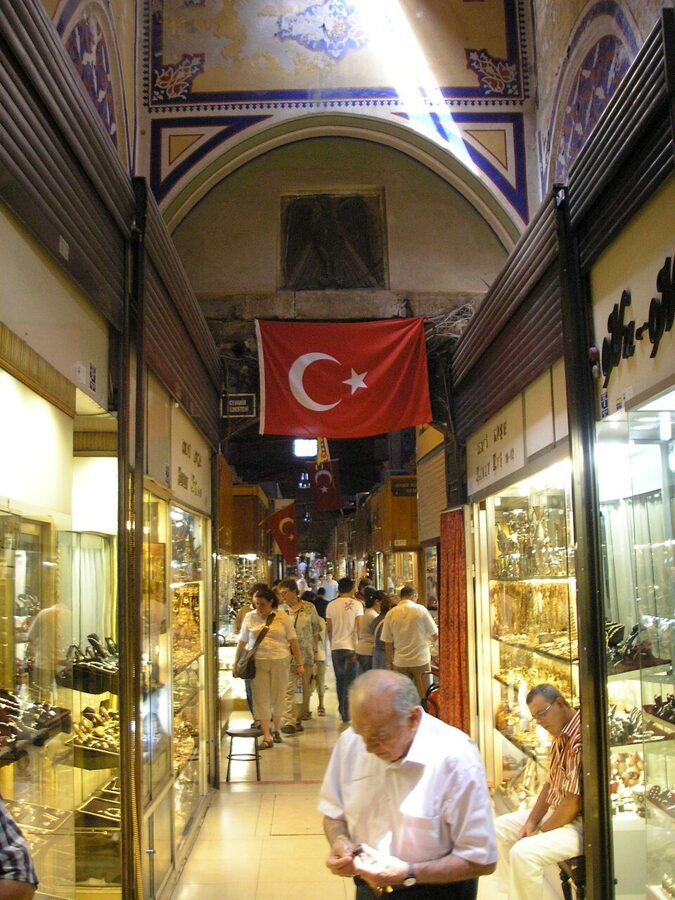
At first the two halls stood alone among ruined churches and a cistern. Shops filled the gaps between them and the Beyazıt mosque, then roofed lanes joined the shops, and by the early 17th century the bazaar had reached roughly its present outline. Around 1638 the traveler Evliya Çelebi counted 67 streets, 5 mosques, 7 fountains, 18 gates and about 3,000 shops, with another 300 in the surrounding hans: something like a tenth of all the shops in Istanbul.
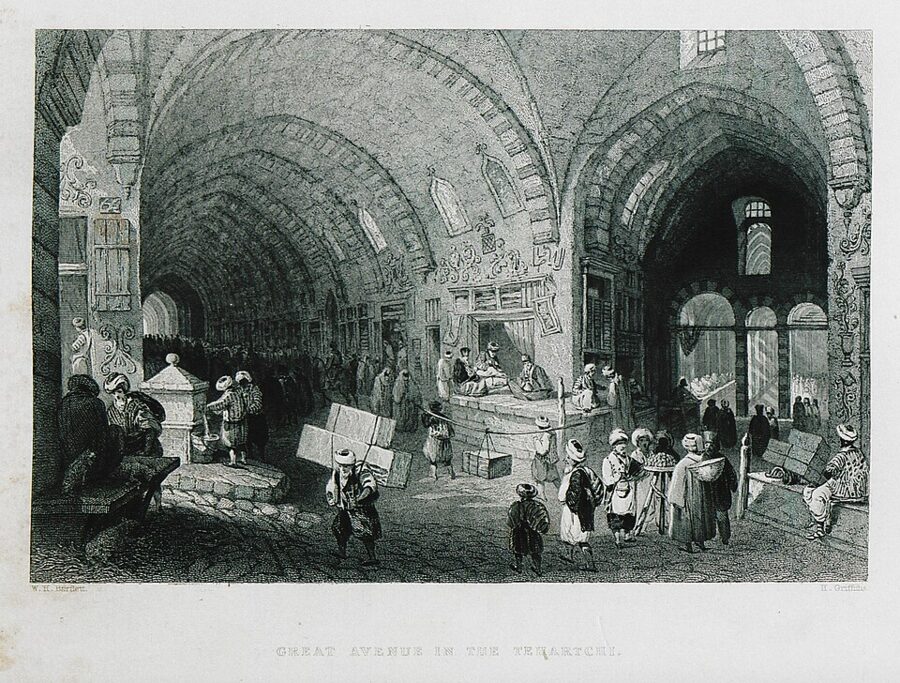
Fires, earthquakes and a roof
Fire is the bazaar’s real history. The recorded fires run from 1515 and 1548 through 1588, 1618, 1645, 1652, 1658, 1660, 1687, 1688 and 1695 to 1701, which was the worst. A fire regulation of 1696 ordered the lanes between the bedestens vaulted over in masonry, and after the 1701 fire the grand vizier Nevşehirli Damat İbrahim Paşa rebuilt much of the complex in stone and brick in 1730–31. That is when the market became properly covered, and the name Kapalıçarşı started to make sense.
More fires followed in 1750 and 1791, and the earthquake of 1766 brought damage repaired by the court architect a year later. The earthquake of 1894 was the last great blow: walls and a dome came down, the repairs ran to 1898, and the rebuilt bazaar was smaller than before. The old flea market on the west side was left outside as an open street, and several hans that had been part of the bazaar ended up beyond its walls.
The 20th century added two more fires, in 1943 and 1954, with repairs finished in 1959, and a restoration in 1980 that also stripped the advertising hoardings off the walls. Two stories from the older record are worth carrying in with you. In 1591 thieves took 30,000 gold coins from the old bedesten and the bazaar stayed shut for two weeks until the gold turned up under a floor mat; and the only official night opening in its history came in 1867, when Sultan Abdülaziz rode through the lit-up lanes on horseback after a trip to Egypt.
Guild streets and their names
Ottoman trades were organized in guilds, each under an officer called the kethüda, and each guild had its street. Prices, quality and the number of shops were fixed, and a new trader got in only by inheriting a place or buying out a retiring member. The guilds were abolished in 1913, and in 1927 the streets were given the official names they still carry.
Those names are a vocabulary lesson in trades that have mostly gone. Kalpakçılar were fur-cap makers, Fesçiler made fezzes, Yorgancılar quilts, Terlikçiler slippers, Takkeciler skullcaps, Zenneciler women’s clothes, Aynacılar mirrors and Sahaflar sold books. Today the main street named for the cap makers sells gold, carpets fill much of Sahaflar Caddesi, and the leather shops are along Perdahçılar (the polishers).

The restoration, and what it changed
By the 2000s the bazaar was in poor shape: lead had been stolen from the roof and replaced with concrete, shopkeepers had cut back columns and walls to gain space, and the press called it an earthquake risk. A full restoration was announced more than once from 2012. The work that stuck began after a protocol signed at the Istanbul governorship in June 2020; in November 2021 the Fatih mayor, Mehmet Ergün Turan, said the first of two planned years was done, covering floors, cracks and the painted decoration.
By September 2024 the roof had been renewed in its historic form, and reports described the rest of the work as continuing. It goes on in phases while the shops trade, so expect a scaffolded corner rather than a closed street. In 2026 the bazaar kept its usual hours apart from the bayram closures.
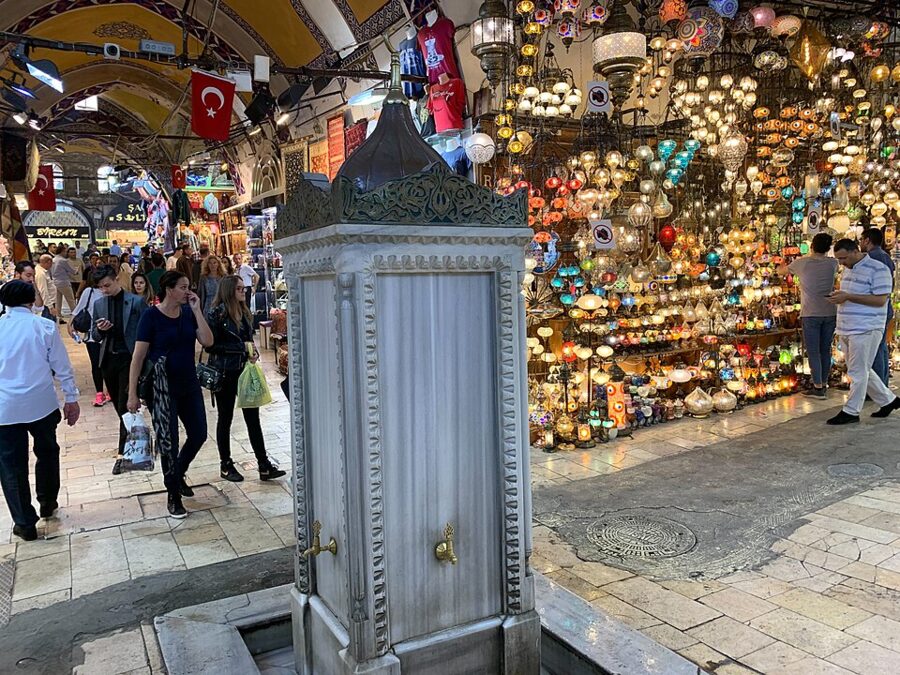
The visible change is underfoot and overhead: new paving, cleaned vaults, and freshly repainted ornament along the main streets. The less visible one is the roof, which is now something you can walk on, with an escort.
How the bazaar is laid out
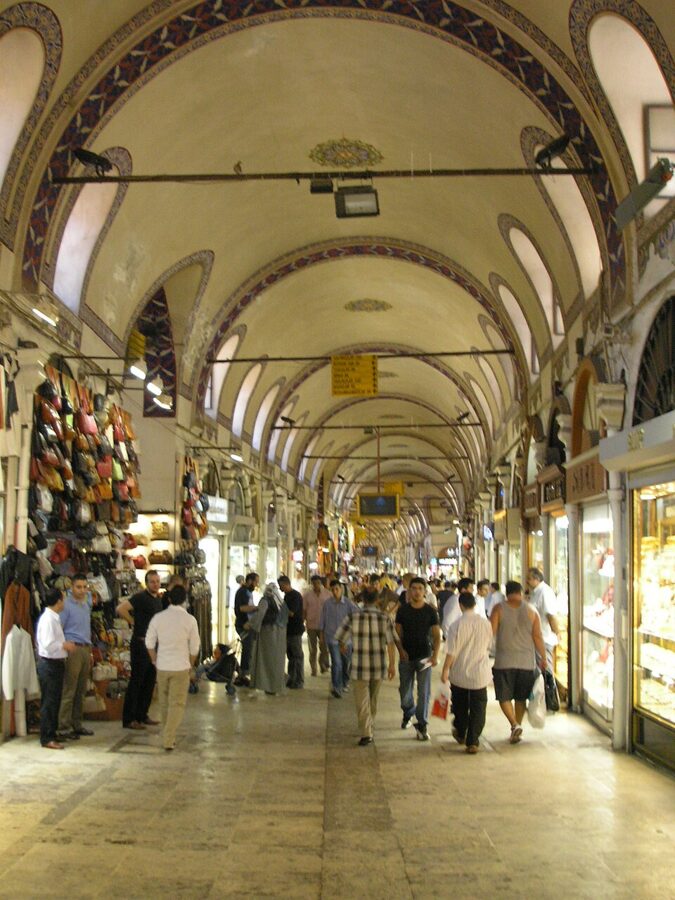
The bazaar is a rough rectangle on a slope, higher in the south and west, dropping toward the Golden Horn in the north. One straight street does most of the work: Kalpakçılar Caddesi runs from the Beyazıt Gate in the west to the Nuruosmaniye Gate in the east, lined almost the whole way with gold and jewelry shops. Learn it first. Everything else is a rib off it, and if you lose your bearings, walking uphill brings you back toward it.

North of the spine, in the middle of everything, stands the İç Bedesten. It measures about 43 by 30 meters: eight stone piers in two rows carry fifteen brick domes, and 44 windowless vaulted cellars (mahzen) are built into its walls, which served as the city’s safe-deposit boxes. Its four gates are named for the trades outside them: Sahaflar to the north, Takkeciler to the south, Kuyumcular to the east and Zenneciler to the west.
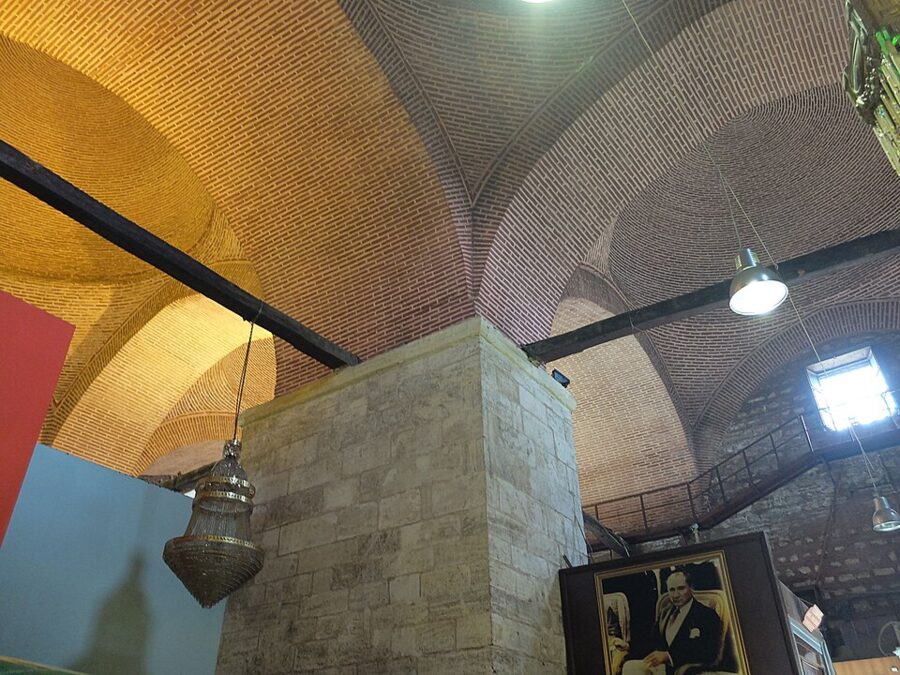

Treat the İç Bedesten as a small museum you are allowed to shop in. The stock is older and dearer, the light is dim, and the dealers are used to people who look. Ask before photographing a showcase, and step aside when a customer comes in.
A short walk east is the Sandal Bedesteni, roughly 40 by 42 meters, with twelve piers under twenty domes. It took its name from sandal, a cloth woven in Bursa in the color of sandalwood, and the silk trade moved here once it was built. European competition ruined the cloth dealers; the city bought the hall in 1914 and from 1915 used it as an auction room, mostly for carpets. In 2018 part of it was let to a celebrity steakhouse, and the chain’s sign on the historic gate caused an outcry.
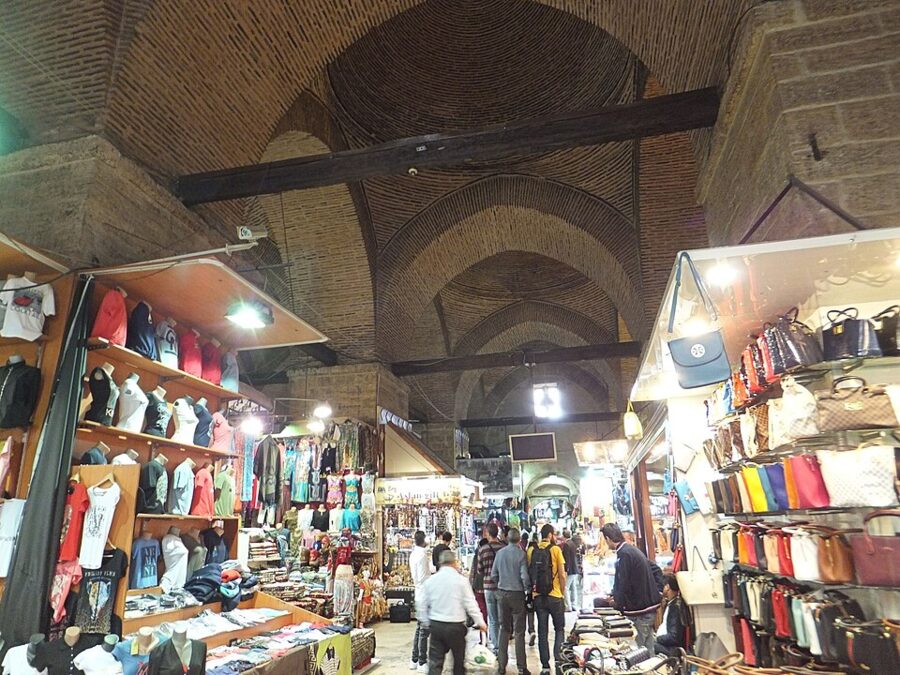

The gates worth knowing
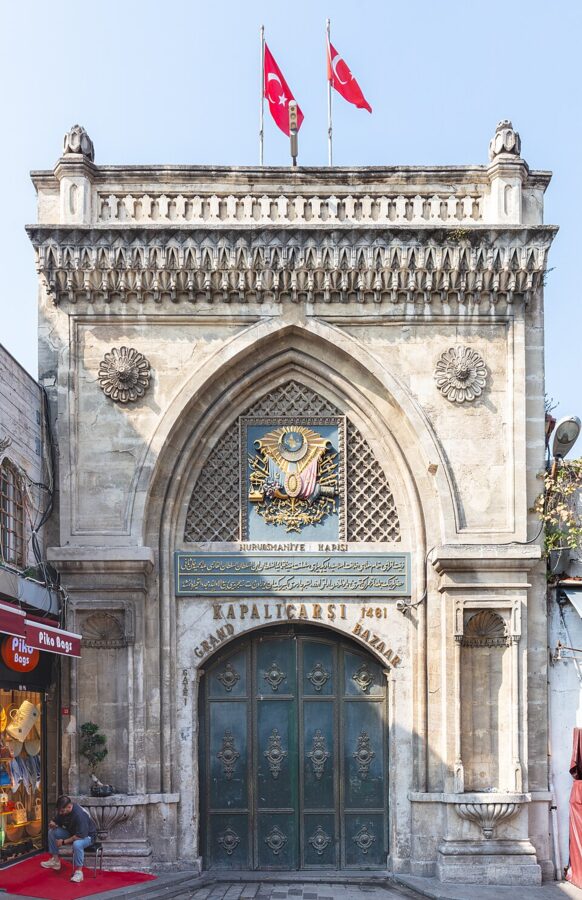
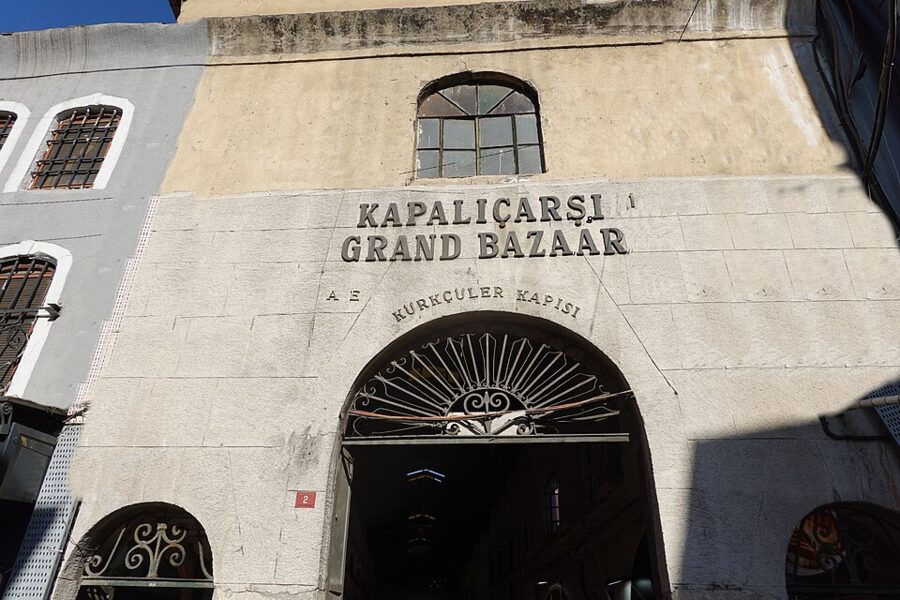
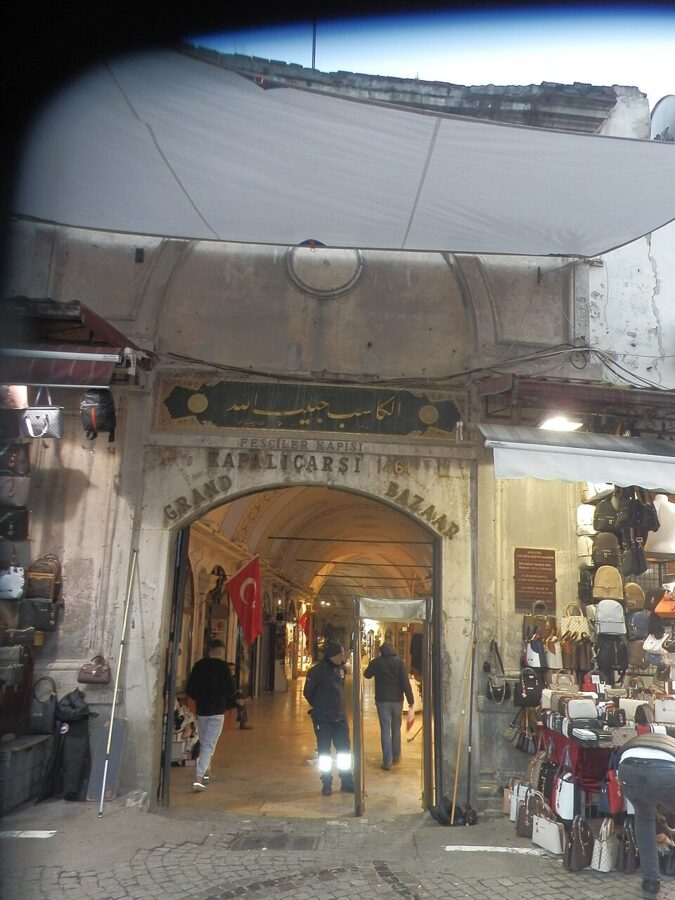
There are around 20 gates, depending on what you count as one. Four matter for planning.
| Gate | Side | Use it for |
|---|---|---|
| Nuruosmaniye | East | Arriving from Sultanahmet or the Çemberlitaş tram stop; drops you on the main street |
| Beyazıt | West | The Beyazıt–Kapalıçarşı tram stop, Beyazıt Square, the Sahaflar book market and the university |
| Örücüler | North | Büyük Valide Han and Çakmakçılar Yokuşu |
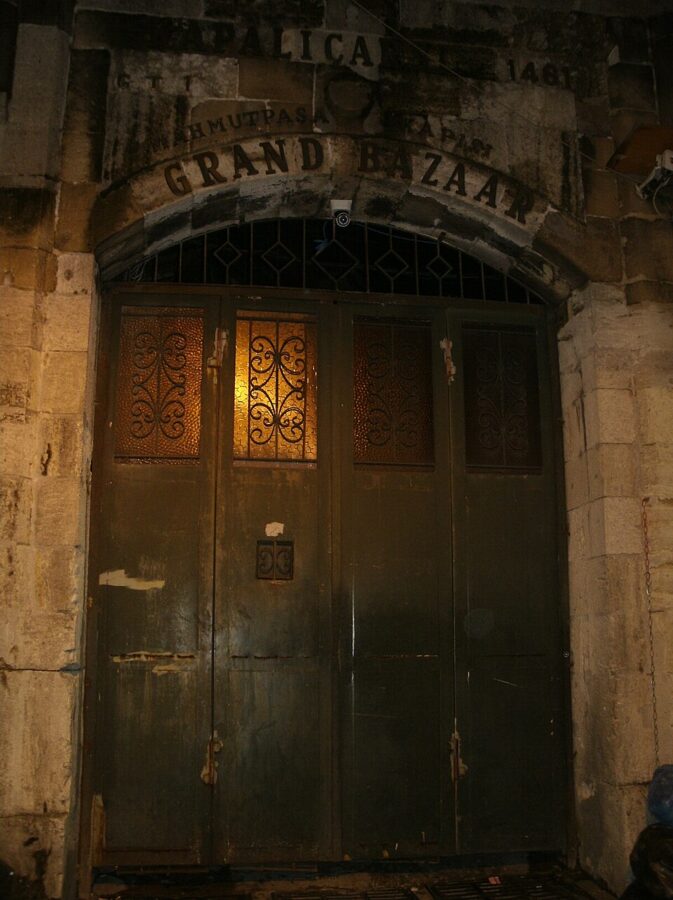
| Mahmutpaşa | North-east | The walk downhill through the wholesale streets to the Spice Bazaar and Eminönü |

A two-hour walk through it
This route assumes you start from Sultanahmet, where most of the old city’s hostels are (the Istanbul travel guide covers the neighborhood), and want to end either at a tram stop or at the ferries. It costs nothing until you choose otherwise.
- Çemberlitaş tram stop to the Nuruosmaniye Gate (5 minutes). Walk through the courtyard of the Nuruosmaniye Mosque, begun under Mahmud I in 1748 and finished in 1755, Istanbul’s first big mosque in the Ottoman Baroque style. The arcade of shops along its wall was built to pay for it.
- Kalpakçılar Caddesi (20 minutes). Walk the gold street to the Beyazıt end and back, without stopping to buy. Note the side streets.
- The İç Bedesten (20 minutes). Enter by the Kuyumcular Gate and look for the eagle; leave by the Sahaflar Gate on the north side.
- The Sandal Bedesteni and the lanes around it (15 minutes).
- Zincirli Han (15 minutes). In the north-east corner, by the Mahmutpaşa Gate.
- Out through the Mahmutpaşa Gate. From here either go down Mahmutpaşa Yokuşu to the Spice Bazaar and Eminönü (20 minutes with stops), or cut west through the lanes to Büyük Valide Han and take the slower way down by Çakmakçılar Yokuşu.
- Or loop back west via the Halıcılar fountain and leave by the Beyazıt Gate for the book market and the tram stop.

The northern exit is the one I would take. Downhill is easier on the legs, the streets beyond the gate are where Istanbul does its own shopping, and the walk ends at the water. If you would rather go uphill from there to the Süleymaniye Mosque instead, the Süleymaniye walk down to the Golden Horn picks up a few streets away.
The hans the tour groups miss
A han is a merchants’ inn: a courtyard building with storerooms and workshops below, and rooms above where traveling traders once slept and kept their goods. The bazaar and the streets around it are full of them, some inside the walls and many outside since the 1894 rebuilding. The tour groups stay on the main streets, and the hans are where you see the bazaar working: silver being worked, gold being weighed, porters (hamal) carrying bolts of cloth on their backs.
Zincirli Han
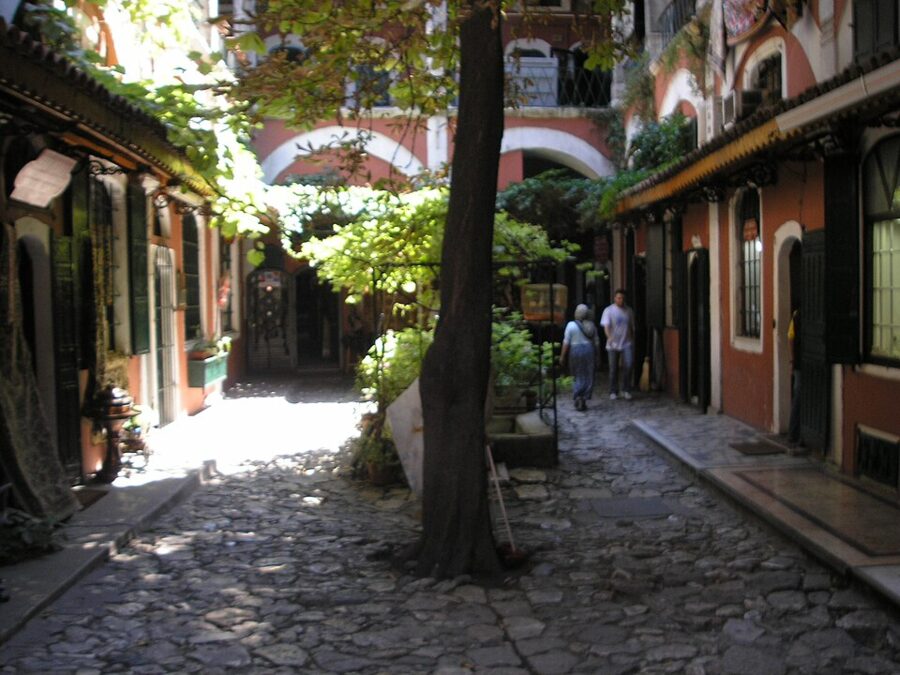
Zincirli Han, the “han with the chain”, sits in the north-east corner of the bazaar, a few steps from the Mahmutpaşa Gate. It dates from the early 18th century (1708 is the date usually given) and is the best-kept courtyard inside the walls: a two-story arcade around a cobbled yard with a tree in it. Jewelers’ workshops fill the upper floor, and a few of the ground-floor shops sell what is made above.
Büyük Valide Han and its roof
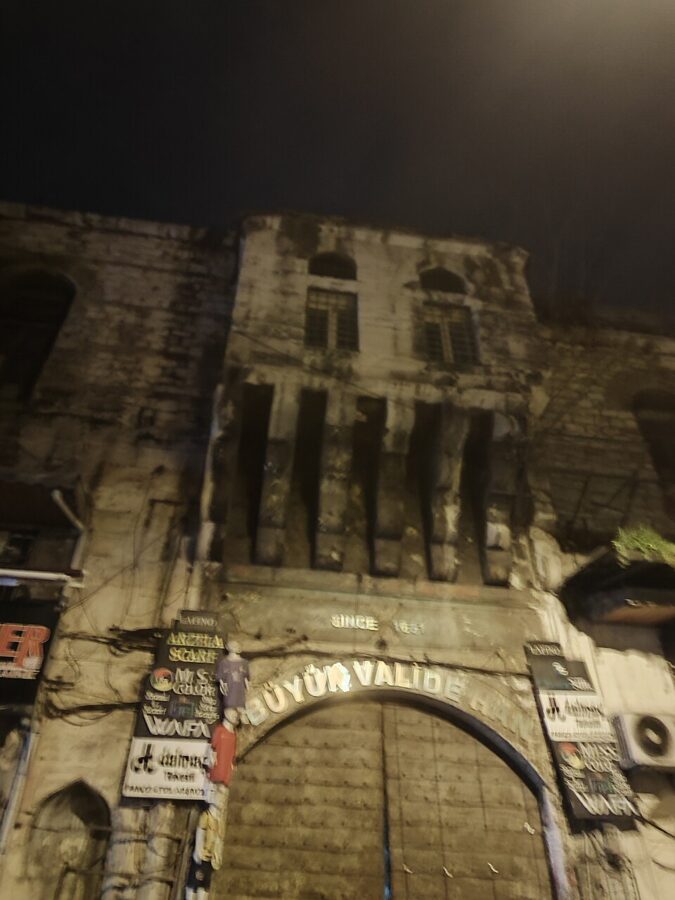
The largest han in Istanbul is just outside the bazaar, a three-minute walk from the Örücüler Gate on the north side, with its entrance on Çakmakçılar Yokuşu. Kösem Sultan, mother of the sultans Murad IV and İbrahim, had it built in the mid-17th century (most sources give 1651, the year she was murdered), and its rents went to her mosque complex in Üsküdar. It has three courtyards on sloping ground and two stories, and in one corner stands a tower older than the han, which scholars connect with the Byzantine city.

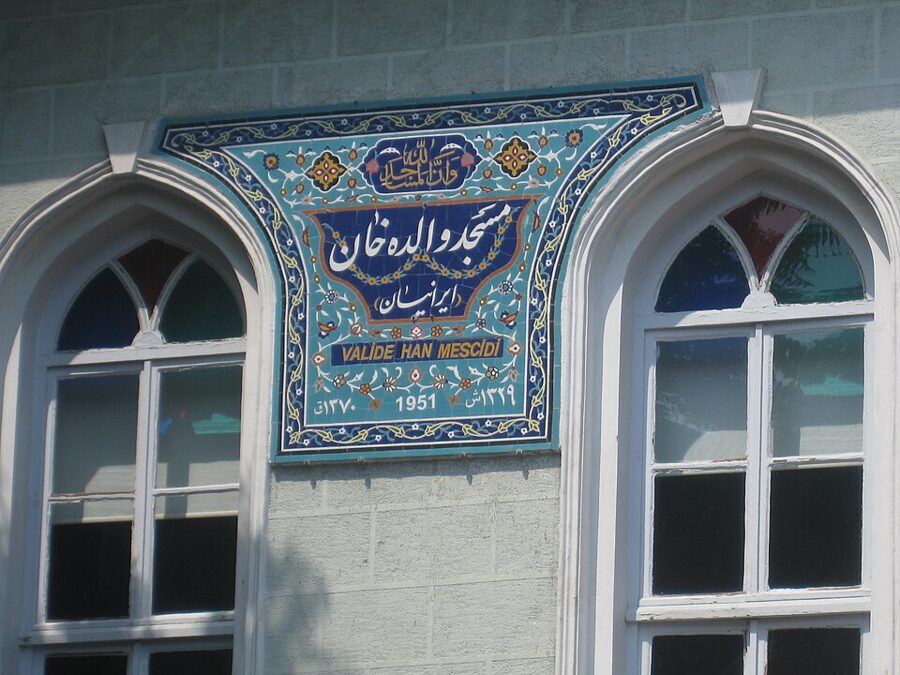
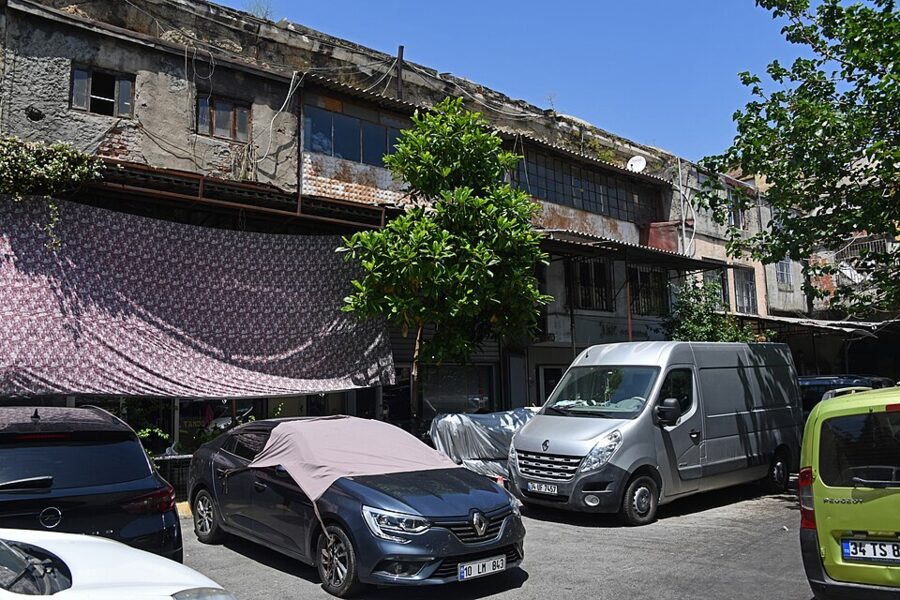
For centuries the han was the base of Istanbul’s Iranian merchants, and a small Shia mosque still stands in one of the courtyards. Today the rooms hold workshops, storerooms and wholesalers, and a courtyard doubles as a car park. It is shabby, busy and entirely real, which is the point of going.

The roof is the famous part, and here I would manage expectations. Photographs of the domes with the Golden Horn and Süleymaniye behind them are everywhere, and for years visitors were let up informally. No authorized roof access with a fixed schedule could be confirmed in late 2026, and the roof is uneven, unfenced and in places fragile.
If someone offers to take you up for a fee, that is their arrangement, not the building’s, and you are on your own up there. I would skip it and spend the money on the bazaar’s own supervised roof walk, below. The courtyards are worth the visit by themselves.

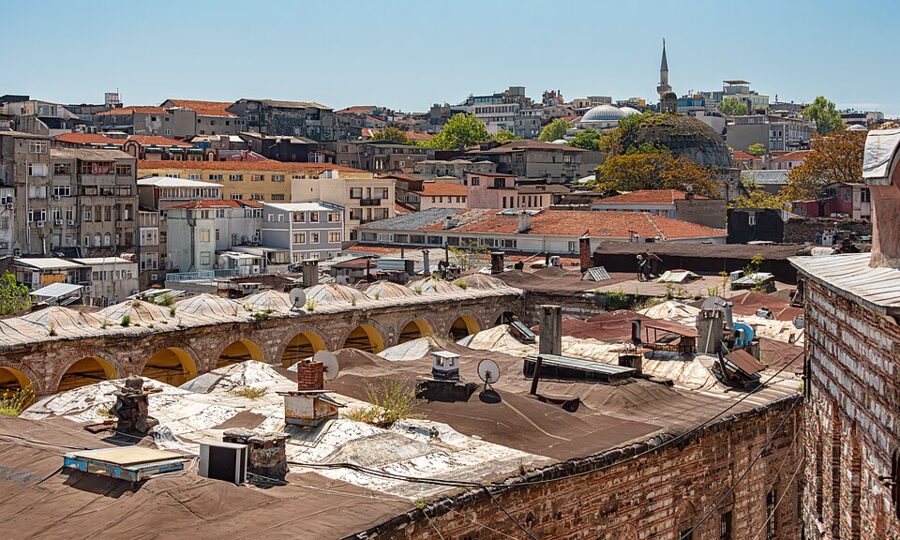

The bazaar’s own roof
The restoration opened a legal way up. In 2024 the owners’ board started escorted tours of the Grand Bazaar roof, along the walkway known as the kedi yolu (the cat path), booked through travel agencies, in groups of ten for about 20 minutes. Children under 15 and adults over 80 were not taken, every visitor was insured before going up, and the board’s then chairman, Fatih Kurtulmuş, said the fees went toward the bazaar’s upkeep.
The Fatih municipality also runs a free guided Hanlar Turu (hans tour) of the bazaar’s inns that takes in the roof, with registration through the municipality; places filled fast in 2025 and 2026. This is one of the few places where I would accept a tour: you cannot get onto that roof alone, and the view of the Skyfall chase rooftops with Süleymaniye on the hill behind is the best free hour in the district. Check the group size, the time on the roof and the cancellation terms, and that the guide is licensed, before paying anyone.
Kalcılar Han and the silver workshops
Kalcılar Han stands on Mahmutpaşa Yokuşu, just below the Mahmutpaşa Gate. The name comes from kal, the old trade of melting down and refining precious metal, and the building still houses silversmiths and silver manufacturers who supply the shops above. Its business listings read like a directory of the trade: workshop after workshop of silver makers and wholesalers on its floors.
Nothing here is laid on for visitors, which is why it is worth five minutes. The same goes for the dozens of smaller hans along Mahmutpaşa Yokuşu, Çakmakçılar Yokuşu and Uzunçarşı Caddesi: every open courtyard gate is an invitation to look, as long as you behave like a guest in someone’s workplace.
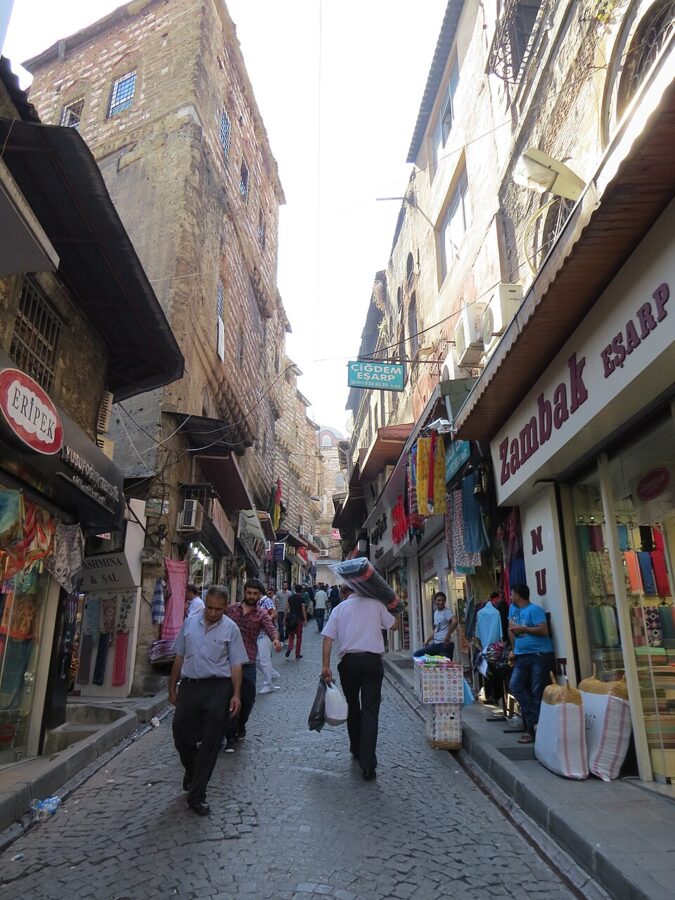

Kürkçü Han
Further down Mahmutpaşa Yokuşu is Kürkçü Han, the furriers’ han, built around 1467 by Mahmud Pasha, Mehmed II’s grand vizier. It is the oldest surviving han in Istanbul and today a yard of yarn and haberdashery stalls with a worn two-story shell around it. Istanbul knitters come here for wool, and it is the most ordinary shopping in the district, which is exactly why it is worth seeing.
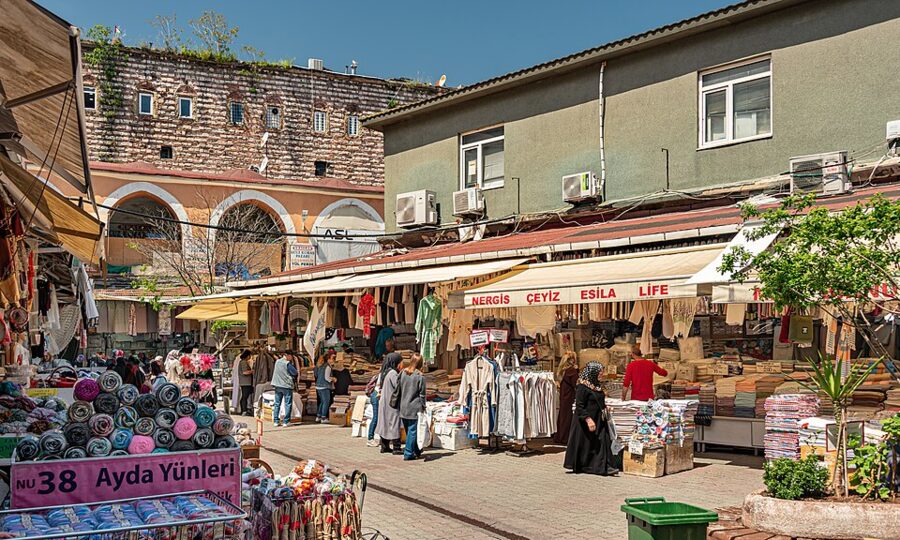

Visiting a working han
- Go on a weekday morning, when the workshops are busy and the courtyards are open; on Sundays many are shut.
- Porters with loads have right of way on every stair and passage. Step aside before they ask.
- Ask before photographing anyone at work, and accept a no.
- Stay on the ground floor and open galleries; a closed door or a dark stair is someone’s workshop or storeroom.
- Buy a tea from the han’s tea stove (çay ocağı) if there is one. It is the polite way to sit down, and it is cheap.
Shopping without being taken
The bazaar’s prices are aimed at people who will be gone tomorrow, and the main streets are the dearest square meters in the city. That does not make shopping here a mistake. It means you do it with a price in your head, three shops compared, and the willingness to walk out.
Haggling in practice
Not everything is negotiable. Gold is sold by weight at the day’s gram price, displayed on screens, plus a workmanship charge (işçilik); you can bargain the workmanship, not the gold. Food, tea and anything with a printed price tag are fixed. Carpets, leather, lamps, ceramics, scarves and souvenirs are open, and the first price usually assumes you will push back.
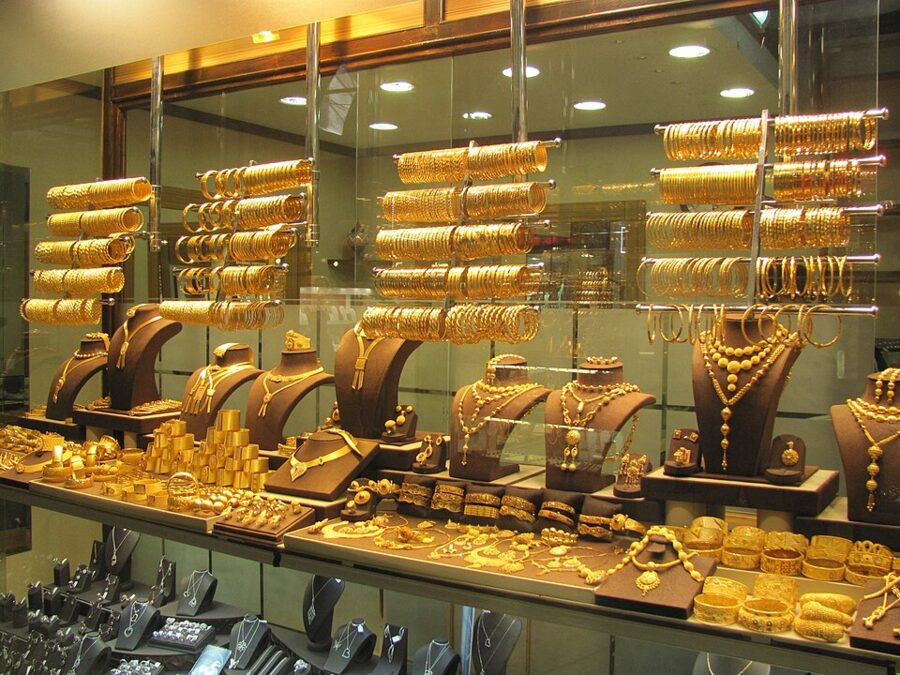

My method is plain. Decide what the thing is worth to you before you ask, ask the price, show real interest, and make one counter-offer well below your ceiling. For souvenirs on the busy streets, open at about half the asking price and expect to settle somewhere between half and two-thirds. Walking away is a normal move and nobody takes offense, but walking away over the last 50 lira on something you love is a bad trade.
Ask for the price in lira. Many shops quote tourists in euros or dollars, and the shop’s exchange rate is rarely the bank’s. Accepting tea does not commit you to buying anything; both sides know that, and saying “teşekkürler, bakıyorum” (thanks, I’m just looking) is enough.
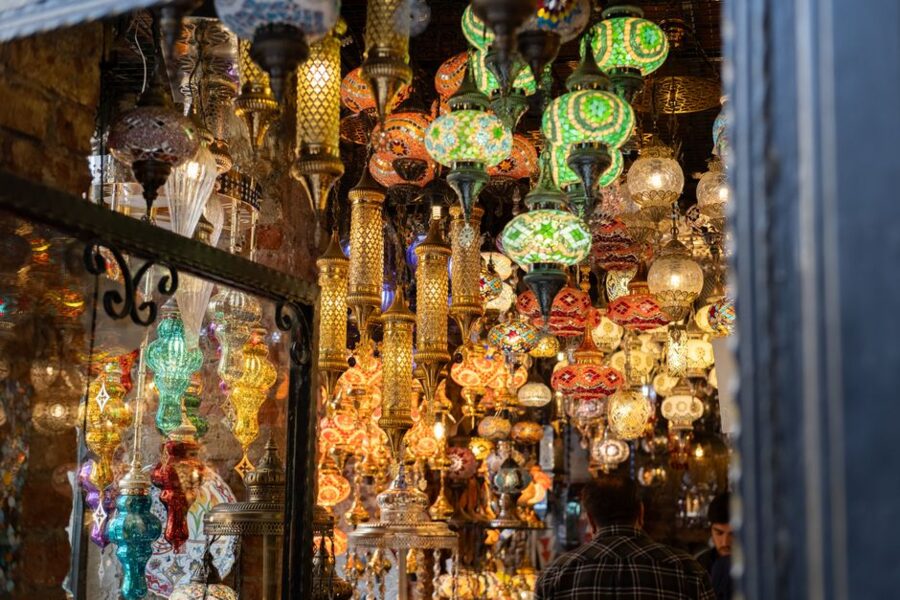
What things cost in 2026
There is no price list, and the bazaar’s own prices move with the customer. The useful benchmark is what the same thing costs elsewhere in Turkey. These are online retail prices from November 2026, which is what a Turkish shopper would compare against.
| Item | Benchmark in Turkey, November 2026 | What to watch for |
|---|---|---|
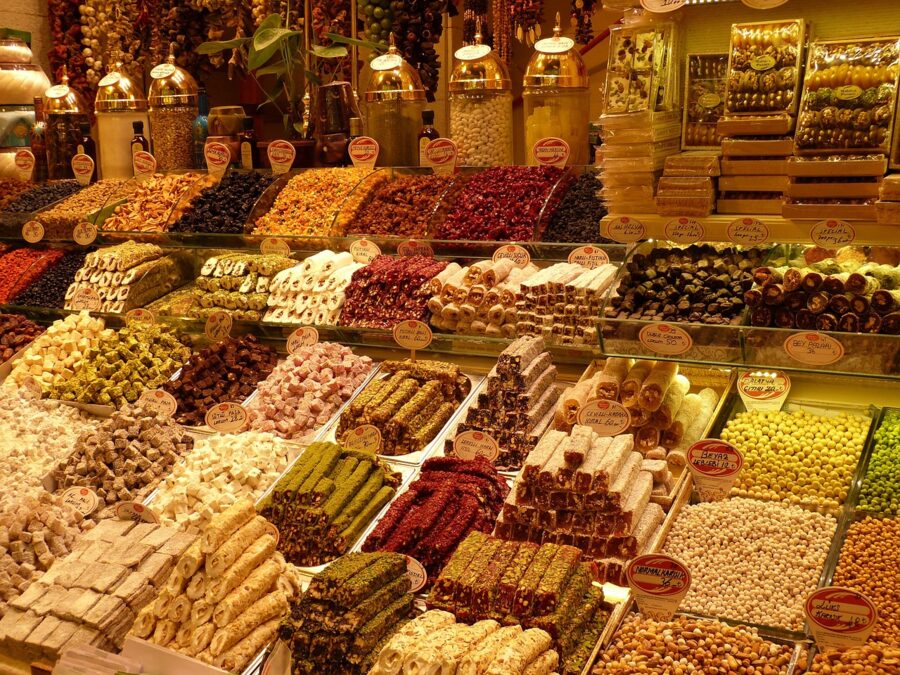
| Lokum (Turkish delight), mass-market brand | About 145 TL for 500 g mixed flavors; about 300 TL for 500 g with pistachio | Loose lokum in tourist lanes is sold per 100 g or by the box; ask the kilo price |
| Lokum, premium confectioner | About 1,250–1,350 TL a kilo | Pistachio content sets the price; the label gives the percentage |
| Peştemal (flat-woven hammam towel) | About 245–550 TL for cotton | Check the label for cotton or linen; polyester blends are lighter and shinier |
| Silk scarf from a Turkish brand | About 1,100 TL; 6,800 TL and up from a luxury house | A “silk” scarf priced like a towel is viscose or polyester |
| Leather jacket from a chain store | From about 2,500 TL | Compare seams, lining and smell before you compare prices |
| Gold | The day’s gram price on the screens, plus workmanship | Bargain the workmanship only, and ask for the carat and weight on the receipt |
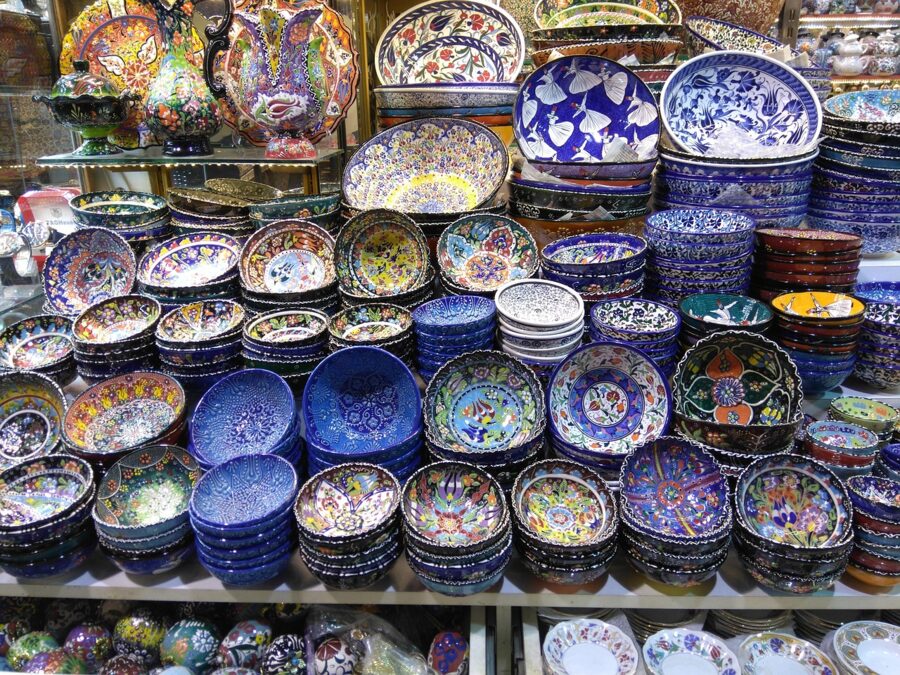
For lamps, ceramics and carpets there is no fair single figure, because hand work and factory work sit side by side at very different prices. With ceramics, learn one distinction: hand-painted pieces show small irregularities in the brushwork and cost accordingly, while transfer-printed ones are perfectly uniform and cheap. Both are fine to buy. Just know which one you are paying for.
Fakes, and the law at home
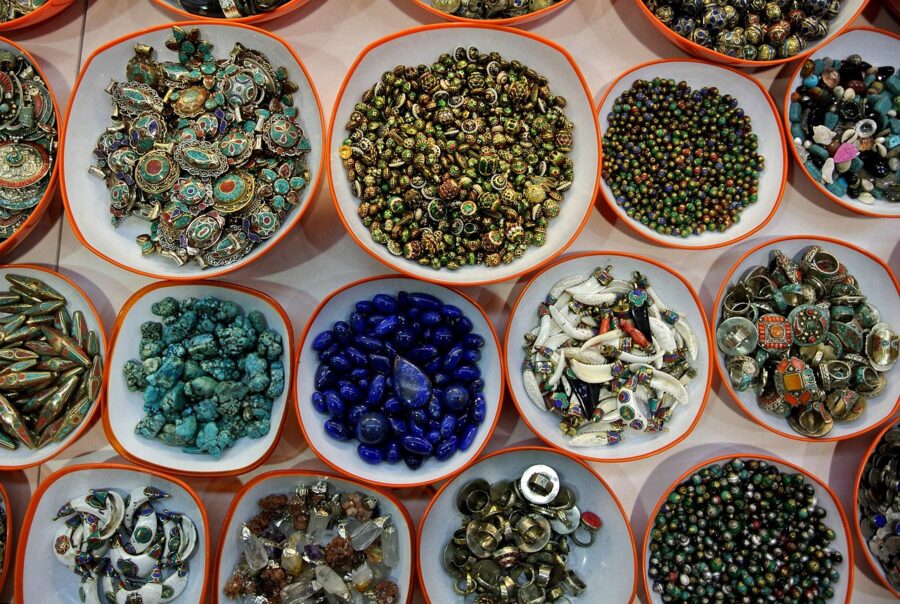
The “genuine fake” handbags, watches and football shirts are sold openly in and around the bazaar. Buying one is not the problem in Turkey; bringing it home can be. United States customs lets a traveler keep one article of each type bearing a counterfeit trademark, for personal use, once every 30 days; three fake handbags mean two are seized, and selling the one you keep within a year makes it forfeit.
Elsewhere the rules vary, and European customs can seize counterfeits from luggage, with fines in some countries. Read your own customs agency’s page before you buy. The quieter fakes are the ones to worry about: the “antique” that is new, the “handmade” carpet that is machine-woven, the “silk” that is not.
Carpet shops
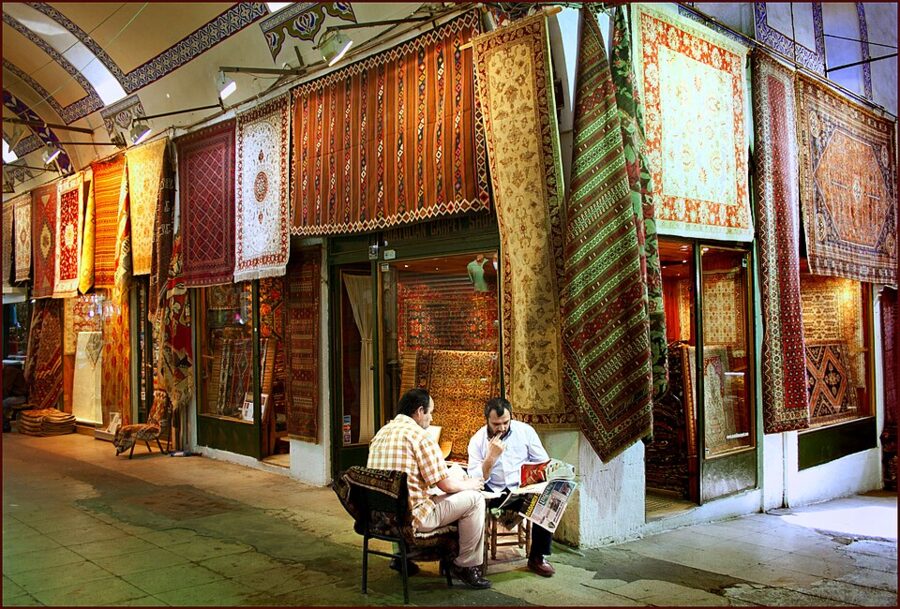
The carpet shop is the bazaar’s set piece: tea, a stool, and a young man unrolling forty rugs at your feet while the owner explains each one. It is pleasant, and it is designed so that you feel you owe something by the end. You do not.
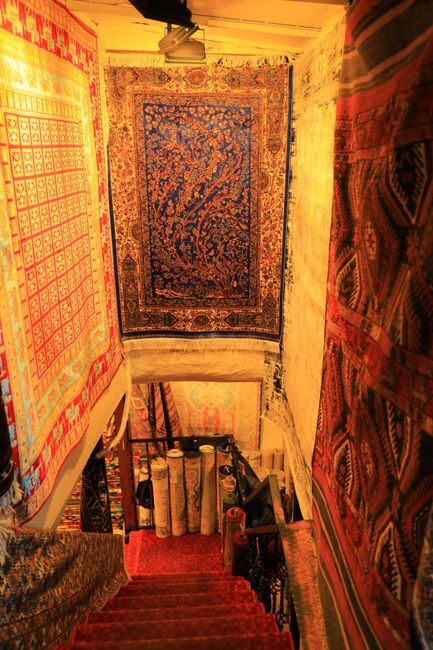
- The friendly walk. Anyone who starts a conversation in the street and offers to show you a cousin’s, uncle’s or friend’s shop is on commission, and you pay it. The approach is common between Sultanahmet and the bazaar.
- Check the back. On a hand-knotted carpet the pattern shows through clearly on the back, and the knots are slightly irregular; a machine-made rug has a uniform grid and often a glued or latex backing.
- Price by area. Ask the price per square meter and the knot count, and compare two or three shops on the same basis.
- A certificate is only paper. A shop’s own “certificate of authenticity” proves nothing; the itemized invoice with size, material, origin and age is what counts.
- Carry it if you can. The risk with shipping is that what arrives is not the carpet you chose, or arrives months late. A kilim folds into a backpack; if you must ship, photograph the piece, its back and its label, and get tracking and insurance in writing.

Antiques and the export law
Turkey takes this seriously. Under the Law on the Protection of Cultural and Natural Property (No. 2863), movable cultural property that needs protection cannot leave the country, and exporting it is punished with five to twelve years in prison and a judicial fine. Some old ethnographic objects may be bought and sold freely inside Turkey, but anything old-looking leaving the country can be inspected by museum specialists, and an item judged not exportable is handed back for you to keep in Turkey.
In practice, coins, icons, manuscripts, old ceramics, seals, Ottoman jewelry and genuinely old carpets are the objects most likely to count as cultural property, and coins are the easiest to buy without thinking. For anything old, ask the dealer for an itemized invoice and a document from a museum directorate stating it is not a protected cultural asset, and do not accept “you don’t need paperwork”. For a new carpet, the invoice is your proof that it is new.
Cards, cash and the exchange rate
Most shops take cards, and some offer a lower price for cash in lira; ask both prices. If you pay by card, insist on being charged in lira and decline the offer to convert to your home currency on the terminal, which comes with a worse rate. Check the amount on the screen yourself before you tap.
Small things, tea and the toilets are easier in cash, and several banks have branches and machines in and around the bazaar. Use a machine attached to a bank branch, and see the Turkey travel tips for tipping and the other small-change habits.
The markets around it
The Kapalıçarşı is the center of a trading district that runs downhill all the way to the Golden Horn. Its neighbors are cheaper, rougher and more local, and three of them are worth more of your time than another hour on the gold street.
Sahaflar and Beyazıt
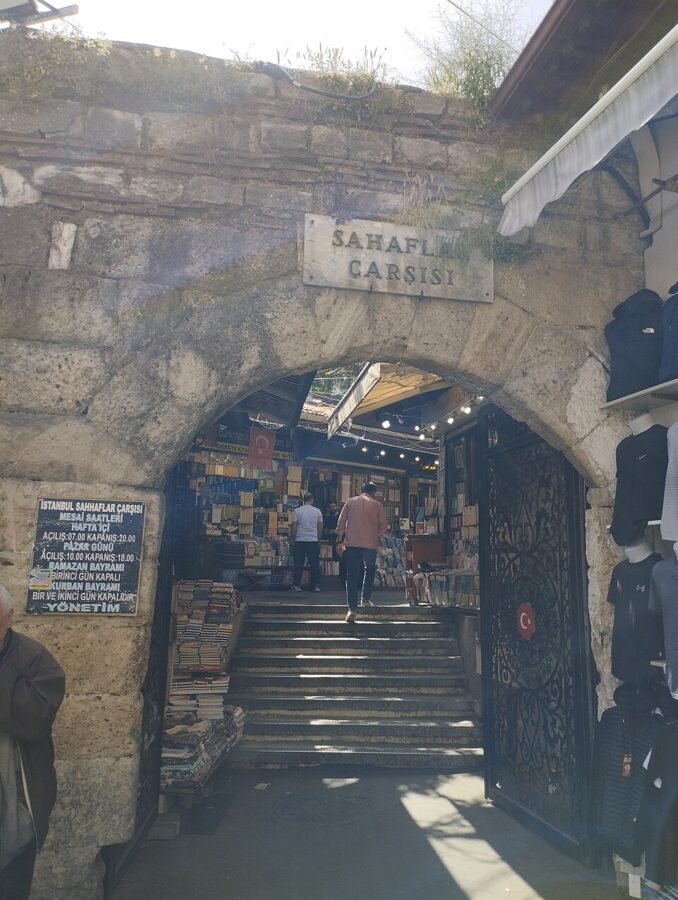
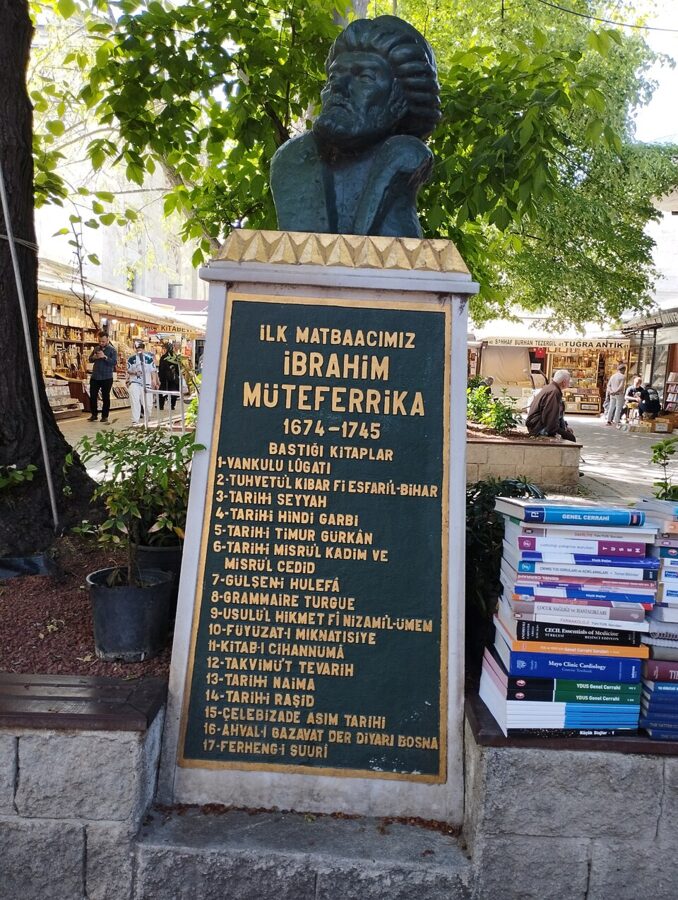
Leave by the Beyazıt Gate and the Sahaflar Çarşısı is a two-minute walk away. It is the secondhand book market, a shaded courtyard of small bookshops between the bazaar and the Beyazıt Mosque. The area sold books and paper in Byzantine times too, though the booksellers (sahaflar) only moved into this courtyard from inside the bazaar after the 1894 earthquake. A bust of İbrahim Müteferrika, who printed the first books in Ottoman Turkish in the 1720s, stands among the stalls.

Old engravings and maps are the souvenir here, and the export rule above applies to anything genuinely old. The Beyazıt Mosque next door, built for Bayezid II between 1501 and 1506, is the oldest surviving imperial mosque in the city. Like every mosque it closes to sightseers during the five daily prayers, and for longer at Friday noon.

Mahmutpaşa, downhill to Eminönü
Mahmutpaşa Yokuşu is the steep, unroofed street that runs from the Mahmutpaşa Gate down toward the Spice Bazaar. It is the wholesale and cheap retail strip of the old city: clothes, underwear, scarves, toys, wedding favors and kitchen goods, sold to Istanbul families and to traders from the provinces. Prices are a fraction of the bazaar’s, nobody speaks to you in four languages, and on a Saturday it is packed.
This was always the bazaar’s link to the port. Goods landed at the Eminönü quays went up this slope by porter and cart, and the grand vizier Mahmud Pasha built a mosque, a bath and a han along it in the 1460s, with a market of 265 shops around them. The bath, the Mahmutpaşa Hamamı of 1466, has long since been turned into shops, but its dome still rises over the stalls.
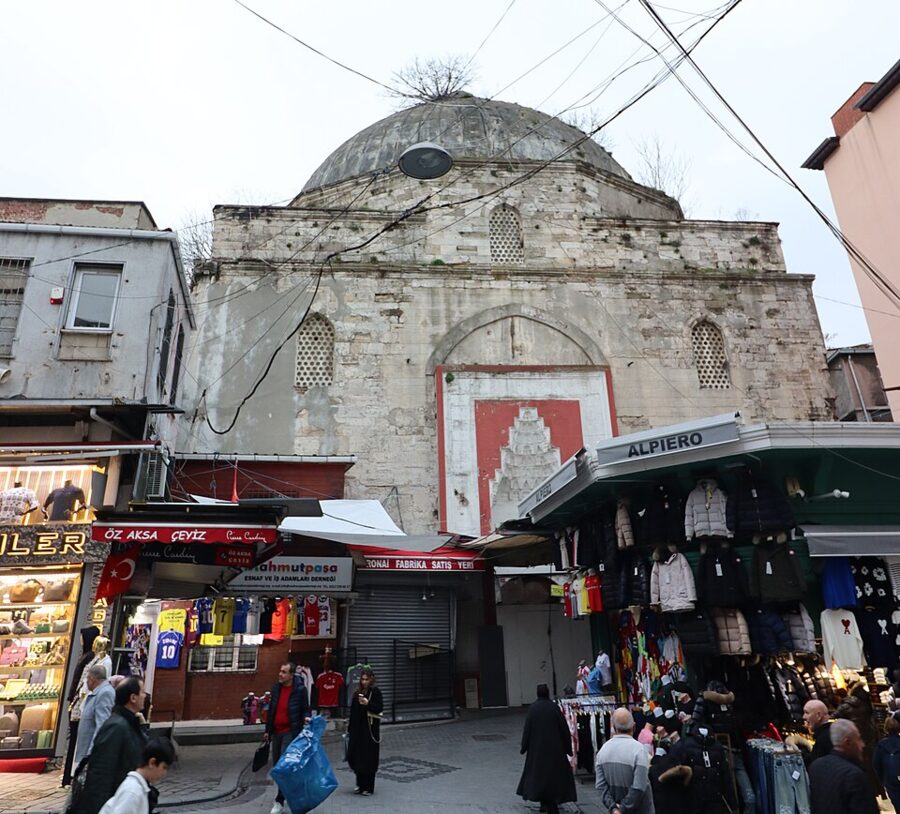

Allow 20 minutes to walk down, an hour if you browse. The street is narrow, porters push through with loads on their backs, and pickpockets work the crush, so keep your bag in front. At the bottom you come out among the coffee roasters and cheese shops on the west side of the Spice Bazaar.
The Spice Bazaar (Mısır Çarşısı)
The Spice Bazaar is the other covered market, smaller, L-shaped and built against the New Mosque at Eminönü. Safiye Sultan began the complex in 1597, and Turhan Hatice Sultan had it finished by the architect Mustafa Ağa in 1664; the market’s rents paid for the mosque. It was first called the New Bazaar or the Valide’s Bazaar and took the name Mısır Çarşısı (the Egyptian Bazaar) later, after the goods that came from Egypt.
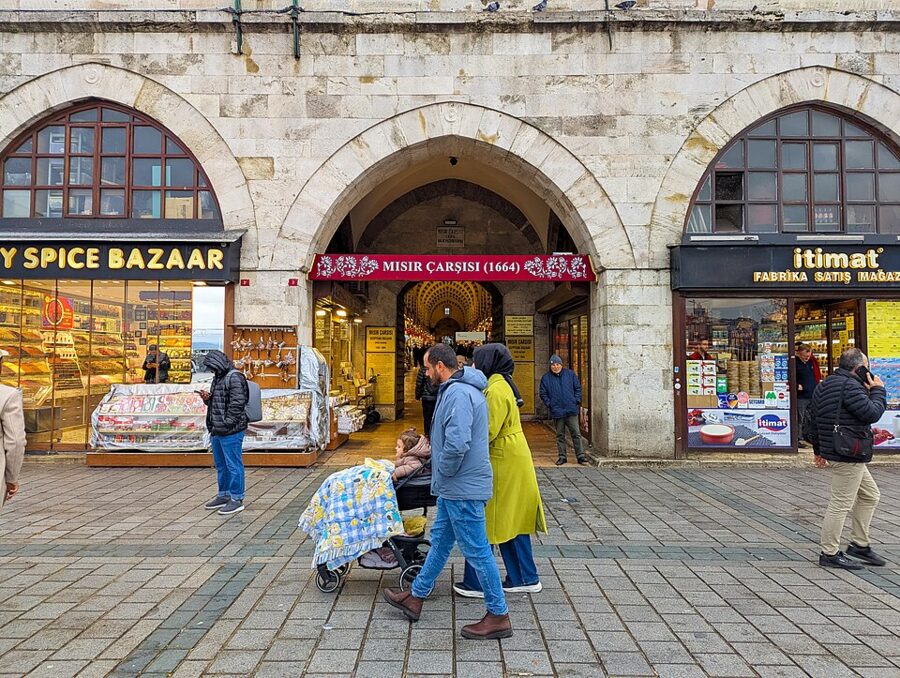

Unlike the Grand Bazaar it trades seven days a week, and the market’s own site gives the hours as 08:00–19:30. It still closes for the bayrams: both bazaars were shut for the four days of Kurban Bayramı in June 2025. It came through fires in 1691 and 1940, and today it is a two-story building with six gates.
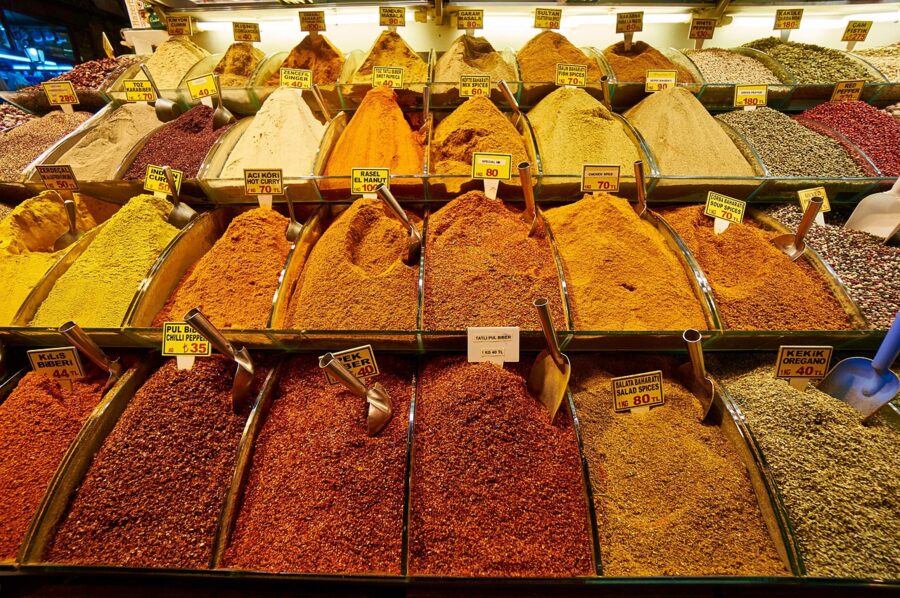
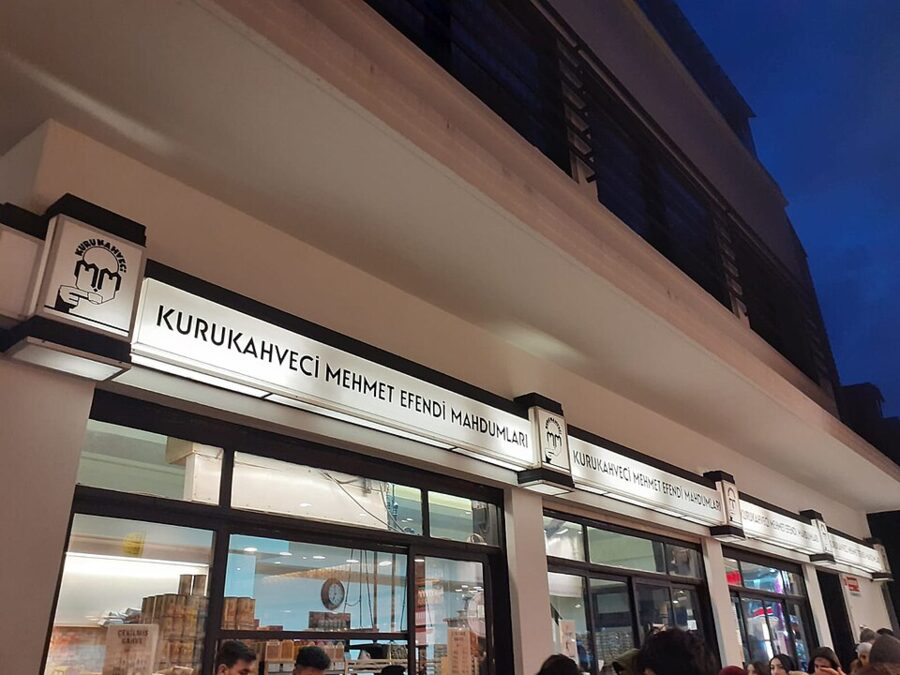
Inside it is now mostly lokum, dried fruit, tea blends and spice mixes at tourist prices, sold in vacuum packs, and the cheap “saffron” is usually safflower. The better shopping is outside. Kurukahveci Mehmet Efendi, the coffee roaster on Tahmis Caddesi by the western side, has been selling ground Turkish coffee to the city since the 19th century, and the queue at its window is the best coffee shopping in the district.

The Arasta Bazaar
The Arasta is a single straight street of shops below the Blue Mosque, built in 1617 as part of the Sultan Ahmed mosque complex, whose upkeep its rents paid for. It is small, tidy and aimed squarely at visitors: carpets, ceramics, towels, jewelry. Prices are no lower than in the Grand Bazaar, but it is calmer, and it trades on Sundays.
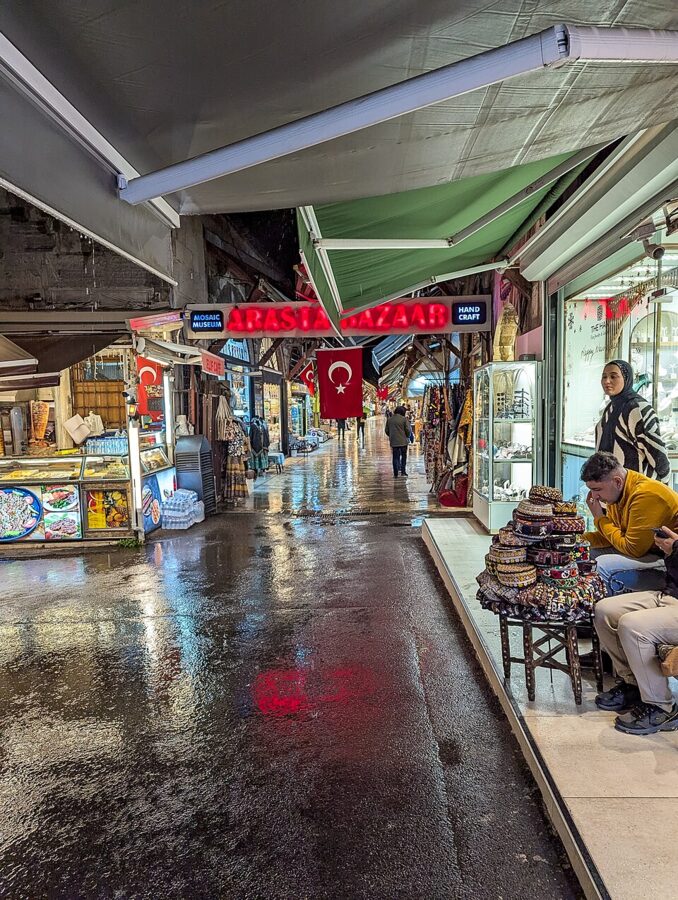

For local prices, go to Kadıköy on the Asian side, a 20-minute ferry from Eminönü, where the market streets around the fish market sell the same lokum, spices and towels to residents for less than either bazaar charges.
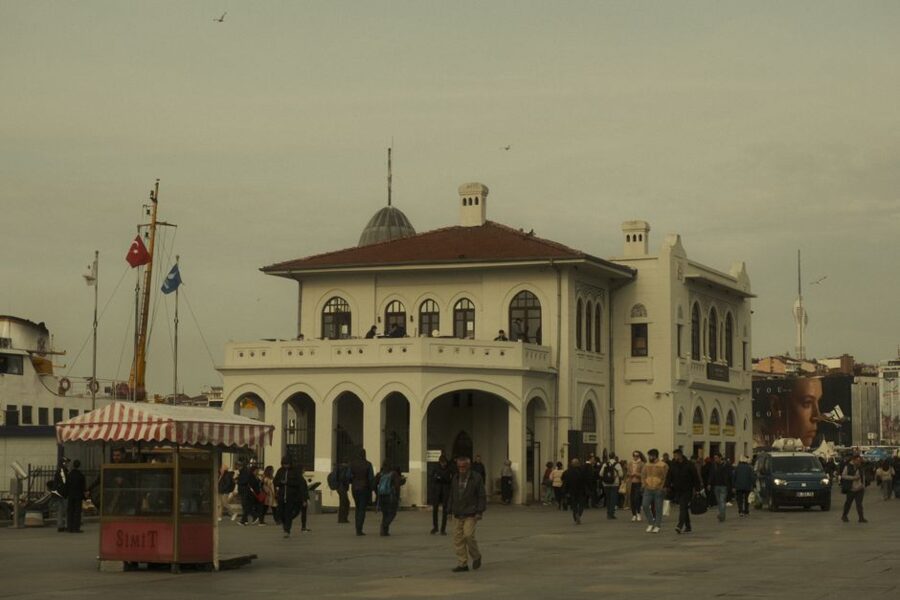
Tea, lunch, toilets and timing
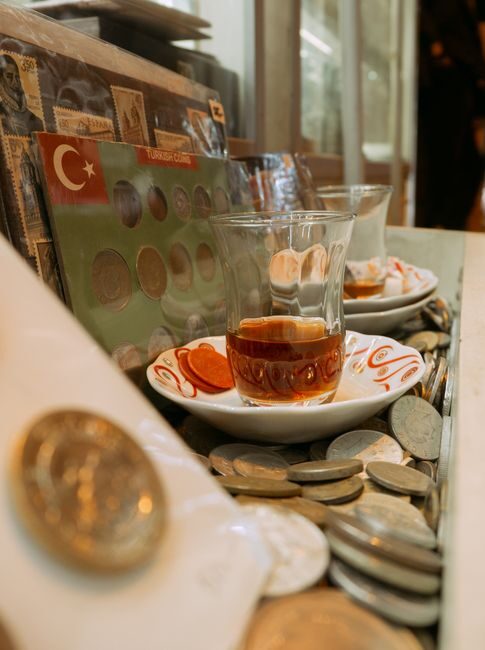
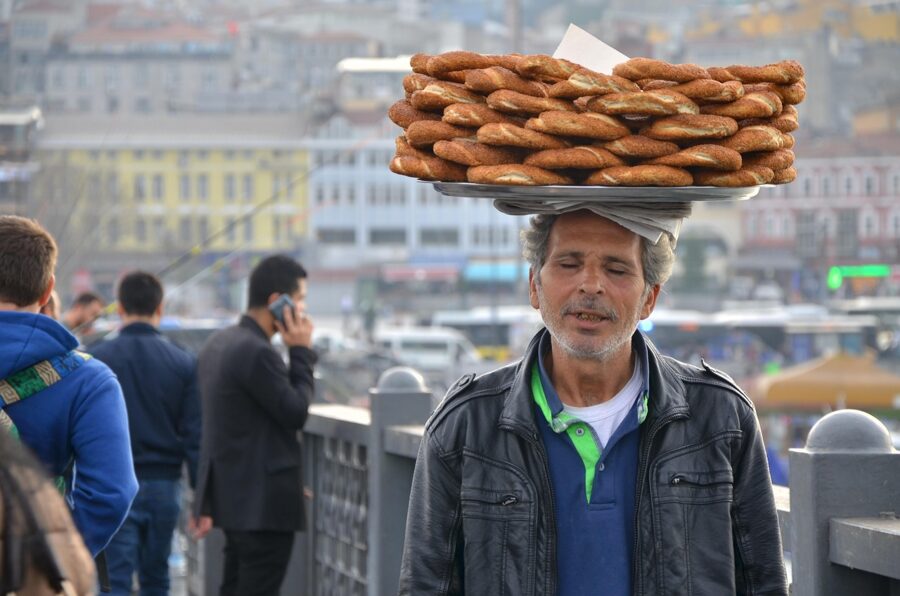
Eating cheaply in the bazaar is easy if you eat like the people who work there. Tea comes round on swinging trays from the tea stoves in the hans, and shopkeepers order it by the glass all day; if you are sitting in a shop for any length of time, it will reach you too. Simit sellers wait at the gates, and the lunch places that feed the traders are esnaf lokantaları (tradesmen’s canteens) tucked into the hans and side streets, where you point at a tray of stew and rice and pay a fraction of what a terrace restaurant charges.
The one name worth knowing is Dönerci Şahin Usta, a tiny beef döner counter just inside the Nuruosmaniye Gate, in business since 1969. There is a queue at lunchtime, and it moves fast; a dürüm is the easy order to carry off. For the rest of the city’s cheap food, from the fish sandwiches at Eminönü to midye in Beyoğlu, see the guide to Istanbul street food.
Toilets
Toilets (signed WC or tuvalet) are near several gates and in some of the hans, and they charge a small fee in cash, so keep a few coins or small notes. As recently as 2012 the bazaar was criticized for having no proper public toilets at all, and there are still few for the size of the crowds, so do not leave it until the last minute.
Prayer times
The bazaar has its own small mosques and prayer rooms, and shopkeepers step away to pray, though the bazaar itself keeps trading. For visitors, prayer times matter at the mosques around it: the Nuruosmaniye, the Beyazıt and the Mahmutpaşa mosques all close to sightseers during the five daily prayers, and for longer at Friday noon. Check the day’s times on the Diyanet’s prayer timetable and plan your mosque visits around the noon and afternoon prayers.
Crowds and the best hour
The usual figure is 250,000 to 400,000 people a day, and the traders’ association counts about 44 million a year. The tour groups arrive from late morning, and the main streets are at their worst from about 11:00 to 15:00.
The best hour is the first one, 08:30 to 09:30 on a weekday, when shopkeepers are still raising shutters, polishing glass and drinking their first tea. The second best is after 16:00, when the groups have gone, though you then have little time to compare prices before closing.
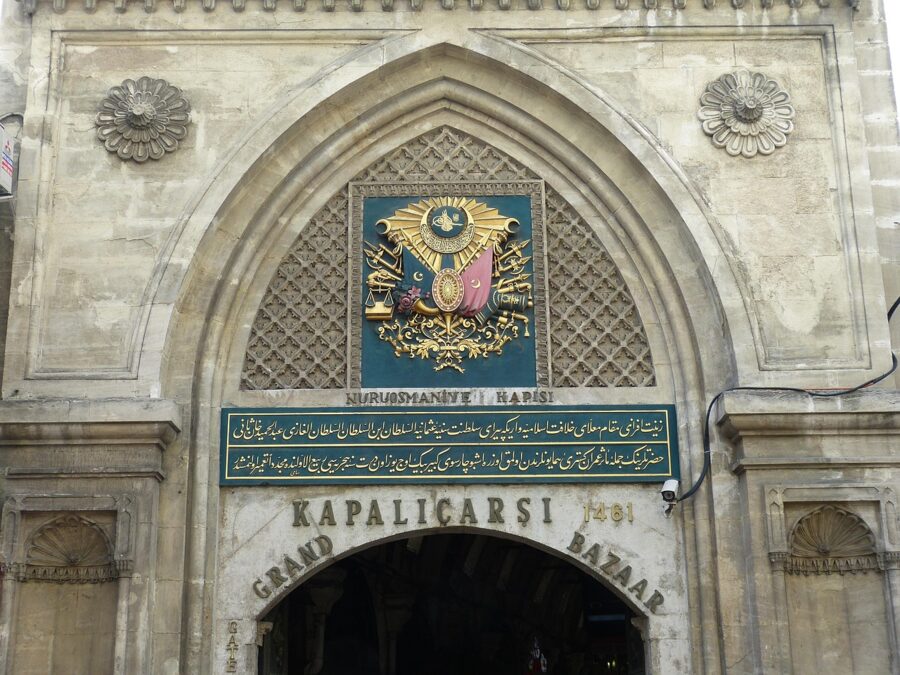
So: in at the Nuruosmaniye Gate at opening, two hours of looking, one glass of tea, nothing bought until the end. Then out of the Mahmutpaşa Gate and down the hill, through the wholesale crush, to the Spice Bazaar and the water. At Eminönü the ferry to Kadıköy runs all day, and the fare is one tap of the card you came in on.