A single ride on Büyükada’s electric bus costs 158.35 TL in 2026. The city ferry that carried you across the Sea of Marmara from Bostancı cost 171.89 TL, so the short hop up the hill is priced almost the same as the sea crossing. That one comparison decides how to do the Princes’ Islands cheaply: pay for the boat, then walk.
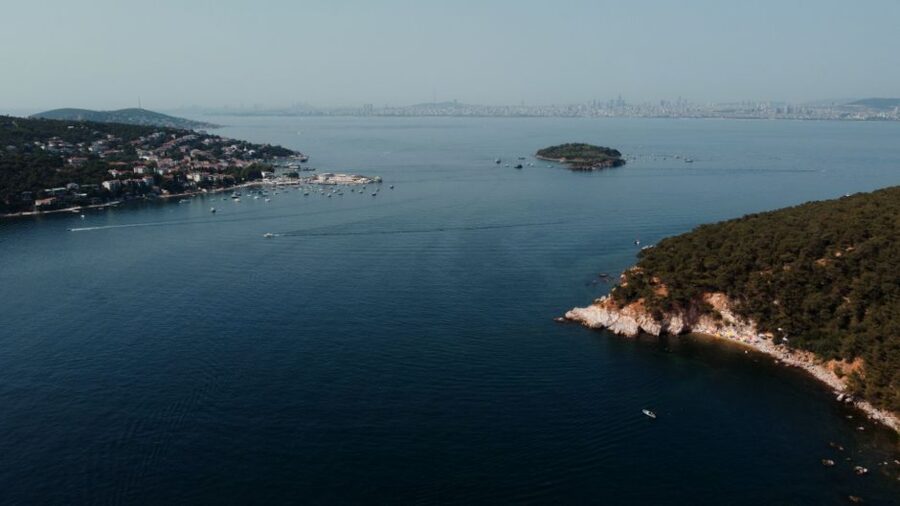
The islands, Adalar in Turkish, are nine lumps of rock and pine off Istanbul’s Asian shore, and four of them have towns: Kınalıada, Burgazada, Heybeliada and Büyükada, in the order the ferry reaches them. Private cars are banned. There are wooden mansions, Greek monasteries on hilltops, a seminary that has been shut since 1971, a writer’s house museum, and swimming off the rocks from June to September. All of it is reached on the same city transit card you use for the tram.
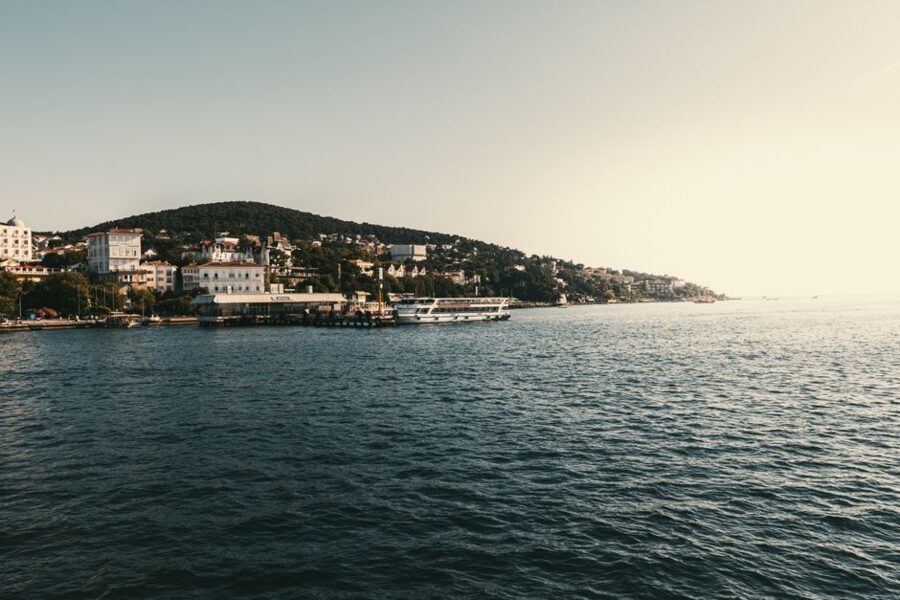
Which island for what, in one table:
| Island | Pick it for | From Bostancı | Time you need |
|---|---|---|---|
| Kınalıada | The quickest swim, an Armenian church, a bare red hill to climb | About 25–30 minutes | 2–3 hours |
| Burgazada | Quiet, a writer’s house museum, the sunset at Kalpazankaya | About 30–35 minutes | 3–4 hours |
| Heybeliada | Pine woods and walks, the Halki seminary on its hill | About 35–40 minutes | Half a day |
| Büyükada | The mansions, the Aya Yorgi climb, the most beaches and restaurants | About 35–45 minutes | A full day |
The cheapest and fastest way over is the Şehir Hatları city ferry from Bostancı on the Asian side, at 171.89 TL each way on the Istanbulkart since the July 2026 tariff. From Kabataş, Beşiktaş or Eminönü on the European side the boats take around an hour and a half to Büyükada, and the sail past the old city is half the point. Go on a weekday between April and June or in September and October; a hot Saturday in July means queues at the turnstiles on both ends.
Contents
- Getting there: city ferries, private boats and the island hop
- Getting around without cars
- Büyükada: mansions, a hilltop monastery and Trotsky’s ruin
- Heybeliada: the seminary, the naval school and the pines
- Burgazada: Sait Faik’s island
- Kınalıada: the red island
- A short history of the islands
- Swimming, eating and staying the night
- A day plan, and what it costs
Getting there: city ferries, private boats and the island hop
Two kinds of boat serve the islands: the big city ferries of Şehir Hatları, owned by the Istanbul municipality, and smaller private motor boats, mostly from Bostancı. If you are new to the ferry system as a whole, the Bosphorus cruise guide covers the cards, the piers and the commuter boats in the city proper.
From Bostancı: the short crossing
Bostancı is the island gateway. The Marmaray suburban rail line and the M4 and M8 metro lines all stop here, and the ferry pier is a 5-minute walk from the Marmaray station toward the sea. Boats leave Bostancı for the islands through the day and, on the Şehir Hatları Bostancı–Adalar ring line, through the night as well: the company has kept its night sailings on this line every day in both the summer 2026 and the winter 2026–27 timetables.

The crossing takes about 25–30 minutes to Kınalıada and 35–45 minutes to Büyükada, depending on how many islands the boat calls at. The fare on the Istanbulkart rose by 10% on 20 July 2026, from 156.26 TL to 171.89 TL one way. Island lines get no transfer discount, so the cheaper fare you get by changing from a metro to a city ferry within two hours does not apply here.
From the European side: Kabataş, Beşiktaş and Eminönü
From Sultanahmet or Beyoğlu, the long boat from the European shore saves the trip to Bostancı and gives you the skyline on the way out. The T1 tram ends at Kabataş, and the F1 funicular drops down to it from Taksim. City ferries from Kabataş and Beşiktaş take around an hour and a half to Büyükada, some calling at Kadıköy on the way.
The private company Mavi Marmara runs two tourist sailings a day from the European side in its winter 2026 timetable. They leave Beşiktaş at 09:30 and 11:30, Kabataş at 09:45 and 11:45, and Eminönü at 10:00 and 12:00, reaching Heybeliada at 11:00 and 13:00 and Büyükada at 11:15 and 13:15. The return boats leave Büyükada at 14:30 and 15:30, which makes them a half-day option at best; a full day means coming back on a later boat via Bostancı.
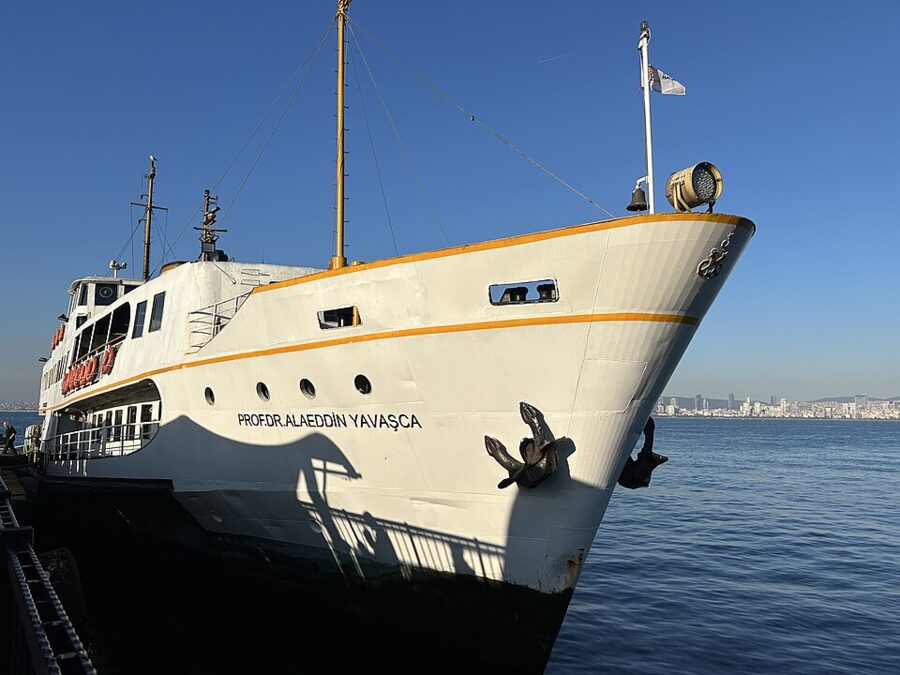

Mavi Marmara from Bostancı: the winter 2026 timetable
Mavi Marmara also runs a dense shuttle between Bostancı and the islands, and its winter 2026 timetable is the easiest to plan a day around. Its fares are set by the company rather than the city tariff, so check the price at the turnstile before you tap.
| Route (Mavi Marmara, winter 2026) | Departures |
|---|---|
| Bostancı to Heybeliada and Büyükada | 07:10 (not Sundays or holidays), 08:05, 09:00, 10:30, 11:35, 12:30, 13:30, 14:45, 15:30, 16:20, 17:30, 18:20, 19:30, 21:05, 22:00, 23:00 |
| Bostancı to Kınalıada and Burgazada | 08:05, 09:05, 10:30, 12:00, 14:30, 16:30, 17:35, 18:30, 19:40, 21:05, 23:00 |
| Büyükada to Bostancı | 06:20 to 20:35 through the day; the 21:50 is the last direct boat |
| Kınalıada to Bostancı (direct) | 07:15 to 20:40 through the day |
| Burgazada to Bostancı via Kınalıada | 07:00 to 20:25 through the day |
The 22:35 from Büyükada and the 23:30 from Heybeliada only shuttle between the two islands. Miss the 21:50 and your way home is the city’s night ring line, which is fine, but at double fare after 00:30.
Hopping between islands
Every boat that calls at more than one island lets you get off at one and pick up the next sailing on to another. The classic three-island day goes Bostancı to Burgazada or Kınalıada in the morning, Heybeliada at lunch, and Büyükada for the afternoon and the boat home. Each boarding is a separate tap of the card and there is no transfer discount on island lines, so a three-island day costs three or four taps rather than two.
Between Heybeliada and Büyükada almost every boat from Bostancı calls at both, so you rarely wait more than an hour; Kınalıada and Burgazada are paired the same way.
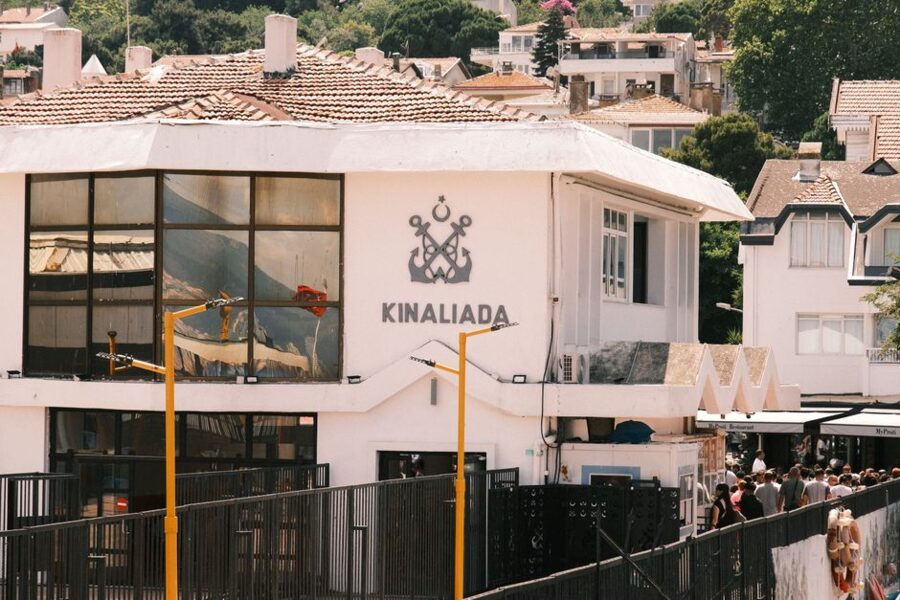
Summer, winter, weekends and the lodos
Şehir Hatları ran its summer timetable from 29 June to 6 September 2026, with extra sailings on the island lines; the winter timetable runs from 7 September 2026 to 27 June 2027. Winter means fewer boats, not none.
The weather is the bigger variable. A strong lodos, the warm southwesterly gale of the Marmara, can cancel island sailings in autumn and winter, the small motor boats included. Check the forecast the evening before, and if the wind is up, choose Kınalıada, which is closest to the mainland and quickest to get back from.
Weekends between May and September are when the islands fill up. Arrive before about 09:30 and the first two hours on Büyükada are almost quiet; a Tuesday in late September is the best island day Istanbul offers.
The Istanbulkart and what the boat costs
The Istanbulkart works on every Şehir Hatları boat and on the island buses. Personalized cards give students, teachers and older residents discounts, but visitors pay the full fare. One card can pay for several people; tap once per person.
| Item, July 2026 tariff | Full fare |
|---|---|
| Şehir Hatları, Bostancı–Adalar, one way (Istanbulkart) | 171.89 TL |
| Same, return | 343.78 TL |
| Night sailings, 00:30–05:30 | Double the day fare |
| Marmaray to Bostancı, one way | 37.40 TL (1–3 stations) to 82.17 TL (36–43 stations) |
| Standard Istanbul bus or metro ride | 46.20 TL |
Getting around without cars
Nothing on the islands is far. Büyükada, the largest, is about 5.4 km², with an outer road of roughly 11–12 km; the other three are smaller still. Only service vehicles, the city’s electric buses and licensed electric taxis use the roads, which leaves your feet, a rented bike, or a bus ticket.
The end of the phaetons
Until 2020 the islands moved by horse. Phaetons, the four-wheeled open carriages, lined the square behind the Büyükada pier and ran the “small tour” and “big tour” around the island for generations. In December 2019 horses on the islands began dying of glanders, a contagious bacterial disease, and animal-rights protests that had been building for years reached the city council. On 16 January 2020 the Istanbul municipal assembly voted to end the phaetons as transport, and by July 2020 electric vehicles were running in their place.
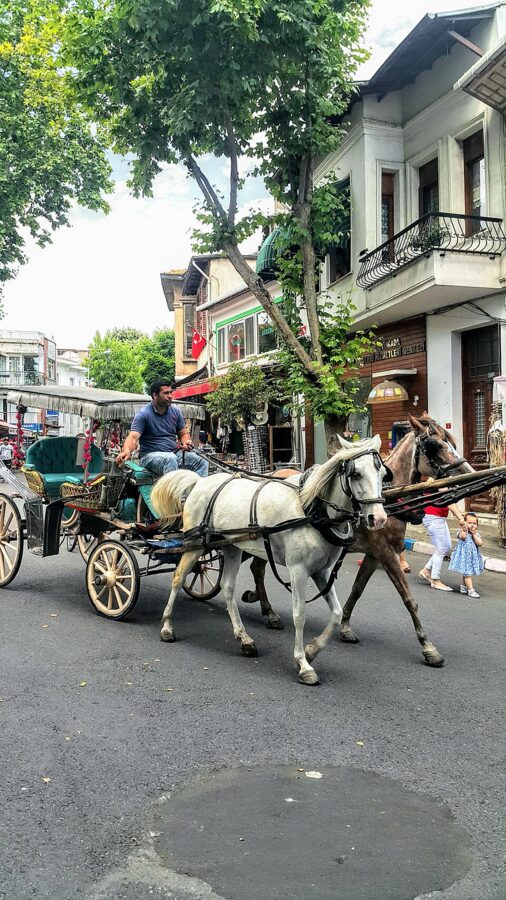

Residents protested when the first electric buses arrived in 2020, worried they would turn pedestrian lanes into roads. Six years on, the sound of the islands is bicycle bells and gulls rather than hooves.
Adabüs and Adamini: the electric buses and taxis
İETT, Istanbul’s bus authority, runs the islands’ public transport with small electric buses known as Adabüs and electric taxis called Adamini. In 2024 the fleet was 40 buses with 13 seats and 20 taxis with three. The fares are set apart from the rest of the city and are steep for anyone without an Adakart, the card for island residents and workers.
| İETT island fares, 2026 | Full fare | Adakart |
|---|---|---|
| Adabüs electric bus, one ride | 158.35 TL | 46.20 TL |
| Adamini taxi, flag fall (Istanbulkart) | 207.75 TL | 103.88 TL |
| Adamini taxi, per km (Istanbulkart) | 166.27 TL | 83.13 TL |
| Adamini taxi, per minute waiting (Istanbulkart) | 32.13 TL | 16.07 TL |
| Adamini taxi with a contactless bank card | 249.29 TL flag fall, 199.52 TL per km | – |
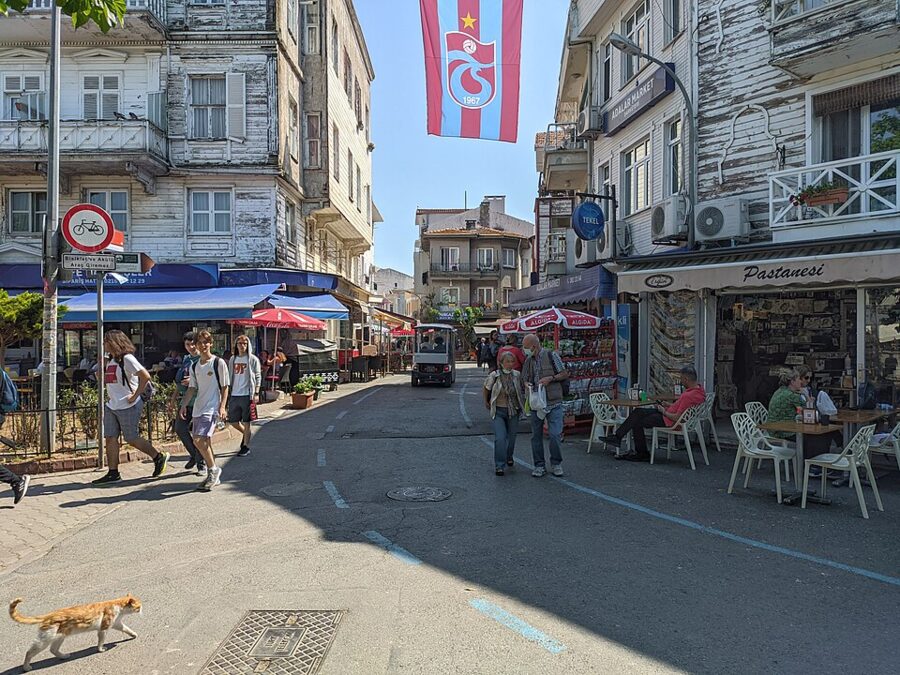
The lines are short and named for the places they link. On Büyükada, BA1 runs from the Çarşı (the market by the pier) to Tepeköy and Kadıyoran, BA4 to Kumsal and Maden, and BA5 to Nizam. Heybeliada has HA1 from the Çarşı to Akçakoca and İtfaiye, Burgazada has BU1 to Kalpazankaya, and Kınalıada has KA1 to Narçiçeği. On summer weekends walking is often faster than the bus queue.
Bikes
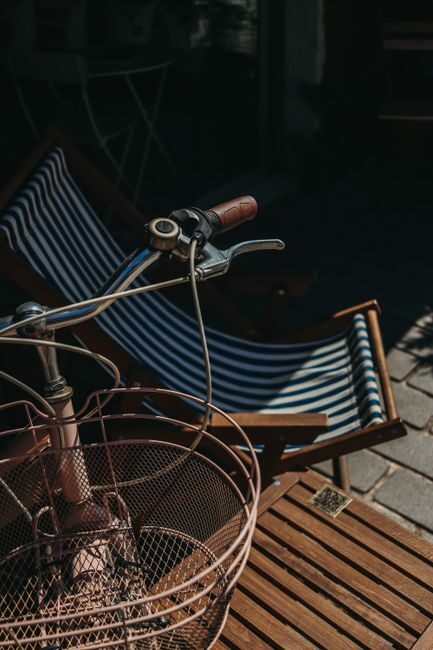
Bike rental shops cluster around the piers on Büyükada and Heybeliada. Press reports in July 2026 put rental at about 100–150 TL an hour and 300–450 TL a day on Büyükada, so a day on a bike costs less than two bus rides. Check the brakes before you pay, and ask for a lock.
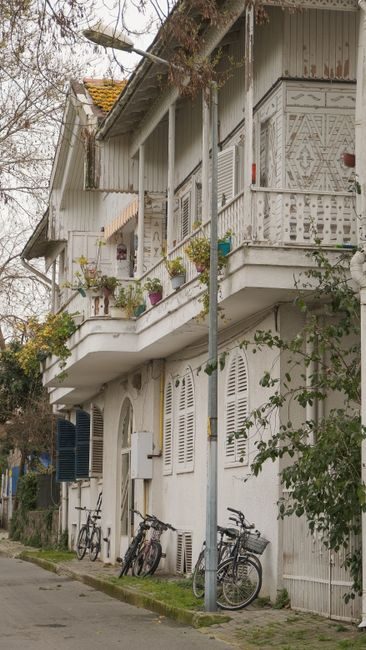
The Adalar municipality’s 2025 bicycle regulation bans riding on the narrow pedestrian streets around the pier, including Gülistan Caddesi and Çiçekli Yalı Sokak, so walk the bike through the market. The rules on electric bikes have been tightened in recent years and the municipality restricts their rental, so stick to ordinary bikes from a licensed shop. On Büyükada the short loop through Nizam and Maden is about 6 km and mostly flat, and the long loop around the island is about 12 km with real hills on the south side.
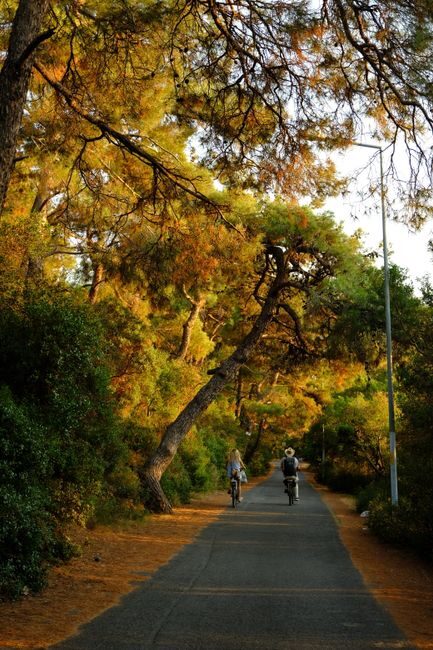
Walking
Walking is free, and on Kınalıada and Burgazada it is all you need. On Büyükada you can do the pier, the mansions, Aya Yorgi and back in four to five hours at an easy pace. Bring water: on Büyükada’s inland route the tea gardens at Lunapark Meydanı and the café on Yücetepe are about the only places to buy a drink.
Büyükada: mansions, a hilltop monastery and Trotsky’s ruin
Büyükada, the Greek Prinkipo, is the largest island and the one most people mean by “the islands”. The town spreads along the shore from the pier, with the mansions behind and two wooded hills, İsa Tepesi to the north and the 203 m Yücetepe to the south. Plan a full day, or a night.
The pier and the clock tower
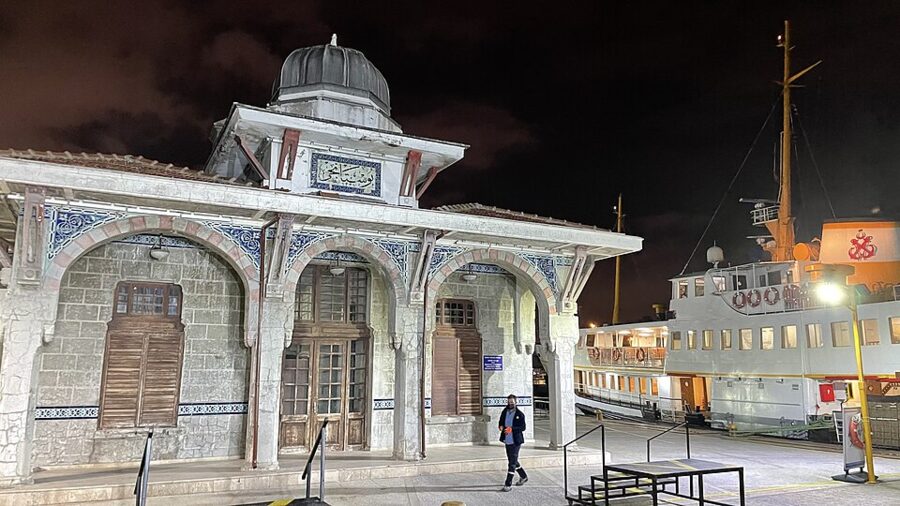
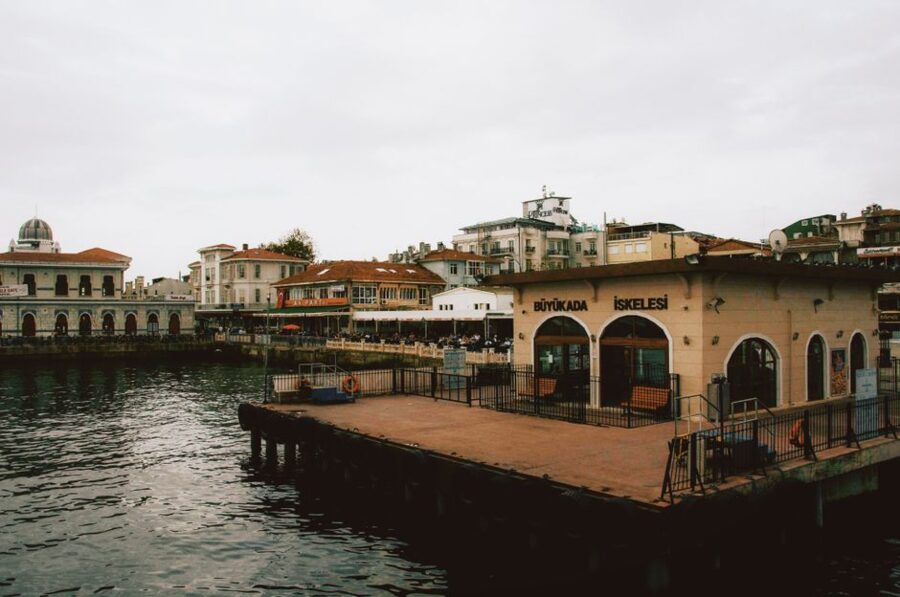
The arched ferry terminal was designed by the Armenian architect Mihran Azaryan in 1899 and went into service in 1915; it once held the island’s cinema. Straight ahead as you leave it is the small clock tower, put up in 1923, the year the Turkish Republic was founded. The square beside it was the phaeton rank until 2020.
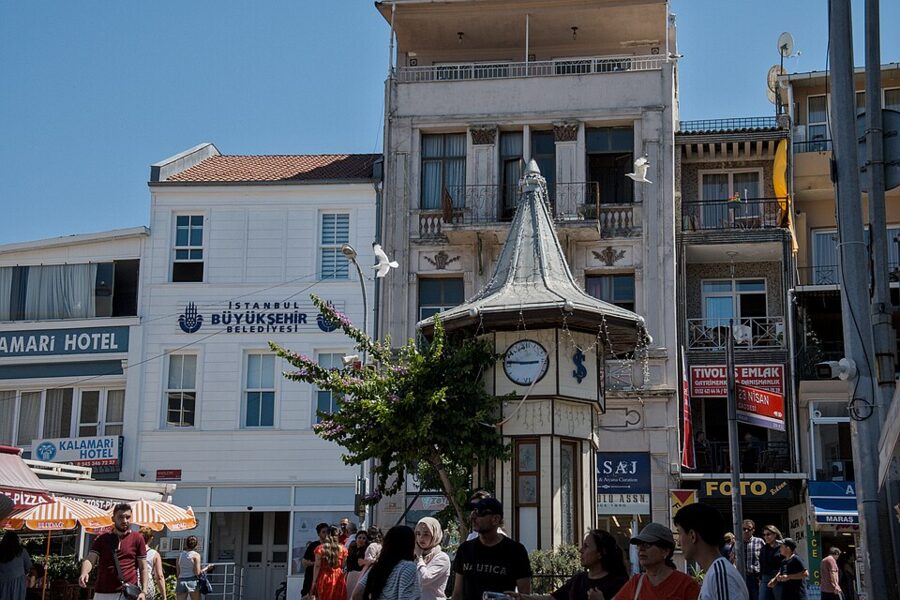

The wooden mansions
The reason to wander Büyükada rather than rush it is the houses. In the 19th century, after the first steam ferry service reached the island in 1846, Istanbul’s wealthy Greek, Armenian, Jewish and Levantine families built summer mansions here, mostly in wood, with balconies, bay windows, fretwork and gardens. Çankaya Caddesi, the road that climbs south from the town, has the best run of them, and has been called one of the most beautiful streets in the world.
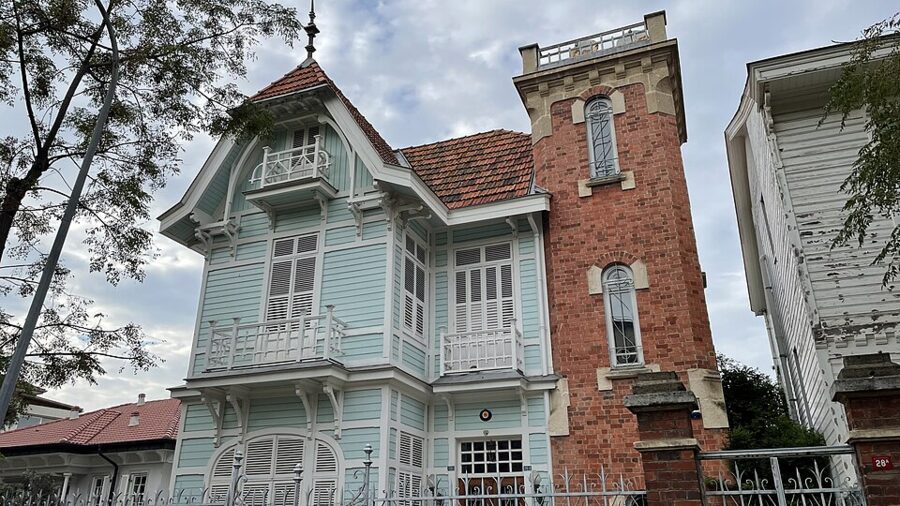

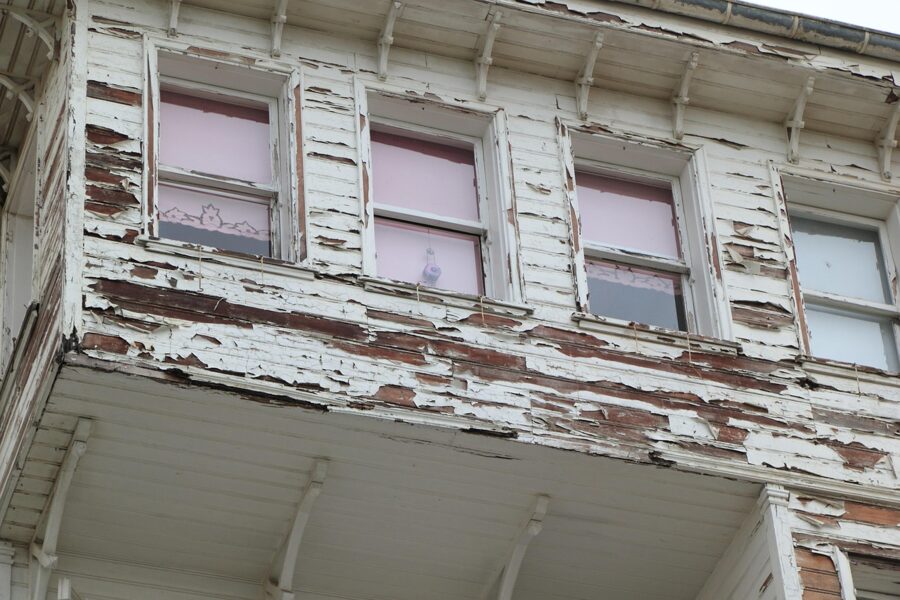
Some of the houses have names that tell their story. Con Paşa Köşkü was the house of Trasivulos Yannaros, known as Con Paşa, who is credited with starting the first ferry service to the island. Others, such as the Yelkencizade, Hacopulo, Fabiato and Mizzi mansions, carry the names of the families who built them. Many are beautifully kept; some are peeling and propped up.
Aya Yorgi on Yücetepe
The walk everyone does on Büyükada is the climb to the Greek Orthodox monastery of Aya Yorgi Koudounas, St. George of the Bells, on top of Yücetepe. From the pier it is a 30–40 minute walk inland to Lunapark Meydanı, the square in the valley between the two hills where the phaeton tours used to end. From there a steep, cobbled lane climbs about half an hour to the summit at 203 m.
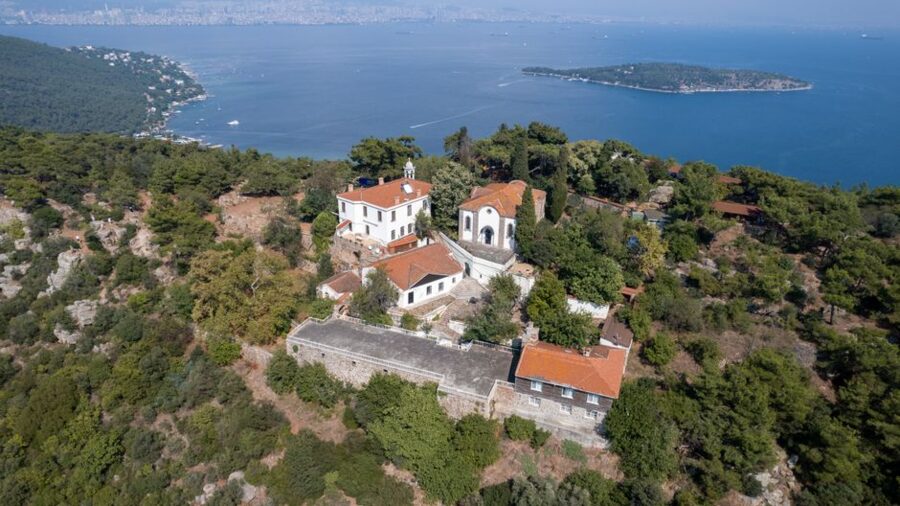
The monastery was probably founded in the 10th century, though the buildings you see now are 18th and 19th century. Its name comes from a legend: a shepherd heard bells ringing under the ground, dug, and found an icon of St. George buried to hide it from the crusaders of 1204. A copy of the icon is in the church; the original is at the Patriarchate in Fener.
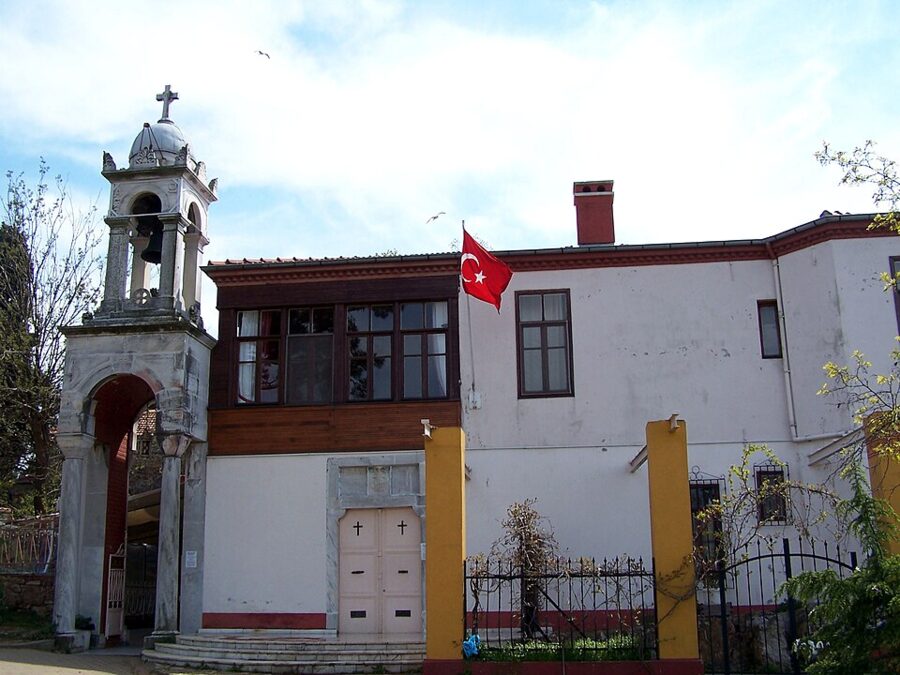

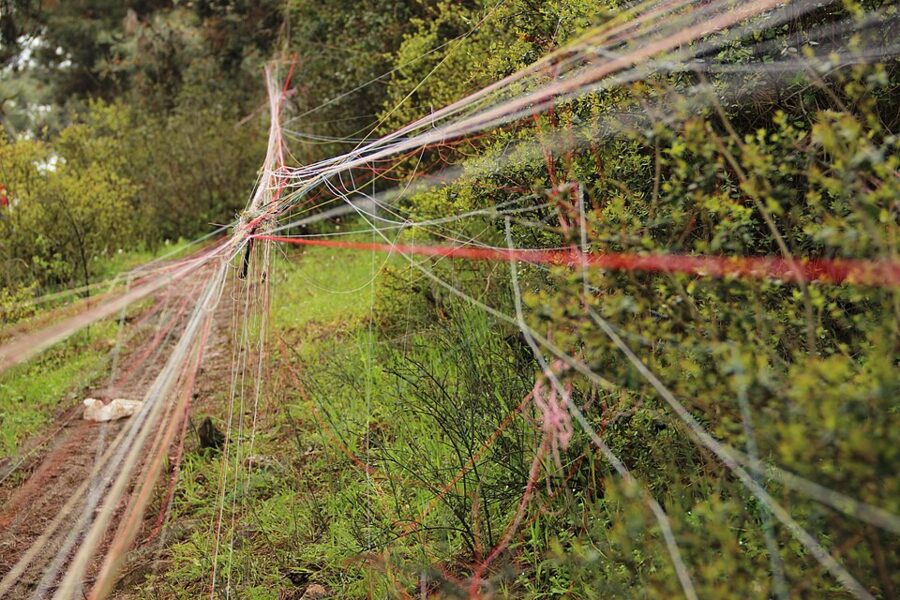
Twice a year the hill becomes something else. On 23 April and September 24, tens of thousands of people, Muslim and Christian, climb Yücetepe to make a wish, many unwinding a spool of thread along the path as they go. 23 April is also Turkey’s National Sovereignty and Children’s Day, one of the public holidays, which is why that crowd is so large. Unless the pilgrimage is the reason you came, those are the two days to be on another island.
The view from the top takes in the whole archipelago, the open Marmara to the south and the long line of the Asian shore to the north. On any day but the two wish days, it costs nothing and comes with no queue, which is more than you can say for the city’s paid viewpoints.
Trotsky’s house
After Stalin expelled him from the Soviet Union, Leon Trotsky arrived on Büyükada in April 1929 and lived on the island until July 1933, writing much of his History of the Russian Revolution there. The house he rented in the Nizam quarter is now a roofless brick-and-stone shell behind a fence, overgrown and unmarked. Sources disagree on what to call it; it appears as the Yanaros mansion, the İzzet Paşa house and the Sivastopol mansion.
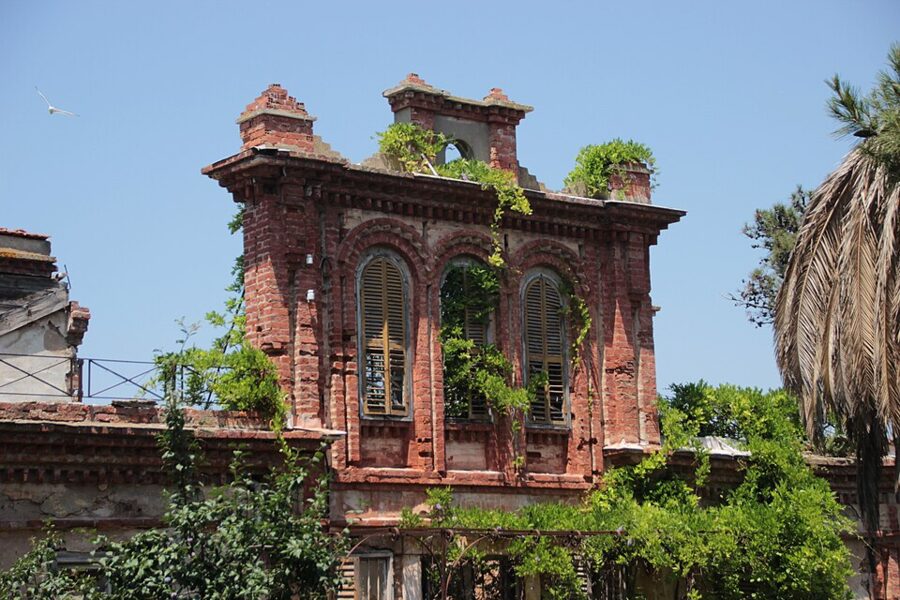

In August 2026, 86 years after his murder in Mexico, an international gathering on Büyükada marked the anniversary. The rest of the year the ruin is a short detour from the shore road through Nizam, and you will likely have it to yourself.
The Greek orphanage
On İsa Tepesi, the hill closest to the pier, stands the largest building on the island: the Prinkipo Greek Orthodox Orphanage, a timber giant often described as the largest wooden building in Europe. It was designed by Alexandre Vallaury and built in 1898 as a hotel and casino, the Prinkipo Palace. When Sultan Abdülhamid II refused to let it open, Eleni Zarifi bought it in 1903 and gave it to the Ecumenical Patriarchate, and it housed orphans until 1964.
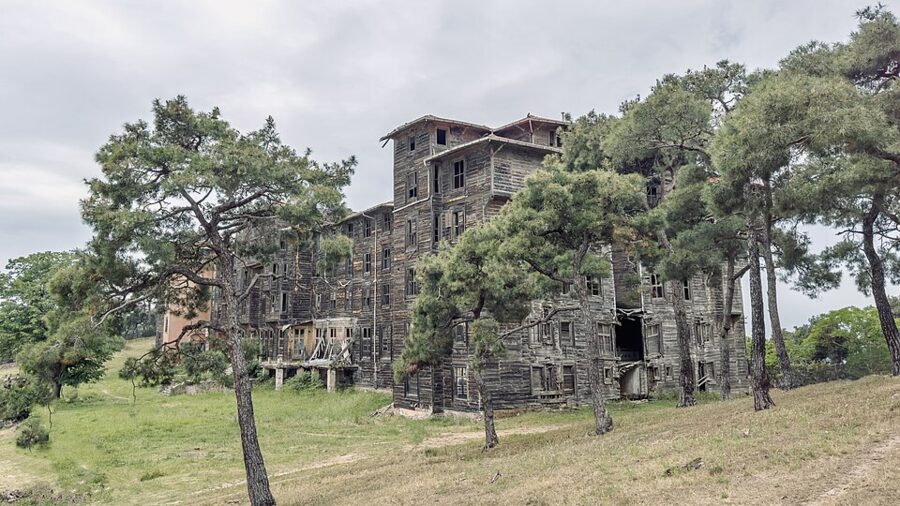

The state returned the building to the Patriarchate in 2010, by which time it was collapsing. In June 2026 the Patriarchate signed a restoration agreement with two investors, Bilgili Holding and the Greek group ĒNSOFI, to restore it and bring it back into use with its original character kept. Until that work is done, the fence stays. The Adalar Museum opened an exhibition on the building’s history on 22 May 2026.
The Hamidiye Mosque, the churches and the synagogue
Büyükada’s religious buildings sit within a short walk of each other. The Hamidiye Mosque was built for Sultan Abdülhamid II in 1893, in a European-influenced style with Turkish details. Like every mosque, it closes to visitors during the five daily prayers and for longer at Friday noon; visit between prayers, with shoulders and knees covered, and women with a scarf.
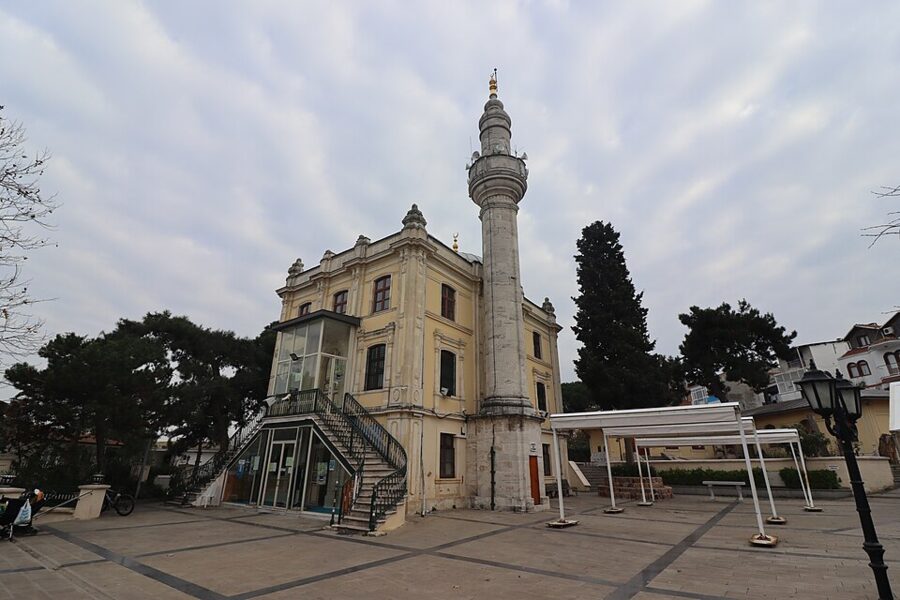

The island’s Greek Orthodox churches include Aya Dimitrios in the Kumsal quarter, where the small remaining community holds its main services, and the Panagia. There are also the Franciscan church of San Pacifico and the Armenian Catholic church of Surp Asdvadzadzin. They are not always open; Sunday morning is the likeliest time to find a door open.
In Kumsal too is the Hesed le Avraam synagogue, opened in 1904 and rebuilt in 1921, which opens for worship only in summer, when the island’s Jewish families are in residence. Its story and that of Istanbul’s other synagogues are told in the guide to Istanbul’s Jewish heritage.
The Adalar Museum
The Adalar Museum, the islands’ city museum, opened in 2010 in a converted helicopter hangar at Aya Nikola on Büyükada’s east coast. It tells the story of the islands’ people as much as of their buildings, with objects, some 6,000 photographs, 20,000 documents and oral-history recordings. It reopened in 2024 with a new exhibition. Check its opening days before you walk out, as it sits on the far side of the island from the pier.
Dilburnu and the beaches
West of the town, the wooded headland of Dilburnu is a nature park with picnic spots under red pines and views back over the harbor. The island’s beaches lie along the coast on both sides of it and further south: Yörükali and Nakibey are the best known, with Eskibağ, Kumsal, Aya Nikola, Halik Koyu and Prenses Koyu among the others. Most are run as paid beach clubs; prices are covered below, under swimming.

Heybeliada: the seminary, the naval school and the pines
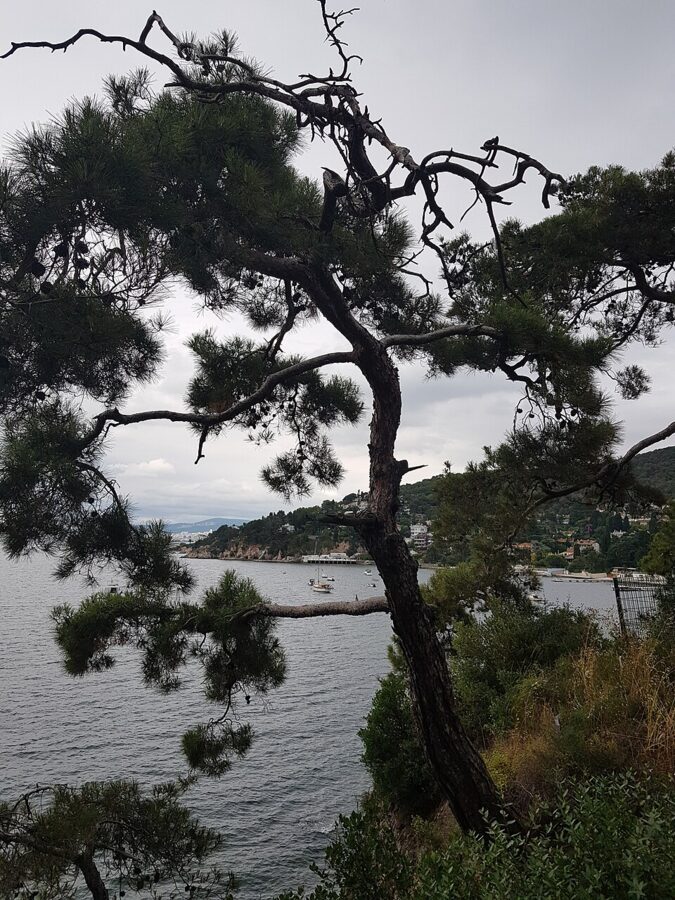
Heybeliada, Halki in Greek, is the second-largest island and the greenest of the four. Its name means “saddlebag island”, because from a distance it looks like one dropped on the sea. There is a small town by the pier, a run of handsome wooden houses, and then pine woods over most of the rest, with four hills, the highest at about 140 m.
The Halki seminary in 2026
On the Hill of Hope above the town stands the Theological School of Halki. It was founded in 1844 by Patriarch Germanos IV at the Monastery of the Holy Trinity, which tradition dates to the 9th century, and the present building, designed by Periklis Fotiadis, opened in 1896 after an earthquake wrecked the first one in 1894. For more than a century it trained the clergy of the Ecumenical Patriarchate, including the current Patriarch, Bartholomew.
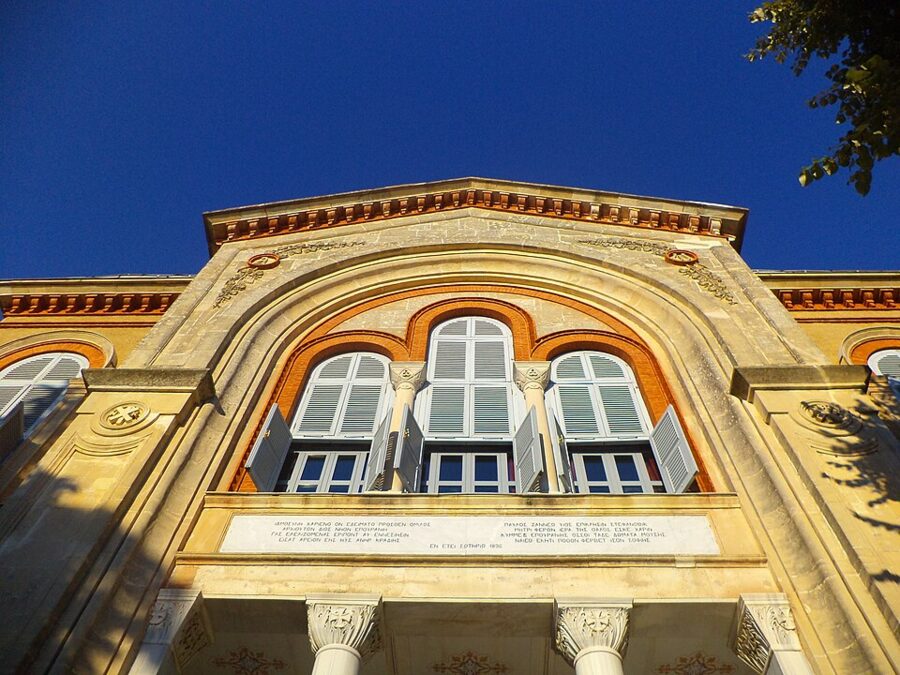

In 1971 a Turkish law on private higher education closed it, and the seminary has stayed closed ever since. Successive Turkish leaders have said it would reopen; it has not. In September 2025 the issue came up in talks between the American and Turkish presidents at the White House, and in May 2026 Bartholomew spoke of inaugurating the renovated buildings in September.
That inauguration did not mean a reopening. The Patriarchate’s own spokesman said in May 2026 that there was no license for teaching to resume, and in October 2026 the abbot of the Holy Trinity Monastery said the renovation of the complex would be finished in January 2027. Whether the school reopens still depends on a decision in Ankara. In late 2026 it is a restored building waiting for students.
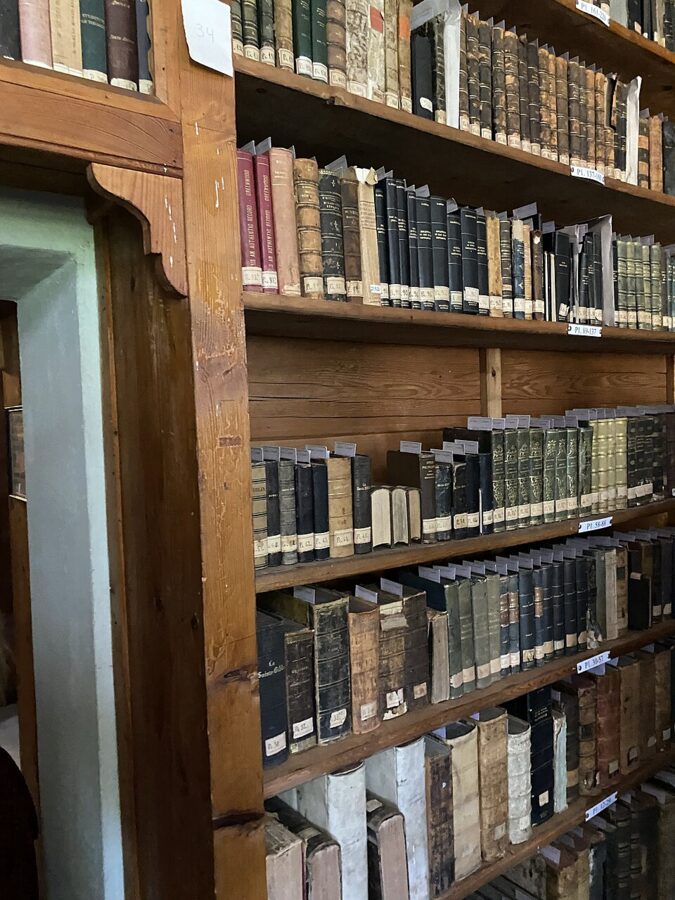

During the works, don’t count on getting inside; the walk up and the view down over the island are reason enough on their own.
The naval school
The large complex to the left as you step off the boat is the old Naval High School, the Deniz Lisesi. The Ottoman navy’s school moved to Heybeliada for good in 1851–52, and generations of officers trained here; the poet Nâzım Hikmet was a cadet between 1913 and 1918. The high school was closed on 31 July 2016, along with every other military high school, after the failed coup attempt, and since 2017 the campus has served as the preparatory section of the Naval Academy.
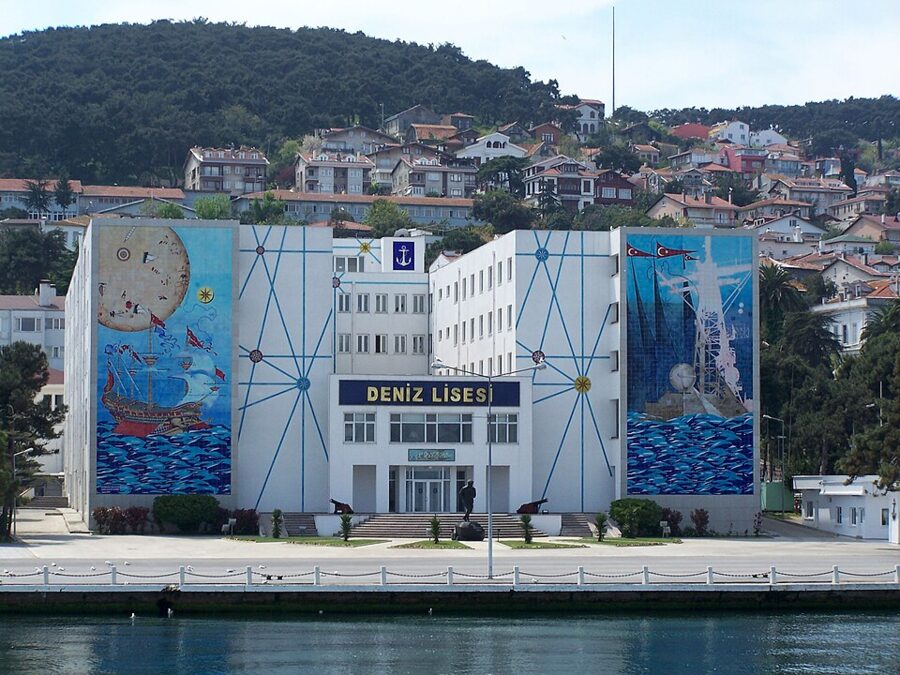

Inside the grounds stand two things you cannot visit: Kamariotissa, the only Byzantine church left on the island and the last one built before the conquest of 1453, and the grave of Edward Barton, the second English ambassador sent to Constantinople by Elizabeth I, who chose to live on Heybeliada. Both are off limits while the school is in use.
Pine woods, Değirmenburnu and Çam Limanı
The best of Heybeliada is the walk. From the town, the road heading west along the north shore climbs through the pines to Değirmenburnu Nature Park, a headland with picnic tables and views over to Burgazada and the Asian shore. Carry on round the south side and you reach the bay of Çam Limanı, where a disused sanatorium stands in the trees above the water.
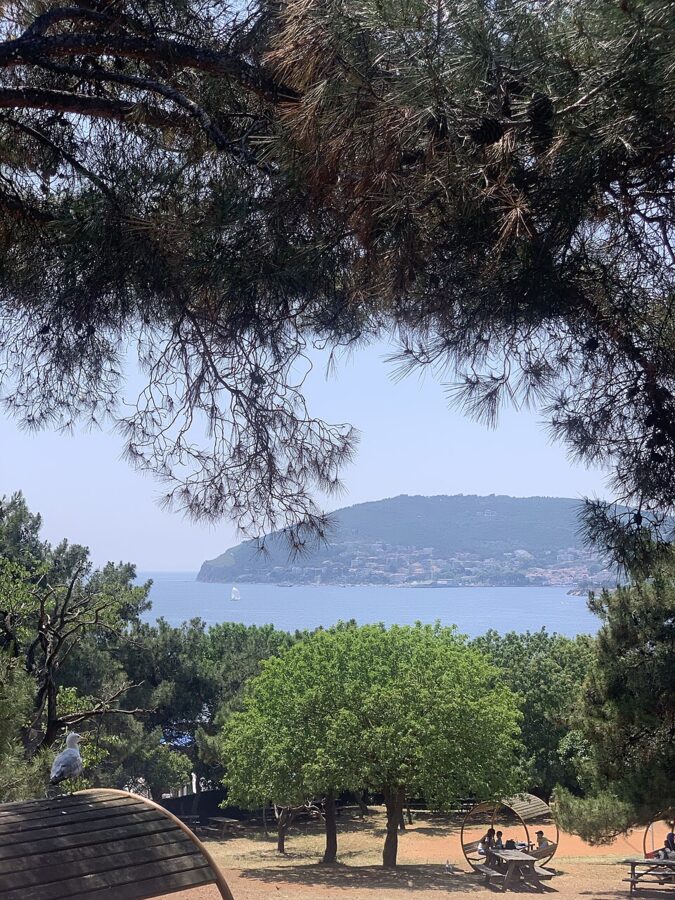

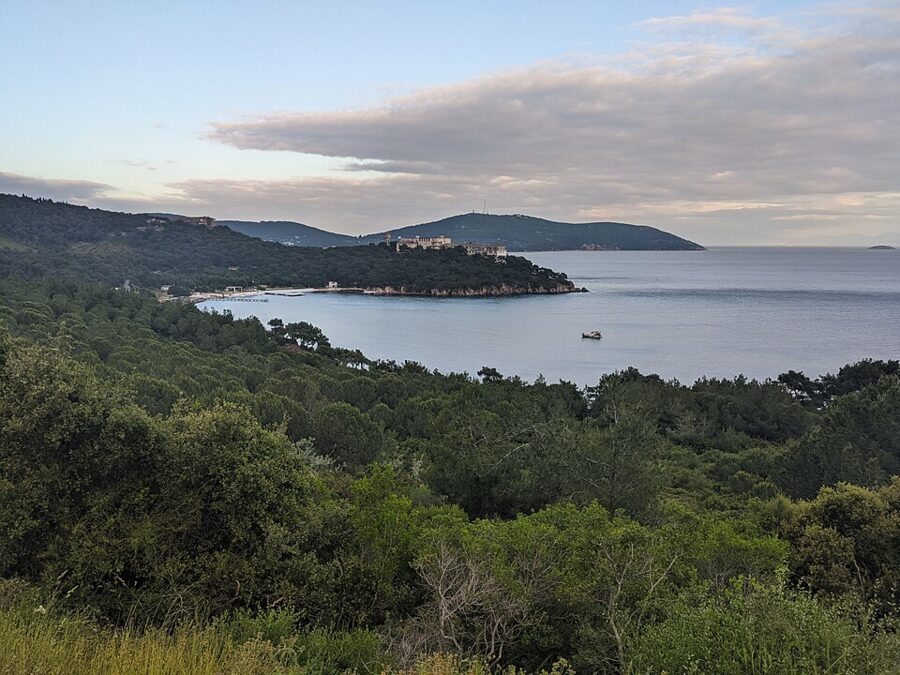

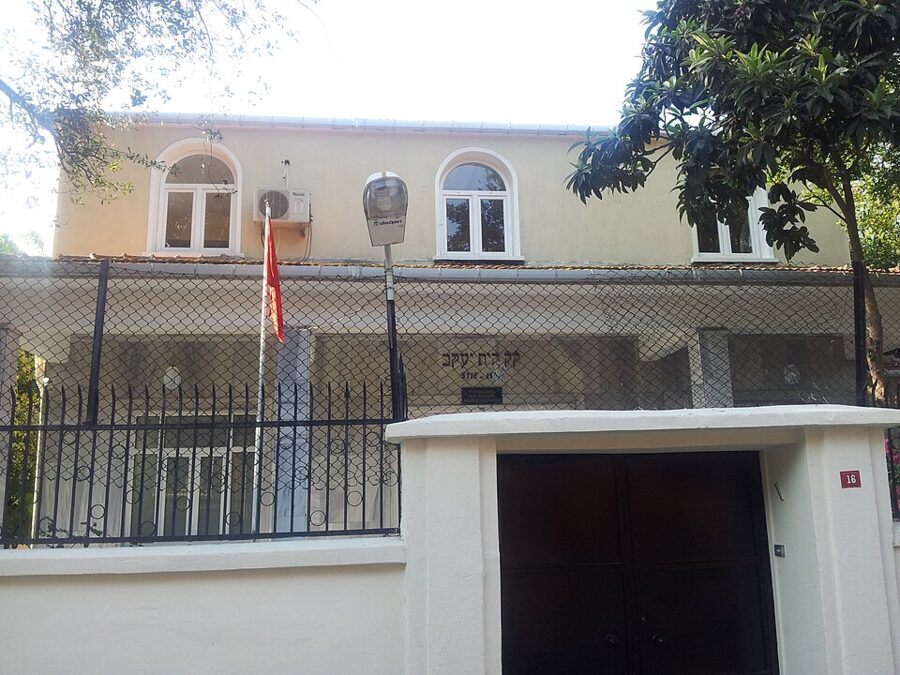
A full circuit of the island on foot, with stops and a swim, is a long half day. Back in town, the Aya Nikola church by the shore dates from 1857, the Bet Yaakov synagogue was built in the 1940s, and the house where İsmet İnönü, Turkey’s second president, spent his summers from 1924 is now a museum.

Burgazada: Sait Faik’s island
Burgazada is the third largest and the quietest of the four, a single hill about 2 km across, wrapped in pine. The ancient Greek name was Antigoni, after Antigonus, father of the general Demetrius who fortified it; the Turkish name comes from the Greek word for a tower or fort. Until the middle of the 20th century much of its summer population was Jewish, and it is still the island Istanbul people go to when they want the islands without the crowds.

The Sait Faik Abasıyanık Museum
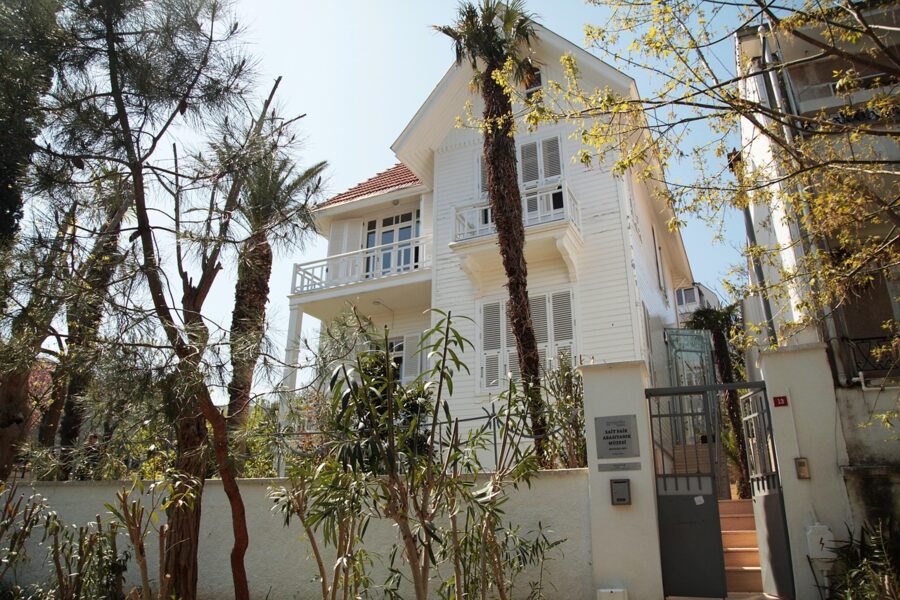
Sait Faik Abasıyanık, one of Turkey’s best-loved short-story writers, spent much of his last ten years in his mother’s house on Burgazada, and the island runs through his stories: its fishermen, its cafés, its winters. After he died in 1954 his mother left the house to the Darüşşafaka Society on condition it became a museum, and it opened on 22 August 1959. It was restored between 2009 and 2013.
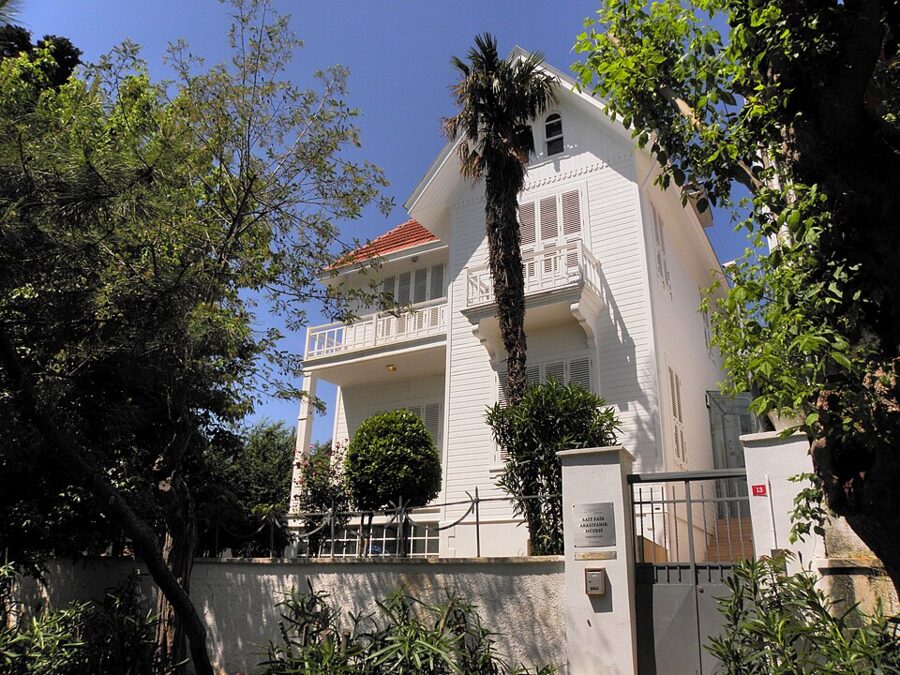

Inside are the writer’s belongings, photographs, letters and postcards, and the rooms are small enough to see in half an hour. Entry is free. The museum is closed on Mondays and Tuesdays; sources disagree on whether it opens on Sundays, so plan for a Wednesday to Saturday visit.
A bronze statue of the writer has sat in the square by the pier since 2012. On the west side of the island, Kalpazankaya, “counterfeiter’s rock”, is the island’s sunset point, and the story goes that the first fake coins in the country were struck there. It was one of Sait Faik’s favorite spots, and the BU1 electric bus runs out to it from the pier if you don’t want to walk.
Aya Yani and the walk around the hill
The Greek Orthodox church of Aya Yani, St. John, stands a few minutes’ walk from the pier. Tradition holds that Methodios, later Patriarch of Constantinople, was held prisoner for seven years in a crypt on the spot during the iconoclast persecutions of the 9th century, and the present church stands over it.
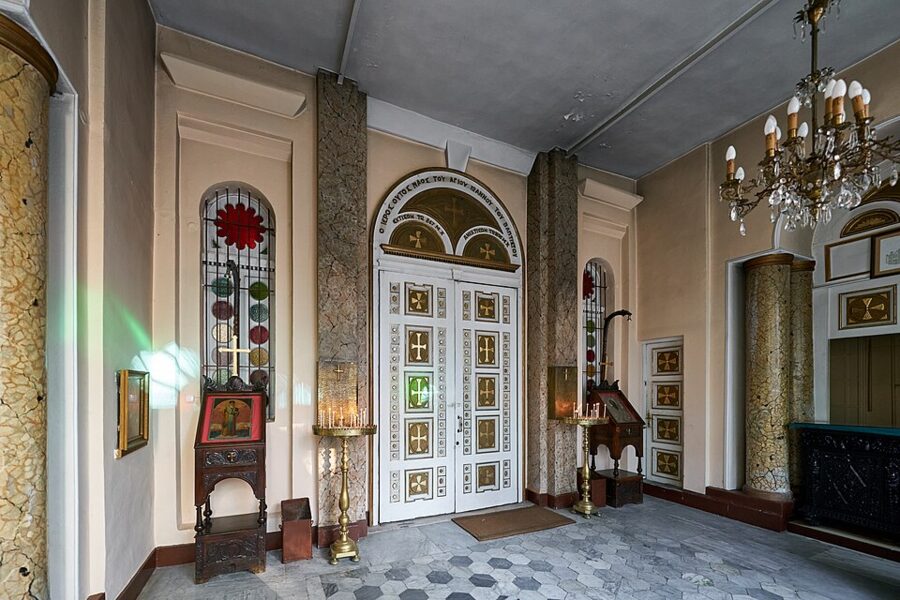

The road around the island makes a good two- to three-hour walk with a swim. In October 2003 a forest fire, driven by a lodos, burned a large part of the pine forest; replanting began ten days later, and the woods have largely grown back. Bayraktepe, the summit at around 170 m, carries the Hristos monastery and a view over Kaşık Adası, the tiny island between Burgazada and Heybeliada.
Kınalıada: the red island
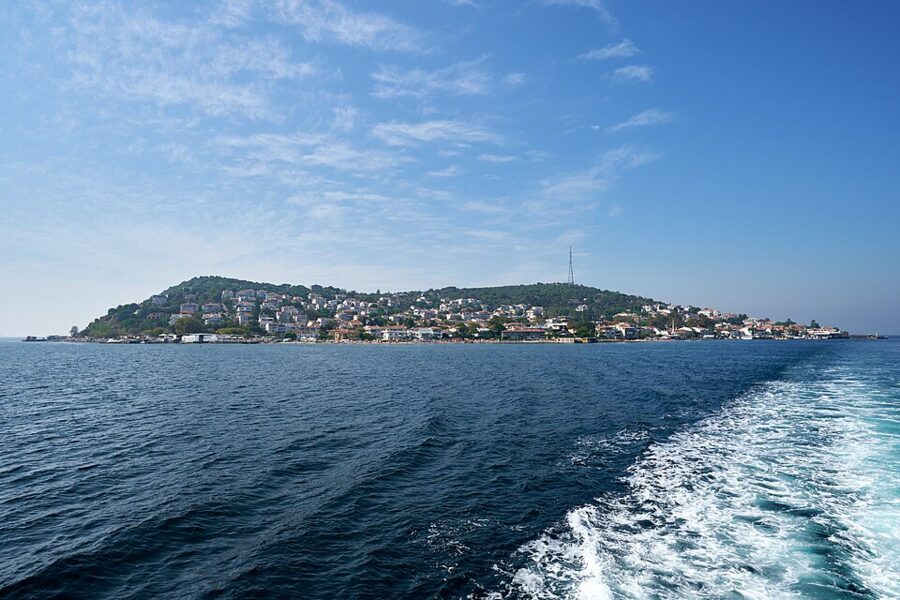
Kınalıada is the closest island to Istanbul, about 12 km south of the city, and the smallest of the four inhabited ones. Its name means “henna island”, from the reddish color of its bare earth, which contains iron and copper; the Greek name, Proti, simply means “first”. It has the fewest trees of the four, the slopes of its western hills were cut back by centuries of quarrying, and it looks from the ferry like a hill of rust with houses on it.

The Armenian church and the island’s Armenian summers
From the 19th century to the middle of the 20th, Kınalıada was the Armenian island. In summer around 90% of the people on it were Armenian, and the island was the summer retreat of the Armenian patriarchs of Istanbul. The church of Surp Krikor Lusavoriç, St. Gregory the Illuminator, was opened for worship in 1857 by Patriarch Hagopos III Seropyan and is the only Armenian church on the islands.
The community is far smaller now, and the church is the clearest trace of the island’s Armenian summers. As with the Greek churches, Sunday morning in summer is the best chance of finding the door open; otherwise, see it from the street.
The bare hill and the Hristos monastery
The island’s high points are Çınar Tepesi at 115 m and Manastır Tepesi, Monastery Hill, at about 93 m. On Manastır Tepesi stands the Greek Orthodox Hristos Monastery, the Monastery of the Transfiguration, and the climb up to it is short, steep and treeless. From the top you look straight back at the city skyline, closer here than from any other island.
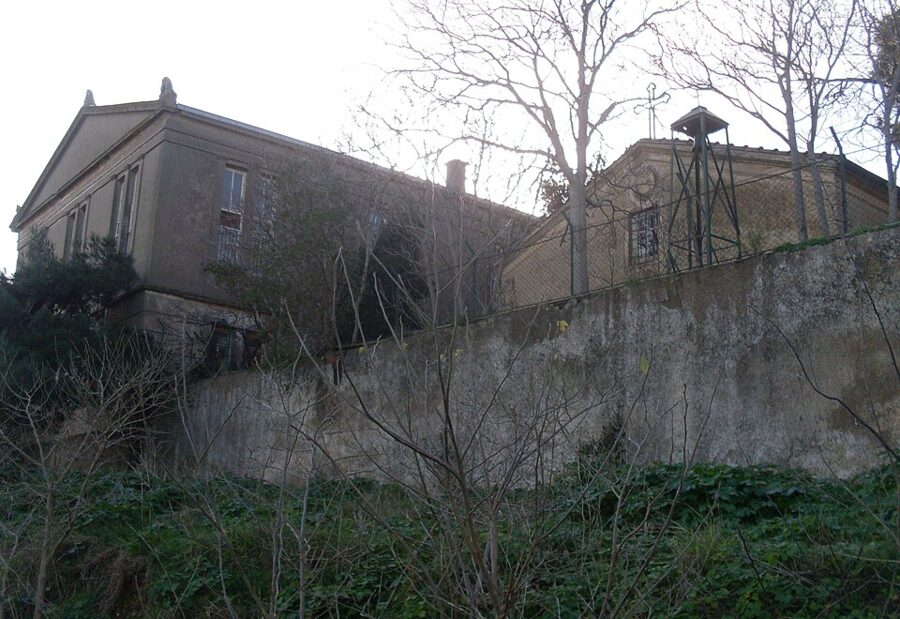

Byzantium used Proti for its most important exiles. Romanos I Lekapenos was sent here in 944, and after the defeat at Manzikert in 1071, the blinded emperor Romanos IV Diogenes was shipped here to die. The bare hill above the harbor was a prison long before it was a weekend escape.
Swimming off the rocks
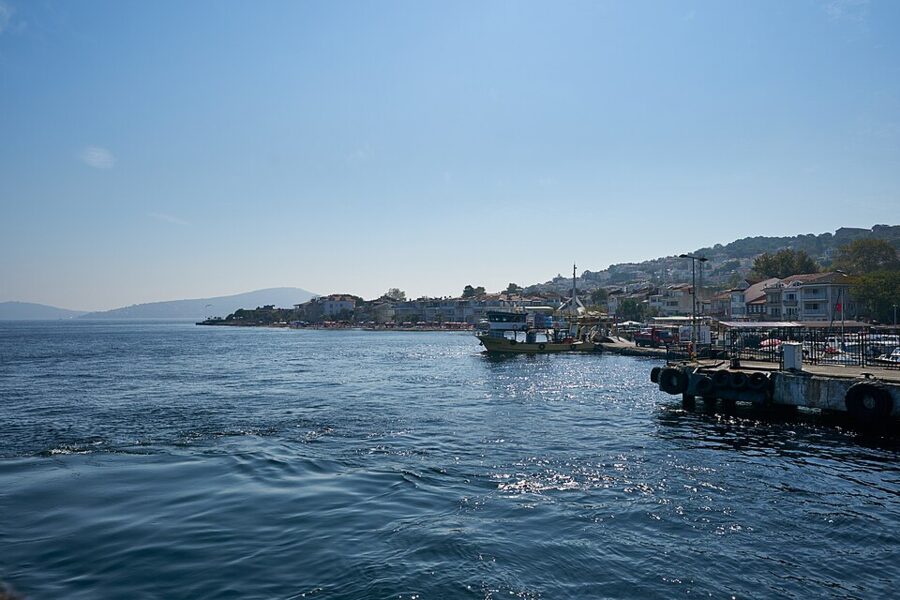
Kınalıada is the easiest island to swim from. The shore is rocky almost all the way round, you can get into the sea from nearly every side, and you can be swimming within minutes of stepping off the boat. In summer that is exactly why people come.

A short history of the islands
The ancient Greeks called the islands Demonesoi, a name sources read either as “the people’s islands” or “the demons’ islands”. In Byzantine times the largest became Prinkipo, “the prince’s island”, after a palace built there in the 6th century, and the whole group became the Princes’ Islands because of who was sent to them. Byzantium exiled emperors, empresses and patriarchs here: a convent on Büyükada held the empresses Irene, Euphrosyne, Theophano, Zoe and Anna Dalassena at various times.
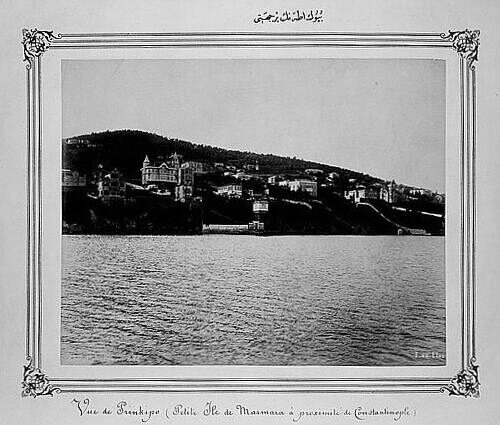
The Ottoman fleet took the islands in 1453, about a month before the conquest of Constantinople, and for nearly four centuries they were a backwater of monasteries and fishermen; Evliya Çelebi counted 200 Greek houses on Büyükada in 1640. The change came with steam. From 1846 a regular ferry service made them reachable from the city in an hour or two, and they turned into the summer resort of Istanbul’s minorities.
The Ottoman census of the 1880s counted 7,937 people on the islands, of whom 5,501 were Greek, 533 Armenian and 254 Muslim, with Jewish, Catholic and many foreign residents besides. In 1912 one count gave 10,250 Greeks and 670 Turks. The Greeks settled Büyükada and Heybeliada, the Armenians Kınalıada, and Jewish families Burgazada and parts of Büyükada, and each built churches, synagogues, schools and summer houses.
The 20th century emptied most of that out. Turkish families and officials began to summer here after 1923, and the minorities left in waves, after the anti-Greek riots of September 1955 and the expulsions of Greek citizens in the mid-1960s. In 2022 the Adalar district had 16,690 registered residents, by far the smallest population of any Istanbul district, and in summer the number swells several times over.
What is left is a pattern you can still read on a day’s walk: monasteries on the hilltops, synagogues that open for the summer, an Armenian church on a red hill, and wooden houses built for families most of whom have long since left.
Swimming, eating and staying the night
Beaches: paid, free and the rocks
The islands’ swimming season runs from about mid-June to mid-September, with the water at around 20–24°C. The beaches on Büyükada are mostly paid beach clubs with loungers, umbrellas, showers and a bar. In June 2026 their entry prices ran from 500 TL to 2,000 TL, depending on the club and the day, with weekends at the top end.
At Istanbul’s beach clubs in 2026, a toasted sandwich started at about 300 TL and grills ran 600–700 TL, so eat before you go. The budget alternative is the rocks: on Kınalıada, around Burgazada and in the bays of Heybeliada you can swim for free from platforms and flat stones, with no facilities but no fee.
Eating: the fish row and the cheaper options
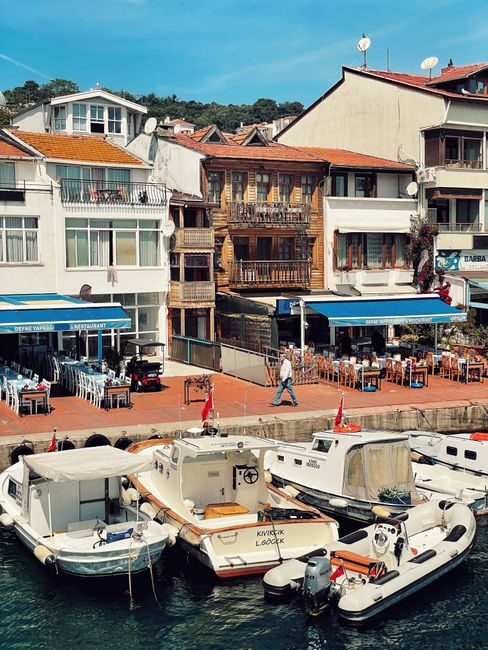
The fish restaurants along the pier front and Gülistan Caddesi on Büyükada are where most visitors eat: meze, grilled fish and rakı at tables by the water, the standard spread of coastal Turkish food. They are not cheap. Ada Et Balık, a family restaurant on Güldalı Sokak in Nizam, open daily from 09:00 to midnight, quotes about 550–800 TL for a portion of fish in 2026, with turbot, prawns and fish sold by the kilo above that.
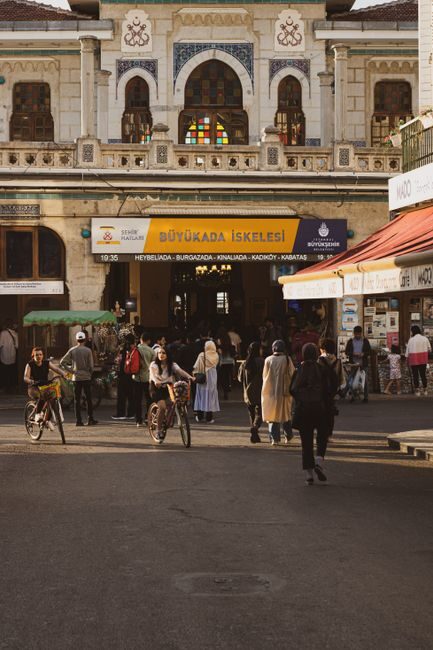
Look at the menu and the price before you sit, and ask for the price of fish sold by weight before it goes on the grill. The cheaper route is the market streets by the pier: bakeries, börek, the island’s ice cream shops, and simit from the carts. A spread of village breakfast, the long Turkish breakfast with cheeses, olives, eggs and jams, costs about 750–1,500 TL a head on the islands in 2026, so it is a treat rather than a daily habit. The same snacks you find on the city’s street food circuit are sold here at a small island markup.
The best months for fish are September to November: the Marmara fishing season opens on September 1, and by the end of the month bonito and mackerel are plentiful and cheaper. A fish sandwich here is a snack-counter menu item rather than the boat-side institution it is at Eminönü; check the board for the price.
The budget meal is a picnic: bread, cheese, olives and fruit from the market near any pier, eaten under the pines at Dilburnu or Değirmenburnu, or on the rocks of Kınalıada.
Staying the night
The islands empty out after the last day boats, and that is the best reason to stay: the town at dusk without the crowd, and the first ferry back with commuters. The beds are in small hotels and family pensions on Büyükada and Heybeliada rather than hostels, and summer weekends book up early.
The landmark on Büyükada is the Splendid Palace Hotel on 23 Nisan Caddesi, the white building with two domes above the waterfront, open since the early 20th century; sources give 1908 or 1911. It is still a hotel in 2026, with high-ceilinged rooms and old furniture, and it is a splurge rather than a backpacker bed. Book it, or any island pension, direct, and confirm whether breakfast is included.
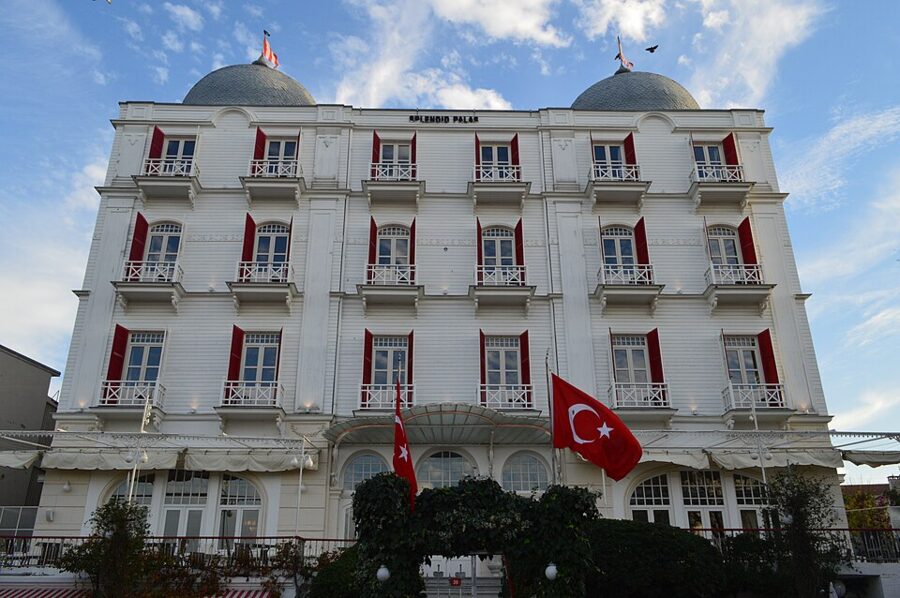

If a hotel bed is out of budget, the night boat is the answer: the Şehir Hatları ring line to Bostancı runs all night, so you can stay for dinner and still sleep in a hostel bed in the city. Even at the doubled night fare it costs a fraction of a room.
A day plan, and what it costs
This is the day I’d do for a first visit: two islands, mostly on foot, out early and back after dark. It starts from the European side; from Kadıköy or anywhere on the Asian side, start at Bostancı and save the trip.
- 07:15 Marmaray from Sirkeci or Yenikapı to Bostancı, then 5 minutes on foot to the pier.
- 08:05 The Mavi Marmara boat that calls at Heybeliada first, or the next city ferry; about 35 minutes.
- 08:45–11:45 Walk up to the Halki seminary for the view, then through the pines to Değirmenburnu, with a picnic under the trees.
- 12:05 Short hop on to Büyükada.
- 12:30–14:00 The mansions along Çankaya Caddesi, then the walk inland to Lunapark Meydanı.
- 14:00–15:30 The climb to Aya Yorgi, a drink at the top, and down.
- 15:30–18:00 Back through Nizam past Trotsky’s house, a swim in summer, and Dilburnu for the evening light.
- 18:30 Dinner in the market streets, then the 20:35 or 21:50 Mavi Marmara boat to Bostancı, or the Şehir Hatları ring later.
| Cost for one person, 2026 | Budget day | Comfortable day |
|---|---|---|
| Marmaray to Bostancı and back | About 75–165 TL | About 75–165 TL |
| City ferry, Bostancı to the islands and back | 343.78 TL | 343.78 TL |
| Island hop (Heybeliada to Büyükada) | One more card tap | One more card tap |
| Getting around | On foot: 0 TL | Bike for the day: 300–450 TL |
| Swimming | The rocks: 0 TL | Beach club: 500–2,000 TL |
| Food | Picnic from the market, plus a tea | Fish dinner: 550–800 TL a portion, plus meze and drinks |
| Sights | Aya Yorgi, the mansions, the seminary hill and Sait Faik’s museum are free | Same |
| Total before food | About 420–510 TL plus the island hop | About 1,200–3,000 TL plus the island hop |
The island hop is the line to watch, since each extra island is another tap. If money is tight, choose two islands, not four: Büyükada and Heybeliada make the best pair, Kınalıada and Burgazada the quietest.
For a lighter day, take the Mavi Marmara boat to Kınalıada for a swim, hop to Burgazada for the Sait Faik museum and Kalpazankaya, and come back on the last boat at 20:25 (winter 2026) or a later city ferry. The islands are one of several cheap escapes covered in the guide to day trips from Istanbul, and the Istanbul travel guide has the rest of the city.
Whatever you pick, put 700 TL on the Istanbulkart the night before, be at Bostancı for the 08:05, and look up the last boat home the moment you land. On Büyükada in winter 2026, the last direct Mavi Marmara to Bostancı leaves at 21:50; after that it is the city’s night boat and a double fare.