About 20,000 people walk through Topkapı’s gates on a summer day, and roughly half of them squeeze into the Harem. You can stay ahead of most of them with one decision: be at the Imperial Gate when it opens at 09:00, on any day but Tuesday, buy the 2,750 TL combined ticket and walk straight to the Harem while the tour groups are still gathering in the first courtyard.
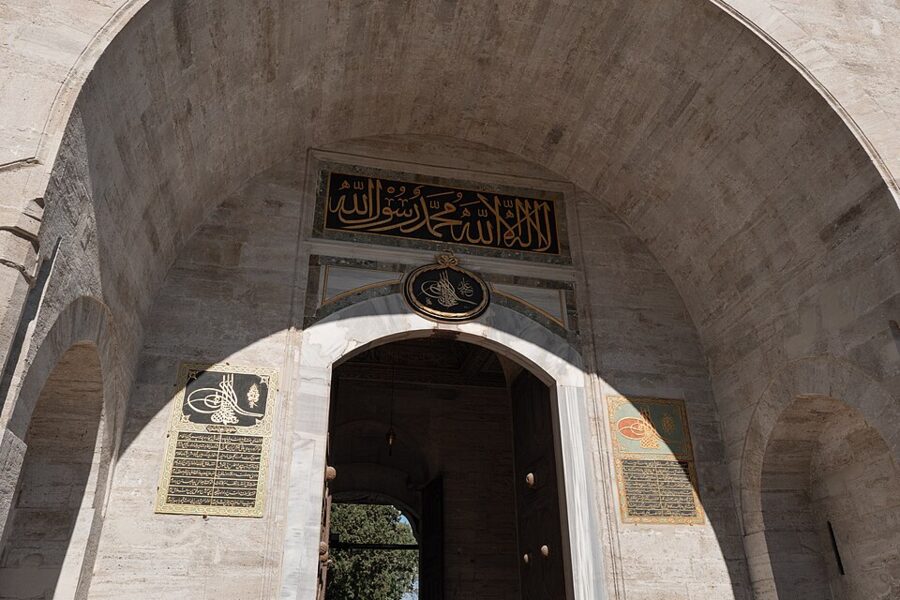

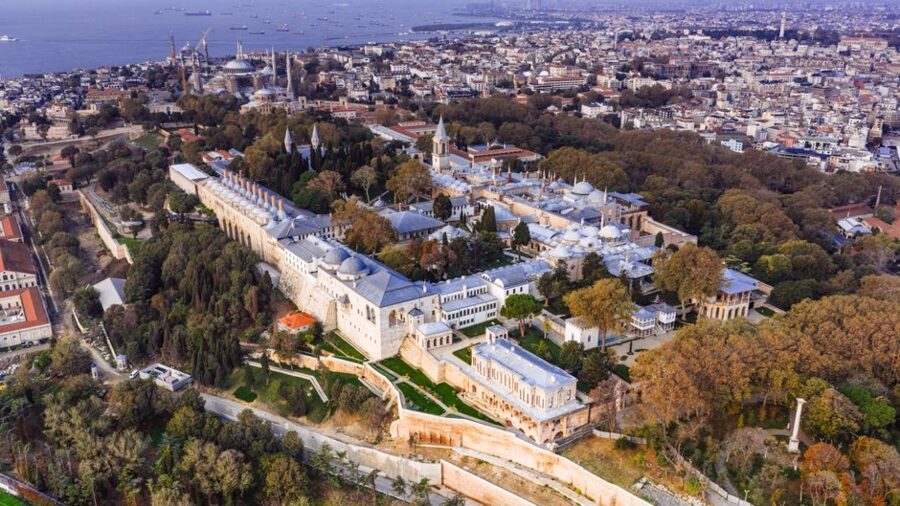
That one ticket covers the palace, the Harem and the Byzantine church of Hagia Irene, and since October 2026 the first courtyard also holds five new museums in the old Imperial Mint. The palace itself is a run of four courtyards, each more private than the last, and you walk them in the order the sultan’s visitors once did: from the parade ground open to soldiers and petitioners to the terraces only his household ever saw.

Contents
- Topkapı tickets in 2026 and who sets them
- The first courtyard: the Imperial Gate, Hagia Irene and the Mint
- The second courtyard: the council, the kitchens and the Tower of Justice
- The Harem, room by room
- The third courtyard: the Treasury, the Sacred Relics and the Audience Chamber
- The fourth courtyard: kiosks over the Bosphorus
- A short history of the Ottoman court at Topkapı
- Bags, photos, guides and lunch
Topkapı tickets in 2026 and who sets them
Topkapı is run by the Directorate of National Palaces (Milli Saraylar), not the Ministry of Culture, so the ministry’s euro prices and rules do not apply. The palace was attached to the National Palaces by a decree published in the Official Gazette on 6 September 2019, and it prices foreigners in Turkish lira. The figures below come from the National Palaces tariff that took effect on 13 May 2026, and they match the Topkapı price list the directorate publishes.
| Ticket (2026) | Foreign visitors | Turkish citizens | Discount rate |
|---|---|---|---|
| Combined: palace, Harem and Hagia Irene | 2,750 TL | 500 TL | 250 TL |
| Harem only | 1,050 TL | 400 TL | 150 TL |
| Hagia Irene only | 1,050 TL | 350 TL | 150 TL |
Children up to six go free. Students aged 7 to 25 get the discount rate with a student card, but foreign students pay twice the discounted price, so 500 TL for the combined ticket, and from age 12 they must show an ISIC card. The combined ticket is valid only on the day you buy it, so you cannot split the palace and the Harem across two mornings the way the Dolmabahçe Palace ticket allows.
There is no official online ticket for Topkapı. The National Palaces e-ticket shop sells Dolmabahçe and a handful of other sites, and it says in capitals that its Full Pass does not include Topkapı. Any “skip-the-line” Topkapı ticket sold online is a reseller’s product with its own markup; at the palace you buy from the windows or the machines beside them, in the first courtyard near the Gate of Salutation.
Some resellers still quote 3,000 TL “from July 2026”. The tariff in force since 13 May 2026 says 2,750 TL, and that is what the windows charge.
MuseumPass Istanbul and the Müzekart
The Ministry of Culture’s MuseumPass Istanbul costs €105, runs for five days from the first museum you enter and allows one entry at each site. The ministry’s own map of valid sites lists Topkapı, the Harem, Hagia Irene and a Darphane section of the palace museum, so a pass holder skips the ticket window. It pays off only if you also want the Istanbul Archaeological Museums and several other ministry sites inside those five days; for Topkapı alone it costs far more than the combined ticket.
The Müzekart, the museum card for Turkish residents, works at most National Palaces sites but not in the Harem or Hagia Irene. Residents using it buy those two separately, at the domestic rate.
Hours, the Tuesday closure and holidays
The palace opens at 09:00 every day except Tuesday. The ticket windows close at 17:00 and the Harem rooms stay open until 17:30, so about 15:00 is the latest arrival that lets you see the whole route without running. If Tuesday is your only free day, swap: Dolmabahçe and the other National Palaces close on Mondays instead.
On public holidays the official list keeps Topkapı open with one exception, the first day of Ramazan Bayramı at the end of Ramadan, though in some years the palace has opened late that day rather than staying shut. Check the National Palaces notice a few days before; the Turkish public holidays guide has the dates. In 2027 that first day falls on a Tuesday, the normal closing day, anyway.
How long to allow and when to arrive
Three hours covers the four courtyards, the Harem and the Treasury at a steady pace. Allow four to five if you read the labels, sit in the fourth-courtyard kiosks and add Hagia Irene, and most of a day if you want the five Darphane museums as well. Even without Gülhane Park, which was once its outer garden, the palace grounds cover about 35 hectares, so a good share of that time goes on walking.
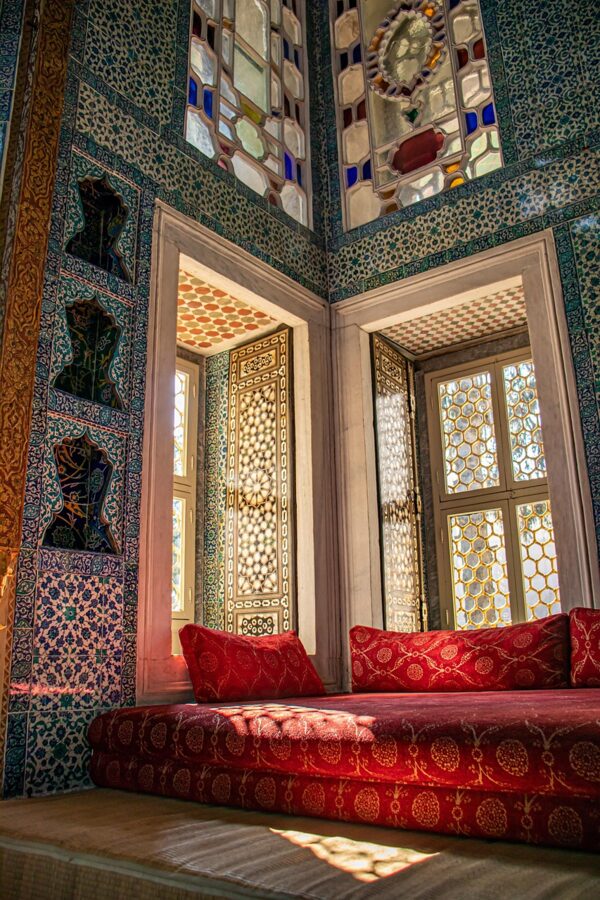
Arrive at 09:00 and walk directly to the Harem entrance, in the second courtyard under the Tower of Justice. Its corridors are narrow and they take around 10,000 visitors a day in summer, so the first hour is the only time it feels like a house rather than a queue. Then work back through the second courtyard, on to the Treasury and the Sacred Relics, and finish on the fourth courtyard’s terraces.
Getting there
The T1 tram stops at Sultanahmet and Gülhane, each 600–700 m from the palace; tap your Istanbulkart as on any other line. From the Sultanahmet stop you walk past Hagia Sophia to the Imperial Gate, which stands just behind it. The streets around are largely closed to traffic, so a taxi gains you nothing, and a bed in Sultanahmet puts you within a ten-minute walk.
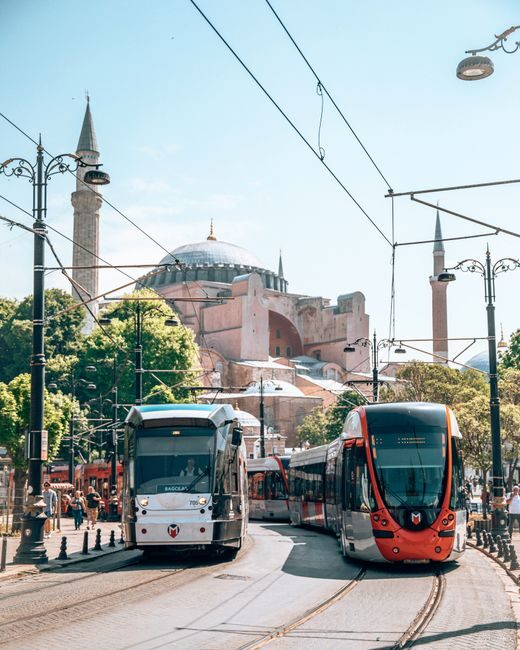
The first courtyard: the Imperial Gate, Hagia Irene and the Mint
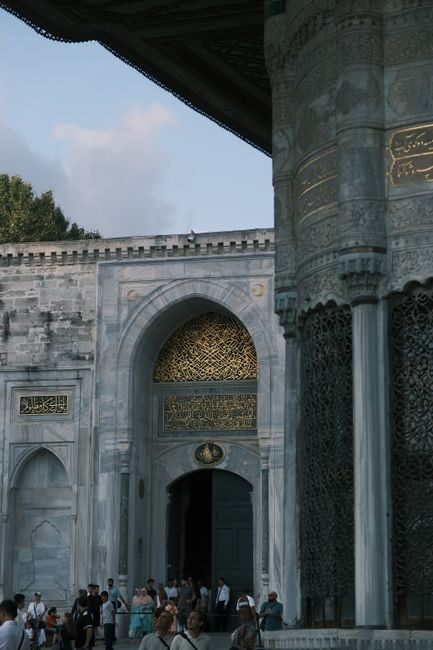
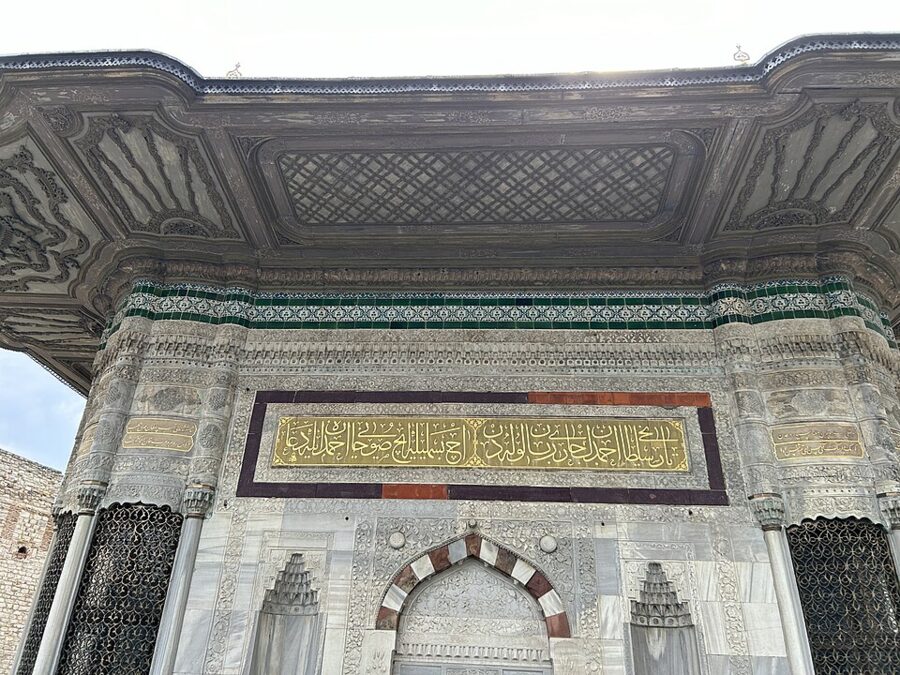
Before the gate, look at the Fountain of Ahmed III in the square, a marble fountain house built in 1728 by the sultan of the Tulip Era. The Imperial Gate (Bab-ı Hümayun) behind it carries an inscription dated 1478, the year the first phase of the palace was finished. It once had a second story with a row of windows; fire and earthquake damage in the late 19th century cost it the upper floor.

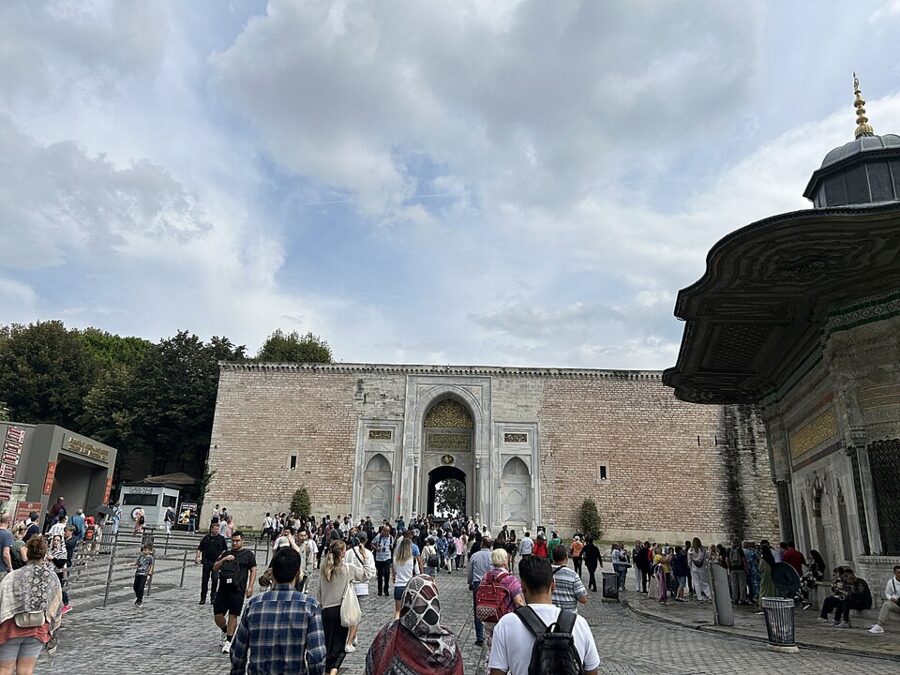

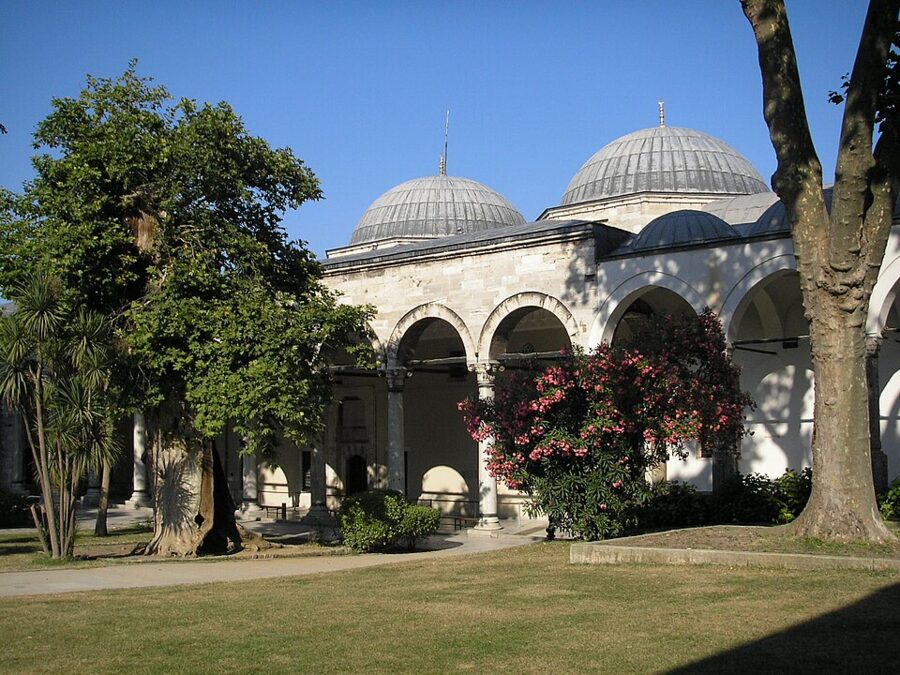
You pass a security scanner inside the gate, and the first courtyard beyond is free. In Ottoman times this was the public court, where janissaries, petitioners and the retinues of foreign ambassadors waited, and it was lined with the palace hospital, the bakeries, a woodyard and the workshops that kept the household supplied. Today it is a shady park with the ticket windows at its far end.
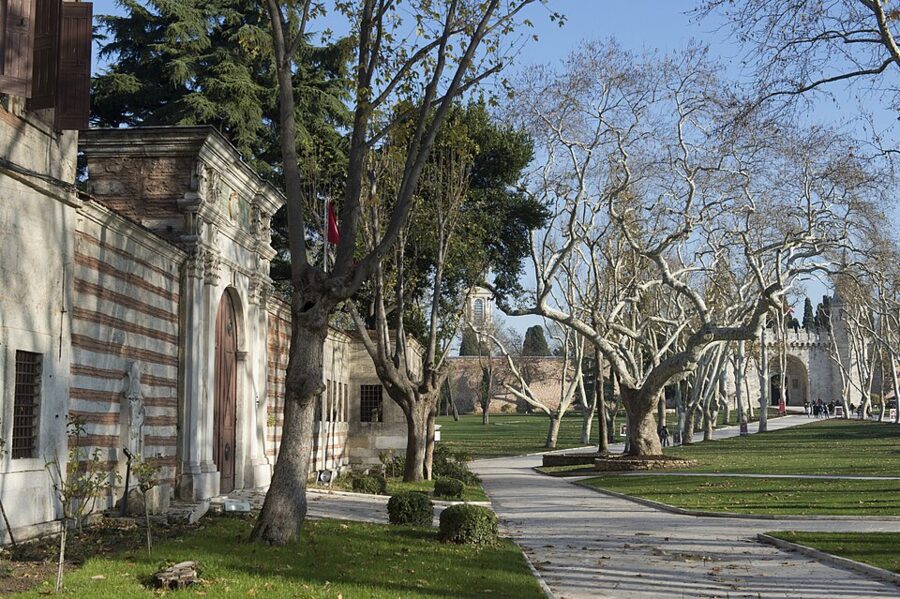

Hagia Irene
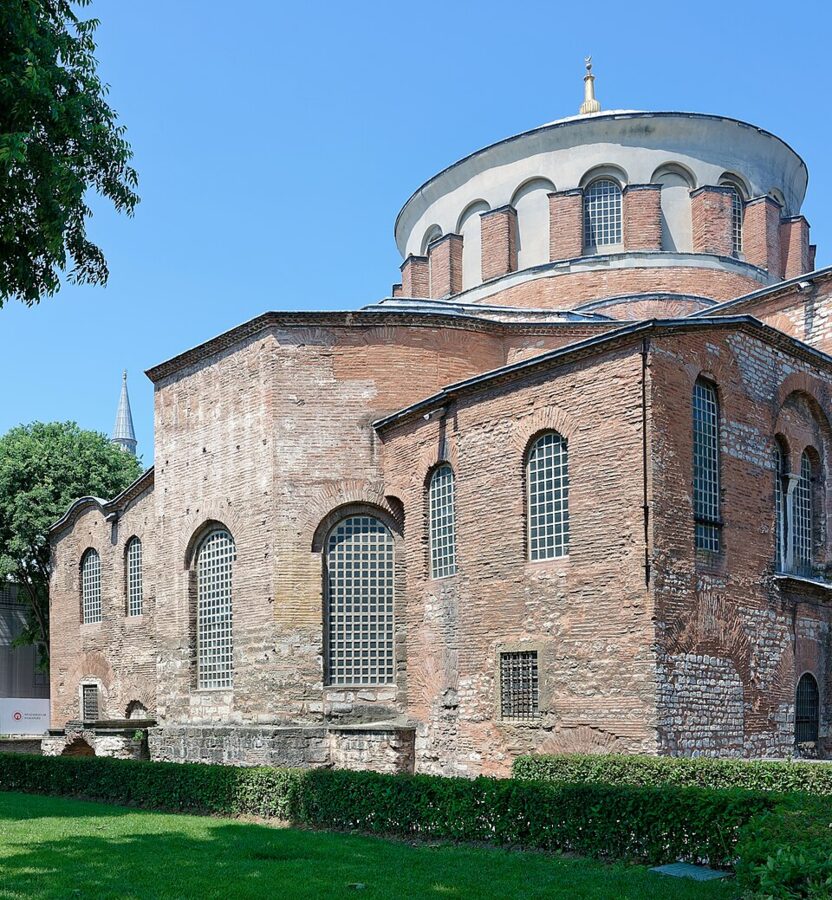

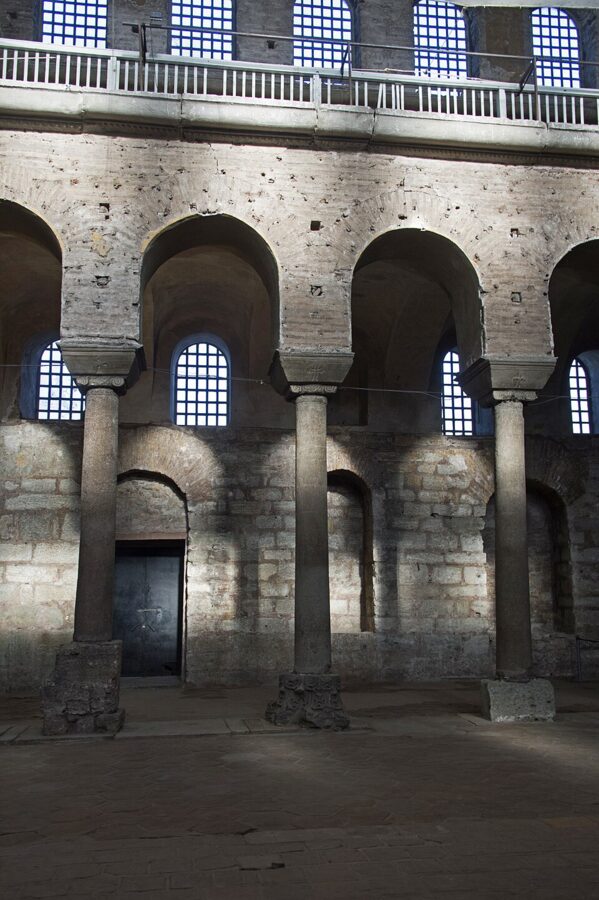
On your left stands Hagia Irene, a Byzantine church nearly a thousand years older than the palace. Its walls are mostly from Emperor Justinian’s 6th-century rebuilding, and the Ottomans never turned it into a mosque: they used it as an arsenal and storehouse, and in the 19th century it held the first state collection of antiquities, the seed of the Archaeological Museums next door. Inside it is bare brick and stone, with a plain mosaic cross in the apse, and it doubles as a concert hall.

The Darphane museums, new in October 2026
Past Hagia Irene, a lane drops into the Darphane-i Amire, the Imperial Mint, a cluster of workshops where the empire struck its coins. After seven years of restoration the National Palaces opened it to visitors on 25 October 2026 as five museums in 17 buildings: porcelain, calligraphy, imperial arms, maps, and the mint’s own furnaces and machinery.
The collections are large. The porcelain museum alone shows about 5,300 pieces, from Chinese wares to European and Turkish factory porcelain, the arms museum about 2,500 weapons, and the calligraphy museum about 2,000 works in ten rooms across two buildings. The mint museum keeps its casting stations and ovens with some 500 tools, many imported from Europe after the Industrial Revolution; for the maps, the directorate’s head gave 200 pieces at the opening while the summary in the same report says 110.
The National Palaces price list shows no separate Darphane ticket, and the ministry’s MuseumPass map lists the Darphane as a section of the palace museum. Ask at the window whether the combined ticket covers it before you plan an extra hour around it.
The second courtyard: the council, the kitchens and the Tower of Justice
The Gate of Salutation (Bâbüsselâm), with its two pointed towers, is where your ticket is checked. Only the sultan rode through it; everyone else, the grand vizier included, dismounted outside. Some historians tie the towers to a 16th-century renovation inspired by fortresses Süleyman saw on campaign in Europe, while Gülru Necipoğlu, whose 1991 study of the palace is the standard work, dates them to Mehmed II’s original walls.
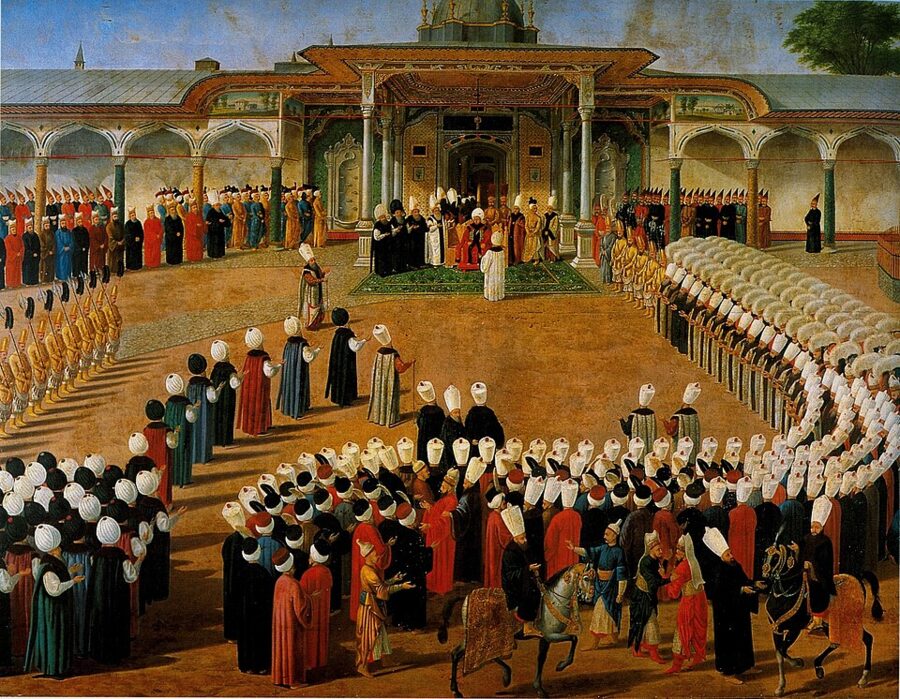
The second courtyard was the stage of government. The Imperial Council met here four days a week, every day in some periods under Mehmed II, starting straight after the dawn prayer, and on pay days the lawns filled with janissaries collecting their wages while ambassadors were led past them to the council hall. Ottoman miniatures show a courtyard with few trees, and visitors of the 16th century wrote of gazelles wandering it.
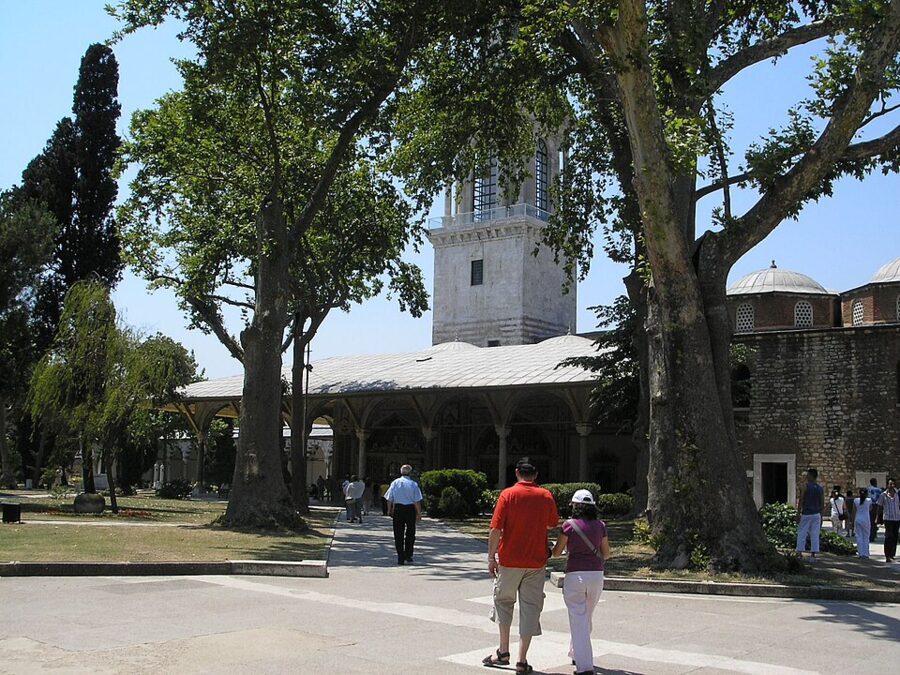
The Imperial Council Hall and the Tower of Justice
The domed Council Hall (Kubbealtı) in the left corner is where the grand vizier and the viziers ran the empire’s business. Above their bench, a gilded grille opens from the Tower of Justice behind: the sultan could listen without being seen. A court chronicler described it in 1527 as a window from which the sultan watched the council, “checking the truth of affairs”.
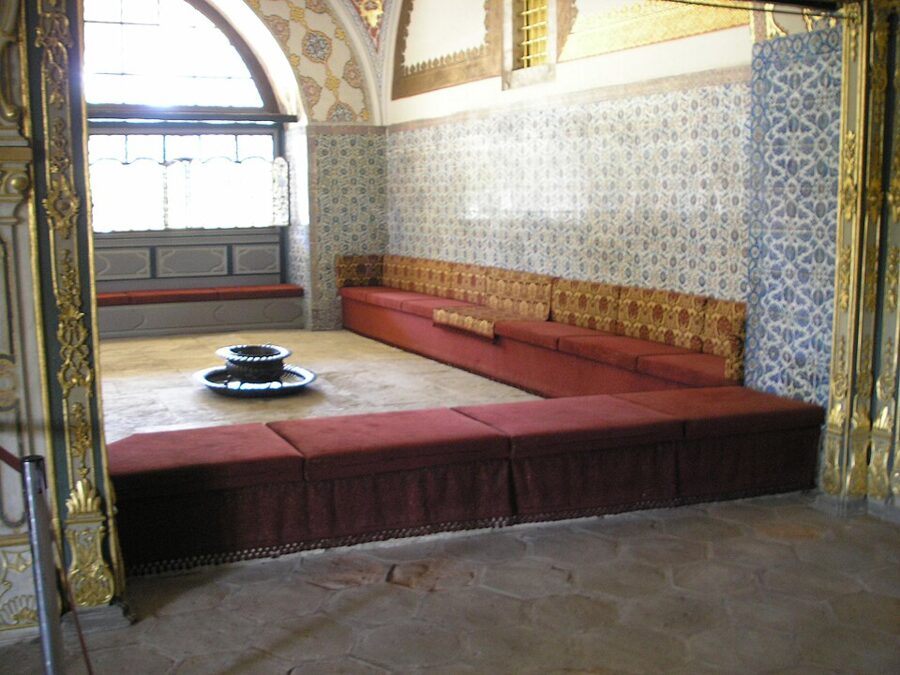
The hall took its present shape when Süleyman’s grand vizier İbrahim Pasha rebuilt the council rooms. The rooms beside it have held the palace’s clock collection. The Tower of Justice above, the palace’s tallest tower, had a back door to the Harem so the sultan could reach his listening post unseen.
The palace kitchens
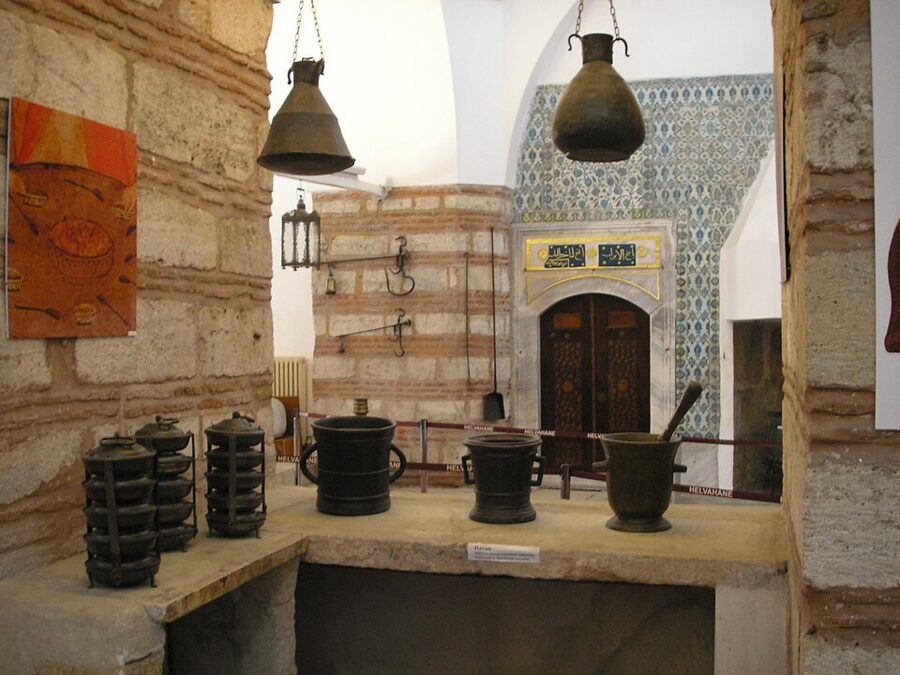
The row of domes and chimneys along the right side of the courtyard is the kitchens, rebuilt by the architect Sinan after a fire in 1574 on the plan of the first ones. Nine hearths and a confectionery kitchen (helvahane) fed 1,500 to 3,000 people on an ordinary day, and far more on council days and at embassy banquets.
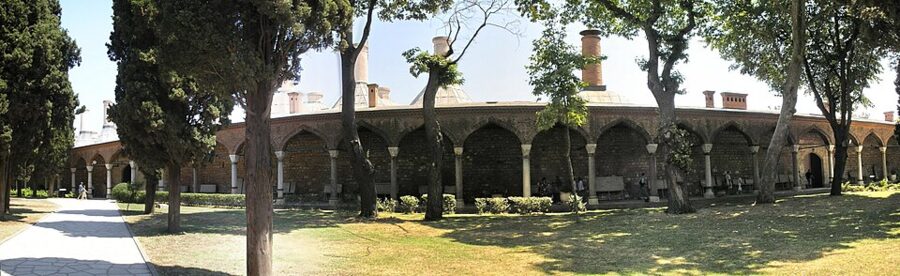
The kitchen halls closed for restoration in March 2021 and reopened in 2024, with the cement of 1940s repairs replaced by traditional lime and brick-dust plaster and the display doubled to about 400 objects. Each case lays a table from palace life: the sultan’s, the Valide Sultan’s, a prince’s circumcision feast, a council banquet, set with Chinese porcelain, copper, silver and tombak, the gilded copper the Ottomans loved. The sultans prized Chinese celadon partly for a legend that it changed color when it touched poisoned food.
The Harem, room by room
The Harem was the sultan’s private household: his mother, his consorts and children, the women who served them and the Black Eunuchs who guarded the doors. Much of it took shape in Süleyman’s long reign, when the dynasty’s women moved in from the Old Palace near Beyazıt, and rooms were added one against another until the 19th century, which is why the route twists, climbs and doubles back.
The Harem reopened in October 2020 after six years of restoration, and the National Palaces has added restored sections almost every year since. Is it worth it? In 2026 the question has answered itself: the Harem is on the combined ticket, and there is no cheaper palace-only ticket for foreign visitors. The real cost is the crowd, which is why it should be your first stop.
From the Carriage Gate to the Concubines’ Courtyard
You enter by the Carriage Gate below the Tower of Justice and pass the Dome with Cupboards, where the Harem’s accounts and valuables were kept, into the Courtyard of the Black Eunuchs. This long, narrow court with tiled walls and timber dormitories housed the men who ran the Harem under the Chief Black Eunuch (Kızlarağası), the official in charge of every servant in it. It reopened in spring 2025 after its own restoration.
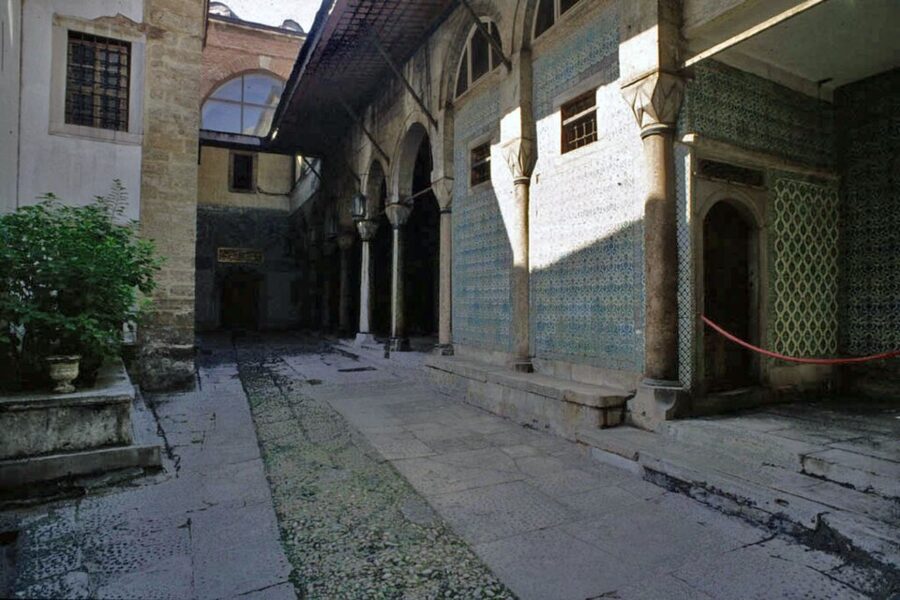

A corridor leads on to the Courtyard of the Concubines and Consorts, the smallest courtyard in the Harem, laid out again after a fire in the late 1660s. It reopened in May 2026 with its rooms dressed in about 750 objects and textiles from the palace collections, at no extra charge. The concubines’ bath beside it, opened to visitors for the first time in its history after the 2024 restoration, shows about 120 objects from Ottoman bathing, and the sultan’s private kitchen, the Kuşhane, has been fitted out again on the Golden Road.
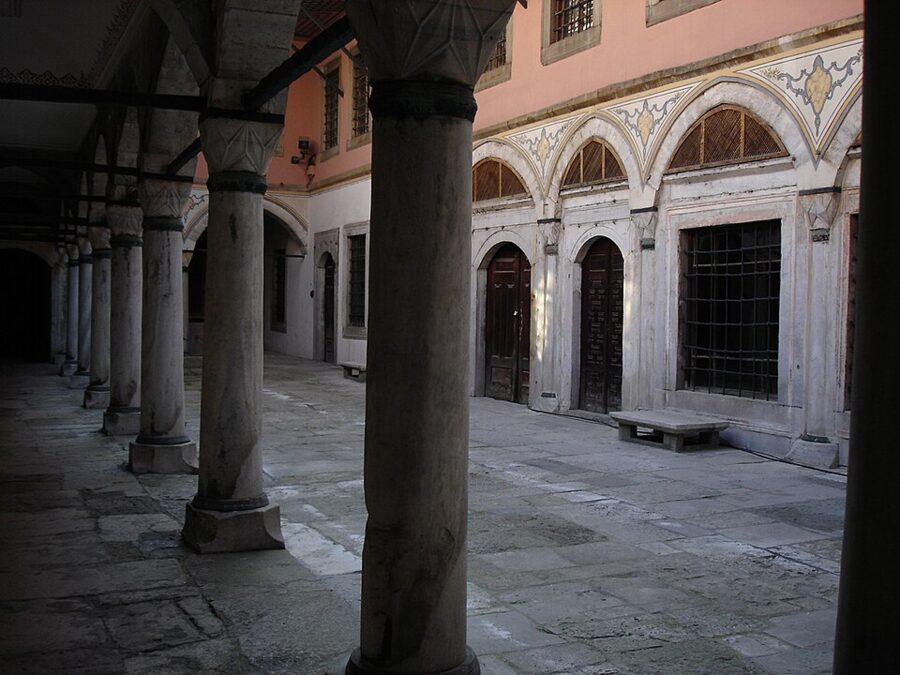

Most girls arrived as children, bought or given as gifts, and were trained in the Harem. A few were chosen as favorites, became consorts and, if a son reached the throne, Valide Sultan; many more were married off to officials with a palace education and left, and some stayed all their lives as staff, with their own hospital and their own gate for the dead.
The Valide Sultan, the Imperial Hall and the privy chambers
Next come the apartments of the Valide Sultan, the sultan’s mother and the senior figure in the Harem. From here she ran a household of hundreds, and in several reigns she ran a good share of the empire too.
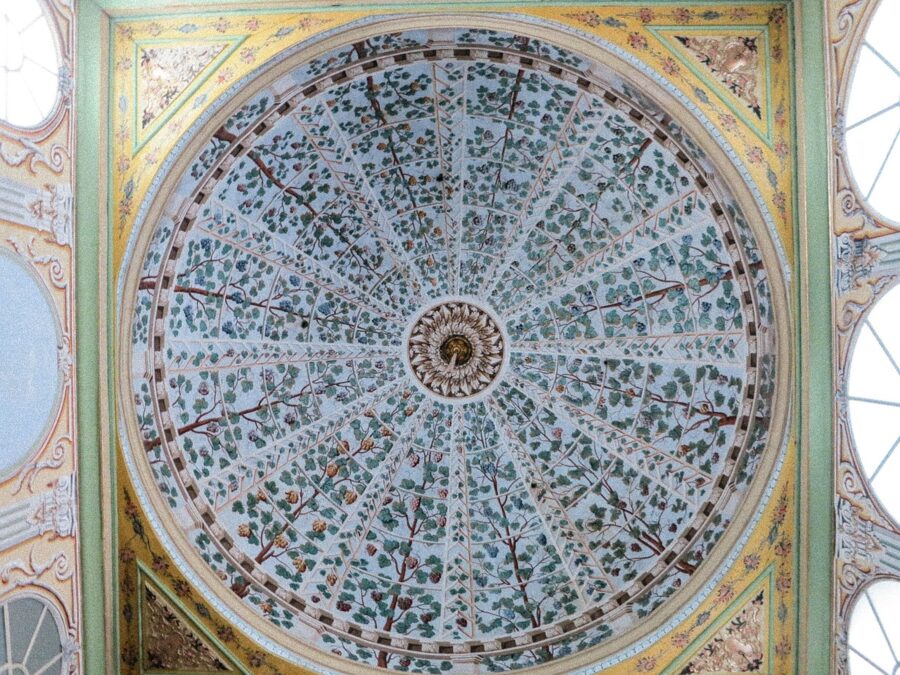
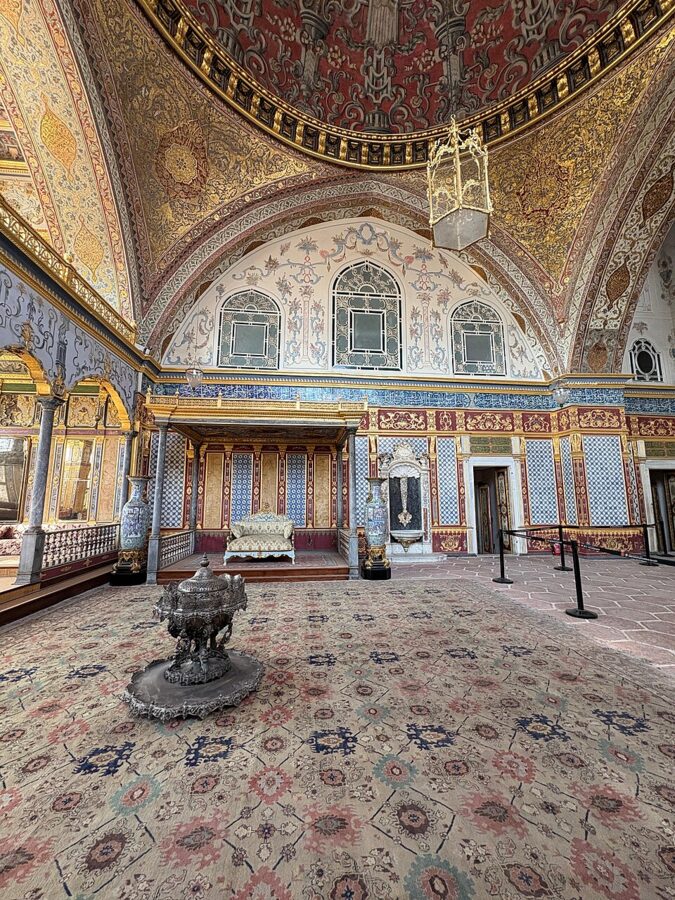
The Imperial Hall (Hünkâr Sofası) is the largest domed room in the Harem, where the sultan entertained his household with music and festivities from a throne on one side while the women watched from the gallery. It was built under Murad III and redecorated in the baroque taste in the 1750s, so its tiles, mirrors and painted dome come from two different centuries.

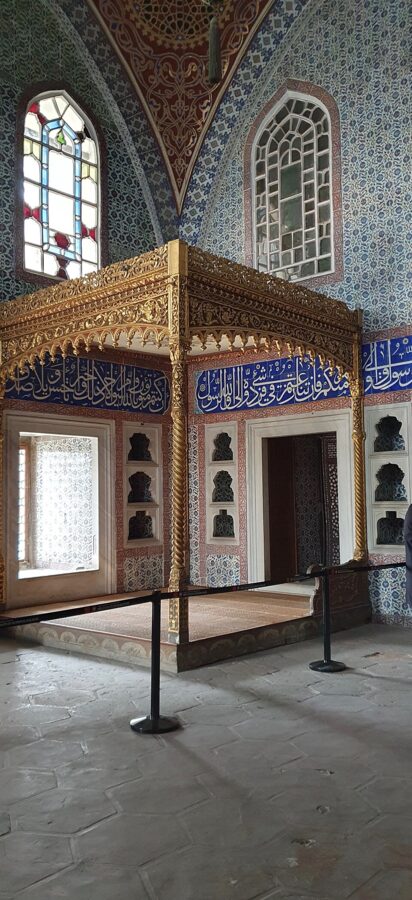
The Privy Chamber of Murad III, built around 1578 and usually credited to Sinan, is the finest room in the palace. Almost all its İznik tiles are original, and its three-tiered marble fountain was placed so that running water would cover the sultan’s conversations from anyone listening at the door.

Two more sultans’ rooms reopened in May 2025 after ten years of work. The reading room of Ahmed I, from the early 1600s, has cupboard doors inlaid with mother-of-pearl by Sedefkâr Mehmed Ağa, the architect of the Blue Mosque, and rare green tiles. Next to it, the Fruit Room of Ahmed III was painted about a century later with bowls of fruit and vases of flowers in the Tulip Era style, and together with Murad III’s chamber they show three sultans’ private rooms across two hundred years.
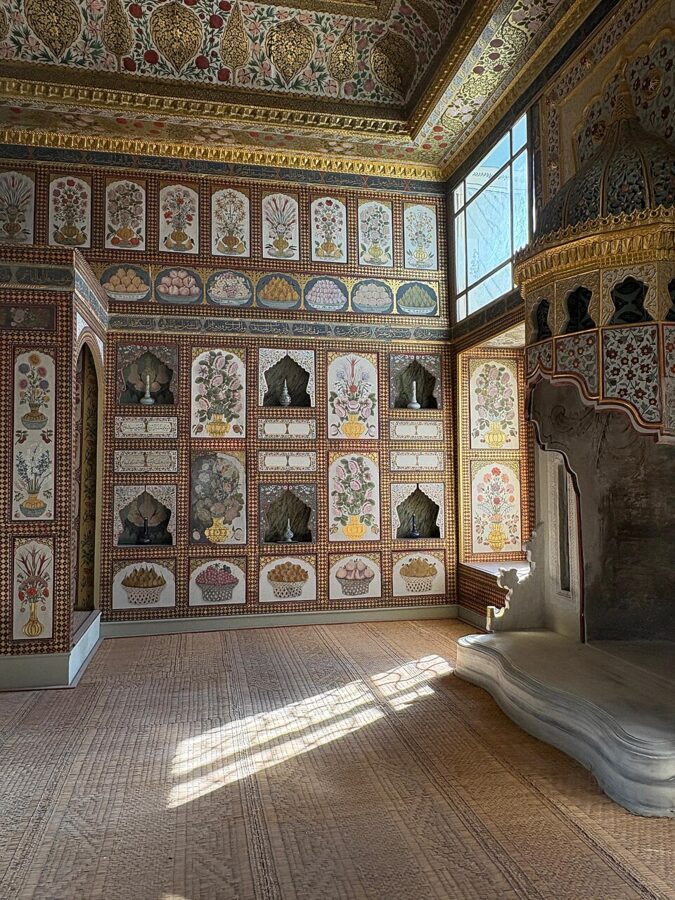

The Twin Kiosk and the princes’ “cage”
The Twin Kiosk, two rooms of about 1600 known as the Apartments of the Crown Prince, has a painted canvas dome and fine İznik panels. It stands beside the rooms called the kafes, the cage: until Mehmed III’s reign, which ended in 1603, princes were sent out to govern provinces, but afterward they stayed in the Harem with their households until they died or came to the throne. From here the Golden Road, the passage the sultan used, takes you out into the third courtyard.

The third courtyard: the Treasury, the Sacred Relics and the Audience Chamber
The Gate of Felicity (Bâbüssaâde) was the threshold of the sultan’s private world. Accession ceremonies and festival audiences were held in front of it, with a throne set under its canopy and the whole court lined up in the second courtyard. Beyond it, White Eunuchs guarded the Enderun, the palace school where boys were trained for the army and the government.
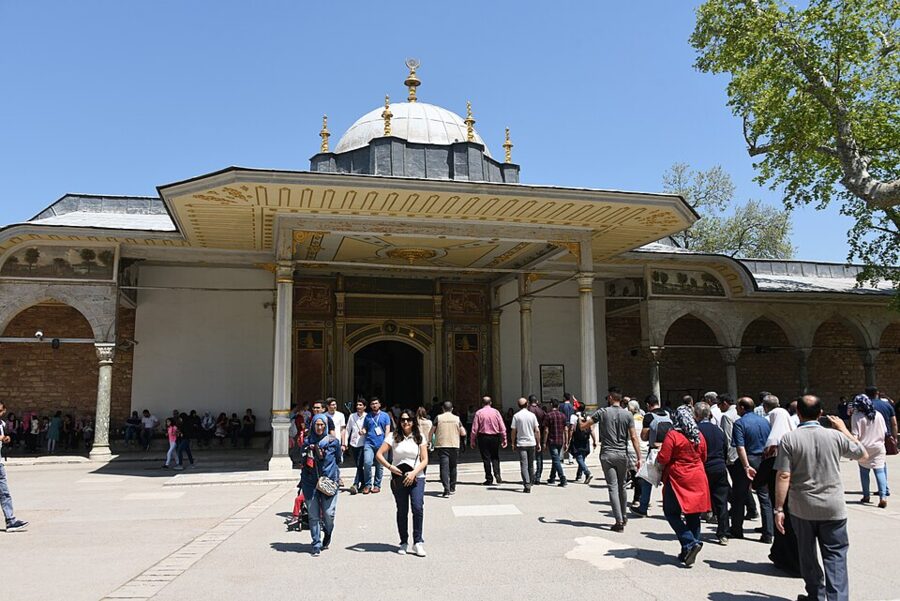

Straight ahead is the Audience Chamber (Arz Odası), where the sultan received the viziers after council meetings and foreign ambassadors on their great day. Its base goes back to Mehmed II, but it has been redecorated so often that the tughra, the sultan’s monogram, over the main door is Abdülmecid’s, from the 19th century. Behind it stands the marble Library of Ahmed III of 1719, light and quiet, the best place in the palace to stand still for five minutes.
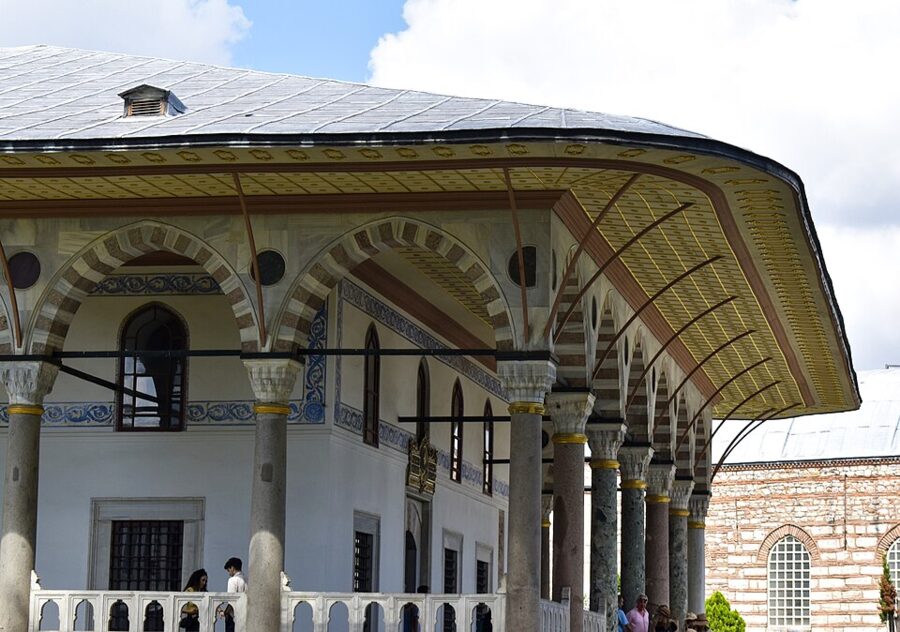
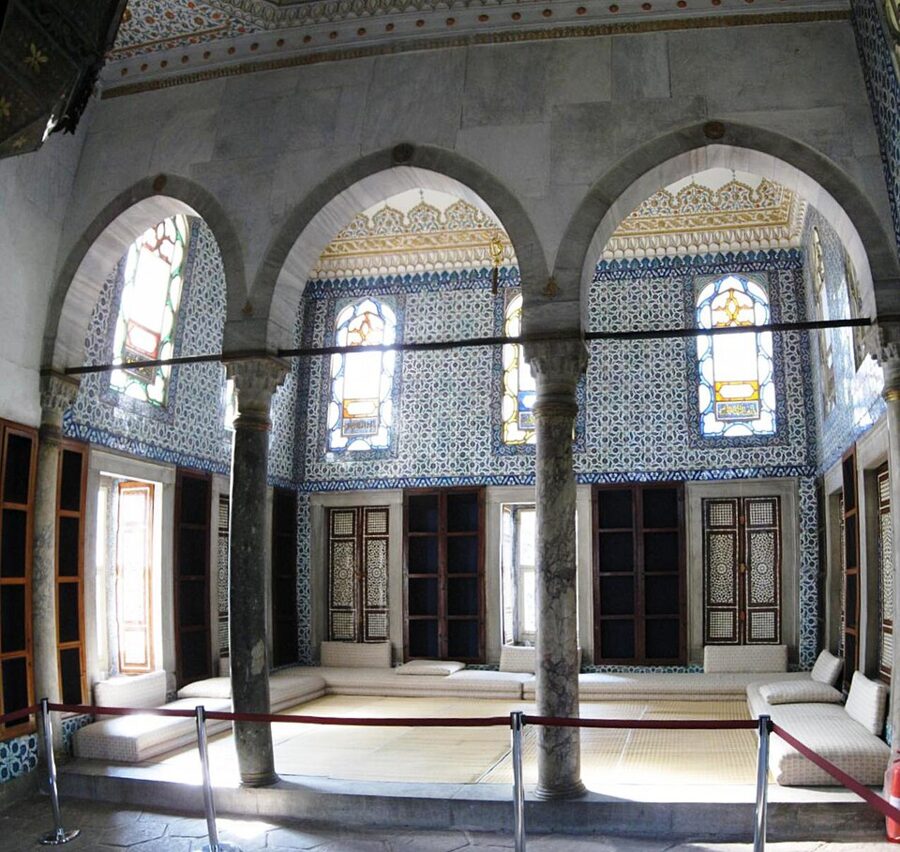
The Imperial Treasury
The Treasury fills the Conqueror’s Pavilion (Fatih Köşkü), one of the oldest buildings in the palace, on the far right of the courtyard. Its rooms reopened in April 2023 along with the Sacred Relics rooms, the dormitories on that side of the courtyard and the Mecidiye Kiosk.
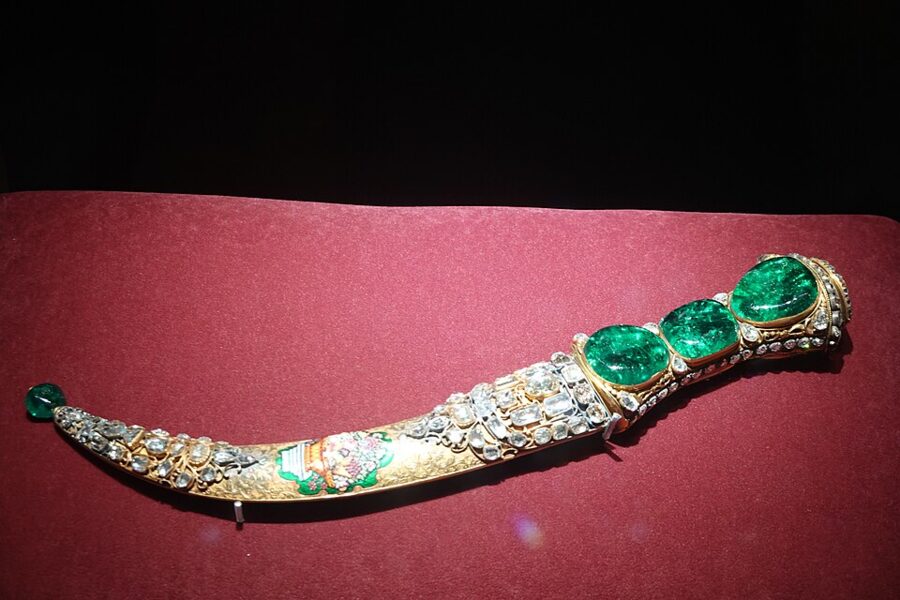
The star is the Topkapı Dagger, gold, with three large emeralds on the hilt and a watch in the pommel. Mahmud I had it made in 1747 as a gift for Nader Shah of Persia, but the Shah was murdered before it arrived and the embassy turned back; in 1964 it became the target of the jewel thieves in the film Topkapi.

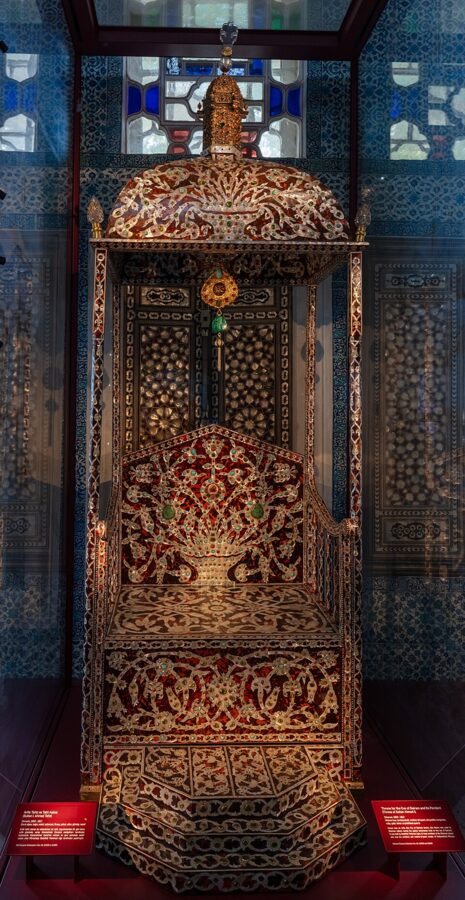
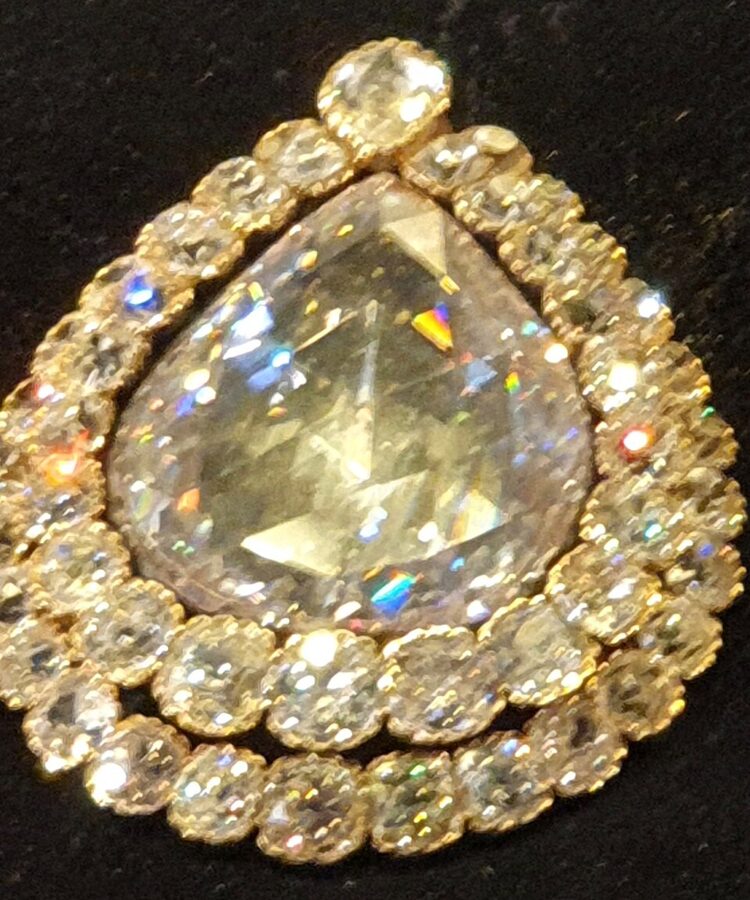
Nearby sits the Spoonmaker’s Diamond (Kaşıkçı Elması), a pear-shaped stone of 86 carats set in two rows of 49 smaller diamonds. How it reached the palace is told several ways, all involving someone selling it for next to nothing, and the legends are better than the records. Look also for the throne of Ahmed I, inlaid with mother-of-pearl and tortoiseshell by the same Sedefkâr Mehmed Ağa who worked in the Harem, and the gold festival throne presented to Murad III in 1585.


The Sacred Relics
In the far left corner, the four domed rooms of the Privy Chamber (Has Oda) were built under Mehmed II as the sultan’s own apartment. After Selim I conquered Egypt in 1517, relics associated with the Prophet Muhammad came to the palace, among them the Holy Mantle (Hırka-i Saadet), and the rooms became their shrine. In Ottoman times the mantle was shown only once a year, to the imperial family in the middle of Ramadan.
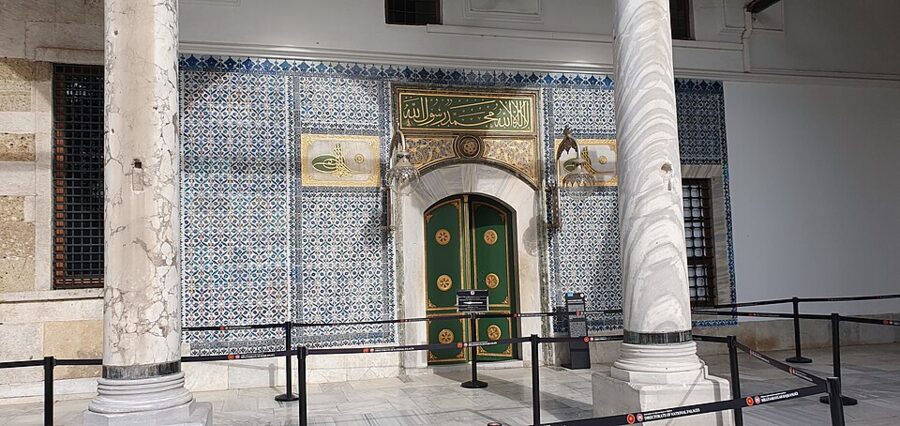

Treat it as a place of worship, because for many visitors it is one. The line moves slowly through the tiled rooms, and nothing inside needs more than a few minutes unless you are there to pray.
Robes, and what is closed in 2026
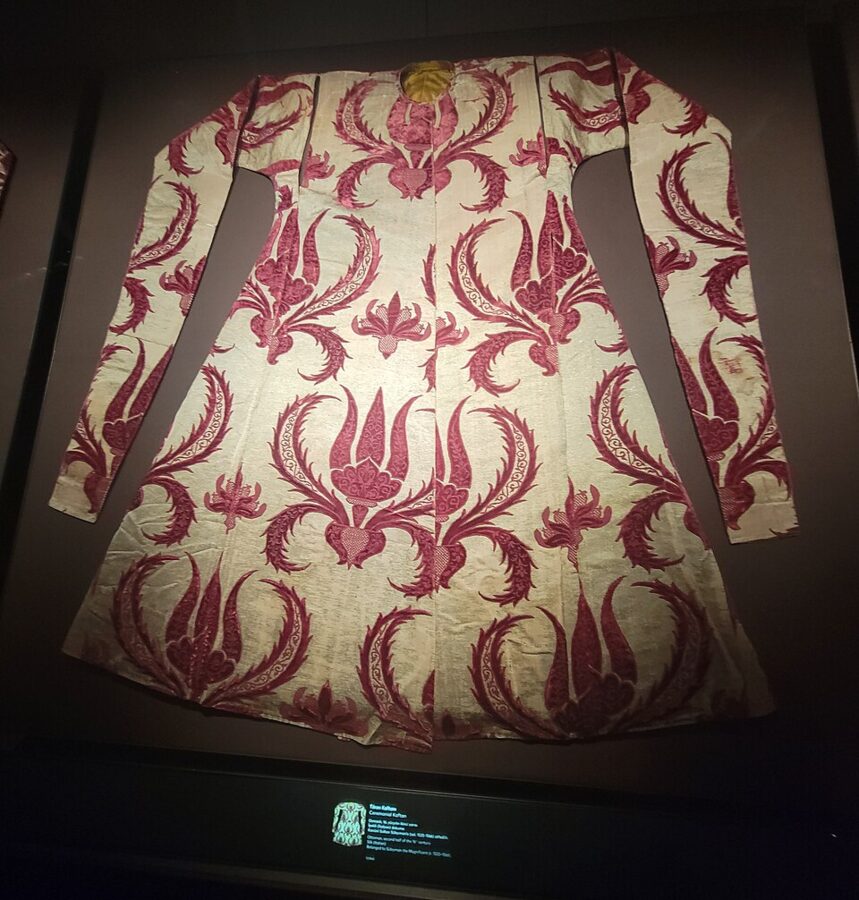
Across the courtyard, the Dormitory of the Expeditionary Force, built under Murad IV in 1635, has housed the sultans’ wardrobe collection of some 2,500 garments, kaftans included. The restoration program that began in 2019 has reopened the main rooms of this courtyard, but single rooms still close for rehangs and repairs without much notice, and parts of the Harem remain off the route. If one hall is shut on your day, the rest of the palace is more than enough.
The fourth courtyard: kiosks over the Bosphorus
The fourth courtyard is not really a courtyard but a set of garden terraces stepping down toward the water, with pavilions built for pleasure rather than government. The square stone tower by the path, the chamber of the chief physician, is the oldest building here, a 15th-century watchtower from Mehmed II’s time.
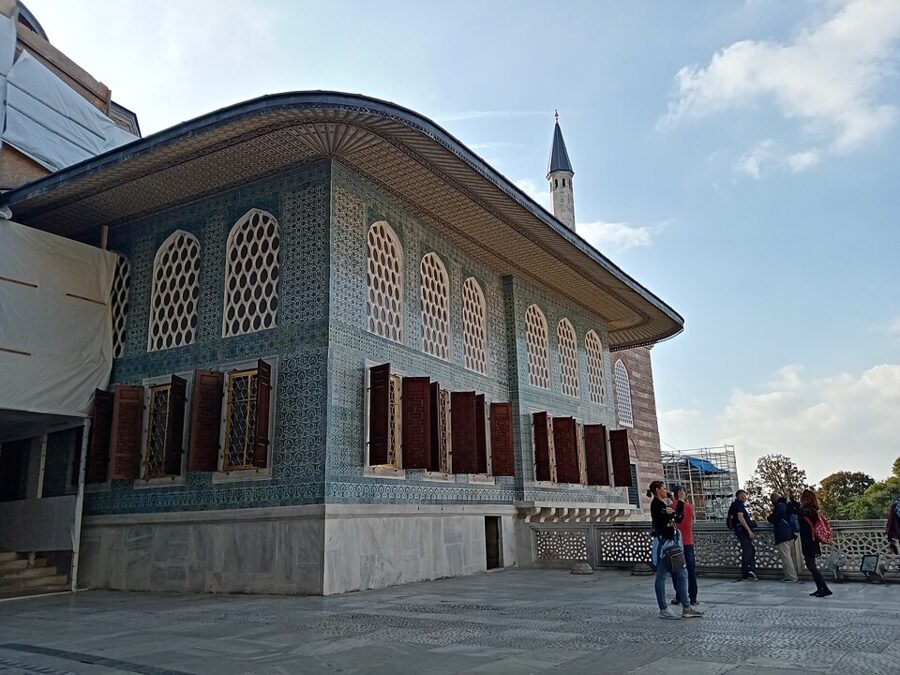
Murad IV’s architect Hasan Ağa built the Revan Kiosk in 1635–1636 and the Baghdad Kiosk in 1638–1639 to mark the sultan’s campaigns against Yerevan and Baghdad. Both keep most of their original decoration: deep eaves, a central dome, İznik tiles, and cupboard doors inlaid with mother-of-pearl and tortoiseshell.
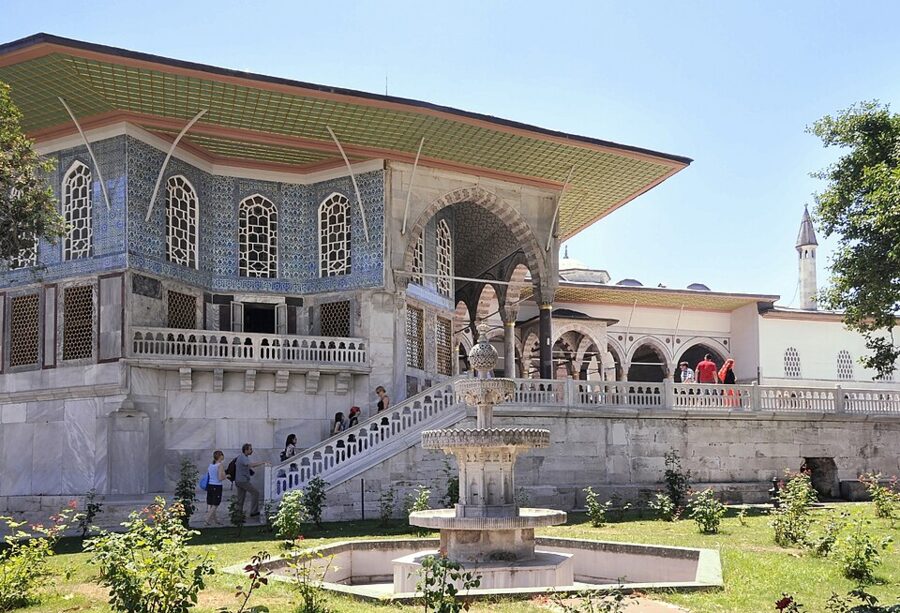

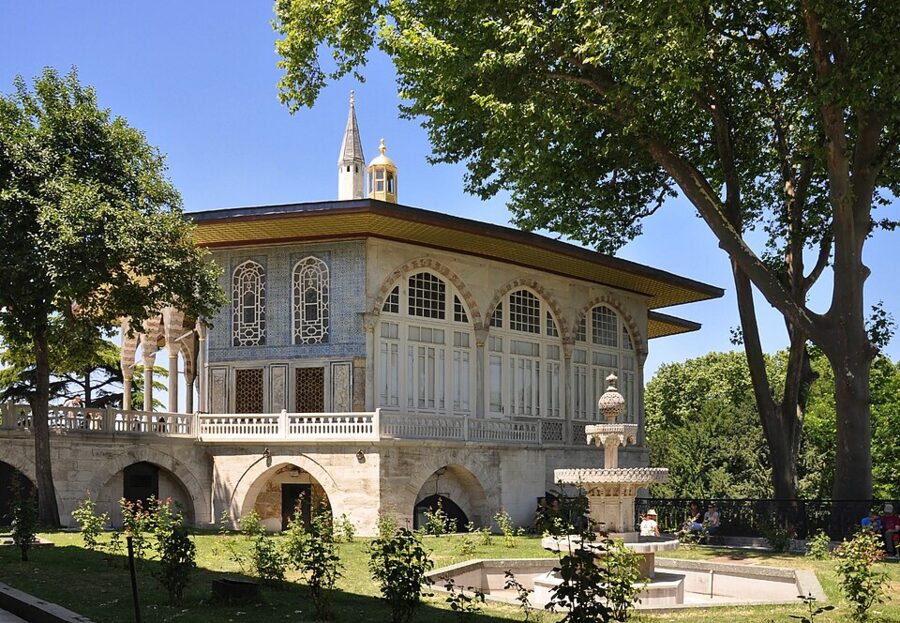

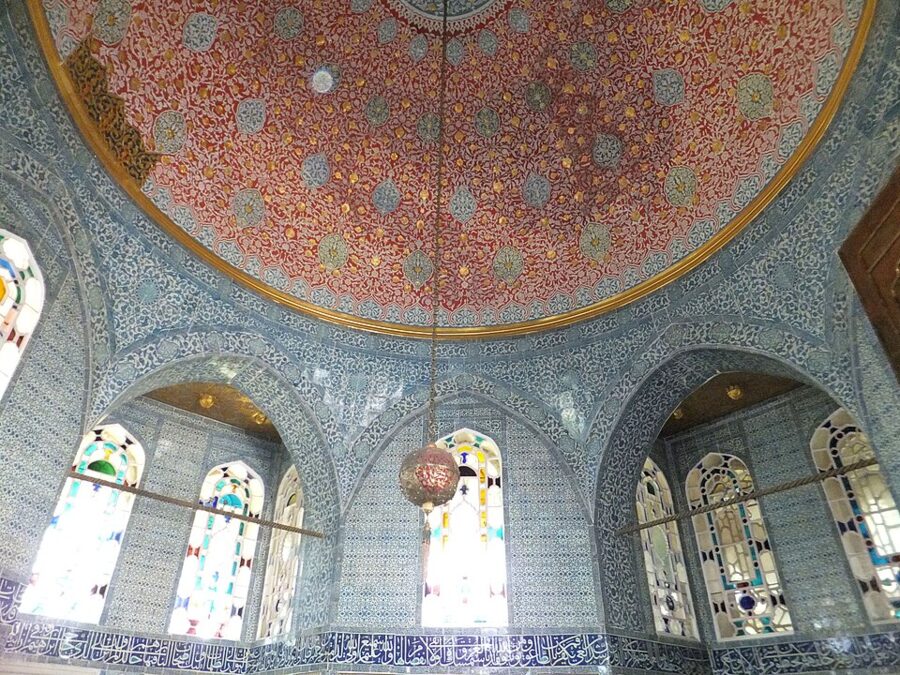

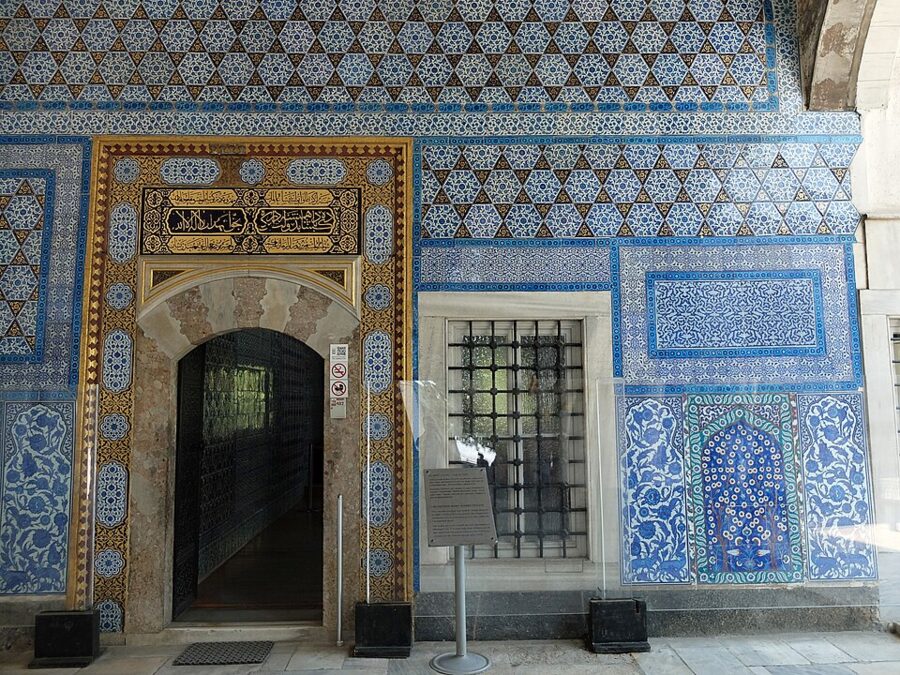
Beside them, Sultan İbrahim added the Circumcision Room in 1640, a summer room for the circumcision ceremonies of the princes. Its walls are faced with tiles older than the building, recycled from elsewhere in the palace, among them blue and white panels drawn in the style of Chinese porcelain.

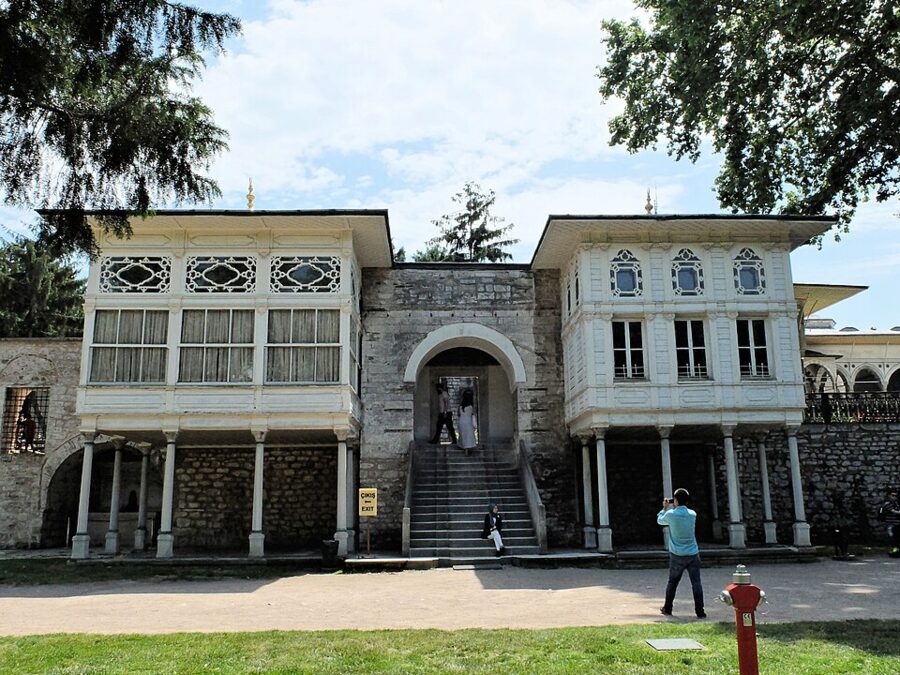
Between the kiosks, the little gilded İftar bower, also İbrahim’s, was where the sultan broke the Ramadan fast at sunset with the Golden Horn below him. Lower down, the Sofa Kiosk is an 18th-century wooden pavilion by the Tulip Garden, and at the far end the Mecidiye Kiosk, built by Abdülmecid, is the last pavilion added to the palace before the court moved out.

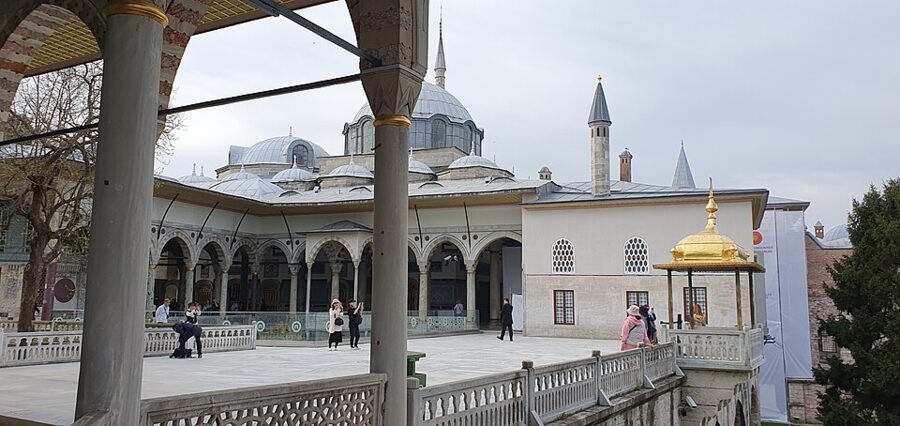

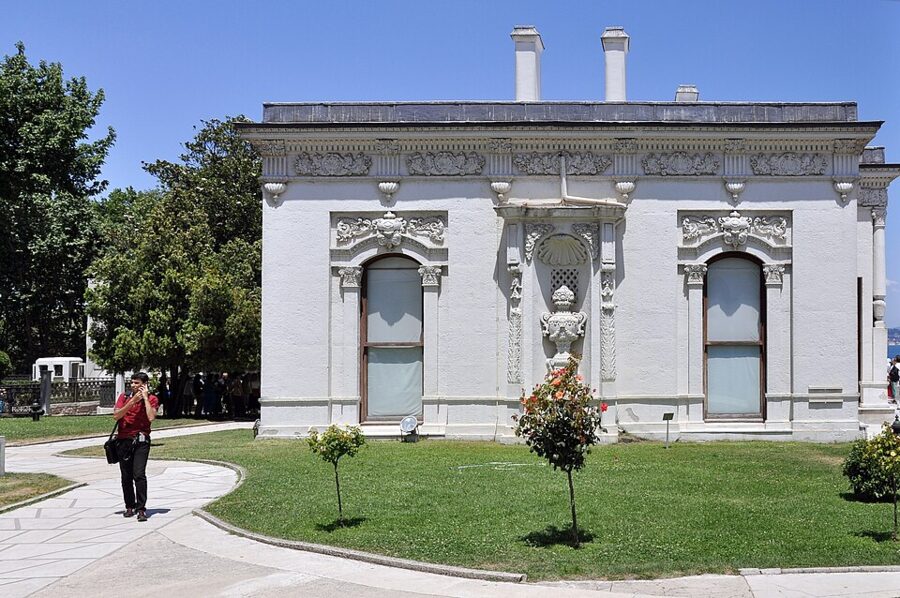

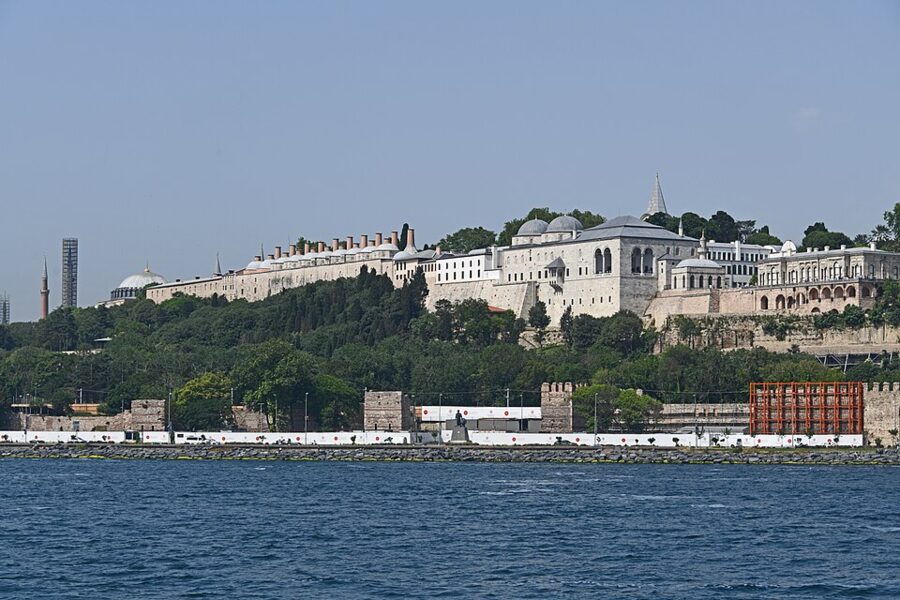
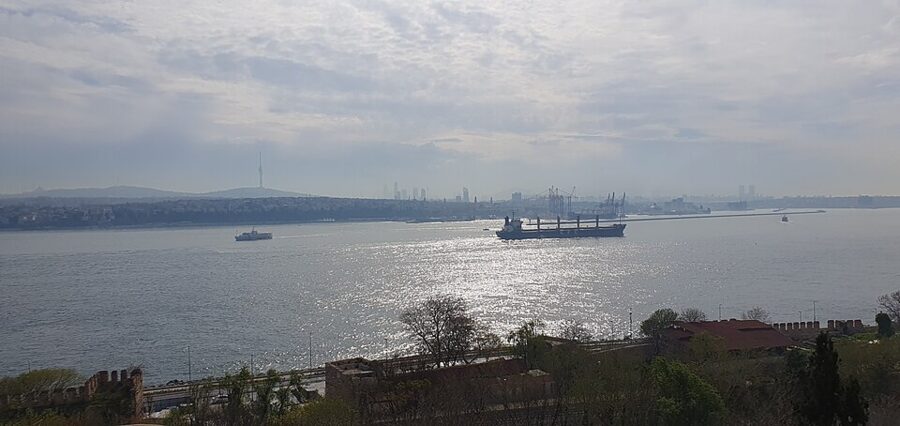
From the terraces you look across the mouth of the Bosphorus to Üsküdar and up the Golden Horn. This is why the palace stands where it does, on the old acropolis of Byzantium: whoever sat here could watch every ship that entered or left the city.

Leaving by Gülhane Park and the Archaeological Museums
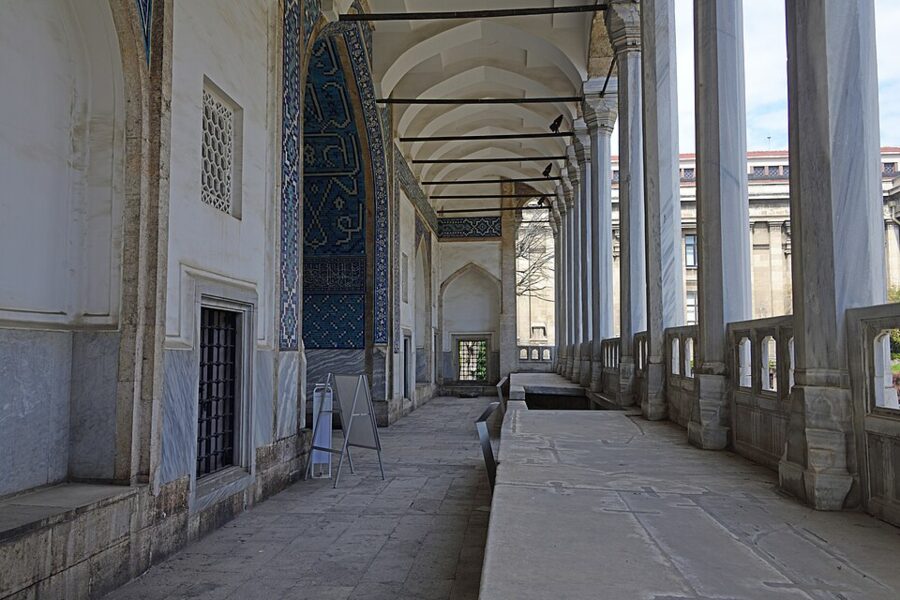
You leave the way you came, through the first courtyard, but instead of going back to Sultanahmet take the path down past the Istanbul Archaeological Museums. They charge €15, open every day from 09:00 to 18:30 with the ticket office closing at 17:30, and the Tiled Kiosk among them, finished in 1472, is one of the earliest buildings of Mehmed II’s palace. If you have energy left for one more museum, this is the one: the Alexander Sarcophagus alone justifies the ticket.
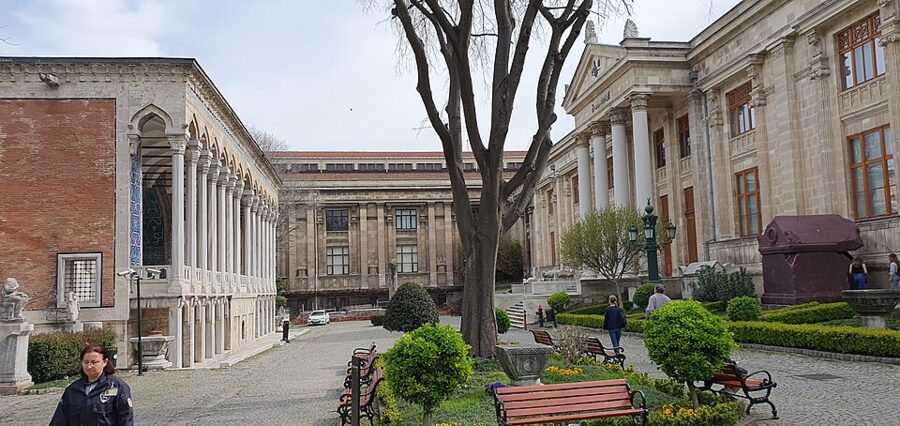


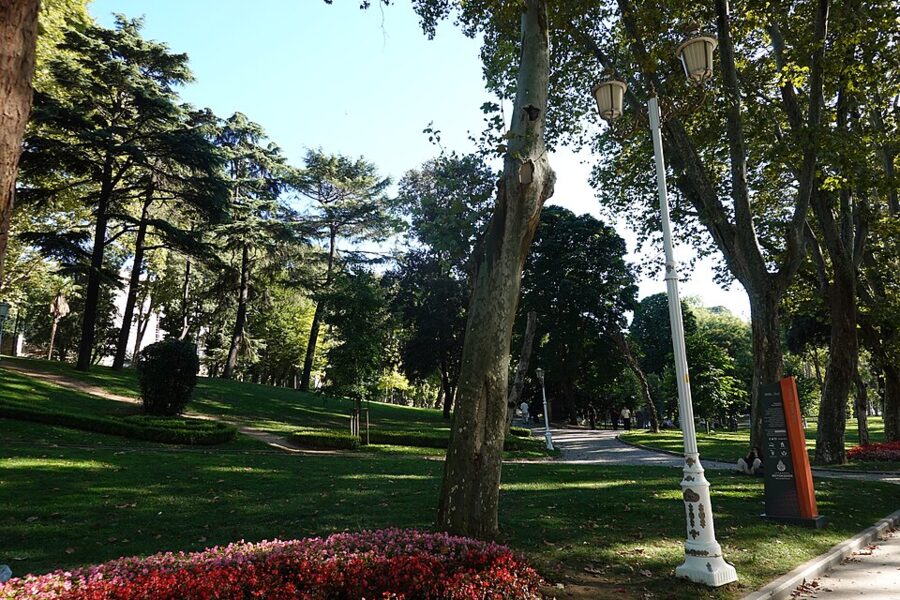
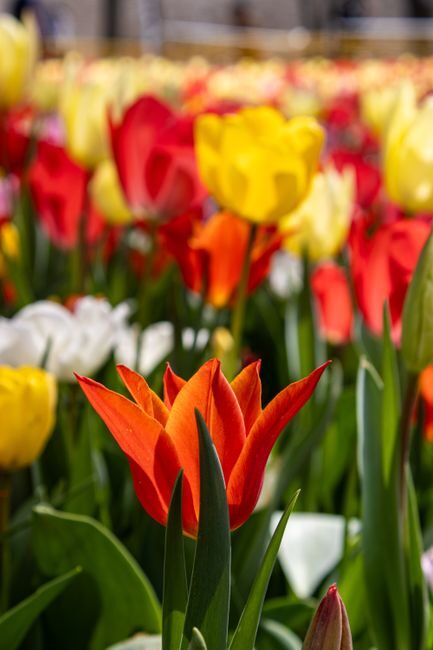
Below the museums lies Gülhane Park, once the outer garden of the palace and now a free public park, with the Gülhane tram stop at its gate. In April it fills with tulips, the flower Ahmed III’s court made a craze of.

A short history of the Ottoman court at Topkapı
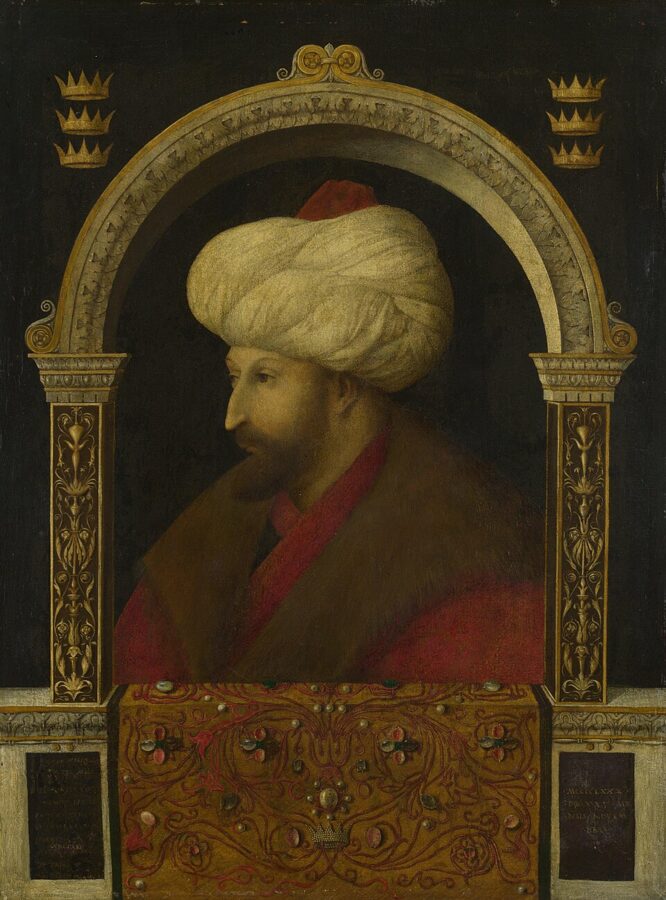
Mehmed II took Constantinople in 1453 and first built a palace near today’s Beyazıt, later called the Old Palace. Within a few years he began a second one on the headland of Sarayburnu, the old acropolis, then an olive grove: the National Palaces give 1460–1478 for the work, the TDV Encyclopedia of Islam suggests it started around 1465, and the inscription on the Imperial Gate gives 1478. For centuries it was simply the New Palace; the name Topkapı, Cannon Gate, came later, from a shore pavilion by a gate flanked with cannon.
The palace was laid out as a sequence of courts that matched the way the state worked. The outer court served the household, the second held the council that ran the empire, the third was the Enderun, the school and private service of the sultan, and the Harem was his family’s home. A register of 1478 lists about 726 people on the palace staff; with the Harem and the sultan’s personal servants, the household was well over 1,500.
The buildings also staged power. Mehmed II’s law code moved routine business to the grand vizier, and the Tower of Justice and the Audience Chamber put the sultan above the council, present but rarely seen. Necipoğlu’s Architecture, Ceremonial, and Power: The Topkapı Palace in the Fifteenth and Sixteenth Centuries is the book to read if you want the full argument.
Over four centuries the court changed shape. Women of the dynasty moved into the palace under Süleyman, the Valide Sultans of the 17th century wielded real power from the Harem, and princes went from governing provinces to waiting in the kafes. By the 19th century sultans preferred their palaces on the Bosphorus shore, and in 1856 Abdülmecid moved the court to the new Dolmabahçe Palace at Beşiktaş. Topkapı kept the treasury, the library, the mint and the relics.
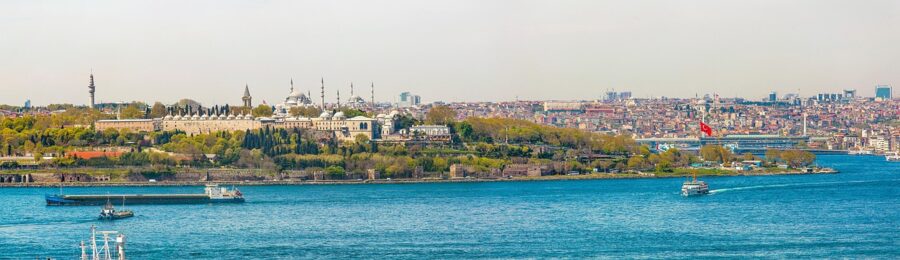
On 3 April 1924, months after the Republic was founded, Topkapı became a museum, the first of the new state. It holds nearly 300,000 archive documents as well as its collections, and it has been part of the Historic Areas of Istanbul on the World Heritage list since 1985. Since 2019 it has been run by the National Palaces, which has spent the years since restoring the Harem, the third courtyard, the kitchens and now the Mint.
Bags, photos, guides and lunch
- Security. Bags go through a scanner at the Imperial Gate, and tickets are checked at the Gate of Salutation. Bring a daypack, not your whole kit.
- Photos. The National Palaces lifted its ban on personal photos in its palaces in early 2026; flash and tripods are still not allowed. In the Sacred Relics I would keep the camera away regardless.
- Dress. Covered shoulders and knees are the safe choice; the Sacred Relics are a shrine, and that is where you are most likely to be asked to cover up.
- Guides. A guide adds stories, not access, and you do not need one to follow the route. An audio guide is available at the palace.
- Walking. Expect cobbles, steps and steep stairs in the Harem; there are no wheelchairs to borrow, and the slopes to the fourth courtyard are hard going with a stroller.
- Smoking. Banned everywhere in the grounds, e-cigarettes included.
- Night openings. Summer night visits have run since 2024 at a much higher price than the day ticket; dates and prices are announced each season.
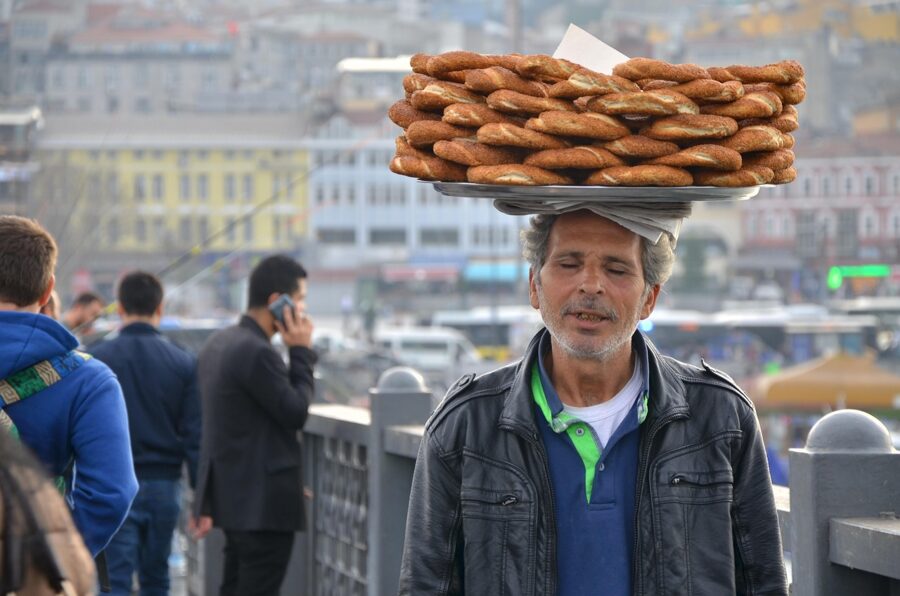
I would eat before or after rather than inside the walls. A simit from a cart on the way to the gate keeps you going until lunch, and the Istanbul street food guide covers what to eat around Sultanahmet and Eminönü. Carry water: the walk from the Harem to the fourth courtyard is longer than it looks on the map.
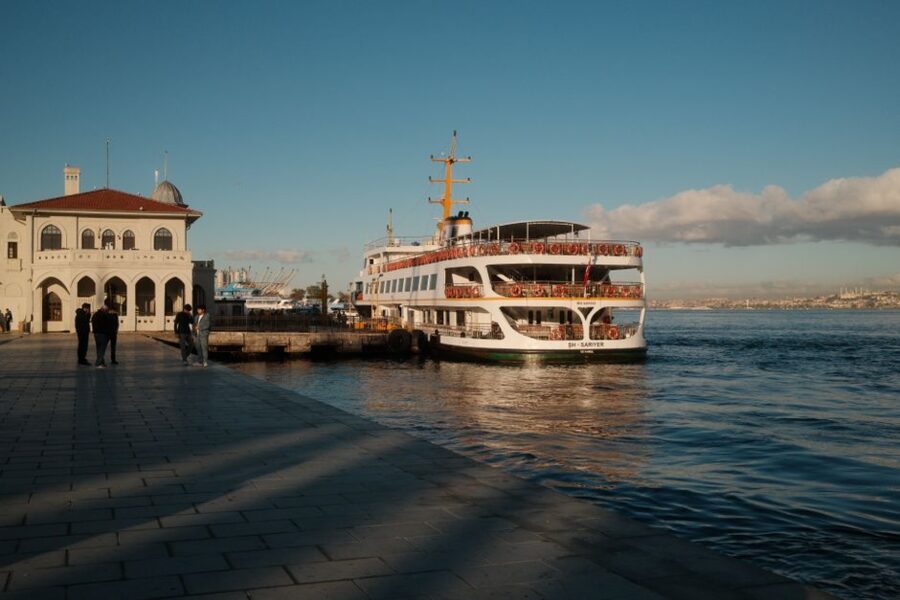
When you are done, walk down through Gülhane Park to the tram, or on to Eminönü and take the commuter ferry across to Kadıköy. Twenty minutes on the water, on the same Istanbulkart, gives you the whole palace on its headland, the view the sultans built it to command.