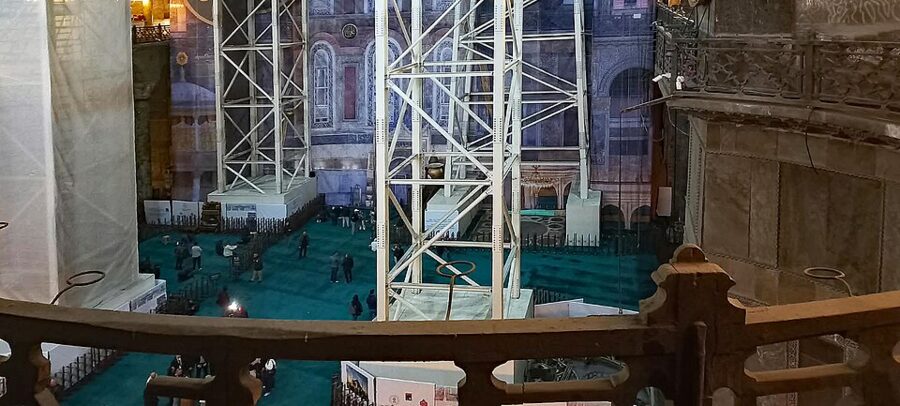
Twenty-five euros gets a foreign visitor into Hagia Sophia in 2026, and it buys a walk around the upper gallery, not the floor. The carpeted ground floor under the dome belongs to the people who come to pray, and they go in free through a different door. Up in the gallery you get the Byzantine mosaics at arm’s length and the finest interior view in Istanbul, which this year includes a steel restoration platform rising 43.5 m from the prayer floor to the dome.
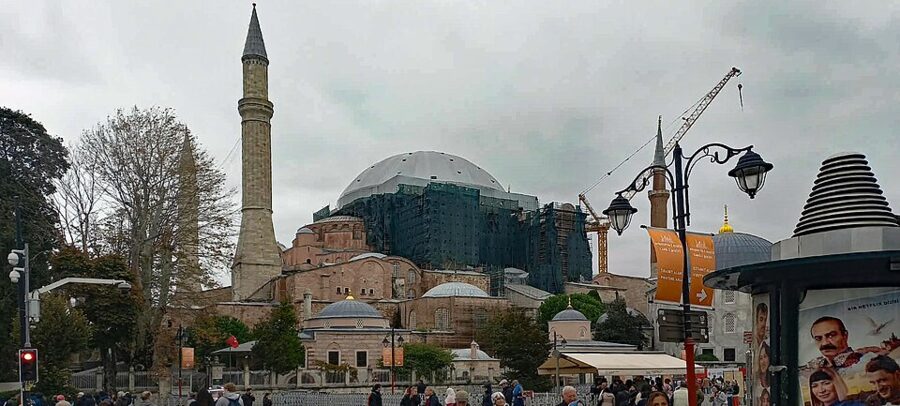
None of that is a reason to skip it. The mosaics of the south gallery are untouched by the scaffolding, the Ottoman calligraphy still hangs in its giant roundels, and from the gallery rail you still get a sense of how a 6th-century emperor roofed a space this size. What it does mean is that you should know the rules before you join the line: which door, which ticket, which hours, and what you will and will not see.
- Ticket: €25 for foreign visitors at the ticket office by the visitor entrance; children under 8 free with a passport or ID. Online, only the €50 combined ticket with the History and Experience Museum is sold.
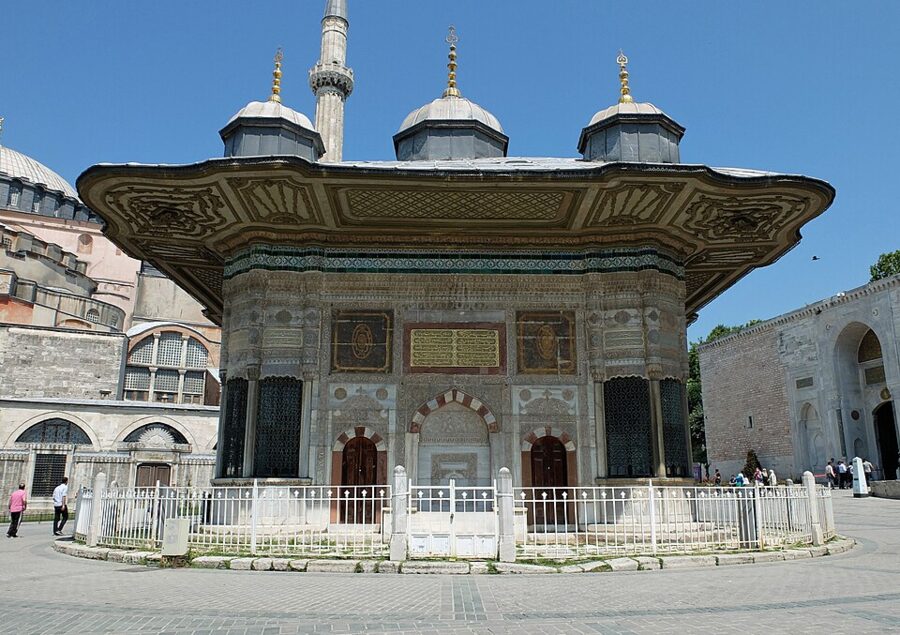
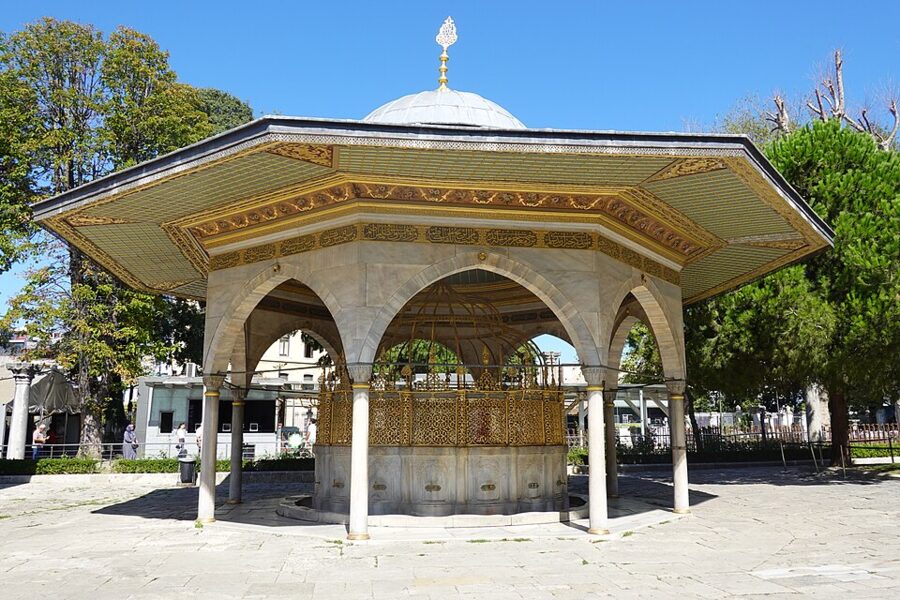
- Entrance: the visitor entrance is on the Topkapı Palace side of the building, near the Fountain of Ahmed III. The doors facing Sultanahmet Square are for worshippers.
- Hours: mornings to early evening, with the Friday noon prayer stopping sightseeing from late morning to mid-afternoon. No official timetable for the gallery is published online; the board at the visitor entrance is the one to trust.
- Dress: shoulders and knees covered for everyone, hair covered for women. Wraps and scarves are available at the entrance.
- Best time: the first hour of the morning on a weekday, or the late afternoon after the tour groups have gone. Never Friday midday.
Contents
- The 2026 ticket: what €25 buys and what it does not
- Finding the visitor entrance
- Hours, prayer times and the Friday closure
- Dress, bags and photos
- Beating the queue, and the touts
- The restoration: what is under scaffolding in 2026
- What you see from the gallery
- The History and Experience Museum: worth another €25?
- Hagia Sophia from Justinian to 2020, in brief
- What is next door
- Getting there, and the move after
The 2026 ticket: what €25 buys and what it does not
Since 15 January 2024, Hagia Sophia has run two entrances. Turkish citizens and anyone coming to pray use the worship entrance and pay nothing. Sightseers buy a ticket and use the visitor entrance, which leads up to the gallery floor, the horseshoe-shaped upper level that wraps the building on three sides. The 2024 notice from the Directorate General of Foundations set the fee at €25 a person, and it still stands at €25 in 2026.
The gallery is run for the Foundations directorate by DEM, the company that also operates the History and Experience Museum on the Hippodrome. Its online ticket page sells only the combined ticket for the gallery and the museum, at €50, valid for three days and non-refundable. The gallery ticket on its own is sold at the on-site ticket office. Turkish citizens buy at the ticket offices too.
| Ticket | Price (2026) | Where to buy | What you get |
|---|---|---|---|
| Hagia Sophia visitor gallery | €25 | Ticket office at the visitor entrance | The upper gallery route, mosaics, the view down into the prayer hall |
| Gallery + History and Experience Museum | €50 | Online (DEM), valid 3 days | Both of the above, on separate days if you like |
| History and Experience Museum only | €25 (foreign adults) | Online or at the museum | 13 halls of film, projection and original objects, audio guide included |
| Children under 8 | Free | Show a passport or ID | Same access as the adult with them |
| Coming to pray | Free | Worship entrance | The ground floor at prayer times, not a sightseeing route |
The Museum Pass Istanbul does not help here. It covers state museums such as the Archaeological Museums and the Galata Tower, while the mosque belongs to the foundation that Mehmed II set up in 1453.
Resellers sell “skip-the-line” gallery tickets for more than €25, usually bundled with an audio guide. What they skip is the ticket line, which is often the shorter of the two. Every visitor goes through the security check, with or without a paper in hand, so I would only pay extra on a summer weekday when the ticket line runs back into the square.
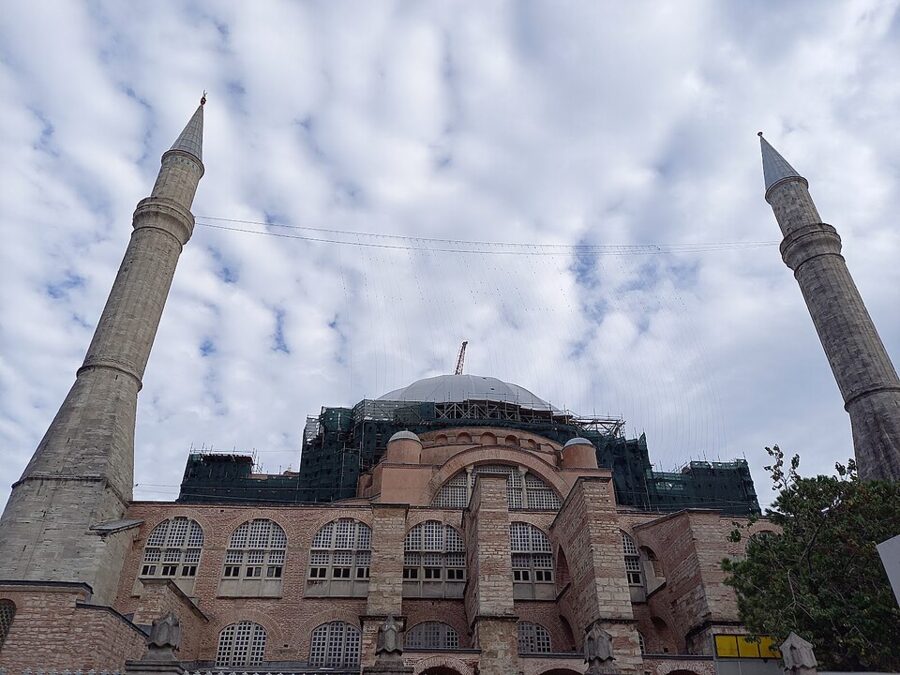

Finding the visitor entrance
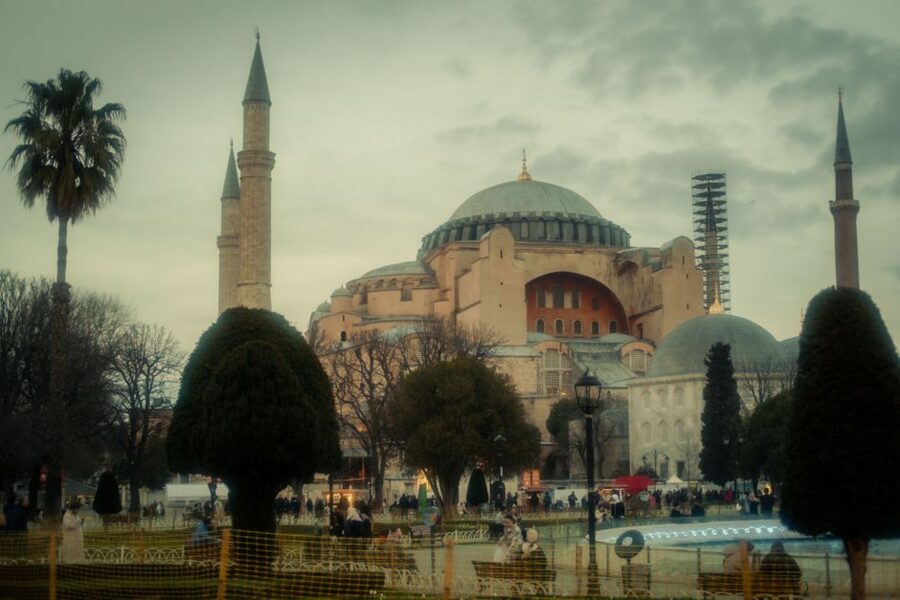
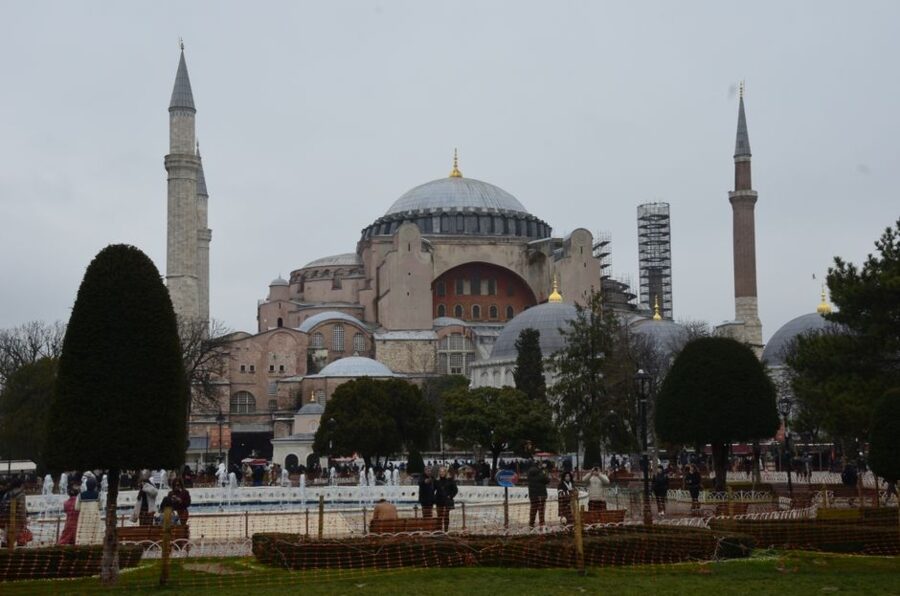
Walk from the Sultanahmet tram stop into the park and Hagia Sophia is on your left, the Blue Mosque on your right. The doors facing Sultanahmet Square are for worshippers. Keep going along the building’s south side, on the street that leads to the gate of Topkapı Palace, and the visitor entrance and ticket office are on that side, near the Fountain of Ahmed III.
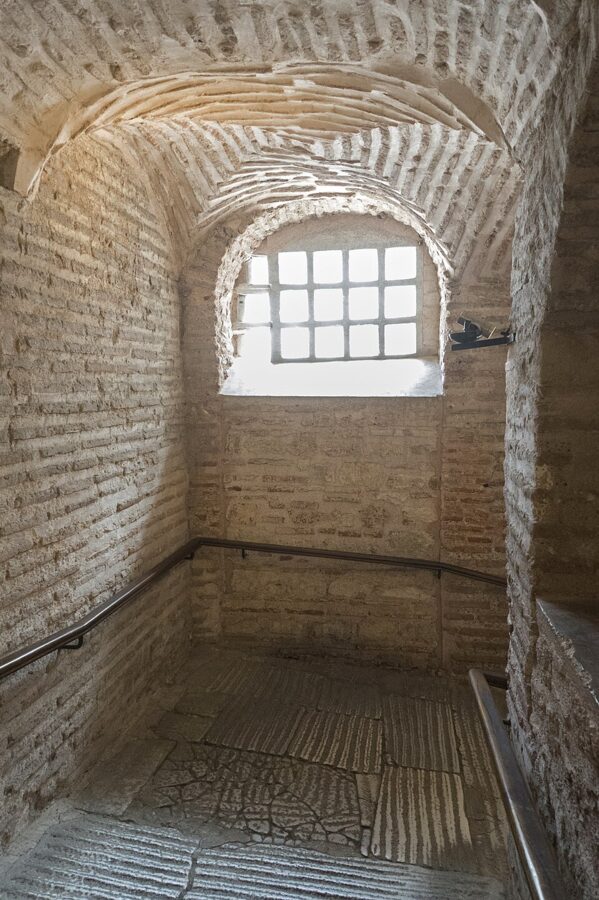
When the gallery opened to sightseers, ramps and a temporary entrance tunnel were built to keep the visitor route apart from the worship area. Follow the signs for the visitor entrance rather than the crowd.

The gallery has always been reached by a ramp rather than stairs: a paved Byzantine switchback under brick vaults, gently sloped and dimly lit. Every visitor passes a ticket check and a security check before going up.

Hours, prayer times and the Friday closure
Hagia Sophia is a working mosque, and the day runs on the five prayers. The ground floor is reserved for worshippers at all times. The gallery is a separate floor, but staff can hold the visitor line around the call to prayer, and the noon and afternoon prayers are when that bites hardest.
No official timetable for the gallery is published online in 2026, and closing times quoted elsewhere range from 18:00 to 19:30. Treat the board at the visitor entrance as the authority, aim to be inside by mid-afternoon, and you will not be caught out. The History and Experience Museum, by contrast, publishes its hours: 09:00–20:00 every day, box office until 19:00.
Prayer times move every day with the sun. The Diyanet’s table for Istanbul is the official one, and it looks like this for a late-November day:
| Prayer | 23 November 2026 | Effect on a visit |
|---|---|---|
| Dawn (İmsak) | 06:24 | Before opening; no effect |
| Sunrise | 07:53 | Not a prayer time |
| Noon (Öğle) | 12:55 | The pause that hurts most; plan around it |
| Afternoon (İkindi) | 15:25 | Expect a pause around the call |
| Sunset (Akşam) | 17:47 | Late visits in winter run into this one |
| Night (Yatsı) | 19:11 | After sightseeing ends |
In June the noon prayer falls just after 13:00 and the afternoon prayer after 17:00, so the summer gap between them is long and useful. Friday is different. The Friday noon prayer is the main congregational prayer of the week, the building fills to the doors and beyond, and sightseeing stops from late morning until the prayer is over and the crowd has left, usually by about 14:30. On a Friday, do Topkapı or the Archaeological Museums in the morning and come here at 15:00.
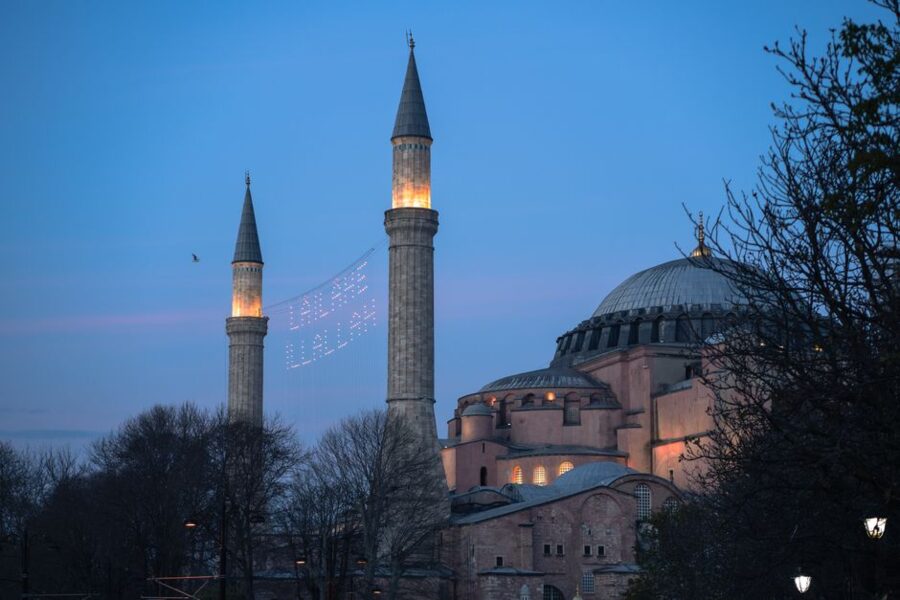
Ramadan, the bayrams and holy nights
The 2027 dates for Ramadan and the bayrams: the fast runs from 8 February to 8 March, Ramazan Bayramı is 9–11 March, and Kurban Bayramı 16–19 May. During the fast the building is at its fullest after dark, when the long night prayers (teravih) follow the fast-breaking meal and the square outside turns into a fair. Daytime visits go on as normal, but the evening queue is a crowd of worshippers, not tourists.
On the first morning of each bayram the holiday prayer fills the building and the square soon after dawn, and Kadir Gecesi (5 March in 2027) brings a crowd that spills into the park. Watch those from outside.
Dress, bags and photos
The dress code is the one every working mosque in Turkey keeps, and it applies in the gallery as much as downstairs. Cover shoulders and knees, with long trousers or a long skirt rather than shorts; women cover their hair. Wraps and scarves are available at the entrance, but your own light scarf saves time.
The mosque manners that hold everywhere hold here: keep your voice down, do not walk in front of anyone praying, and do not point a camera at people at prayer. You will be looking down on worshippers from the gallery rail, so that last one matters more here than in most mosques.
Photographing the building and the mosaics without flash is normal. Bags are checked at security, so pack light: a day pack is fine, a full backpack is a nuisance on the ramp and in the crowded gallery. Eating and drinking are not allowed inside.

Beating the queue, and the touts
There are two lines at Hagia Sophia: the ticket line and the security line, and in summer both run long. The worst of it builds through the morning as the tour groups arrive and stays bad until mid-afternoon, and cruise-ship days in the season make it worse.
- Go early. Be at the visitor entrance before opening on a weekday. If your hostel is in Sultanahmet, it is a five-minute walk.
- Or go late. The last two hours before closing are usually calmer.
- Avoid Friday midday and the first days of the bayrams.
- Combine smartly. If you want the History and Experience Museum anyway, the €50 online ticket gets you past the gallery ticket line on another day.
The square has its old routines. A man tells you the mosque is closed for prayer and offers to show you something nearby while you wait, which ends in a carpet shop; Hagia Sophia does not close for hours on a weekday. Someone else sells a “fast entrance” or a guided tour on the spot. Licensed tourist guides in Turkey carry a photo ID card, so ask to see it, and remember that no guide can take you past security or onto the prayer floor.
Stick to the ticket office at the visitor entrance and ignore anyone who approaches you first.
The restoration: what is under scaffolding in 2026
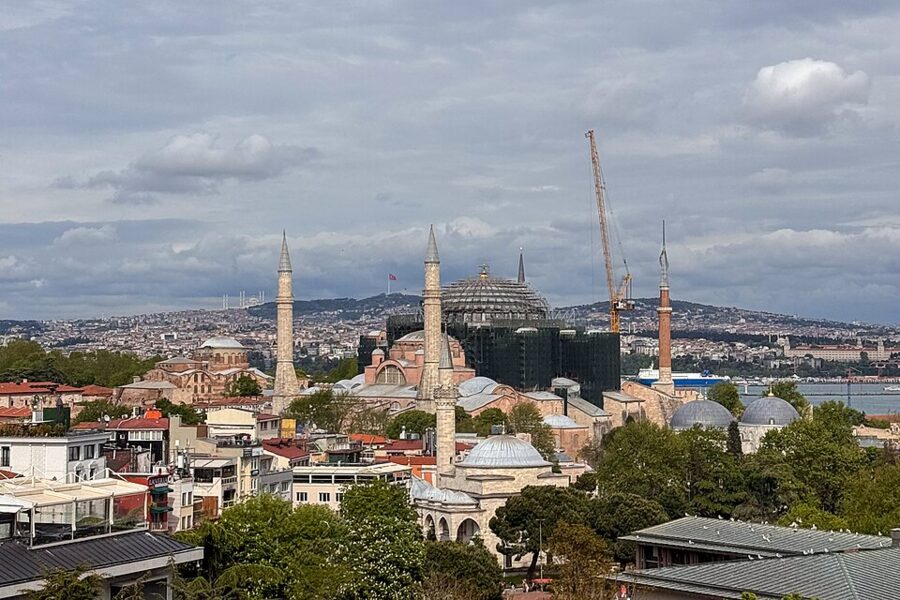
Hagia Sophia is in the middle of the biggest restoration in the history of the Turkish Republic, run by the Directorate General of Foundations under a scientific board. The first phases restored the Ottoman tombs in the south garden, the primary school and the timekeeper’s house, and cleaned the gallery for visitors. The work now under way is structural: making the dome and half-domes safer in an earthquake.
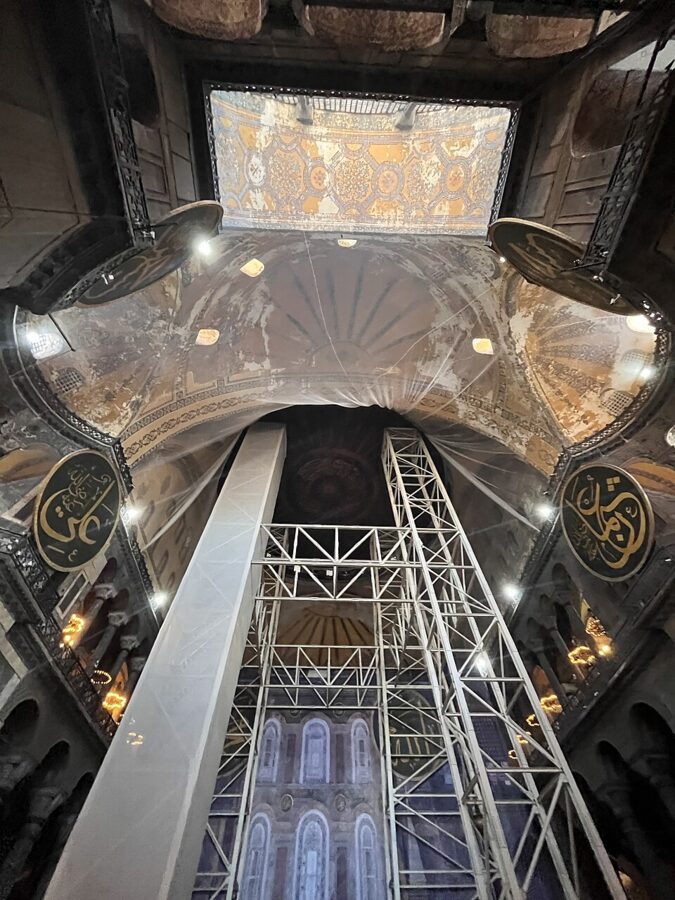

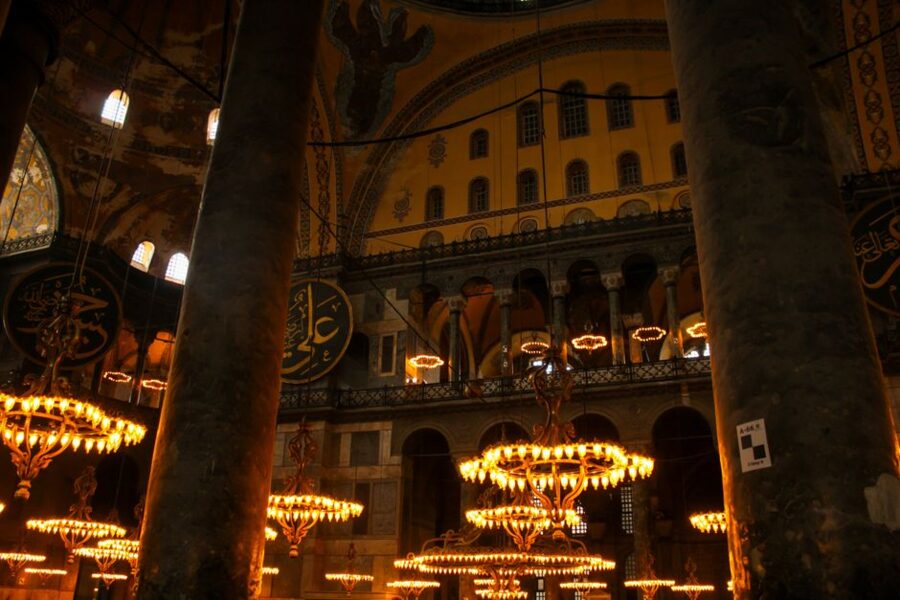
The official account of the dome project sets out the method. All work on the central dome is done from the outside, so as not to disturb the mosaic surface inside. The lead roofing is lifted and repaired or replaced, while a temporary steel cover keeps out the weather, and inside a steel platform on four columns, 43.5 m tall, lets conservators reach the dome mosaics without stopping prayers.
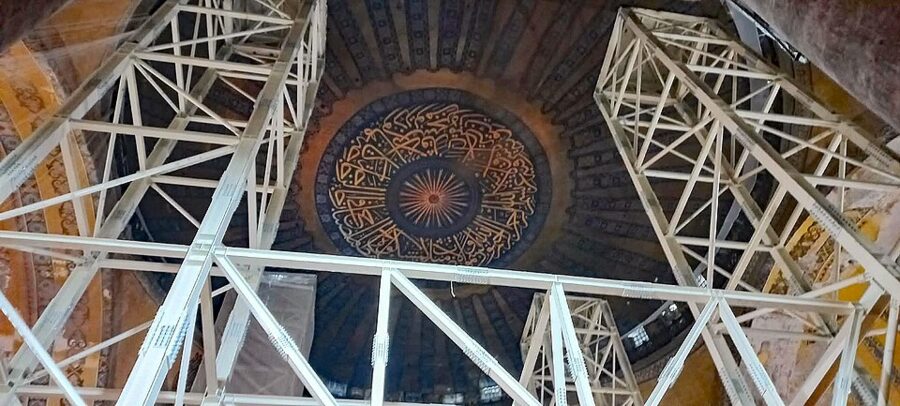
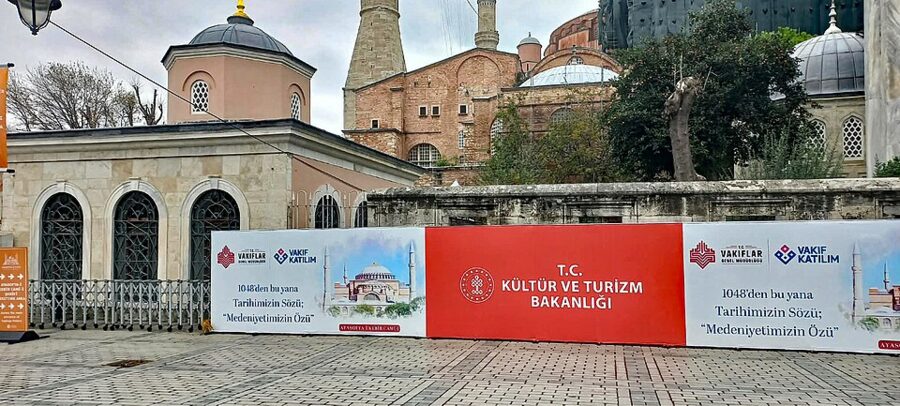
In September 2026 the ministry announced the next stage. Modeling showed that the eastern half-dome, the one over the apse, mihrab and minbar, needs strengthening too, so a second steel platform is going up there. The plan puts a temporary mihrab and minbar into use, shields the originals in place, takes down the chandeliers in that zone, and screens the work areas with printed tarps showing the walls and domes behind them.
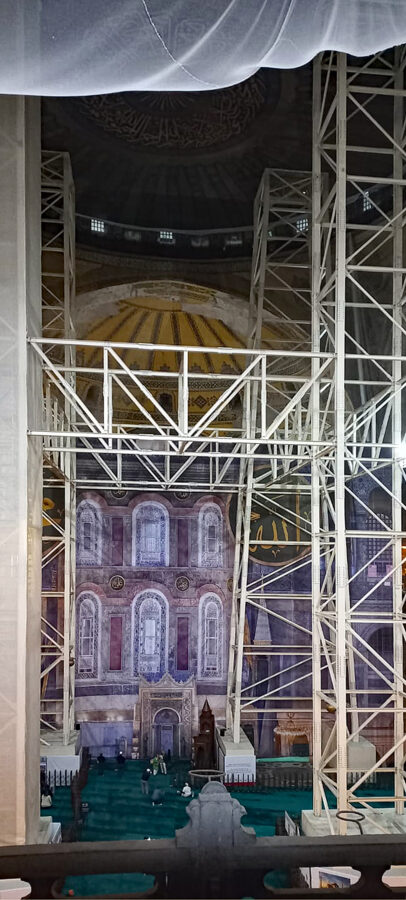
The work has a scholarly side. Members of the scientific board say the paintwork on the eastern half-dome dates from the Fossati restoration of 1847–49, and that they will look beneath it for a Quranic verse of the classical Ottoman period that older pictures show there before 1847. Outside, the north-east minaret was finished in April 2026 after 411 stones and 26 rows of steps were taken down, sorted and rebuilt.
Under the building, teams have cleared about 3,000 tons of mud and rubble from tunnels and chambers since February 2025. The minister has said that suitable parts of the underground, including a four-room tomb chamber on the north-east side that may shed light on the site before the church, are meant to open to visitors once they are made safe. No end date has been announced for any of it. If the dome is your reason to come, the platform will annoy you; if the mosaics are, you will barely notice it.

What you see from the gallery
The gallery wraps the north, west and south sides of the nave, and the best of the mosaics are in the south gallery. Give it an hour, more if you read the panels.
The dome and Justinian’s building
From the west gallery you look straight down the length of the nave to the apse. The central dome rises 55.6 m above the floor, and after centuries of repair it is slightly oval, between about 30.9 and 31.2 m across. It rests on four pendentives, the curved triangles that turn a square of piers into a circle, and on a ring of 40 windows that make it seem to float.
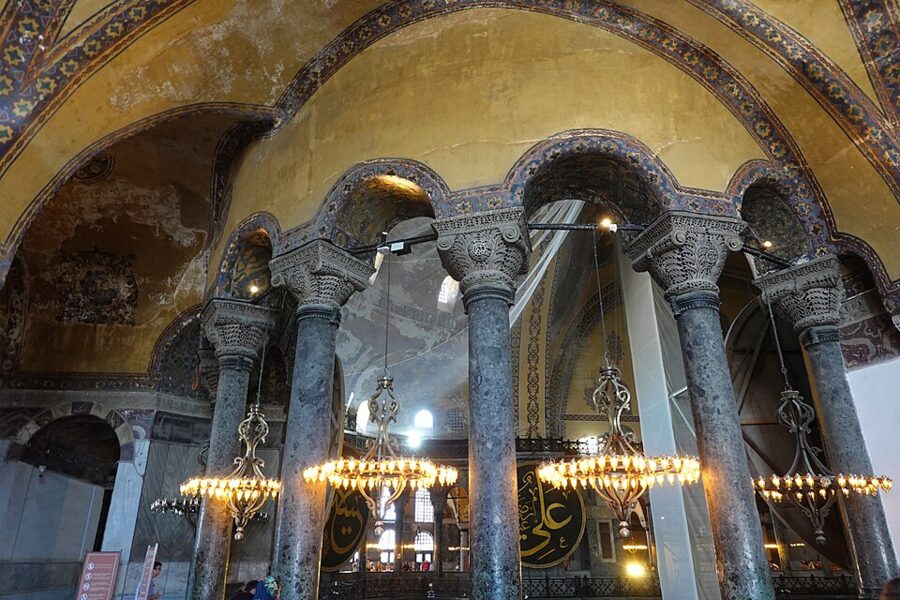

Justinian built it in under six years, from 532 to its consecration on 27 December 537, with two scholars rather than master builders in charge: Anthemius of Tralles, a mathematician, and Isidore of Miletus. Their first dome was too shallow, and it fell in the earthquake of 558. Isidore’s nephew, Isidore the Younger, rebuilt it by 562, about 6 m higher and with 40 ribs, and that is essentially the dome above you, patched after partial collapses in 989 and 1346.

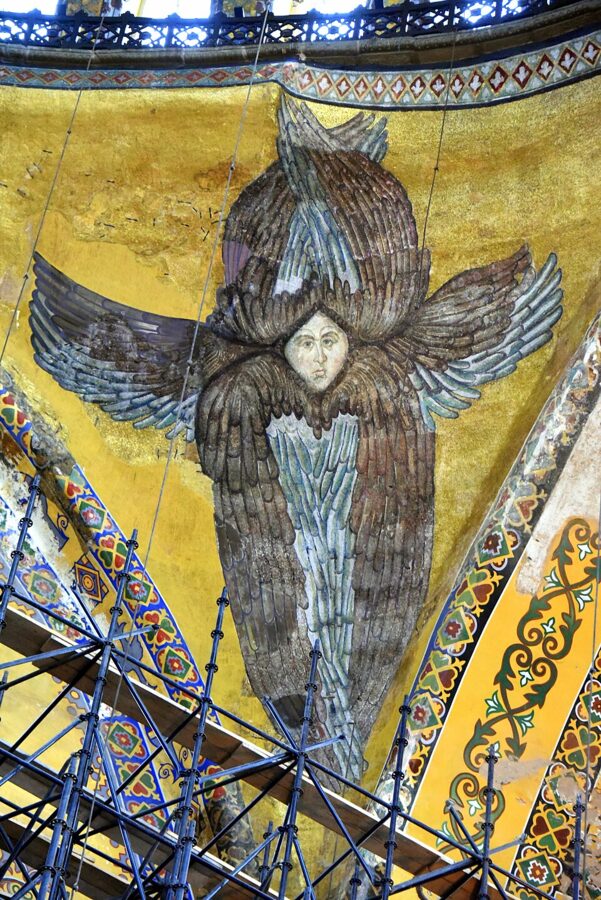
Look into the four pendentives for the six-winged angels. The two on the east side are mosaic, the western pair are painted copies, and in the Ottoman period their faces were covered with metal star-shaped lids. One face was uncovered again in 2009.

The Deesis
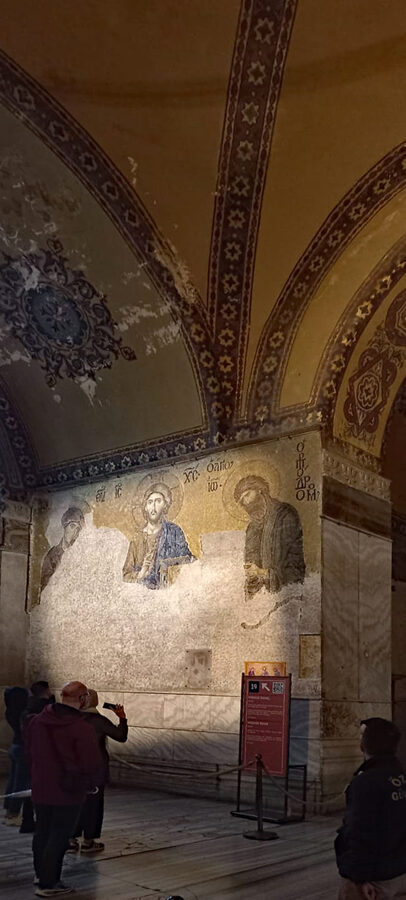
The Deesis is the reason many people pay the €25, and it earns it. Christ is in the center, with the Virgin on his right and John the Baptist on his left, both turned toward him in entreaty for humanity on the Day of Judgment. Much of the lower part has been lost, so what survives is mostly three heads and shoulders, which is enough.
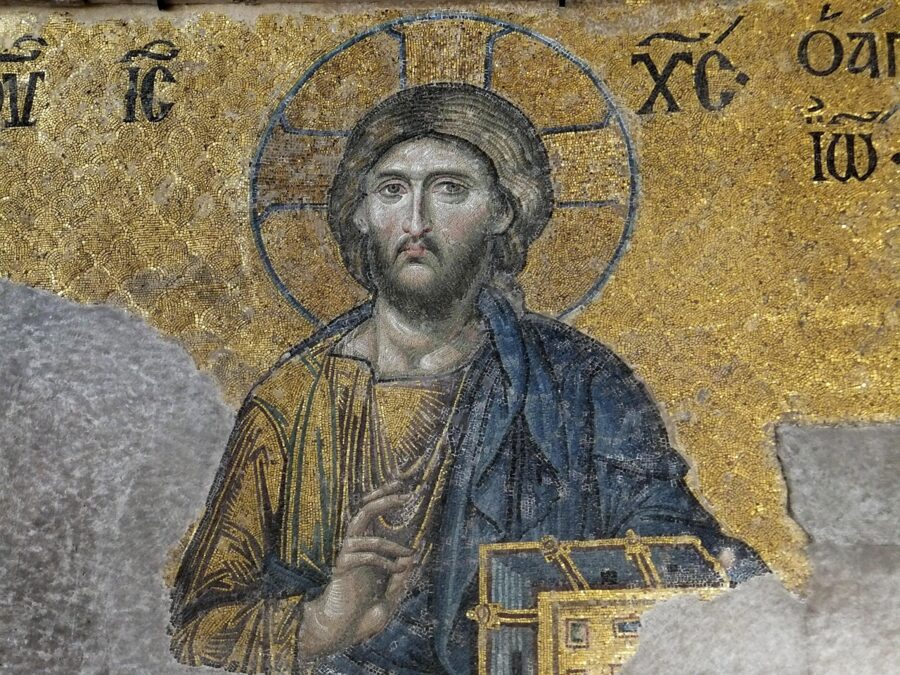
It is usually dated to 1261, when the Byzantines took Constantinople back from the Latin crusaders and needed to say so on the walls of their cathedral. The softness of the faces has invited comparison with Italian painting of the late 13th century. It is in the south gallery, in the area once screened off for the imperial household, and it draws a crowd, so take your photos and then step back to look.
The Empress Zoe and Comnenus panels
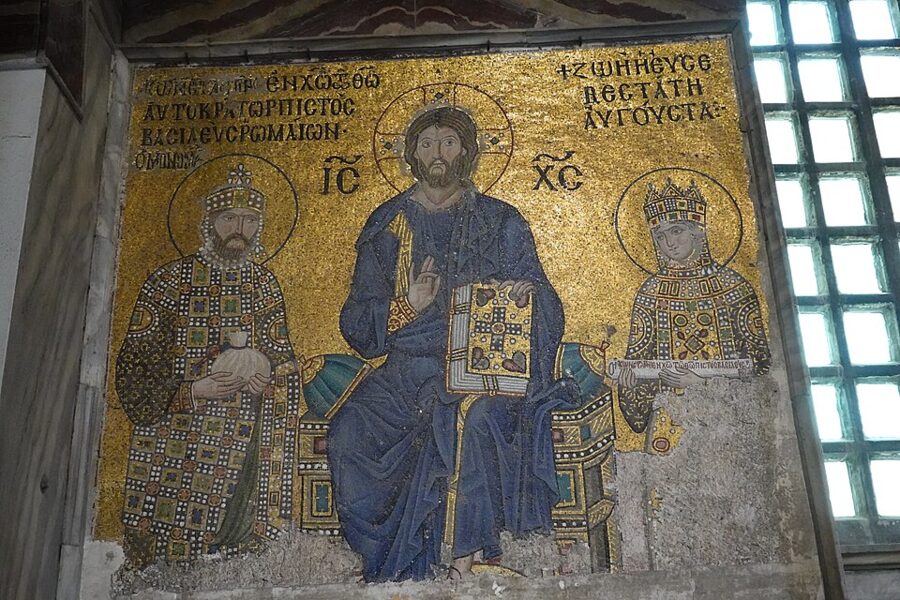
At the east end of the south gallery are two imperial panels, a century apart, that show emperors doing what emperors did here: paying. In the Zoe mosaic of the 11th century, Christ sits between the Empress Zoe and her third husband, Constantine IX Monomachos, who holds a purse of gold for the church. All three heads were replaced at some point: one explanation is that the panel first showed Zoe with an earlier husband, another that it was made for a different couple altogether.

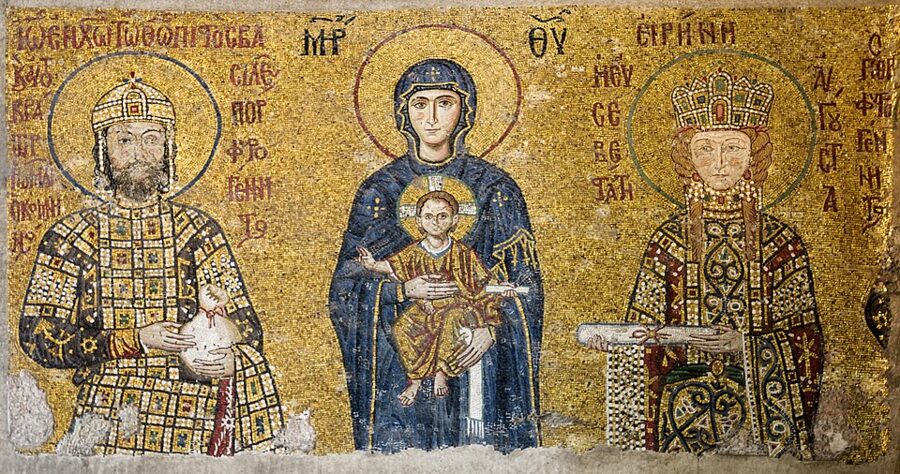
Next to it, the Comnenus mosaic of 1122 shows the Virgin and Child between Emperor John II Komnenos and his empress, Irene of Hungary, whose fair plaits and rosy cheeks are about as close to a portrait as Byzantine art gets. Their son Alexios is on the adjacent pilaster, a beardless youth painted at about the age he was crowned co-emperor.
The empress’s loge, a doge’s grave and a Viking’s name
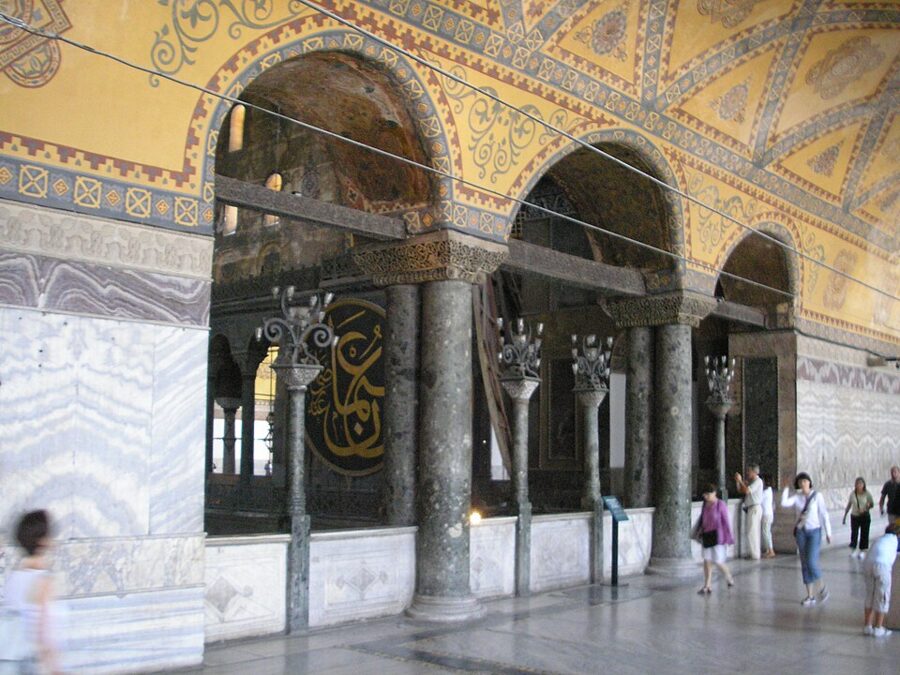
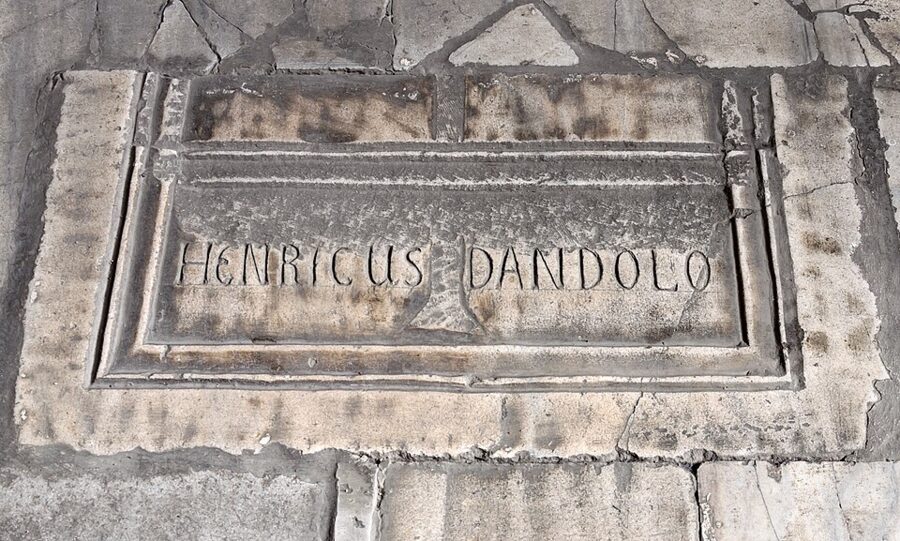
In the center of the west gallery, opposite the apse, a disc of green marble marks where the empress’s throne stood. Further along, in the east part of the gallery floor, a slab reads HENRICUS DANDOLO. Enrico Dandolo, the blind Doge of Venice who steered the Fourth Crusade into sacking Constantinople in 1204, died the next year and was buried in the church he had looted.

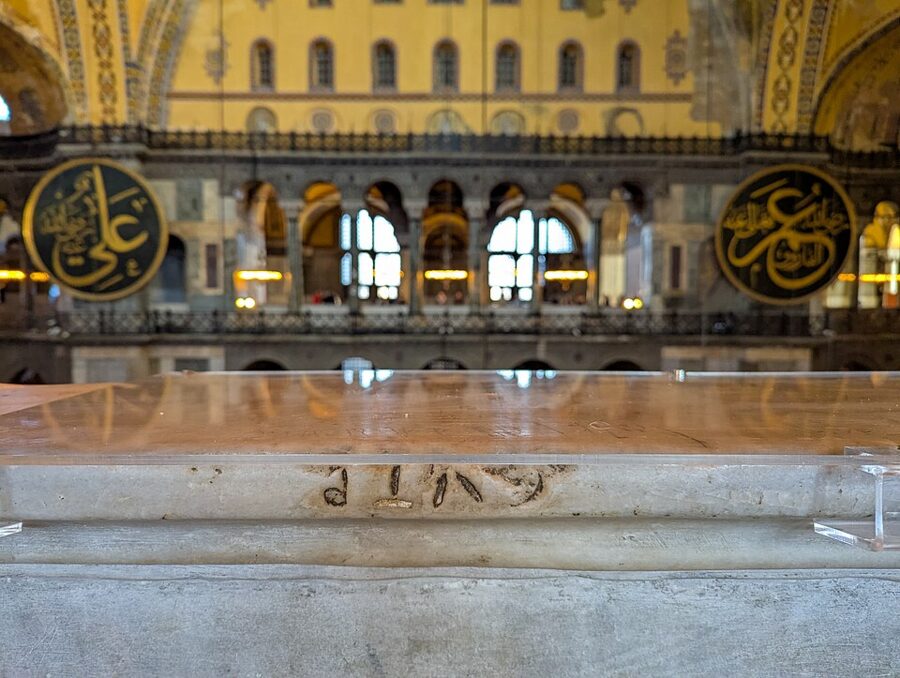
The visitors’ graffiti are older than any souvenir. On the top of a marble parapet in the gallery, scratched runes give the name Halfdan, probably left by a Scandinavian serving the emperors as a mercenary, most likely in the Varangian Guard, around the 9th century. The rest of the text is worn away; it is popularly rendered as “Halfdan was here” and usually reconstructed as “Halfdan carved these runes”.

The apse Virgin, and how she is screened
The mosaic in the half-dome of the apse shows the Virgin seated on a backless throne with the Christ Child on her lap. It is usually connected with a sermon given in the church by Patriarch Photius on 29 March 867, after the iconoclast years, though some scholars date the present image later. It is the oldest of the figure mosaics and, from the gallery, the most distant.
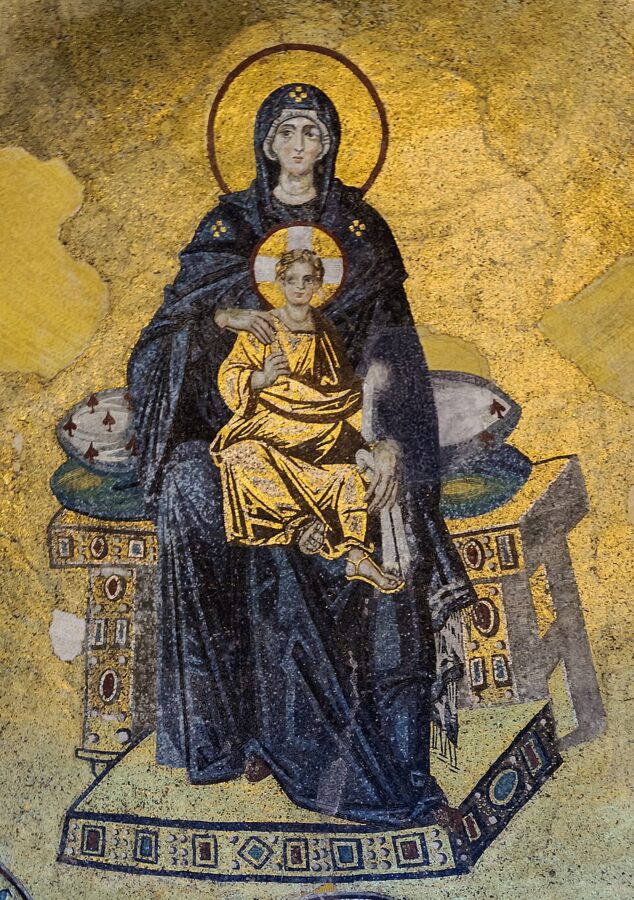
Since the first Friday prayer of July 2020, the Virgin has been covered during prayers, because Islamic practice keeps figurative images out of sight in the direction of prayer. With the eastern half-dome platform going up from September 2026, the apse is behind steel and tarps, so do not count on seeing her on this visit.
The Ottoman additions
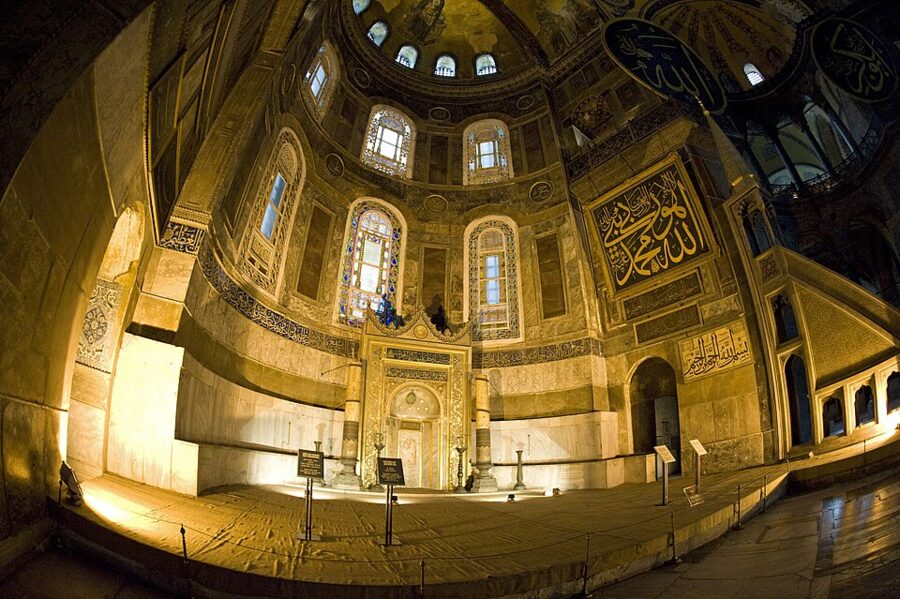
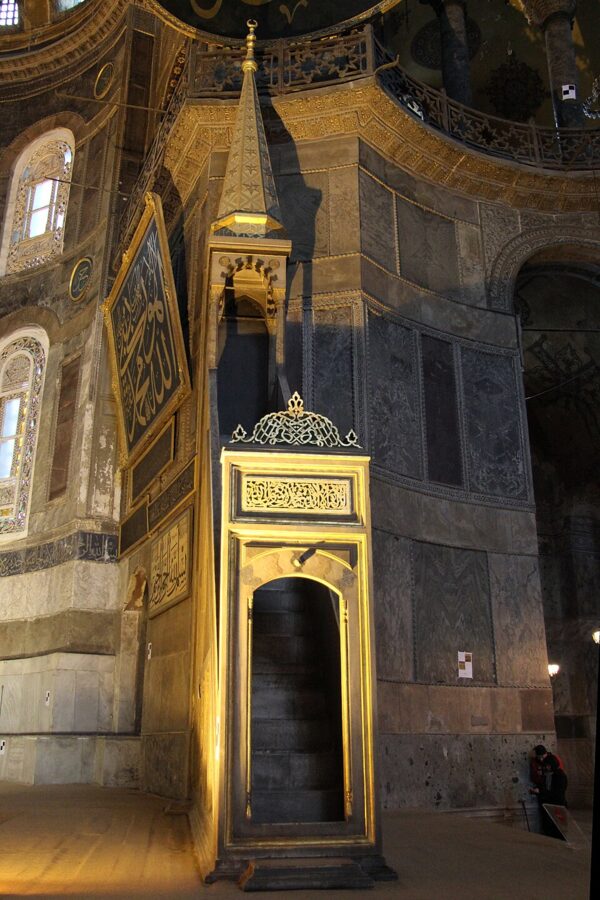
From the gallery you see the mosque that Mehmed II made of the church in 1453, and the sultans who added to it. The mihrab is set in the apse, turned a few degrees off the church’s axis toward Mecca, and Süleyman the Magnificent placed two great candlesticks taken from Hungary on either side of it. The tall marble minbar to its right was installed under Murad III in the 16th century.


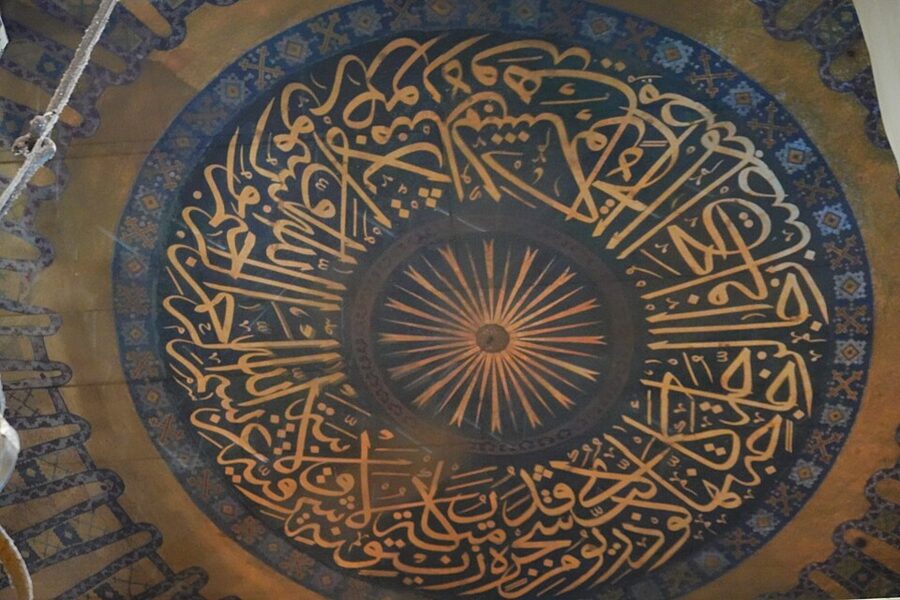
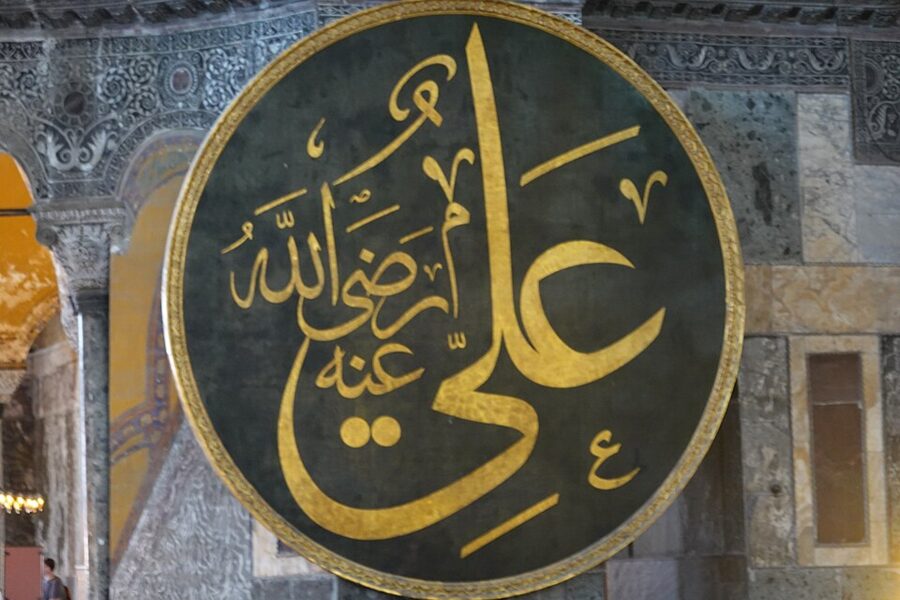
Hanging from the cornices are the eight green roundels, about 7.5 m across, with the names of God, the Prophet Muhammad, the first four caliphs Abu Bakr, Umar, Uthman and Ali, and Ali’s sons Hasan and Hüseyin. The calligrapher Kazasker Mustafa İzzet Efendi painted them for the Fossati restoration of 1847–49; they were taken down in the 1930s and rehung in 1951. From the gallery you are almost level with them.

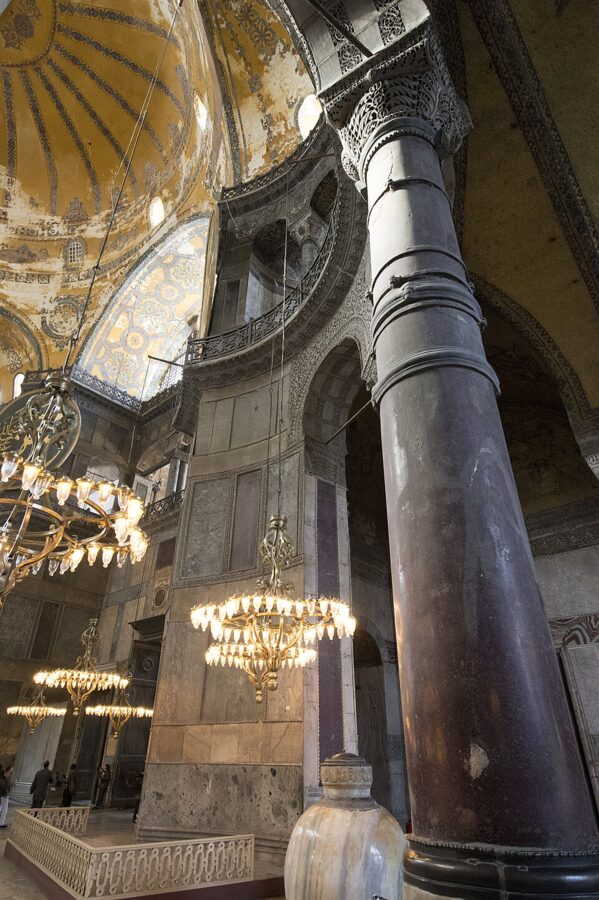
Look down for the two marble lustration urns, Hellenistic jars carved from single blocks of marble and brought from Pergamon under Murad III. Outside, the four minarets are Ottoman: the red-brick one at the south-east corner from Mehmed II’s time or soon after, the slender north-east one from Bayezid II, and the two thick western ones by Mimar Sinan for Selim II. Sinan also added the heavy buttresses that helped the building survive later earthquakes.

The weeping column
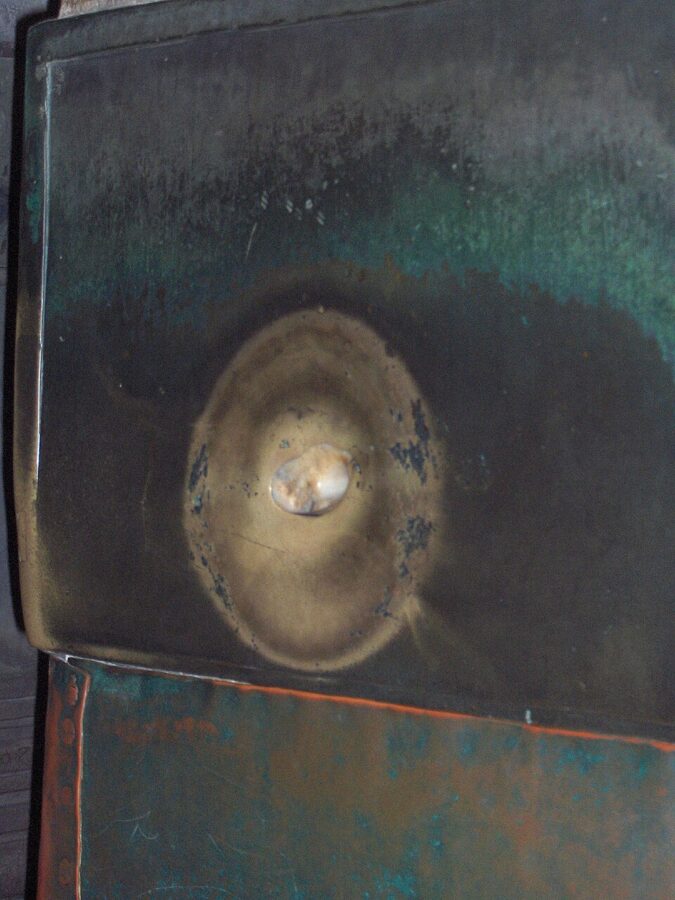
One sight in every guidebook is not on the visitor route. The weeping (or sweating) column stands at the north-west corner of the ground floor, a pillar sheathed in bronze with a thumb-sized hole. Legend says it has been damp since Gregory the Wonderworker appeared there, and that putting your thumb in the hole and turning your hand cures ailments or grants a wish.

The doorway mosaics
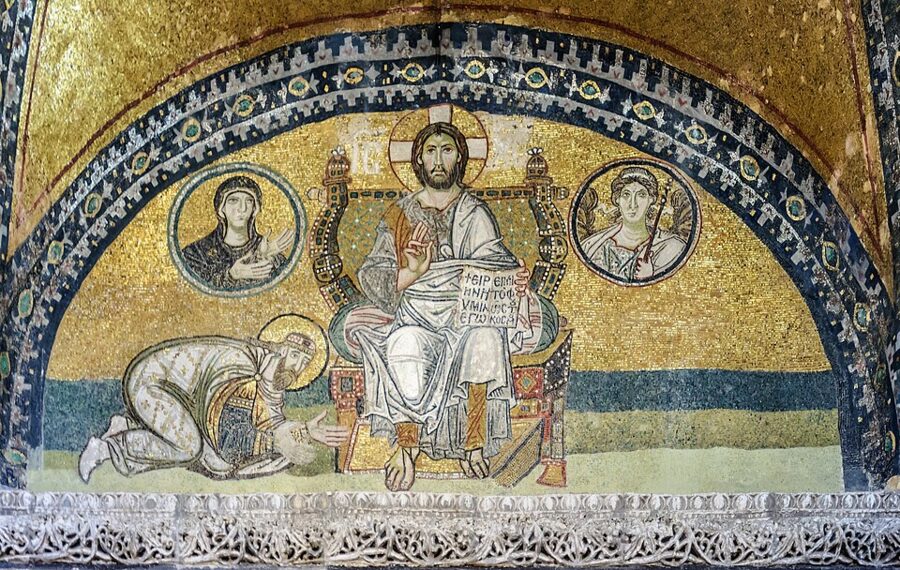
Two more Byzantine mosaics are set over doorways at ground level. Above the Imperial Gate, the great central door of the inner narthex, an emperor, usually identified as Leo VI, kneels before Christ enthroned; it was the first mosaic uncovered by the American Thomas Whittemore in 1932.
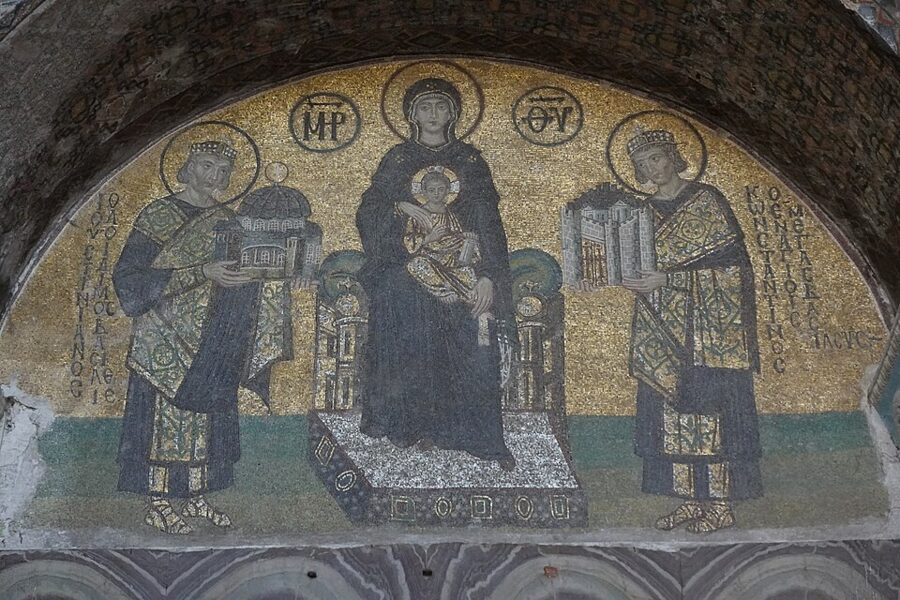
Over the inner door of the south-western vestibule, the Virgin sits enthroned between two emperors: Justinian offering a model of his church, and Constantine offering a model of the city he founded. It dates from the late 10th or early 11th century, and photographs from August 2026 show it unscreened. In the museum years the vestibule was the exit, with a mirror placed so that people leaving could see the mosaic behind them.

The History and Experience Museum: worth another €25?
The Hagia Sophia History and Experience Museum is a separate attraction, about seven minutes’ walk away in the Defter-i Hakani building on the Hippodrome. It opened in 2023 and tells the building’s story in 13 halls over about 3,200 m², with films, projections and audio in 23 languages. A floor of about 300 original objects is arranged in four sections, church, mosque, museum and mosque again, and through the ground-floor windows you can see a Byzantine cistern under the building.
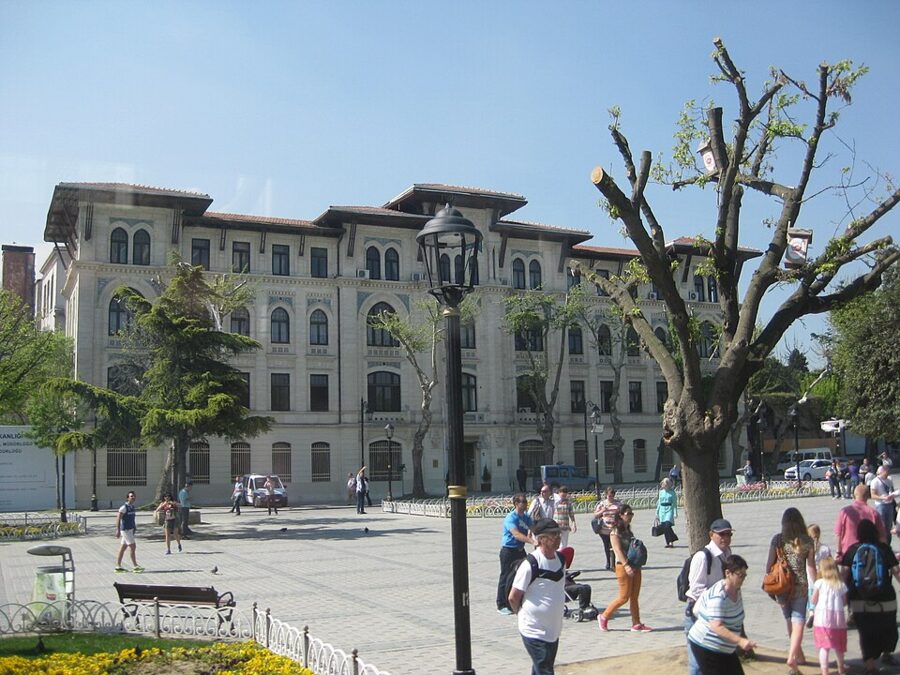

Foreign adults over 8 pay €25, with the audio guide included, and it is open 09:00–20:00 every day, last tickets at 19:00. My view: it is well made, but it is a show about the building rather than the building. If you have the money for one extra ticket in Sultanahmet, the Archaeological Museums or the Harem at Topkapı give you more for it. It is a good rainy-evening fallback.
Touts sometimes steer people there as if it were Hagia Sophia itself. If you are standing in front of a museum entrance on the Hippodrome, you are not at the mosque.
Hagia Sophia from Justinian to 2020, in brief
Justinian’s building is the third church on the site. The first, finished in 360, burned in riots in 404; the second, consecrated in 415, burned in the Nika riots of 532, when the circus factions nearly toppled Justinian. Work on the replacement began the same year, and the story goes that on entering it in 537 he said, “Solomon, I have surpassed thee”. For more than 900 years it was the cathedral of Constantinople and the setting for imperial coronations.
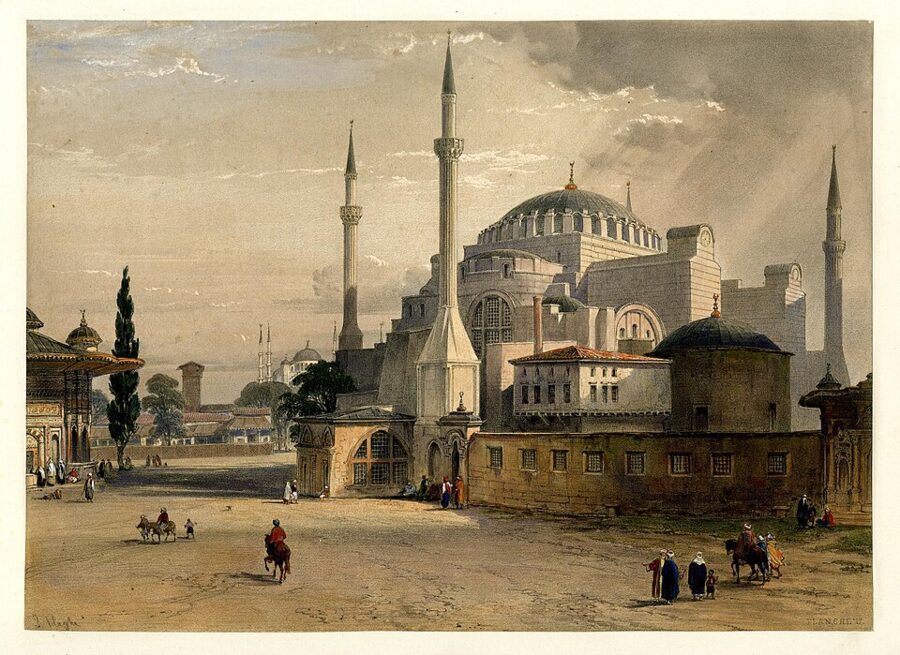
The worst sack the building ever suffered was a Christian one. In 1204 the knights of the Fourth Crusade sacked the city, stripped the church of its treasures and crowned a Latin emperor, Baldwin I, inside it; for 57 years it was a Catholic cathedral. The Byzantines returned in 1261, poorer and fewer, and the building was already showing its age when the Ottomans laid siege in 1453.
Constantinople fell on 29 May 1453. Mehmed II rode to the church, ordered it converted into a mosque, and attended the first Friday prayer there on 1 June. He endowed it with a foundation whose income came from properties across the city, including the stone hall that became the core of the Grand Bazaar. Under the Ottomans the figurative mosaics were plastered over gradually, and minarets, buttresses, tombs, a library and fountains were added around the old church.
In 1847–49 the Swiss-Italian brothers Gaspare and Giuseppe Fossati restored the building for Abdülmecid, uncovering, recording and covering again many of the mosaics. In the 1930s the Byzantine Institute of America, led by Thomas Whittemore, began uncovering them for good. A cabinet decision of 24 November 1934 turned the mosque into a museum, which opened on 1 February 1935; Atatürk visited a few days later.
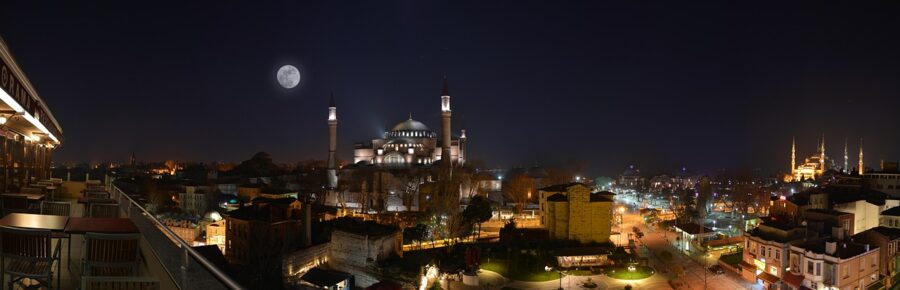
It stayed a museum for 85 years and became one of the most visited sites in Turkey; it has been part of the Historic Areas of Istanbul on the UNESCO World Heritage List since 1985. On 10 July 2020 the Council of State annulled the 1934 decision, ruling that the building was the property of Mehmed II’s foundation and could only be used as a mosque, and a presidential decree returned it to worship. The first Friday prayer was held on 24 July 2020 to a crowd that filled the surrounding streets.
The reconversion drew protests from Greece, the Ecumenical Patriarch and UNESCO. For three and a half years entry was free to all, with sightseers on the prayer floor between prayers; the separate visitor route and the €25 ticket came on 15 January 2024.
What is next door
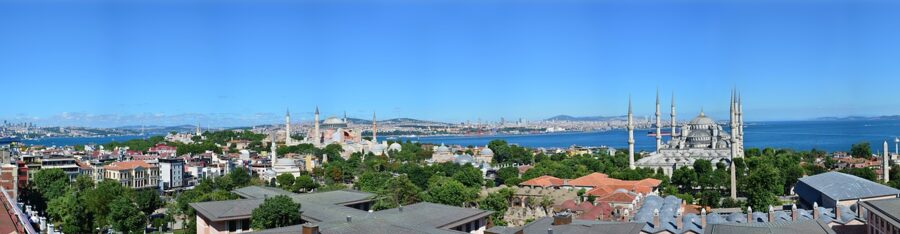
Hagia Sophia sits in a cluster of sights you can walk in a day. In order of distance:
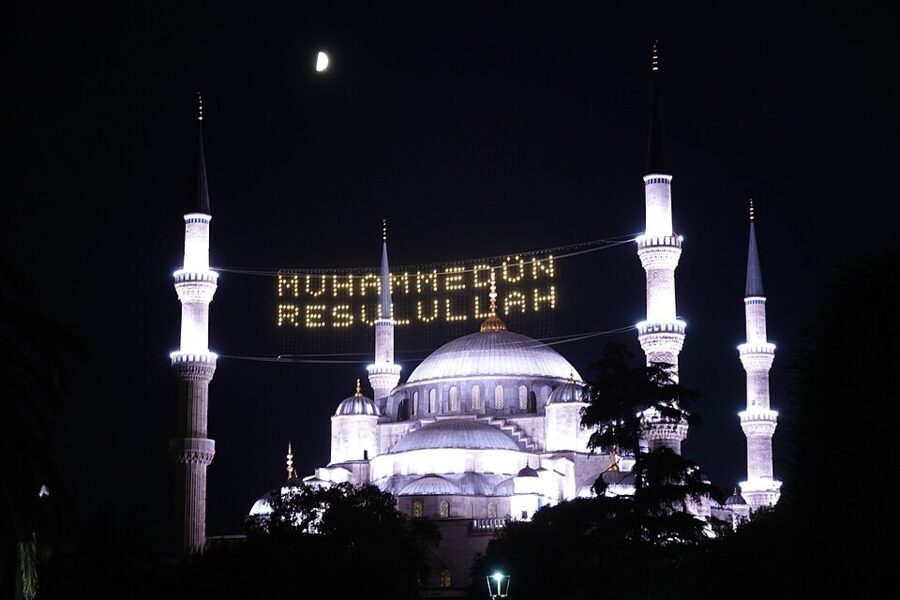
- The Blue Mosque (Sultan Ahmed Mosque), across the park. Free, built 1609–1616, a working mosque with a visitors’ entrance; it closes to sightseers at the five prayers and for longer on Friday at noon.
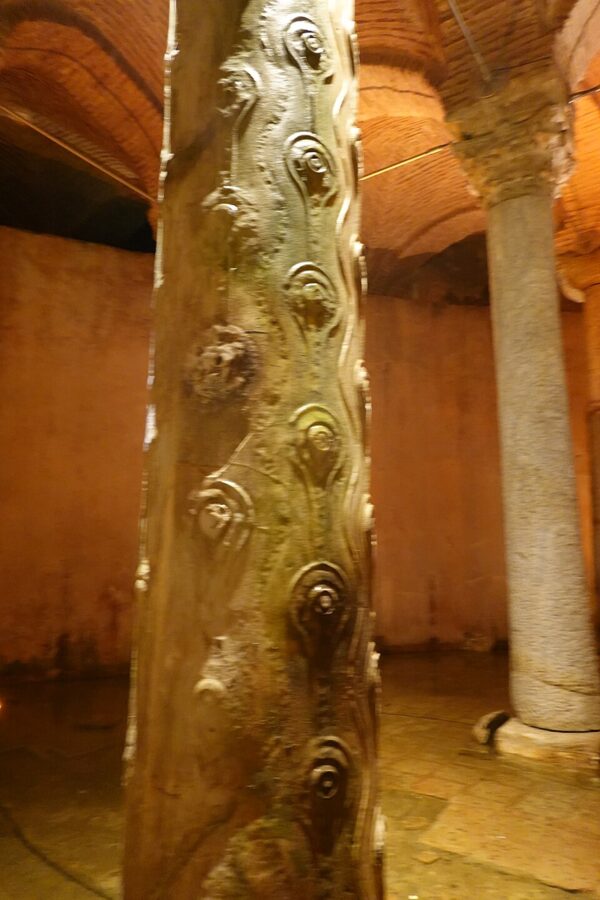
- The Basilica Cistern, two minutes across the tram street. Justinian’s underground reservoir, with 336 columns and two Medusa heads; a separate paid ticket run by the city.
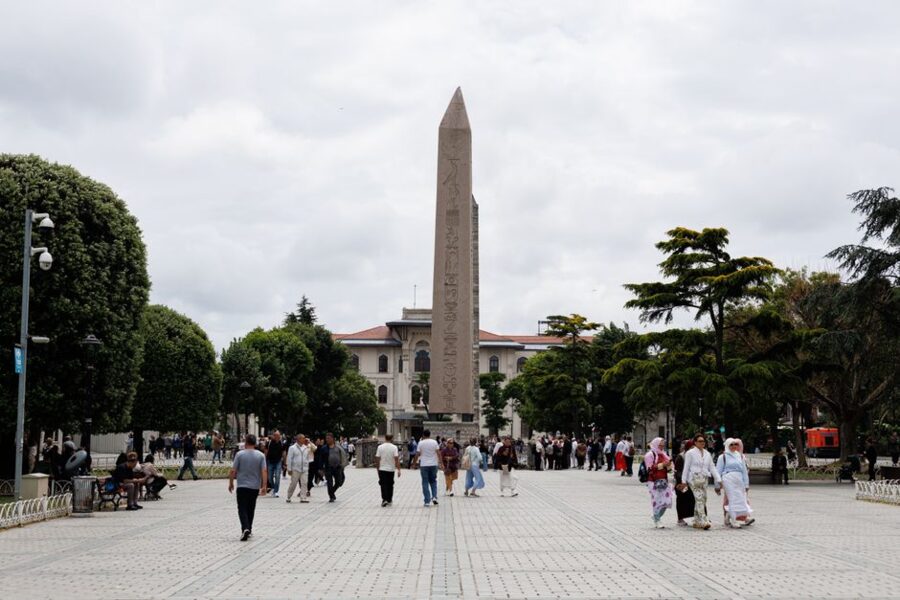
- The Hippodrome, behind the Blue Mosque. Free and always open, with the Egyptian obelisk raised in 390, the bronze Serpent Column from Delphi and the German Fountain given by Kaiser Wilhelm II.
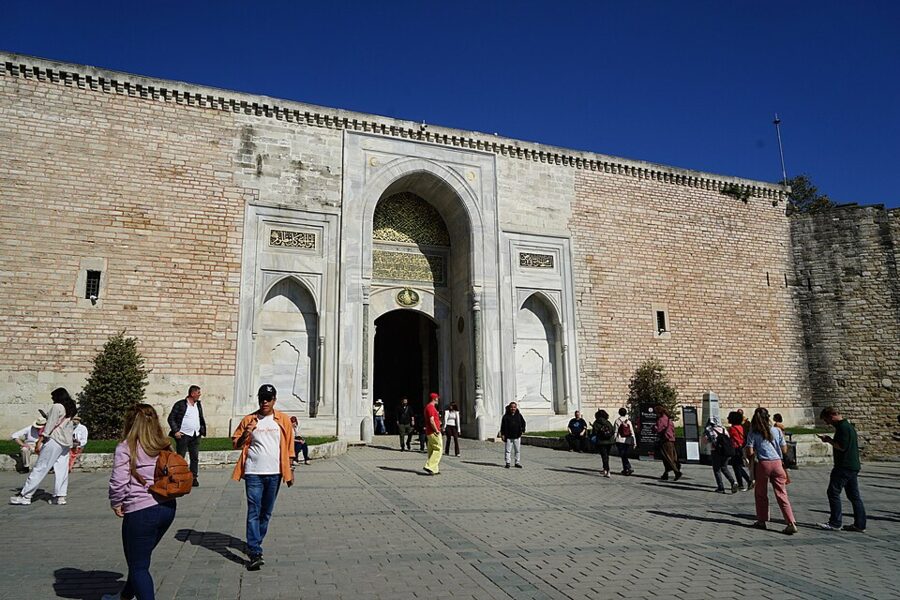
- Topkapı Palace, through the Imperial Gate behind Hagia Sophia. The sultans’ palace and Harem; it closes on Tuesdays. Hagia Irene, the other Byzantine church, stands in its first courtyard.



Getting there, and the move after
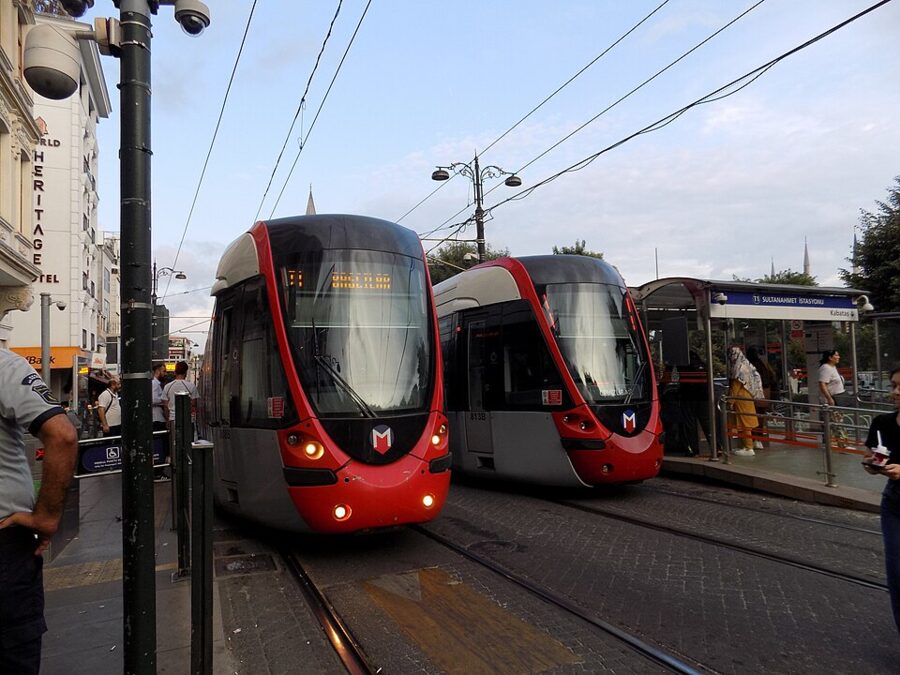
The T1 tram stops at Sultanahmet, a three-minute walk from the visitor entrance, and at Gülhane, a little further on the Topkapı side. From Sirkeci, the Marmaray station and the ferry end of the old city, it is about ten minutes uphill on foot. If you are coming in from the airport, the Istanbul airport to city guide gets you to the tram, and a bed in Sultanahmet puts you five minutes from a dawn start here.

Do the gallery first thing, the Basilica Cistern straight after, and the Blue Mosque when the noon prayer is done. Then take the tram downhill to Eminönü for a fish sandwich and the commuter ferry across to Kadıköy, where the evening costs a fraction of what it does in Sultanahmet. Buy the gallery ticket at the office by the Fountain of Ahmed III, not from the man on the square.