The Ottoman state spent about five million gold lira on Dolmabahçe Palace, and less than twenty years after the sultan moved in, the empire stopped paying its foreign debts. A ticket to walk through the result costs 2,000 TL in 2026. Of the two bills, yours is the better deal.
Dolmabahçe is the long white palace on the European shore of the Bosphorus at Beşiktaş, the one every ferry passes and almost nobody budgets for properly. It takes half a day if you do it well: the state rooms and the Harem in the morning, the painting museum in the old crown prince’s wing, lunch in Beşiktaş market, then either a walk up through Yıldız Park or a ferry across to Beylerbeyi Palace on the Asian side. Everything below is priced for 2026 and set out in the order you meet it.
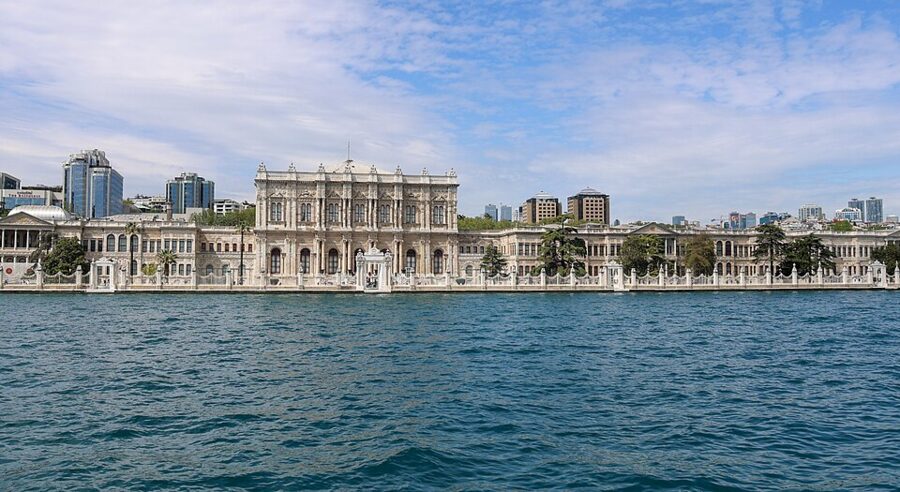

If you have already done Topkapı, the old palace on the historic peninsula, Dolmabahçe will feel like a different country. Topkapı is courtyards, tiles and pavilions built over four centuries. Dolmabahçe is one building put up in a little over a decade by a sultan who wanted to live like a European monarch, and it is stuffed with crystal, gilt and French clocks.

My verdict, up front: if you can afford one palace ticket in Istanbul, make it the one that fits your interest. Topkapı is the empire at its height. Dolmabahçe is the empire spending money it did not have, and the room where the Republic’s founder died, and for a lot of people that is the better story.

Contents
- Why the sultans left Topkapı
- Tickets, hours and closing days in 2026
- The Selamlık: the state rooms
- The Harem and Atatürk’s room
- The gardens and the waterfront
- The Clock Tower, the Painting Museum and the palace kitchens
- Getting there
- Beşiktaş: lunch, the market and the Naval Museum
- Çırağan, Yıldız Park and Yıldız Palace
- Beylerbeyi Palace across the water
- A half-day route on foot and by ferry
- What to skip, and what to book
Why the sultans left Topkapı
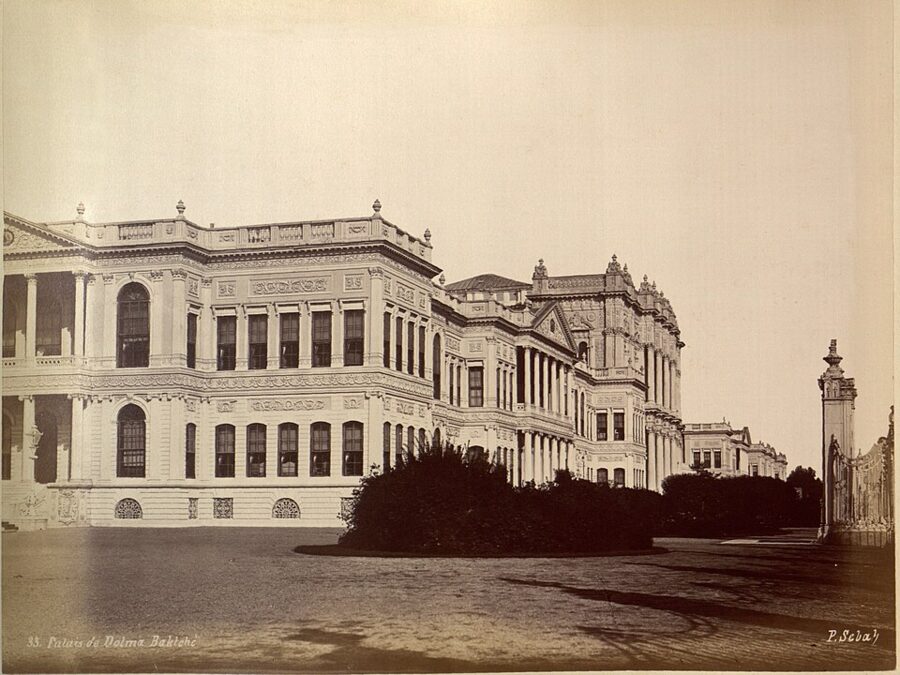
You enter Dolmabahçe through a garden that used to be sea. The site was a bay where the Ottoman fleet anchored, and it was filled in from the 17th century onward to make an imperial garden. That is the name: dolma bahçe, the filled-in garden. A cluster of wooden waterfront pavilions stood here as the Beşiktaş Palace before the present building replaced them.
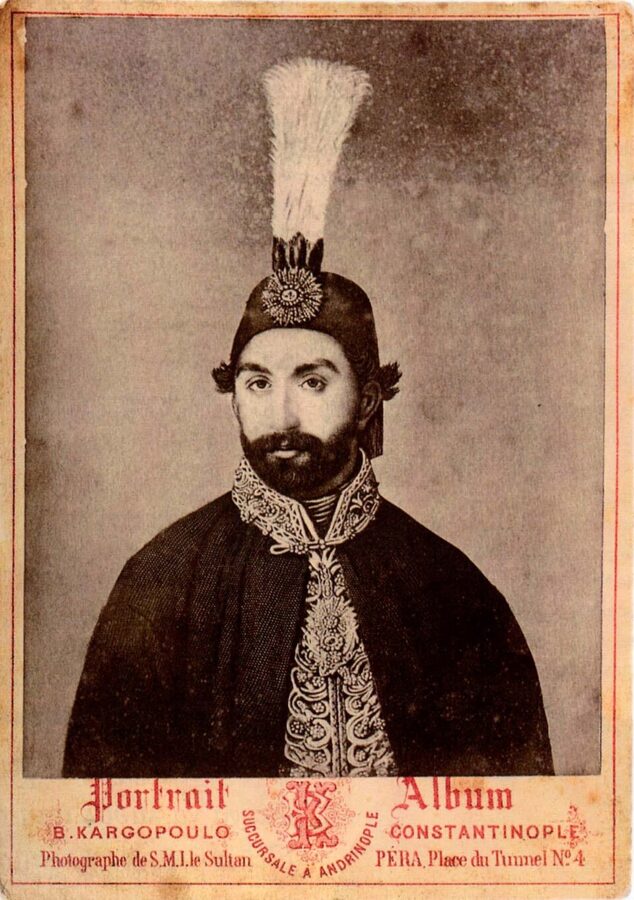
The man behind it was Abdülmecid I, who came to the throne in 1839 at 16 and in the same year put his name to the Tanzimat reform edict, which promised equal treatment for all subjects, regular taxation and a modern army. He spoke some French, liked European music and spent only a few winter months a year in Topkapı, which the sultans had been drifting away from for decades in favor of waterside palaces on the Bosphorus. Abdülmecid decided to build a European-style palace for living, receiving and governing all at once.
The National Palaces directorate, which runs the building today, names the architects as Karabet (Garabet) Balyan, Ohannes Serveryan, Nikogos Balyan and James William Smith. The Balyans were an Armenian family of court architects behind many of the 19th-century palaces and mosques on the Bosphorus, including the mosque next door, the Clock Tower and later Çırağan and Beylerbeyi. Work began in about 1843, and the palace was formally opened in June 1856, a few months after the Treaty of Paris ended the Crimean War.
What it cost
The usual figure for the bill is five million gold lira, and it went onto the state treasury, which was already borrowing abroad. Turkish accounts of the period describe officials’ salaries being paid mid-month instead of on the first, and later only every three or four months. Under Abdülaziz the palace employed more than 5,000 people.
The building did not bankrupt the empire on its own. The Crimean War, the first foreign loans of 1854 and a run of palaces up and down the strait all added to the bill. But in October 1875 the Ottoman government defaulted on its debt, and in 1881 a European-run Public Debt Administration took over a slice of its revenues. When you stand under the Ceremonial Hall chandelier, that is part of what you are looking at.

Who lived here
Six sultans and the last caliph lived in Dolmabahçe between 1856 and 1924. Abdülhamid II, who took the throne in 1876, stayed only 236 days before moving up the hill to Yıldız, convinced that a palace on the water could be attacked from the sea. For his 33-year reign Dolmabahçe was used mainly for the two great holiday receptions a year, and by 1909 it needed a full restoration.
Mehmed V moved back in 1909, and central heating and electricity were installed between 1910 and 1912. The last sultan, Mehmed VI, left the country from here in 1922, and the last caliph, Abdülmecid II, followed in 1924. After that the palace belonged to the Republic, and Mustafa Kemal Atatürk used it on his visits to Istanbul from 1927, worked here, and died here on 10 November 1938.
For the earlier, grander chapter of Ottoman building, Sinan’s mosques on the old peninsula are the place to start; Süleymaniye is three centuries older than this palace and was paid for with the spoils of conquest rather than foreign loans.
Tickets, hours and closing days in 2026
Dolmabahçe is run by the National Palaces directorate (Milli Saraylar), not the Ministry of Culture, and it prices foreigners in lira, not euros. The palace is closed on Mondays. Ticket windows open at 09:00 and close at 17:00. On the first day of each bayram the palace may stay shut or open short hours (it stayed shut on the first day of Kurban Bayramı 2026), so check the National Palaces notice issued a few days before; the Turkish public holidays guide has the dates.
The basic ticket covers the Selamlık, the Harem and the National Palaces Painting Museum, and it is valid for a week, so you can split the visit across two days. Here is what the directorate’s own price list shows for foreigners in 2026.
| Ticket | Foreigners, 2026 | What it covers |
|---|---|---|
| Dolmabahçe Palace | 2,000 TL | Selamlık, Harem and Painting Museum; valid one week |
| Painting Museum only | 600 TL | The Crown Prince’s Apartment at the Beşiktaş end |
| Museum of Palace Collections | 280 TL | The former palace kitchens on Dolmabahçe Caddesi |
| Yıldız Palace | 900 TL | The hilltop palace of Abdülhamid II; closed Wednesdays |
| Beylerbeyi Palace | 800 TL | Asian shore; garden-only ticket 100 TL; closed Mondays |
| Combined Ticket II | 2,750 TL | Dolmabahçe, Yıldız and the European-side pavilions; valid one month |
| Combined Ticket III | 1,050 TL | Beylerbeyi and the Asian-side pavilions; valid one month |
| Combined Ticket I (full pass) | 3,500 TL | Every National Palaces site except Topkapı; valid one month |
The numbers that matter for a backpacker are at the bottom of the directorate’s terms. Foreign students aged 12 to 25 with a physical ISIC card pay twice the discounted price, and the discounted Dolmabahçe ticket is 150 TL, so a student gets in for 300 TL instead of 2,000 TL. Children up to six go free, and the student rule applies at every National Palaces site, Beylerbeyi and Yıldız included.

Which combined ticket, if any
Combined Ticket II is the one worth doing the sums on. Dolmabahçe plus Yıldız bought separately comes to 2,900 TL, so the combined ticket saves 150 TL and throws in the small European-side pavilions, such as Ihlamur, Maslak and Aynalıkavak, that you probably would not have paid for. Each site can be entered once within the month.
The full pass at 3,500 TL only makes sense if you are adding Beylerbeyi and at least one Asian-side pavilion on another day. The Müzekart, the Turkish residents’ museum card, works at most National Palaces sites but is not valid in the Dolmabahçe Selamlık, which is the main reason to come.
Buying tickets and beating the queue
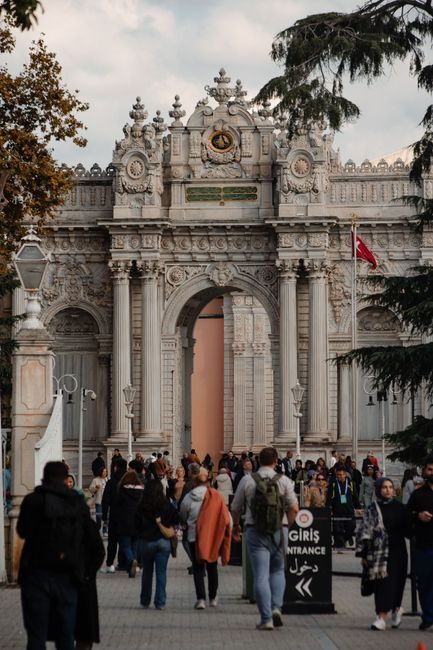
Buy on the official site, millisaraylar.gov.tr, or the Milli Saraylar app, which issues an e-ticket you keep on your phone. That takes you past the ticket window but not past security, and on a busy day the security line is the slow part. Third-party “skip the line” tickets mostly resell the same ticket with a markup and sometimes a guide.
About 1.38 million people went through the palace in 2024, and they are not spread evenly. Be at the Clock Tower before 09:00 on a weekday and you will reach the Ceremonial Hall before it fills; tour groups tend to come later in the morning. Weekends bring Turkish families, and the days around 29 October and 10 November bring very long queues for reasons covered below.
Inside the rules: audio guide, overshoes and photos
The visit is self-paced along a fixed route. An audio guide in several languages is included with the ticket and handed out at the entrance against an ID, which you collect when you return the handset, so bring a passport or a card you can leave for an hour. Expect to be given plastic overshoes to protect the parquet.
Photography used to be banned inside, enforced by attendants calling out at anyone holding a phone. That changed in late January 2026, when the National Palaces lifted the ban on personal photos at Dolmabahçe, Yıldız and its other museums. Flash and tripods are still not allowed, and a few rooms, Atatürk’s among them, are best treated as places to put the phone away anyway.
Allow two to three hours for the Selamlık and the Harem together, and another 45 minutes for the Painting Museum. The National Palaces runs two cafés inside the grounds, one by the Clock Tower and one by the Harem; I would bring water and save lunch for Beşiktaş.
The Selamlık: the state rooms
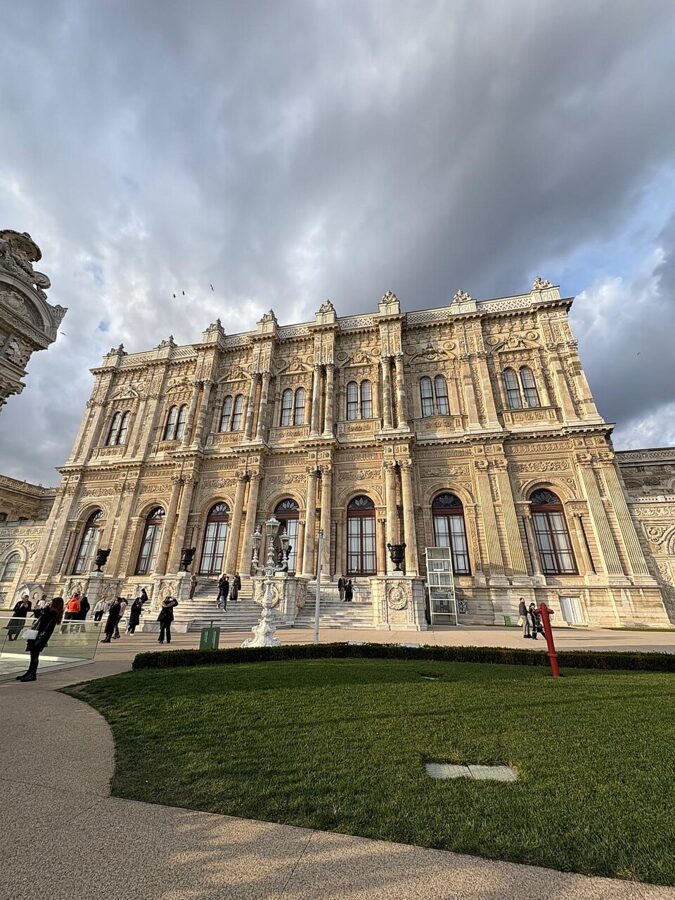
The palace has three parts under one roof. The Selamlık, officially the Mabeyn-i Hümâyun, was where the sultan received officials and the government did business; the Harem was the family’s private house; and the Ceremonial Hall sits between them. The directorate counts 285 rooms, 44 halls, 68 toilets and six Turkish baths in a building with a ground footprint of 14,595 m².
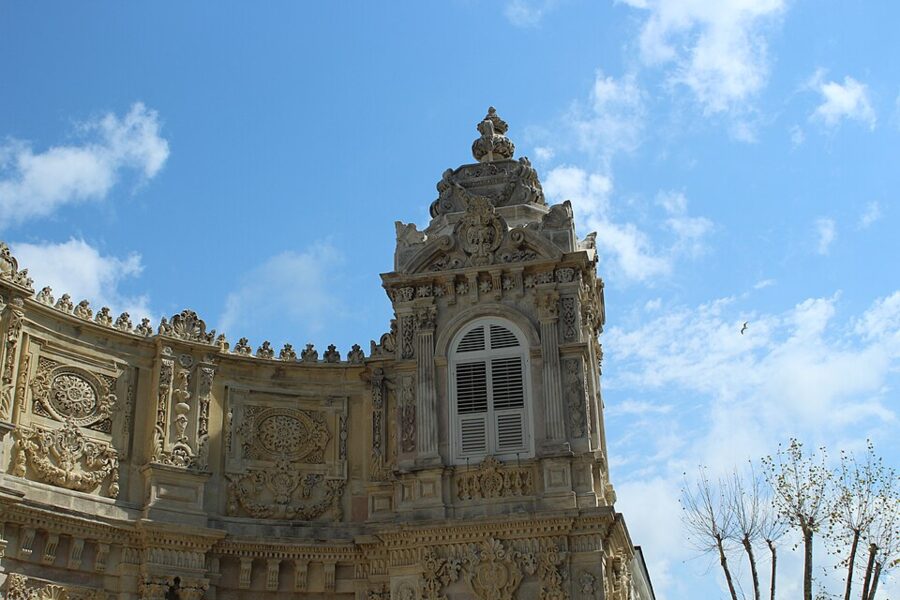
The plan underneath the gilt is Ottoman: a central hall with rooms opening off it, the same layout as a traditional Turkish house. The decoration on top of it is a mix of baroque, rococo and neoclassical borrowed from Europe, and it is everywhere. Look down as well as up, because almost every room has a different parquet floor, and about 4,500 m² of them are covered with 141 carpets and 115 prayer rugs, most woven at the imperial factory at Hereke.
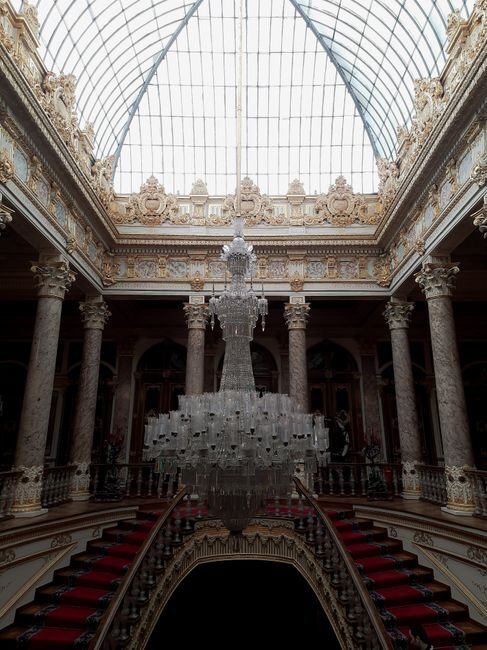
The entrance hall and the Crystal Staircase
Officials waited in the entrance hall, the Medhal, before being led in by a protocol officer. The tables either side carry Abdülmecid’s tughra, the chandelier is English and the upholstery is the deep red the palace used for the sultan’s color. The rooms off it toward the sea belonged to the grand vizier and the ministers.
From here the route climbs the Crystal Staircase, which is the thing people photograph most now that they are allowed to. It is lit from above by a glass roof, and the light on the balusters is best in the morning before the crowds stand in front of it.
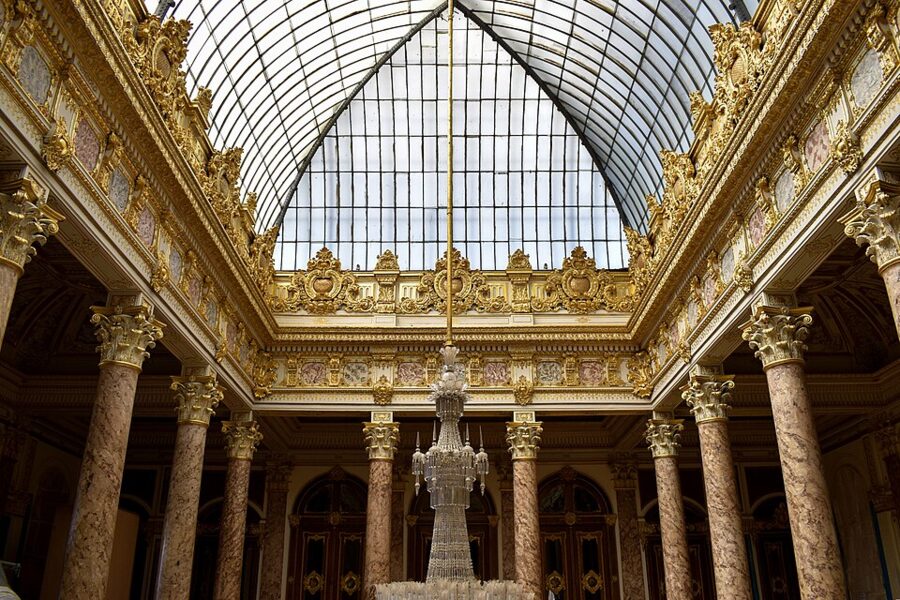
The Ambassadors’ Hall and the Clerks’ Hall
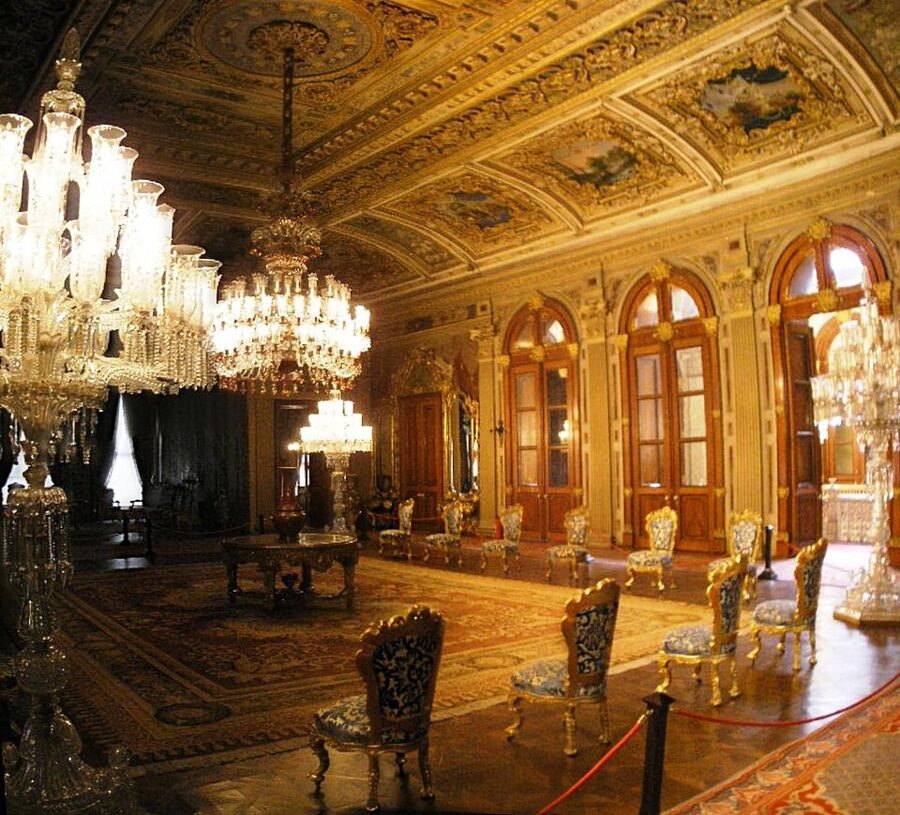
Upstairs, the Ambassadors’ Hall (Süfera Salonu) is where foreign envoys were received, and it is one of the richest rooms in the building, with a gilded ceiling, a crystal chandelier and a Hereke carpet across the floor.

On the route back down, look for the Clerks’ Hall, also called the Tiled Room. Its left wall carries the largest painting in the palace collection, Stefano Ussi’s picture of the Surre procession, the annual caravan that took the sultan’s money and gifts from Istanbul to Mecca and Medina.
In February 2026 the directorate reopened the Yazı Dairesi, the palace secretariat where official correspondence between the court and the government was drafted, after a long restoration, with its original decoration, artworks and diplomatic gifts back in place. Ask at the entrance whether it is on the day’s route; after the gilt of the state rooms it shows the working side of the building.
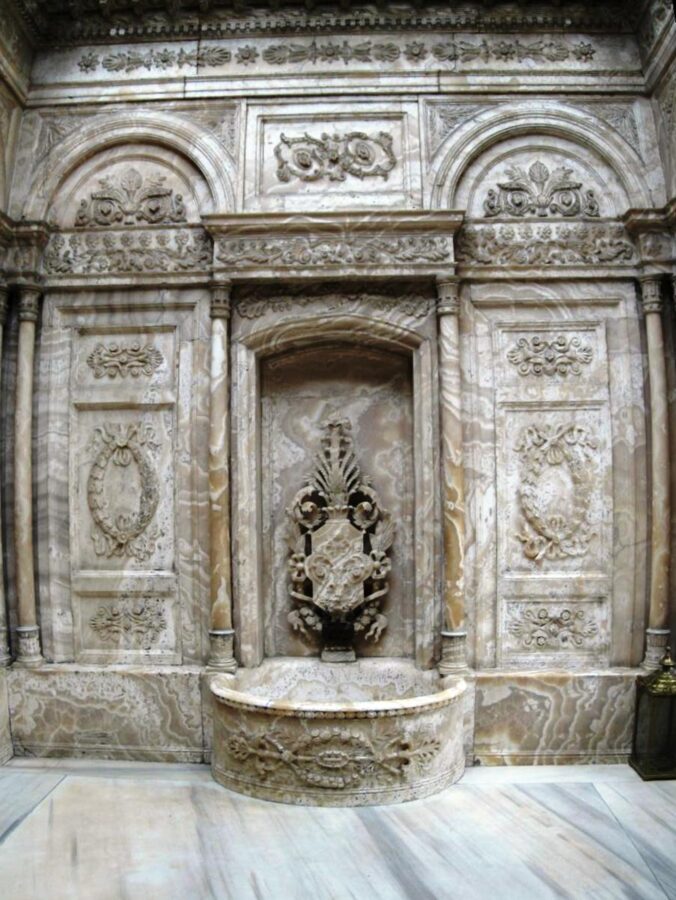
The Sultan’s hamam
The Selamlık bath is a room of carved stone rather than gilt. Its walls are carved Egyptian alabaster, with a rest room facing the sea, a massage room and a hot room with basins of carved marble. The Harem has its own tiled bath, but this one is the showpiece.

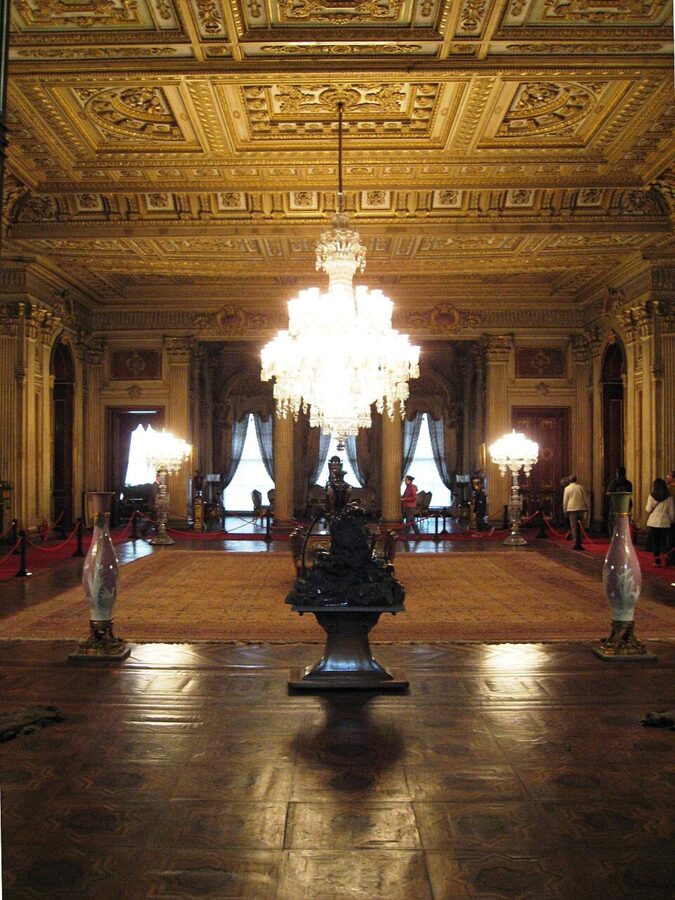
The Ceremonial Hall and the chandelier
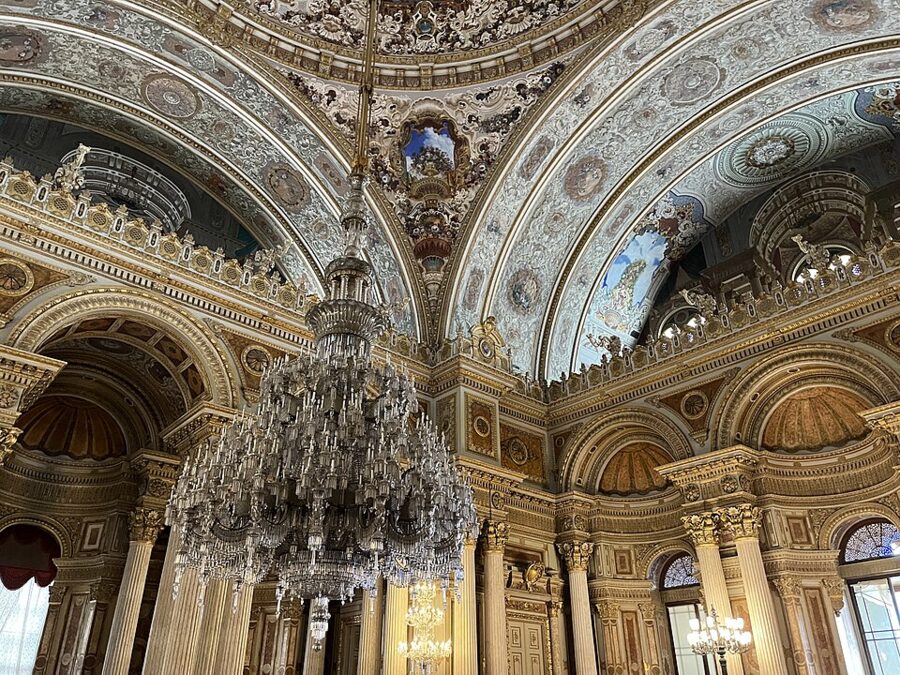
The Selamlık route ends in the Muayede Salonu, the Ceremonial Hall, and everything else in the palace is a warm-up for it. The sultan received holiday greetings here twice a year, seated on a throne at one end while officials filed past, and the upper galleries were kept for the orchestra and the diplomats. The hall was originally heated from below, by a furnace system under the floor.
The chandelier hanging from the 36 m dome is English, has 750 lamps and weighs about 4.5 tonnes. It is often described as a gift from Queen Victoria, but a receipt reported from the palace records shows it was bought and paid for. It is billed as the largest crystal chandelier in the world, a title other chandeliers also claim; either way, it is the heaviest thing you are ever likely to stand under on purpose.
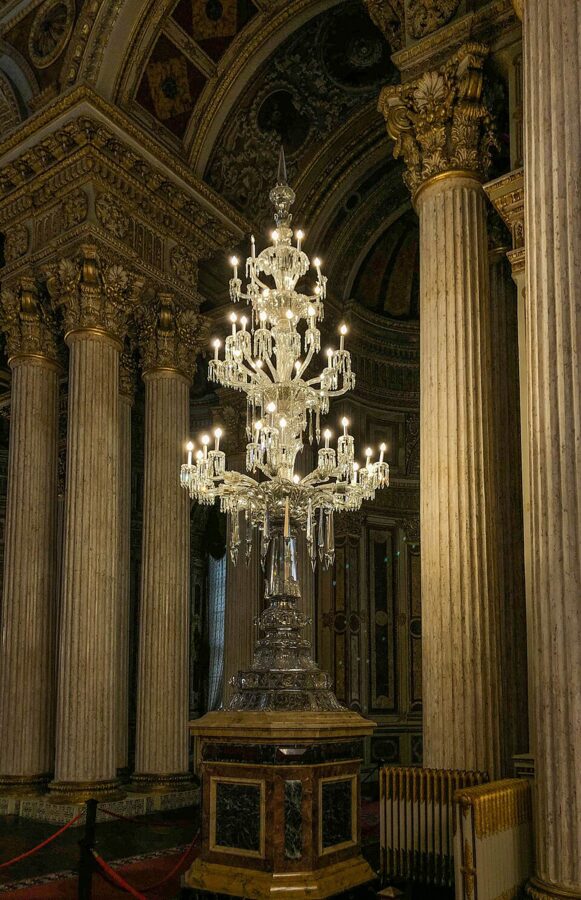

The hall has a Republican history too. The first Turkish History Congress opened here in 1932, and in November 1938 Atatürk’s body lay in state in this room on a catafalque while the public filed past for days.
The Harem and Atatürk’s room
The Harem is entered separately, a short walk through the garden from the end of the Selamlık. It was the family’s private house: the sultan’s own rooms, the apartments of his mother, the valide sultan, and the quarters of his wives, children and the women who served them. It is quieter and less gilded than the Selamlık, and more interesting than its reputation.
Abdülmecid broke with Topkapı custom by allowing the women of his household to leave the palace under escort to shop in the bazaars. The rooms show what the 19th century did to Ottoman domestic life: European furniture sitting next to low cushions and floor mattresses, because the household still lived partly in the old way.

Room 71 and 09:05
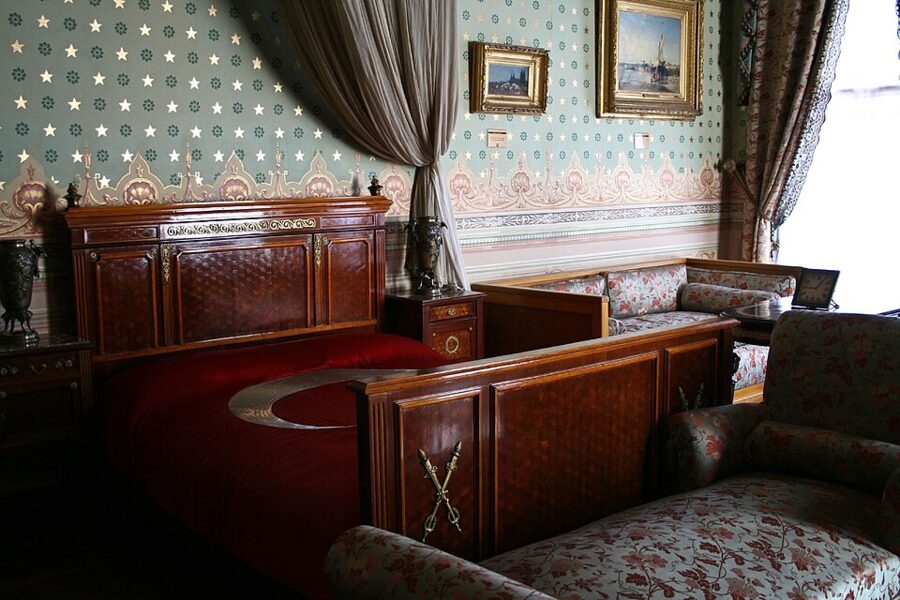
Atatürk spent his last months here as his liver failed, and he died in a small bedroom in the Harem, room 71, at 09:05 on 10 November 1938. The clocks in the palace were stopped at that time. The clocks elsewhere now tell the real time, but the one in his room still shows 09:05, and the bed is covered with a Turkish flag.
Every year at 09:05 on 10 November, sirens sound across Turkey and the country stops for a minute; traffic halts on the bridges and people stand still in the street. The palace becomes a place of pilgrimage that day. Entry was free on the anniversary in 2026, and the queue ran back along Dolmabahçe Caddesi from early morning, so unless you came to take part, pick another day for your visit.

Republic Day on 29 October is the other date that draws big crowds. Both days are worth seeing as a slice of the country, as long as you are not trying to see the chandelier at the same time.
The gardens and the waterfront
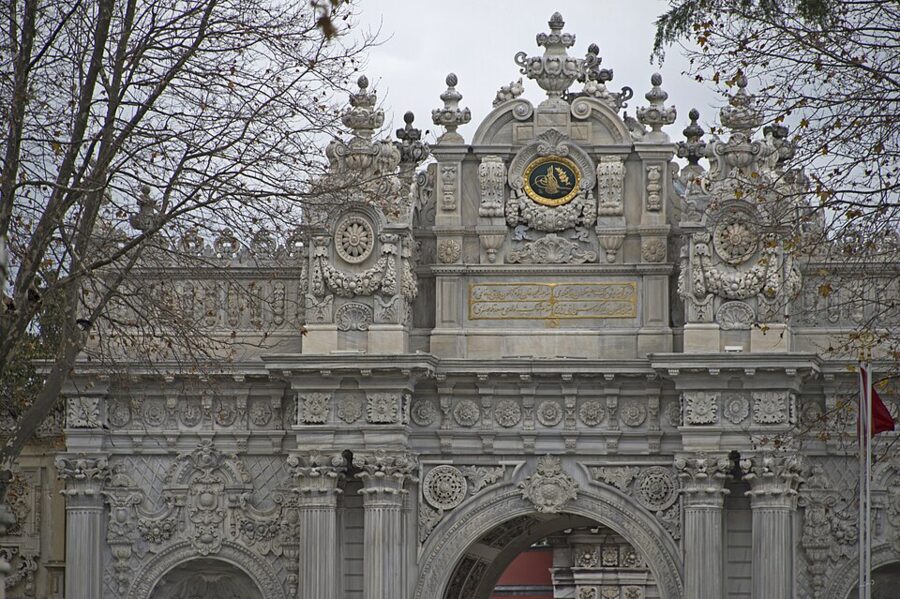
The formal garden in front of the Selamlık has a large pool in the middle, and on the water side of the palace five iron sea gates open onto a 600 m marble quay. From the grounds you look straight across the strait to Üsküdar, which is the way to understand how the building was meant to be seen: from a boat, arriving.

If you want a break inside the walls, the Clock Tower café is the one to use between the two wings; a glass of tea is the cheapest way to sit down inside a sultan’s palace.
The Clock Tower, the Painting Museum and the palace kitchens
Three things sit around the palace that most people miss: the Clock Tower by the entrance, a painting museum in the crown prince’s wing at the far end, and a museum of everyday palace objects in the old kitchens across the road. The first is free to look at, the second is in your ticket, and the third costs 280 TL.
The Clock Tower
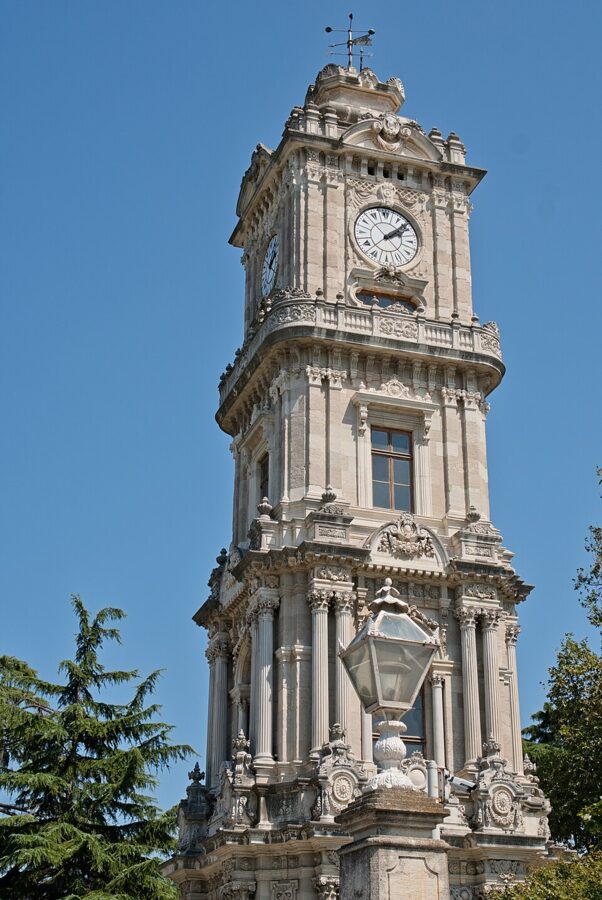
The tower in the square by the ticket windows was added by Abdülhamid II between 1890 and 1895, designed by the court architect Sarkis Balyan. It is 27 m high, four stories of neo-baroque stone with a barometer set into each face of the ground floor and the sultan’s tughra on the sea and land faces. The French clock, made by the Paris firm of Paul Garnier and installed by the court clockmaker Johann Mayer, still runs, partly converted to electric in 1979.
The palace’s Clock Museum, which holds the French and English clocks and the work of the Mevlevi dervish clockmakers, is listed by the directorate as closed for restoration in 2026. If it reopens while you are in town, it is worth half an hour.
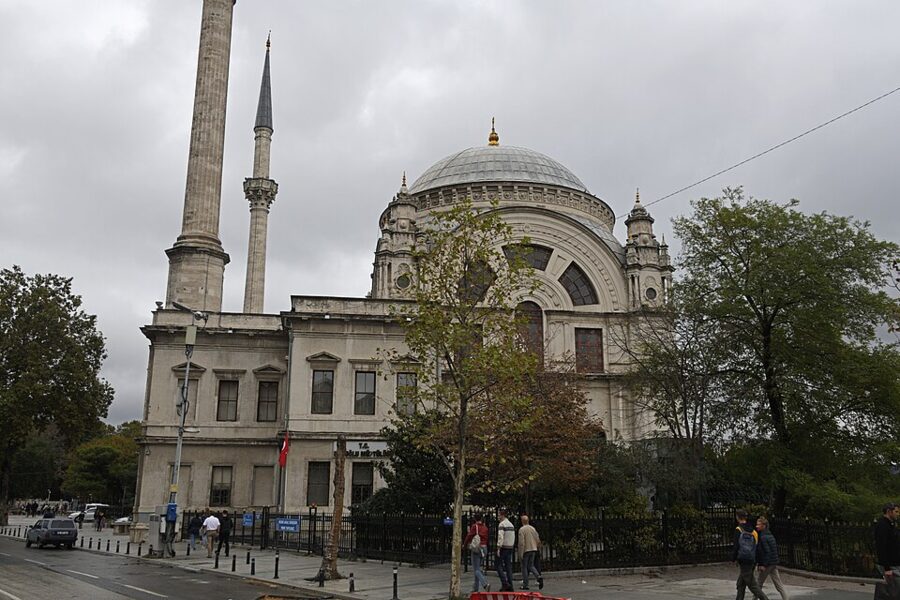

Dolmabahçe Mosque
The mosque between the tram stop and the Clock Tower was commissioned by Abdülmecid’s mother, Bezmiâlem Valide Sultan, and designed by Garabet Balyan. She died in 1853 before it was finished, and her son completed it in 1855. Its huge arched windows flood the prayer hall with light, and it is free to enter outside prayer times.
Road widening has taken its courtyard and fountain, so it now stands almost on the pavement. Dress as for any mosque: knees and shoulders covered, a scarf for women, shoes off at the door. For some years before 1960 the building even housed the Naval Museum, which is now in Beşiktaş.
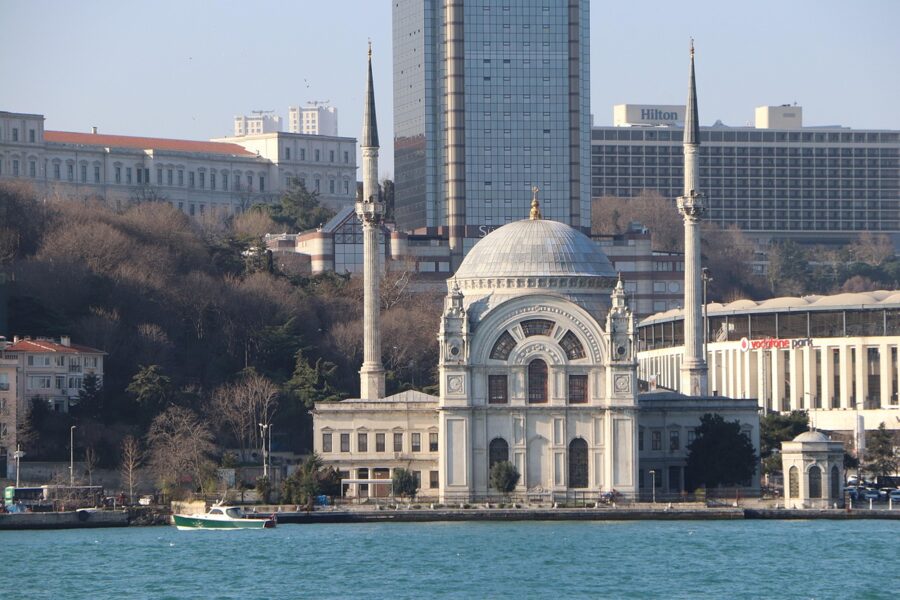
The National Palaces Painting Museum
At the Beşiktaş end of the palace, the Crown Prince’s Apartment (Veliaht Dairesi) houses the National Palaces Painting Museum, opened in 2014 and expanded since. It has its own entrance on Dolmabahçe Caddesi, it is included in the 2,000 TL ticket, and it is sold on its own for 600 TL.
The building is itself a piece of the Tanzimat story. Before 1839, heirs to the throne were kept secluded inside the palace; this wing was built to give the crown princes a house and a life of their own, and Abdülaziz, Murad V, Abdülhamid II, Mehmed V and Mehmed VI all lived here as heirs.
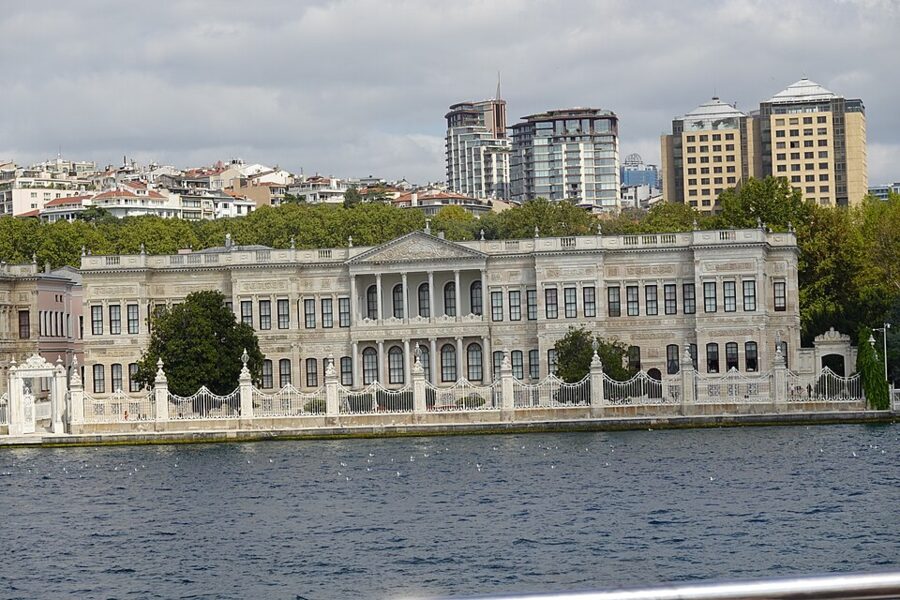

Inside are 553 paintings and drawings across 34 galleries, from the 16th century to the 20th. The highlights are the sea paintings of Ivan Aivazovsky, the portraits of the sultans, the gallery of Osman Hamdi Bey, the painter and archaeologist, and Félix-Auguste Clément’s huge Prince Halim Hunting Gazelles in the Gatah Desert, the largest Orientalist painting in Turkey. One gallery shows the studio of the last caliph, Abdülmecid II, who was a serious painter.
If you are short of time, do the Painting Museum on a second day: your ticket is valid for a week, and the galleries deserve fresh eyes rather than the tail end of a palace visit.
The Museum of Palace Collections
Across from the palace, in the former imperial kitchens next to the Presidential Office, the Museum of Palace Collections (Saray Koleksiyonları Müzesi) gathers objects from all the National Palaces. The directorate charges foreigners 280 TL, and it is closed on Mondays.
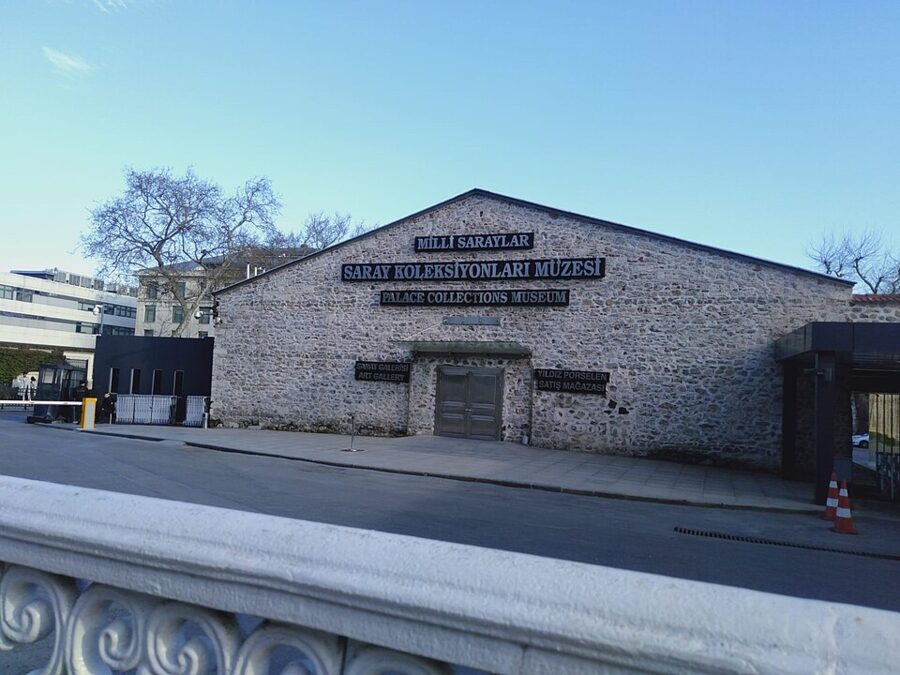

This is the museum of the things the palace used: Hereke textiles, porcelain from the Yıldız factory, silver dinner services for state banquets, giant crystal chandeliers, and the machines the 19th-century court bought from Europe, from typewriters and gramophones to an electroshock device. The best room holds Abdülhamid II’s belongings, including the phaeton he drove himself and the woodworking tools of a sultan who was a skilled carpenter.
Getting there
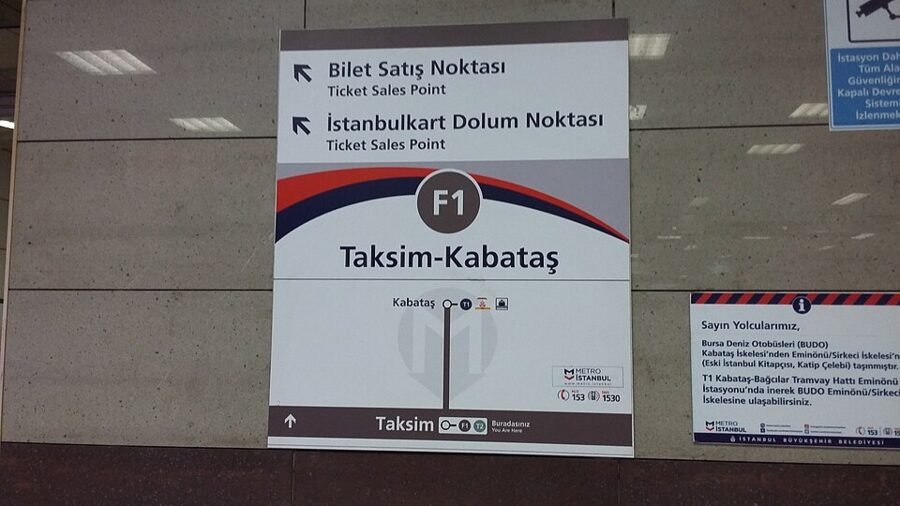
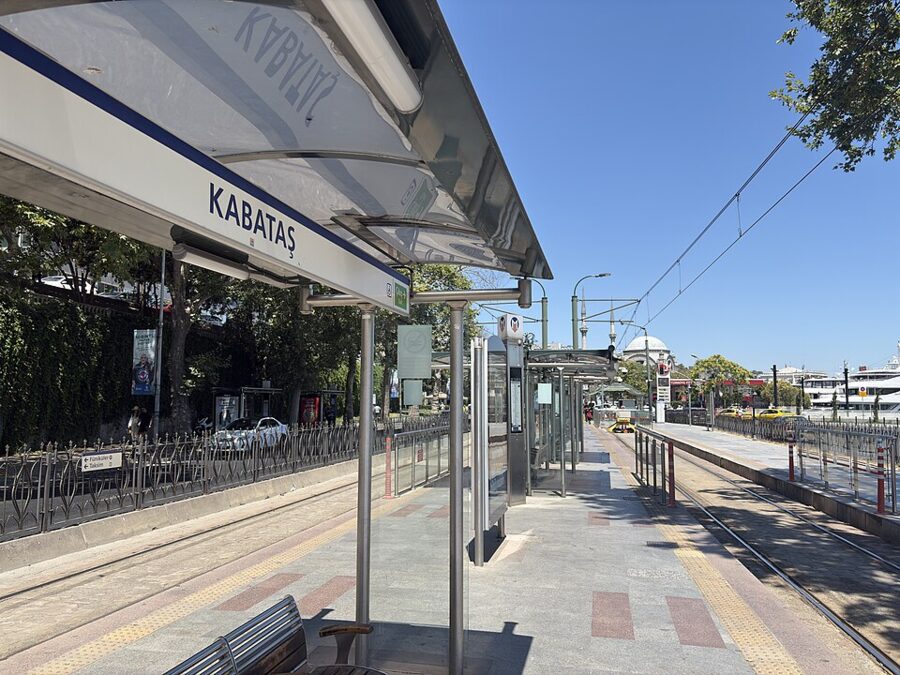
From the old city, take the T1 tram to Kabataş, the last stop on the line, then walk about 8 minutes north along Dolmabahçe Caddesi past the mosque to the Clock Tower. From Taksim, the F1 funicular drops to Kabataş in a couple of minutes. One ride costs 46.20 TL on the Istanbulkart on the tariff in force since 20 July 2026.


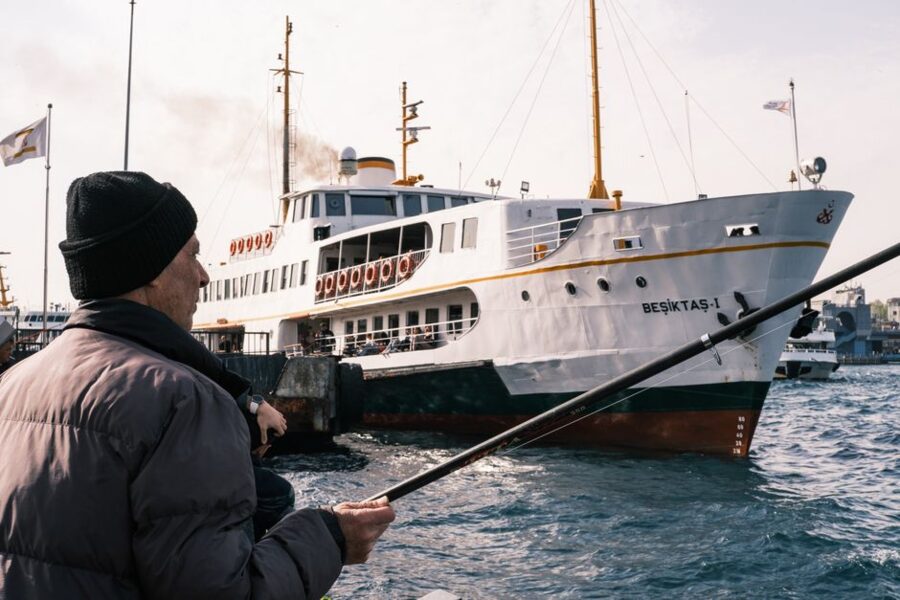
From the Asian side, take a ferry to Beşiktaş. Boats cross from Üsküdar every 10 to 20 minutes through the day, with Dentur Avrasya running the crossing alongside the city’s Şehir Hatları ferries, and city ferries also run from Kadıköy to Beşiktaş. From Beşiktaş pier the Painting Museum entrance is about 5 minutes on foot and the Clock Tower about 15.
Some Princes’ Islands ferries start at Beşiktaş and call at Kabataş, which makes the palace an easy morning before an island afternoon. For the long boat trips up the strait, the commuter alternatives and what each costs, see the Bosphorus cruise guide: the cheap way to see the palace’s water face is from any boat that passes it.

Beşiktaş: lunch, the market and the Naval Museum
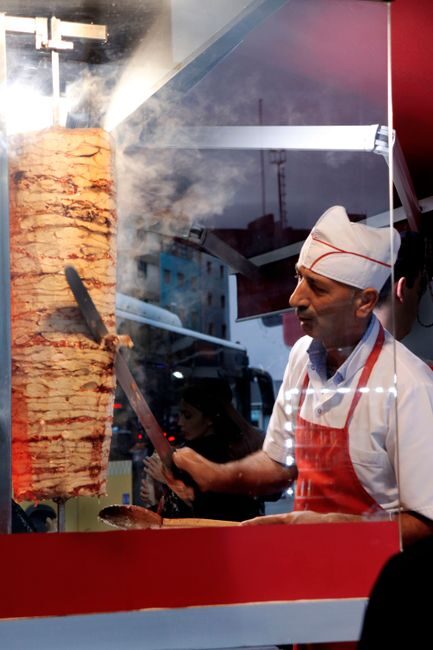
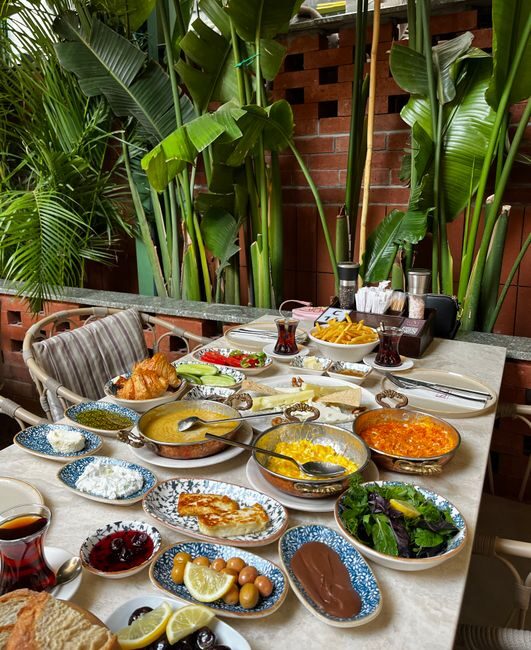
Beşiktaş is a working district, home to a football club, a university crowd and one of the city’s best cheap food markets, and it is where you should eat. The market streets behind the square, the Çarşı, are full of döner counters, pide ovens, fish stalls and the breakfast street known as Kahvaltıcılar Sokağı, where cafés set out menemen, cheeses and kaymak with honey from early morning.
A döner in bread runs about 400 TL in Beşiktaş in late 2026, and a portion on a plate more. The football club’s stadium stands just behind Dolmabahçe, so on match days the whole district fills with black-and-white shirts; check the fixture list if you want a quiet lunch.

The Naval Museum
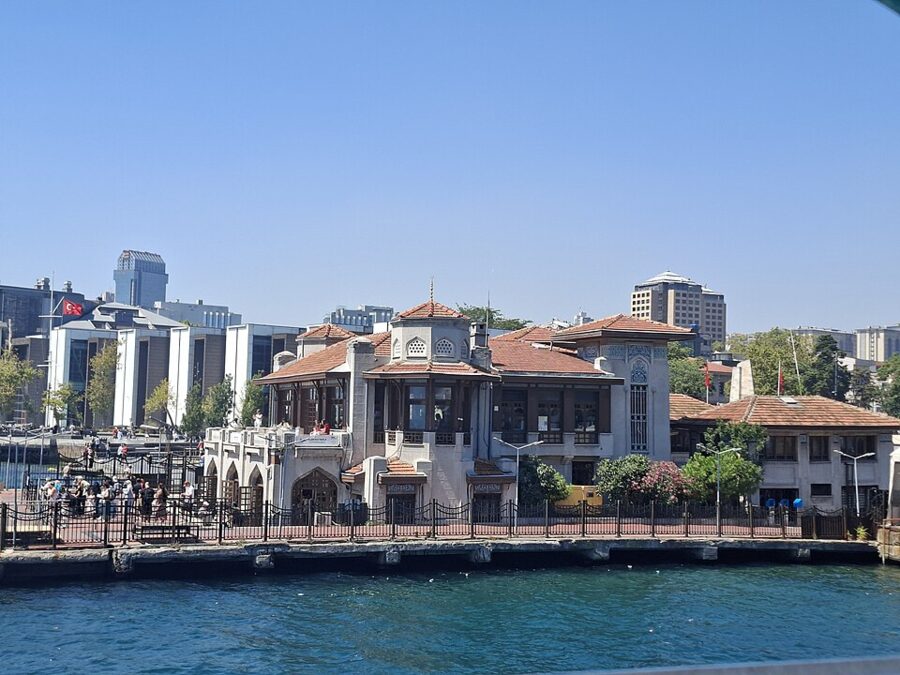
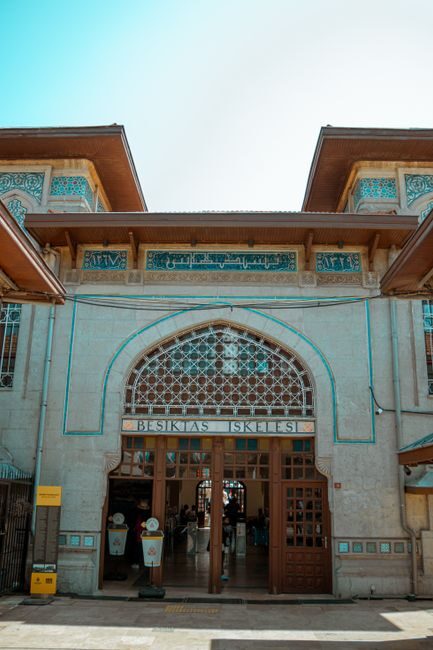
The Istanbul Naval Museum (Deniz Müzesi) stands beside the Beşiktaş pier and is run by the Turkish Navy. Founded in 1897, it moved into a new building that opened in October 2013. It is open Tuesday to Sunday and closed on Mondays, like the palace.
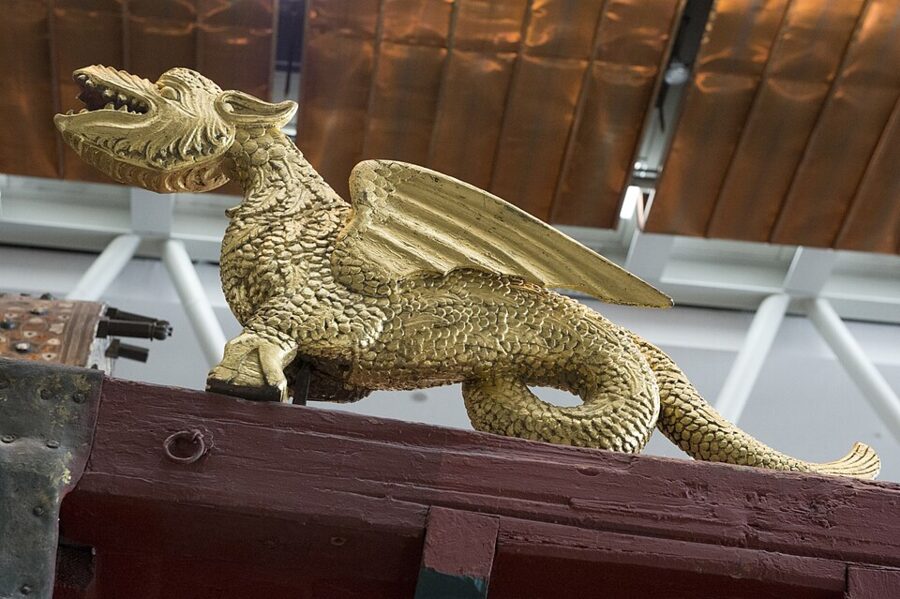
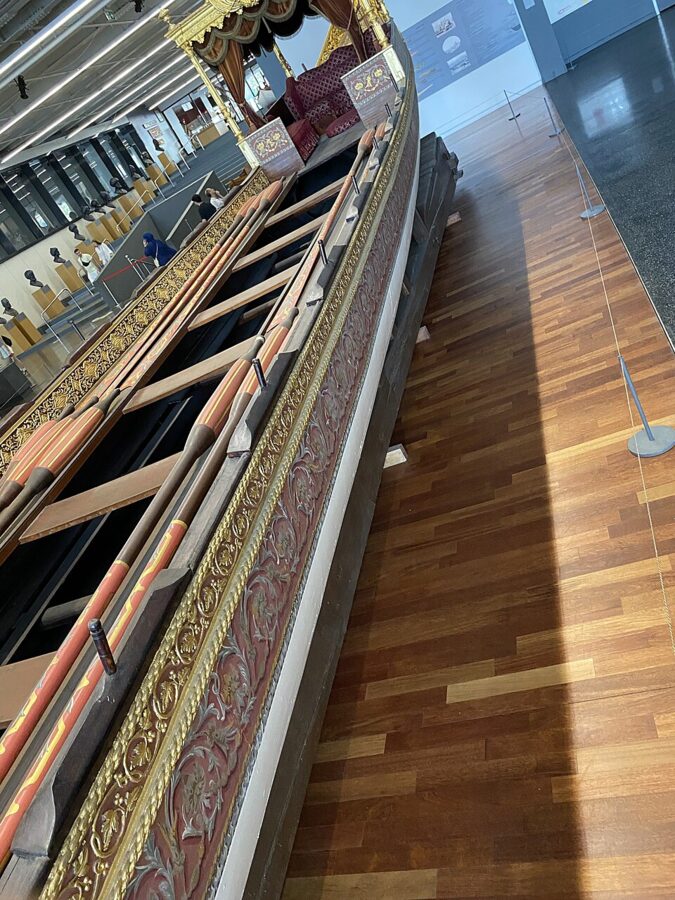
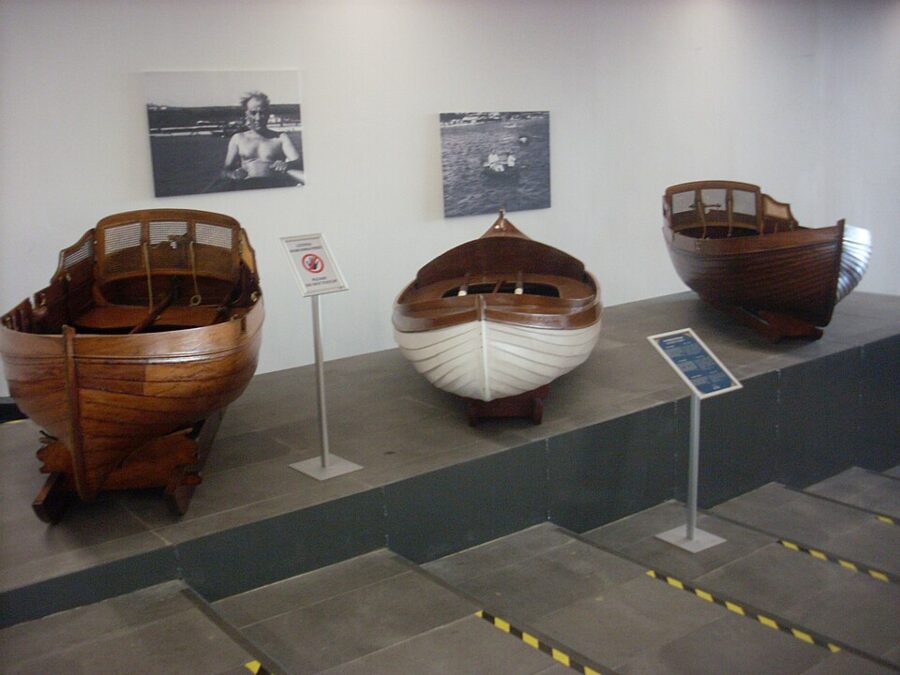
Go for the boats. The caique hall holds the imperial rowing barges that carried the sultans between their palaces, with gilded prows and carved canopies, and the collection includes the Tarihi Kadırga, a war galley built between the late 16th and the late 17th century and the only original galley of its kind known to survive anywhere. In the basement are links of the chain the Byzantines stretched across the Golden Horn in 1453.



Çırağan, Yıldız Park and Yıldız Palace
Walk 15 minutes northeast of Beşiktaş along Çırağan Caddesi and you pass the last palace the sultans built on the water, then reach the gate of the park that rises behind it to the hilltop palace of Abdülhamid II. It is the best free afternoon in this part of the city.
Çırağan Palace
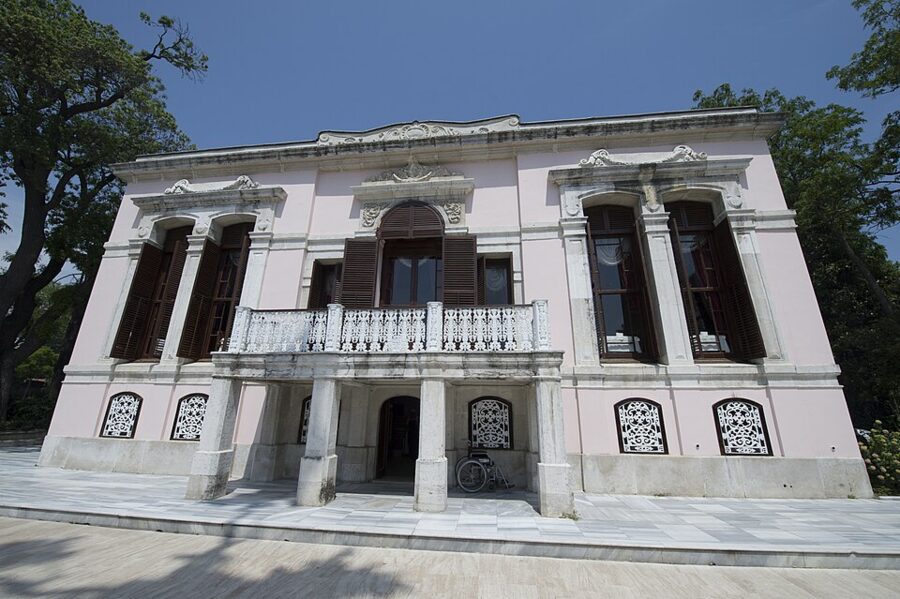
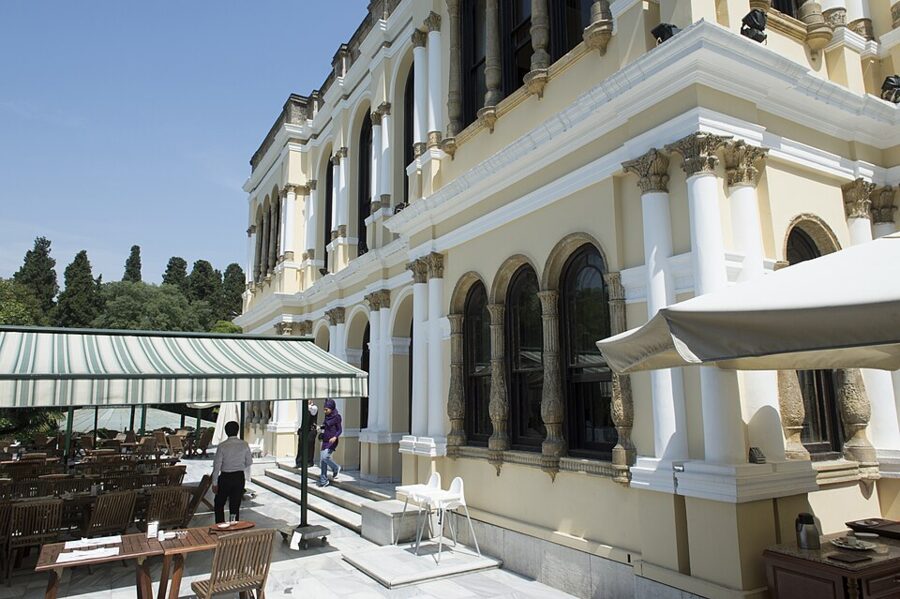
Abdülaziz built Çırağan between 1863 and 1867 on the site of an older palace, to a design by Nigoğayos Balyan, and did not live long in it: he was deposed in May 1876 and died days later. His nephew Murad V, who reigned for 93 days, then spent 28 years here under house arrest. The Ottoman parliament met in the building in 1909, and in January 1910 a fire left only the outer walls standing.
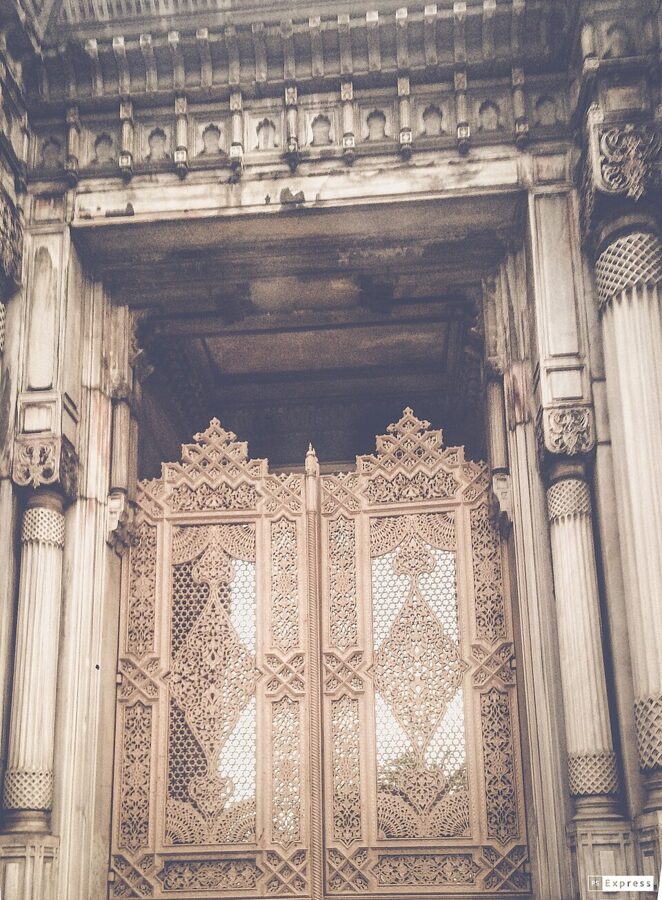
For decades the shell stood empty and its garden was used as a football ground. It was restored as part of a luxury hotel that opened in the early 1990s and is now the Çırağan Palace Kempinski. You can admire the marble gates from the pavement, which is as close as this site gets to a free ticket.

Yıldız Park
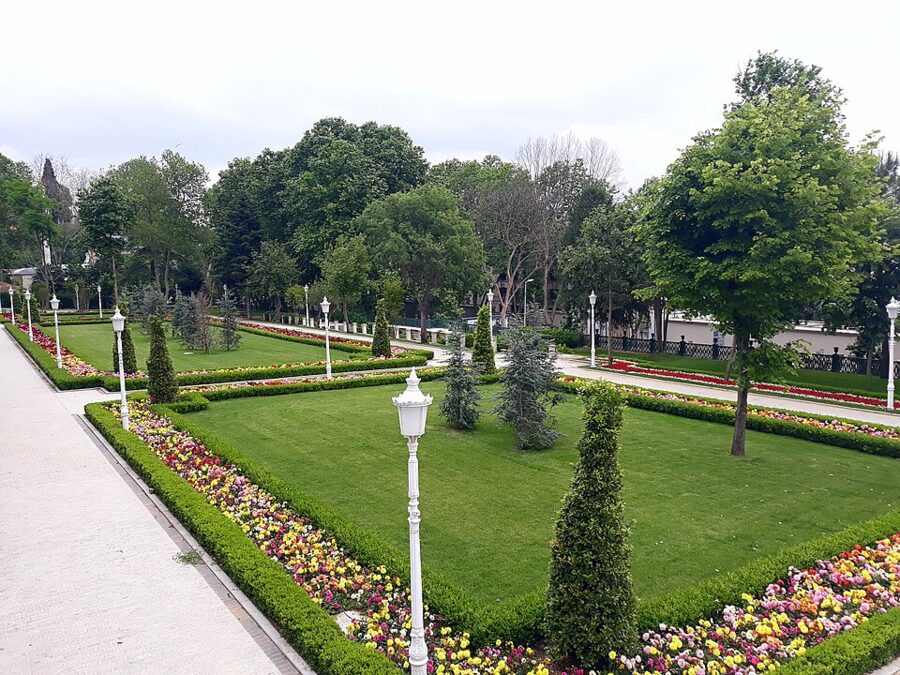
Yıldız Park (Yıldız Korusu) was the outer garden of Yıldız Palace and is now a free public park of about 37 hectares, owned by the Istanbul municipality. Its lower gate is on Çırağan Caddesi, opposite the hotel, and paths climb through old woodland, past ponds and waterfalls, to the upper gate on Palanga Caddesi.
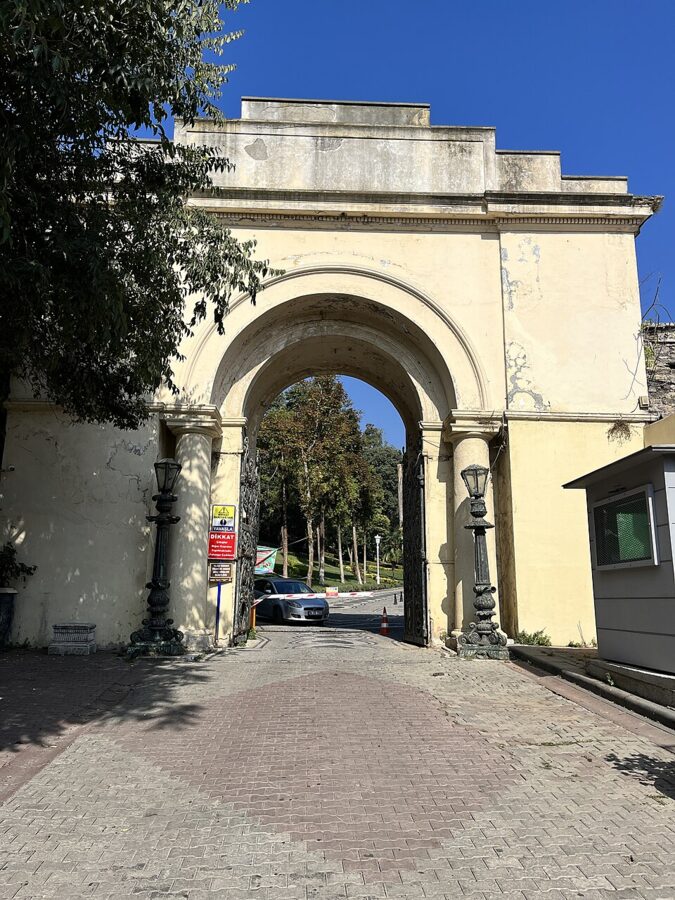

Two 19th-century pavilions survive inside, the Malta Kiosk and the Tent Kiosk (Çadır Köşkü). Allow 20 to 30 minutes to walk up through the park toward the palace walls, steep in places; it is also the only shade on this route in July.



Yıldız Palace
At the top of the hill is Yıldız Palace, which is not one building but a walled complex of pavilions, offices, workshops and gardens covering about 50 hectares. Selim III built the first pavilion here for his mother, Mihrişah Sultan, but it was Abdülhamid II who made Yıldız his palace and ruled the empire from it for 33 years, from 1876 to 1909. At its height, the directorate estimates, around 12,000 people lived or worked in and around it.
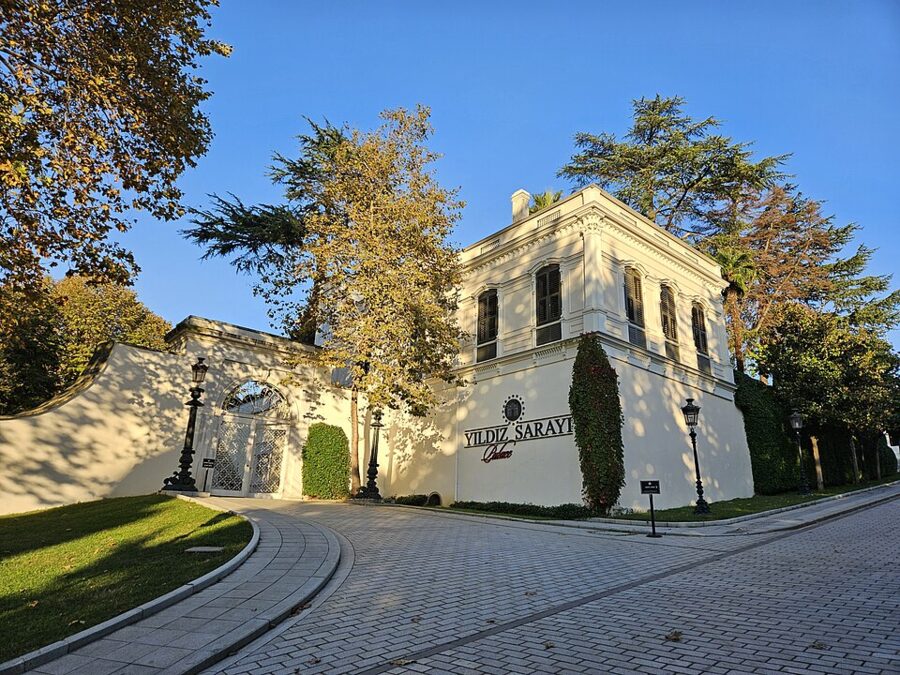

Abdülhamid was suspicious, private and practical. He built a theater, a library, a pharmacy, a zoo and the Yıldız porcelain factory inside the walls, and he worked as a carpenter in his own workshop; some of his tools are in the Museum of Palace Collections at Dolmabahçe. The palace reopened to the public in July 2024 after about six years of restoration, with the Great Mabeyn Pavilion, the Çit Pavilion, the Small Mabeyn Pavilion and the Harem section opened for the first time.
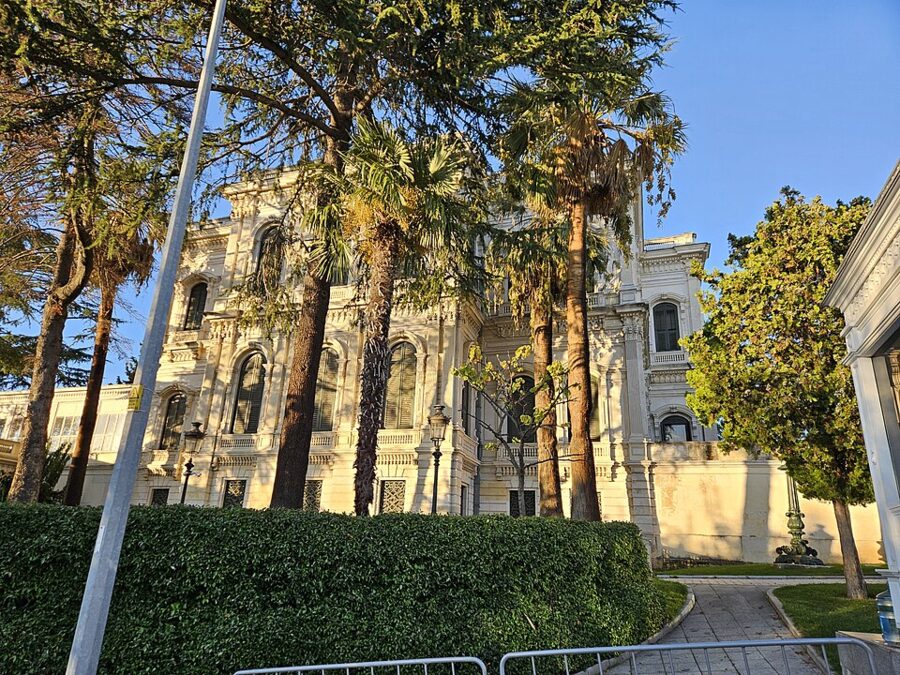

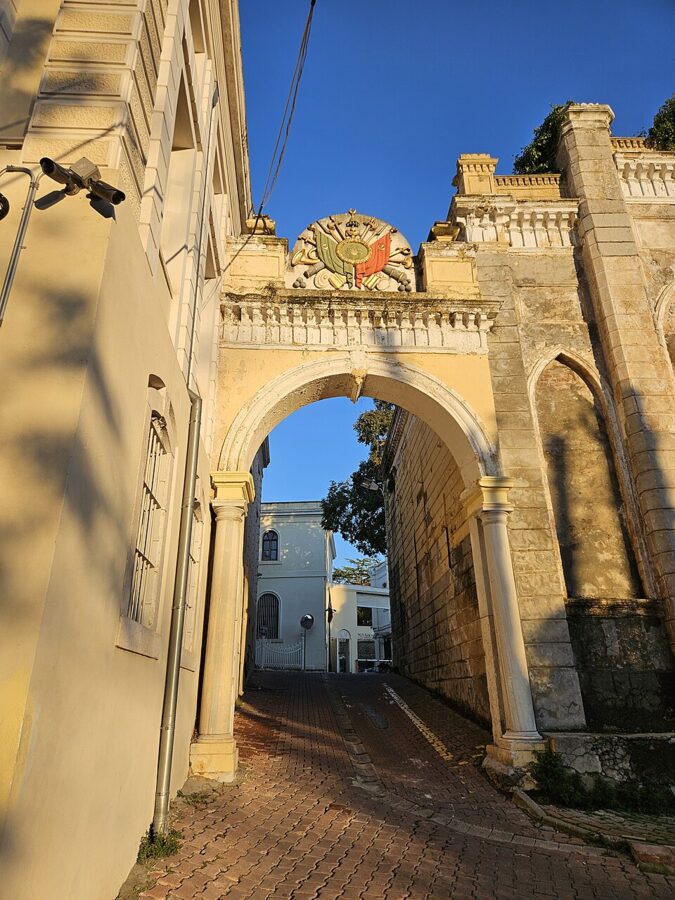

Yıldız Palace costs foreigners 900 TL in 2026, or comes inside Combined Ticket II with Dolmabahçe. Note that it is closed on Wednesdays, not Mondays, and that it closes on all public and religious holidays. If you want both palaces in one day, do it on a Tuesday, Thursday, Friday, Saturday or Sunday.
Beylerbeyi Palace across the water
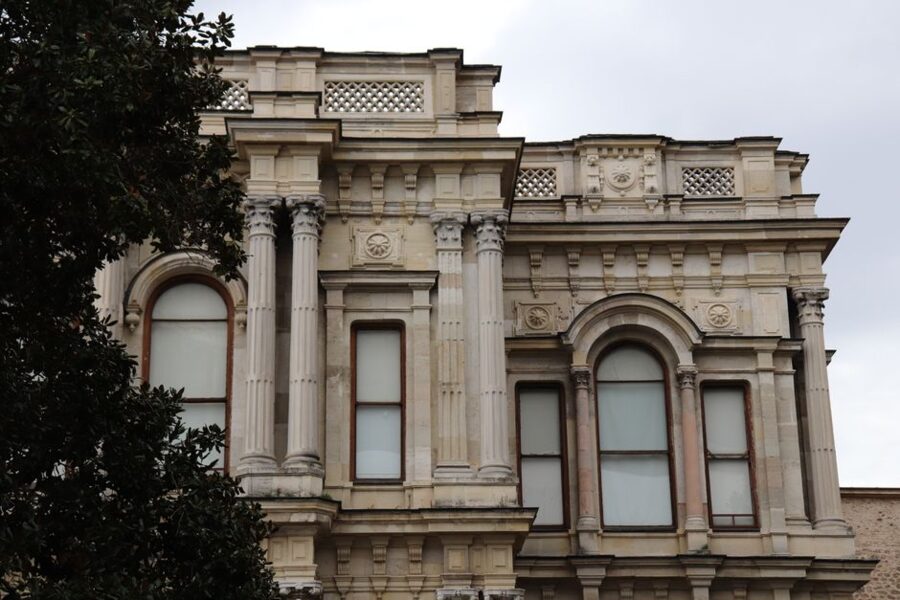
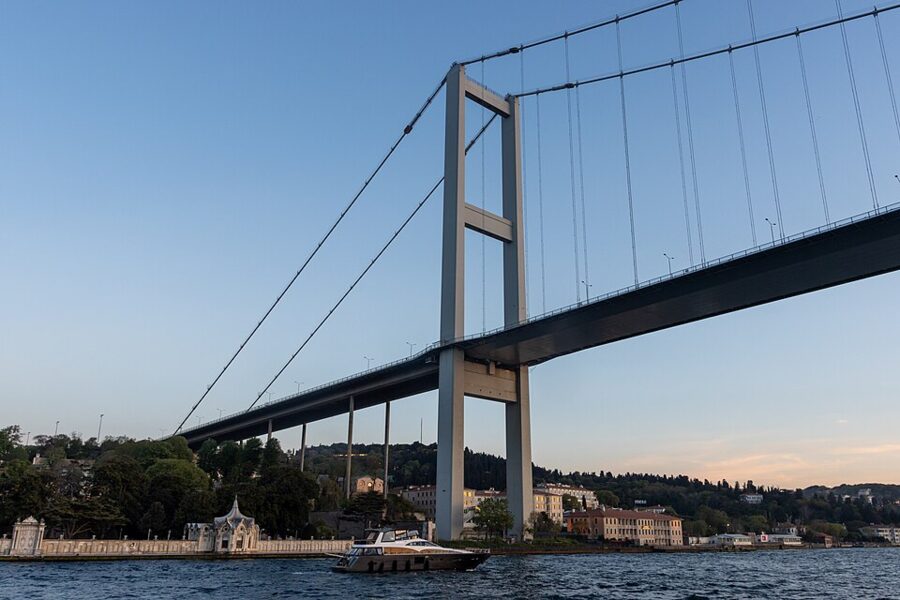
Beylerbeyi is Dolmabahçe’s summer house on the Asian shore, almost under the Bosphorus Bridge. Abdülaziz built it between 1863 and 1865 on the site of a wooden palace of Mahmud II that had burned, and it was used as a summer residence and as the state guesthouse. Empress Eugénie of France and Emperor Franz Joseph of Austria-Hungary both stayed here in 1869.
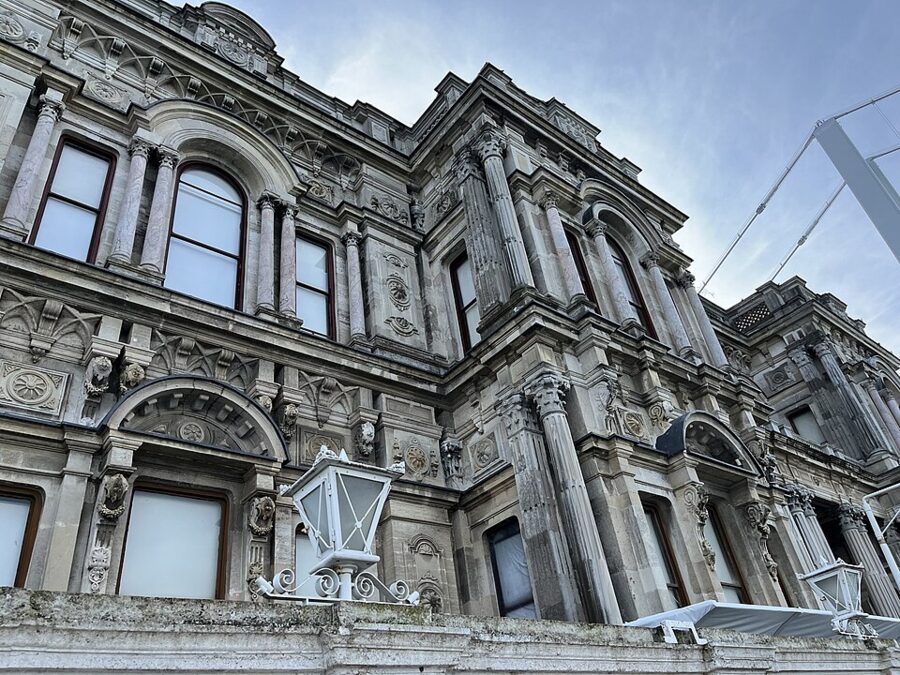

It is a quieter, more human palace: 24 rooms and six halls, floors covered with straw matting from Egypt, Baccarat crystal chandeliers and Hereke carpets, and a terraced garden of about seven hectares with magnolias and Judas trees. Abdülhamid II spent the last six years of his life here after he was deposed, and died here in 1918.
Tickets cost foreigners 800 TL in 2026, or 100 TL for the garden alone, and the palace is closed on Mondays. Some of the outer kiosks are closed, and the directorate has been restoring the building since 2025, so part of the facade may be under scaffolding. Combined Ticket III, at 1,050 TL, adds Küçüksu and the other Asian-side pavilions and is valid for a month.
To get there, take the ferry from Beşiktaş to Üsküdar, then any of the 15-series buses heading north along the shore road, which stop at Beylerbeyi Sarayı outside the gate. The ride is about 15 minutes in normal traffic, and both legs go on the Istanbulkart.

A half-day route on foot and by ferry
This plan assumes a Tuesday, Thursday, Friday, Saturday or Sunday, so that Dolmabahçe, the Naval Museum and Yıldız are all open. It costs one palace ticket and three or four card taps.
| Time | Where | Notes |
|---|---|---|
| 08:40 | T1 tram to Kabataş | 46.20 TL; walk 8 minutes to the Clock Tower |
| 08:50 | Clock Tower queue | Ticket windows open 09:00; e-ticket holders go straight to security |
| 09:10–10:40 | Selamlık | Crystal Staircase early, Ceremonial Hall before the groups |
| 10:45–11:45 | Harem | Room 71; tea at the Clock Tower café on the way out |
| 12:00–12:45 | Painting Museum | Or come back another day within the week |
| 13:00 | Lunch in Beşiktaş Çarşı | About 400 TL for a döner in bread |
| 14:00 | Naval Museum or Yıldız Park | Museum closed Mondays; park free |
| 16:00 | Ferry from Beşiktaş | To Üsküdar for sunset on the Asian shore, or to Kadıköy for dinner |
Add Yıldız Palace and the afternoon is gone; add Beylerbeyi and you need a second day, which the combined tickets are designed for. If you have only two hours, do the Selamlık alone, skip the café, and see the Harem and the Painting Museum within the week on the same ticket.
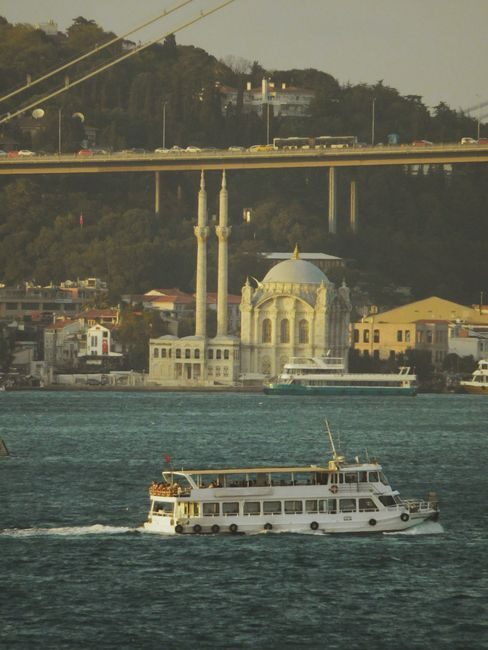
If you keep walking north from the Yıldız gate, Çırağan Caddesi brings you to Ortaköy and its waterfront mosque in about 15 minutes. The Ortaköy Mosque is also a working mosque, closed to sightseers at prayer times, and the square around it is the place for a tea and the classic view of the bridge.
What to skip, and what to book
Skip the private “palace tours” that bundle Dolmabahçe with a boat and a lunch for well over the ticket price; the palace is self-guided now, the audio guide is included, and the boat is a commuter ferry away. Do not rush the Harem to save time, because it is where the human story is. And skip 10 November and 29 October unless the crowd is the reason you came.
Book nothing in advance except, on a busy day, the e-ticket on the Milli Saraylar app. If you hold an ISIC card and are 25 or under, carry the physical card: at 300 TL instead of 2,000 TL, it is the best saving in this part of the city.
Dolmabahçe is usually one day of a longer Turkey itinerary, and the next move from Istanbul is often the night bus. For the coaches, trains and flights out of the city, see getting around Turkey; the bus most backpackers take next runs overnight to Cappadocia.
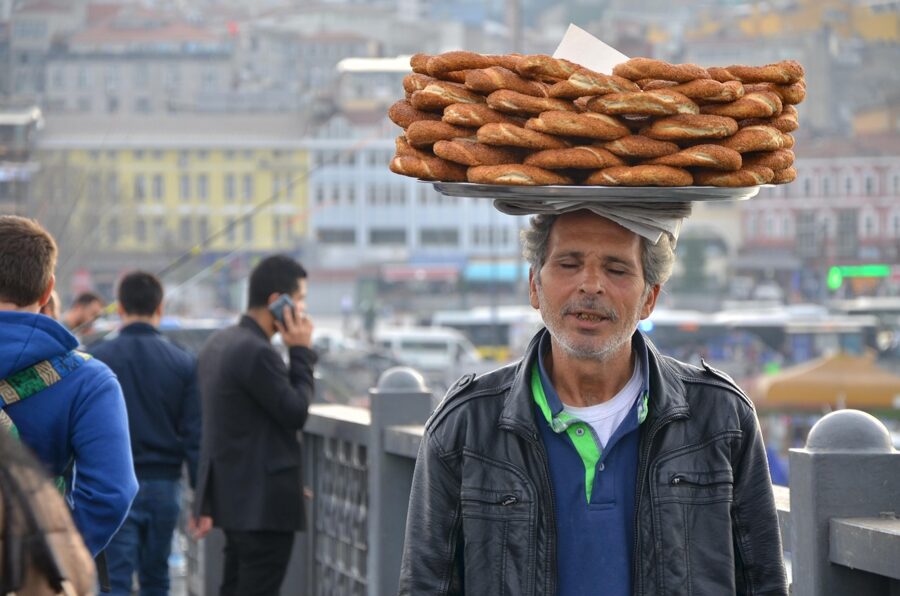
Before you leave Beşiktaş, buy a simit from the cart by the pier and take the ferry back past the palace. The sultan’s view of his own front door cost five million gold lira. Yours costs one tap of an Istanbulkart.